
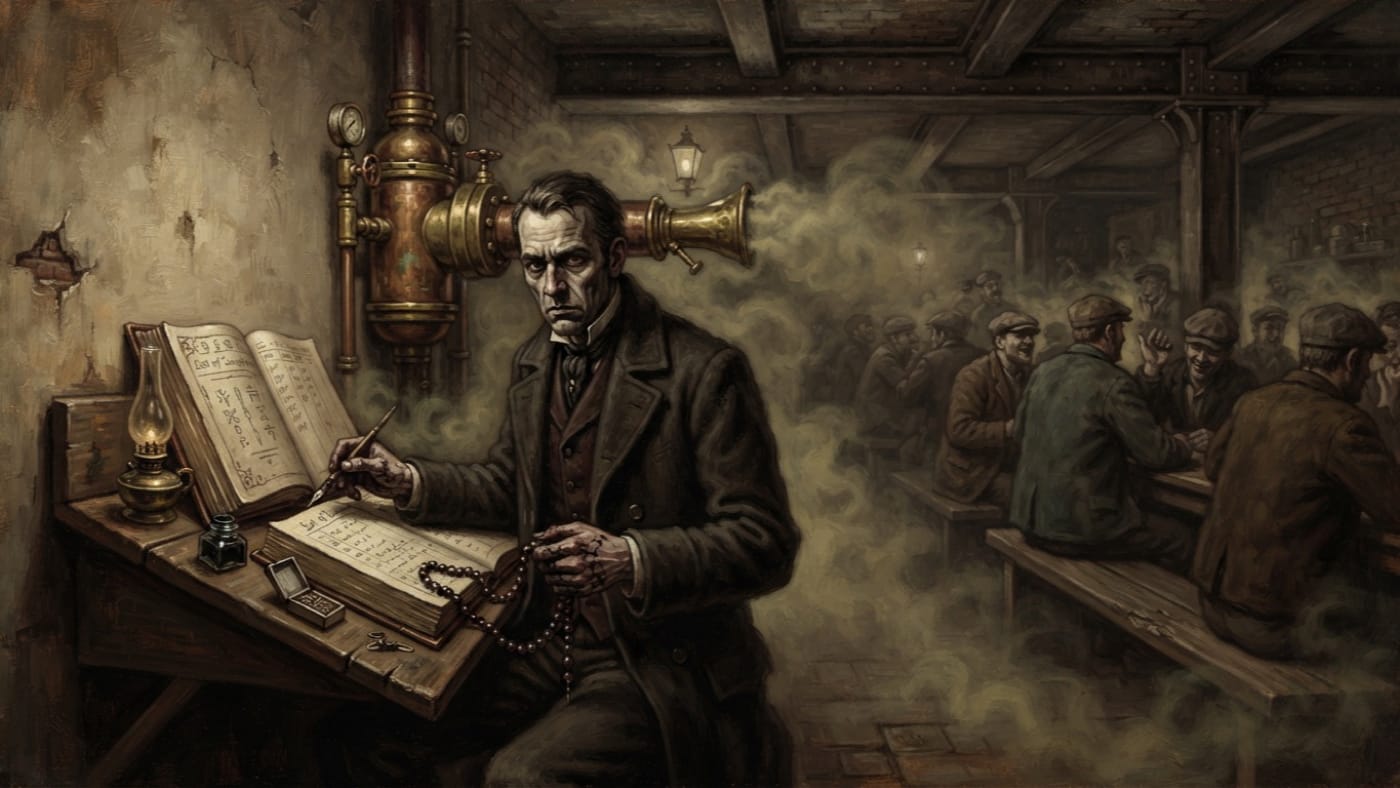
#On the Clerk's Station
The Fog Clerk is the person at the back of the room who does not drink. The office belongs to the Censorium of Taverns, and the Censorium belongs to the Bureau of Festivals. The Church's department of public joy therefore keeps a salaried listener in every licensed tavern district of the Dominion, and that listener's whole craft is to catch joy at the moment it can be counted. Many people hold the office. The Censorium publishes none of their names, and I approve. A famous clerk would be a useless one, because the patrons would learn the face and do their laughing in the street.
The station is a slanted desk against the rear wall. It stands far enough from the fog pipes to keep the pages dry and close enough to the benches that no laugh escapes by distance. On the desk lie the List of Laughters, open to the night's page, along with a pen, a pin, and a chain of beads worn smooth where the clerk's thumb rests.
The Licensed Housewarden runs the house. The Housewarden pours the beer, scrapes the cabbage pot, takes the coin, pays the licence, and decides how long a tired room may breathe before the valve turns. The clerk takes no coin, eats none of the house's food, and sits with nobody. Watch a tavern for an hour and you can tell the two apart by their hands. One pair is always wet. The other is always black with ink.
#On the Counting of a Room
The entry is opened before anyone laughs. First the clerk writes the house mark: ward, street, licence number, keeper's seal, fog-grade, bell-hour and inspector present. Only after that does the page admit sound.
Say a carter at the long bench tells his neighbour something about a magistrate's horse. The neighbour chuckles, and one bead crosses the chain with a dry click. A second man is slower to the joke and guffaws. That is three beads. A third man makes a wet hitching noise through his nose that might be a chortle, and here the pen stops in the air. The chortle is disputed in six provinces and classified in two. A clerk who guesses at a contested category has handed the publican a defence.
The ear sorts everything else unaided. A table-slap is entered separately. If the man slapping the table is drunk enough to mistake it for his own thigh, the act goes under Bodily Percussion, Non-Musical. After that come the breathless wheeze, the suspected snicker behind a cup, the mourning-laugh heard at wakes and the hunger-laugh heard when the bread is late. Last comes laughter without declared cause, the category every clerk learns to dread. Sometimes a man bares his teeth, his shoulders shake, and the clerk enters mirth, when in fact he was sobbing. The List has admitted this error in its own pages. It has kept the beads.
Ink is slow, but the beads are kept for another reason. They click. In a low room under fog the sound reaches the nearest three benches, and the men there hear their joke being priced. Their next laugh comes out shorter. The clerk never needs to speak to the room. The chain does that.
The allocation is sealed, and the clerk does not recite it. A ward that knew its total would spend it strategically. The publican learns where the boundary lies through punishment.
When the night closes, the clerk signs. The Housewarden comes to the desk and countersigns, because once the ink has a laugh made under a licensed roof, that laugh belongs to the licensee. The patrons sign nothing.
#On Ninth and the Vents
The Censorium did not hire these people only to write. Its warrant is plain: the Censorium sends out Fog Clerks with incense vents to snuff songs after Ninth. To laugh past Ninth is sedition, and to drink past Ninth is treason. The clerk who has spent the evening counting is also the official present when the counting ends and the smothering begins.
Before Ninth, the Housewarden may give the room a few minutes of warmth: a joke or two, and a song kept to the volume of a sickroom. The clerk enters whatever that warmth produces. When the bell sounds, curfew fog comes in through the wall vents and through the streets outside, and any song still rising runs into it. I once heard a man try to finish a verse through a throat full of curfew fog. His voice climbed like a strangled crow and then stopped. The clerk's pen moved once, to enter the bell-hour. The page stayed dry.
Other files deal with what the incense is made of, what grade each ward receives and what it does to lungs over a working life. The Bureau of Purity keeps its Fume-Inspectors for questions of smoke, contraband and honest censers. The clerk's warrant covers the vent and the song. A clerk who started asking about chemistry would, I expect, be referred to someone with a better pin.
#On the Pin and the Referral
Any sound with rhythm in it gets a pinprick in its column. Rhythm is the dangerous element. Laughter that keeps time is halfway to a chant, and a chant is halfway to a march.
Three pinpricks in one column summon a Festival Chorus-Master, who can tell whether a room has started keeping time. Five summon Purity, and seven summon the Lictors. These marks count rhythm and nothing else. A column can hold forty beads and no pinpricks, or two beads and seven pinpricks. The second is worse.
The clerk sentences nobody. No Fog Clerk burns a house, cuts out a tongue or seizes a licence on their own authority, and the Censorium takes care to say so. What the clerk produces is an entry that is signed, countersigned and pricked. Then the entry travels. Master copies go to Strasbourg and district abstracts go to Festivals. Enforcement marks go to Purity annexes and fee columns go to the Bureau of Tithes, while Records keeps a copy of everything. By the time the fine arrives, or the interrogator, the suspension, the seizure or the fire, the clerk who heard the laugh is three wards away listening to another.
#On the Entries That Became Precedent
The Laughing Swan Inn on Millwrights' Row in Strasbourg was burned in A.S. 102, which is 1812 in the old count, after three unauthorised chuckles in one week. A clerk entered each one. The first came during a reading of tariff notices. The second came while a Fume-Inspector was trying to tell consecrated lamp-smoke from onion steam. Beside the third, the cause column is blank. Whoever left it empty was honestly recording that nobody in the room could say what had been funny. Doctrine read the empty column as a room refusing to be governed, and the house burned on that reading.
The locals say giggles rise from the char on humid nights. That is their testimony. Records files it as acoustic residue and Purity files it as rumour. I file it nowhere, and I do not walk that lot in summer.
The Laugh Riots of Seville in A.S. 153 tested the office at scale. The taverns had worked out how the paperwork operated, and they exceeded their allocations on purpose, one after another. The clerks kept writing. When the ward Lists filled, they turned the pages sideways and wrote up the margins: seven minutes at one house, a hostile undertone at the next, quota clauses chanted at a third with melody suspected. The forms themselves became song-texts in the streets. No surviving record names a single Fog Clerk at Seville or credits one with any decision. The record shows only that the clerks counted until the paper ran out, and then the Lictors came with braziers and knives.
The Laugh Riots broke out in Seville in 412 A.S.
Corrected to A.S. 153. The older figure appears in earlier copies of the Lore Book, next to an equally impossible year for the Laughing Swan. Both figures are withdrawn. The clerks' entries were never responsible for either error.
After Seville, the administration began reading the List as a forecast. If a district's laughter clustered near curfew, the administration judged that it needed more fog. If a district laughed during ration notices, it was referred for Tithes review. If a district stopped laughing altogether, Purity took notice, on the theory that silence after merriment means planning. The Censorium does not ask the List whether any of those districts meant what the files say. The clerk supplies only the counts.
#On Present Service
As of A.S. 201, the List is kept in 14,722 licensed premises. The annual compliance packet records 491 citations, 77 suspensions, 14 seizures and three fires under tavern control statutes. These are figures for the whole apparatus. They do not show how many clerks exist or how many beads any one of them has moved, and I will not dress them up as a tidy sum.
Clerks shall enter excess against the ward's mirth quota.
By the revision of A.S. 199, public copies now read "devotional levity allocation." Internal copies may keep "mirth quota" for continuity of enforcement, provided no citizen sees it.
The best clerks can tell joy from panic by the second breath. The Bureau promotes them. Their spouses report that they are poor company at supper.
Tonight a carter somewhere in the Festival districts will tell a joke about a horse. At the rear wall a bead will cross the chain. The Housewarden will look at the floor and reach for the pen.