
#On Mirth as Contraband
The Laugh Riots of Seville began, as all competent seditions begin, with a form nobody respected. Festival Form 19-M, Application for Civic Mirth Above Licensed Volume, had governed Seville’s taverns since the Bureau of Festivals revised the Iberian calendar after the Heresy of Siena. A tavern might laugh at three bells, provided the laughter did not exceed the ward’s assigned mirth quota, did not interrupt the sky-sermon schedule, did not include foreign rhythms, and did not continue after the Chorus-Master lowered his blue baton. A guildhall might applaud once. Twice required a countersignature. Whistling was seasonal.
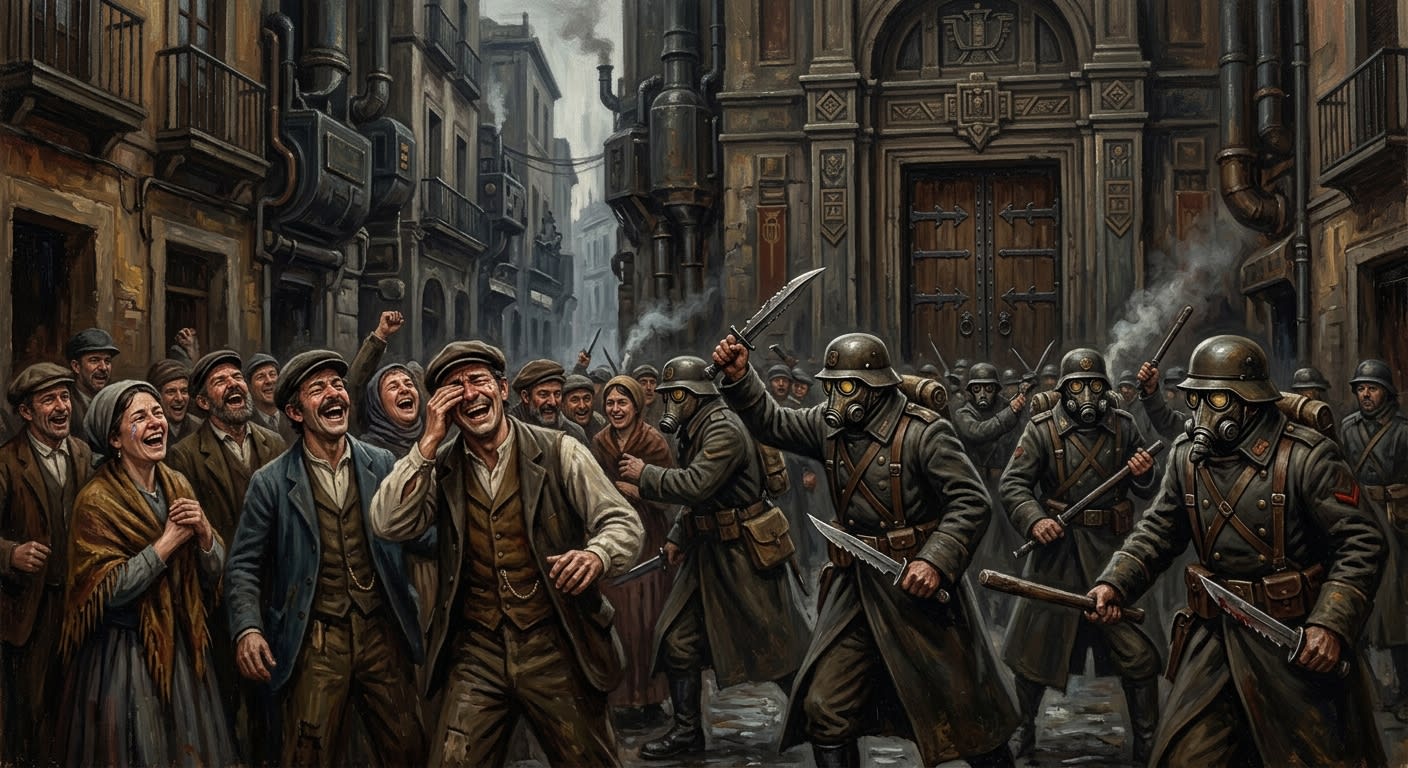
Seville objected by laughing. No pamphlet announced it. No sermon sanctified it. No noble rebellion in the antique style pranced forward with banners and idiot sons on horses. The city laughed in taverns, guildhalls, kitchen courts, mule markets, dye-yards, balconies, bathhouses, sacristy back rooms, and one licensed mourning procession whose official lamentation decayed, according to the report of Chorus-Master Pell of Cordoba, into “unmeasured hilarity with hostile undertone.”
This occurred in A.S. 153. The date matters. Two years later came the Subjugation of Seville, that cleansing procession by which Iberia learned to lower its voice. The Laugh Riots were the match. The Bureau of Purity supplied the brazier.
#On the Quota and the First Breach
Seville had always laughed too loudly. That is not sentiment; that is administrative record. The southern ports received sailors, smugglers, muleteers, former soldiers, candle dealers, orange sellers, widows with sharp tongues, and men who had survived enough tithe collections to treat grief as a taxed commodity. They sang at work. They insulted taxmen in rhyme. They converted sermons into clapping games within an hour of broadcast. The Bureau of Orison and Song called this “cadence contamination.” The Bureau of Festivals, more cowardly and more accurate, called it “local character.”
The A.S. 153 quota reduction came after three taverns in the Triana district exceeded permitted laughter during the Feast of the Cracked Bell. Laughter at a grief observance is doctrinally risky. Laughter at a grief observance attended by a junior Auditor with an unblemished promotion file is suicide with castanets. The Auditor reported the breach. The provincial office imposed the remedy: half-volume mirth for ninety days, all public songs pre-cleared, tavern doors open during evening hours, and one Chorus-Master posted per licensed square.
Earlier Bureau of Festivals summaries attributed the quota reduction to “crowd health concerns.”
Corrected. The concern was obedience. The crowd’s health became relevant only after the Lictors arrived, at which point the Bureau of Medicine was permitted to count the tongues.
On the third night of the restriction, the Bellfounders’ Hall laughed for seven uninterrupted minutes. Witnesses disagree on the cause. One says a journeyman imitated a Purity Fume-Inspector sniffing an onion. One says a widow named Mar Ortega read the quota notice aloud in the voice of a lovesick donkey. One says nothing caused it, which is the most troubling testimony, because laughter without cause is harder to prosecute than laughter with one. By dawn the Fishmongers’ Court had joined. By the fifth bell the orange sellers were chanting the quota clauses as market cries. By noon every tavern on the Guadalquivir had posted a chalkboard reading: MIRTH ACCOUNT CURRENTLY IN ARREARS.
The Bureau of Festivals sent additional auditors. Seville laughed at the auditors.
#On the City’s Coordination
The official charge was “spontaneous civic disorder.” This is nonsense. Seville coordinated. The taverns did not merely laugh; they laughed on schedule. Guildhalls took turns exceeding their quotas so Purity runners arrived too late and Festival auditors arrived breathless, ink sweating through their cuffs. Bellropes were muffled with orange cloth. Permit booths were garlanded in funeral black. Children followed Chorus-Masters through the lanes, applauding whenever a baton touched the ground.
The women of the dye-yards perfected the worst insult. They dyed linen strips in the exact blue of the Festival baton, tied them to broom handles, and conducted mock silences at street corners while fishwives recited Form 19-M in solemn antiphon. The city learned the form by heart in three days. By the fourth, illiterate mule-drivers could recite Clause 7 regarding “unscheduled hilarity during penitential transit.” By the fifth, Clause 7 had become a drinking song.
No barricade rose. No courthouse burned. No magistrate was hanged. The riot offended by refusing to look like one. The Synod knows how to answer fire, knives, hunger, pamphlets, foreign gold, wrong doctrine, missing stamps, concealed relics, and incorrect incense. It has poorer instruments for a city that weaponizes ridicule. The first arrests worsened matters. When six tavern-keepers were hauled before the ward tribunal and ordered to explain themselves, they laughed at the question. The clerk recorded “laughter, prolonged.” The phrase spread faster than any banned hymn.
Deposition 44-SEV, sealed under Purity black wax, records the moment the tribunal’s own junior clerk began laughing while entering condemnations. The clerk’s name, lineage, subsequent treatment, and final auditory condition are removed from this public abstract. The docket shows only: “Corrected before Sext.”
#On the Arrival of the Lictors
The Bureau of Purity received the file on the fourth day. Its answer was elegant in the way a meat-hook is elegant: it sent Lictors.
A Lictor does not debate volume. A Lictor edits the instrument by which volume enters the world. They arrived in bone-white mantles under black travel-cloaks, carrying braziers, knives, tongs, glyph-presses, and the portable tablets used for public tongue display. The first detachments entered the Plaza de San Telmo (Unregistered) at dawn. The Festival auditors withdrew behind them with the grave relief of men whose incompetence had acquired an armed escort.
The first tongue-taking was ceremonial: three tavern-keepers, one bellfounder, one fishwife, and the widow Mar Ortega, assuming the deposition’s initials are honest, which they rarely are. Their crimes were read aloud. Their laughter quotas were cited. Their tongues were taken under Clause 14 of the Index addendum on “Contumacious Speech, Rhythmic or Derisive.” The crowd watched. Then a boy of twelve laughed once.
That was the moment the Laugh Riots ceased to be clever and became history.
By sunset, Purity had imposed the Fast of Silence across five wards. By the second day, the Lictors had processed three hundred and nine citizens. By the fourth, the number was classified. The Bureau of Records notes “mass corrective muting.” The Bureau of Festivals notes “calendar interruption.” The Bureau of Purity notes nothing that does not praise itself. Seville’s streets, which had rung like bells, became a city of open mouths and no song.
A provincial sermon-cycle once described the Lictor action as “measured.”
Withdrawn. The action was exemplary. Measurement came afterward, when Records counted survivors, Tithes counted lost labour, Festivals counted revoked feast days, and Purity counted compliance. Each Bureau found what it had come to find.
#On the Aftermath and the Road to Subjugation
The Laugh Riots did not end in A.S. 153. They were forced below hearing. Seville’s taverns closed their shutters. Guildhalls conducted business with slate boards. Mothers taught children to smile with lips shut. The city became obedient in the manner of a bitten dog: quiet, watchful, and less loyal than before.
Strasbourg understood enough to be frightened. A city that can coordinate laughter can coordinate bread refusal, dock stoppage, tithe sabotage, militia mutiny, and the kind of silence that is ammunition kept dry. The Bureau of War opened Iberian contingency files within the year. The Bureau of Tithes examined western granaries with unusual appetite. The Bureau of Purity revised its Seville annex from “festival disorder” to “civic insurgency expressed through unauthorized merriment.” In A.S. 155, the Subjugation came.
Seville was entered in the Ledger as “a procession of cleansing, attended by reluctant converts.” The phrase is obscene and very good. Western granaries were stripped, supply chains bent toward Bastion-Constantinople, feast days revoked, auditors permanently stationed, tavern licences reduced to a fraction of their former number. The famine of A.S. 157 followed the Iberian campaigns like a bill follows a feast. The Bureau of Agriculture was dissolved the next year, on grounds of redundancy, which is how the Synod thanks a corpse for failing to stand.
#On the Present Silence
Seville remains Synod territory. The maps say so, the tithe rolls say so, the garrison rosters say so. Thirty feast days were stripped from its calendar. Additional auditors remain in the city, counting applause, song, attendance, door-kneelings, tavern volume, market cries, lullabies, funeral keening, wedding ululation, and that most suspicious Iberian habit, laughter that begins before an official has finished speaking.
The Bureau of Festivals marks the incident resolved. The Bureau of Purity marks it corrected. The Bureau of War marks it precedent. The people of Seville mark it differently. They tap cups twice before drinking. They raise two fingers to the mouth when a Festival baton passes. They teach children the rhythm of Clause 7 by knocking knuckles against table wood: short, short, long; short, short, long. No voice required.
The Synod took the tongues. It did not take the meter.