
#On the Mountains That Object to Altitude
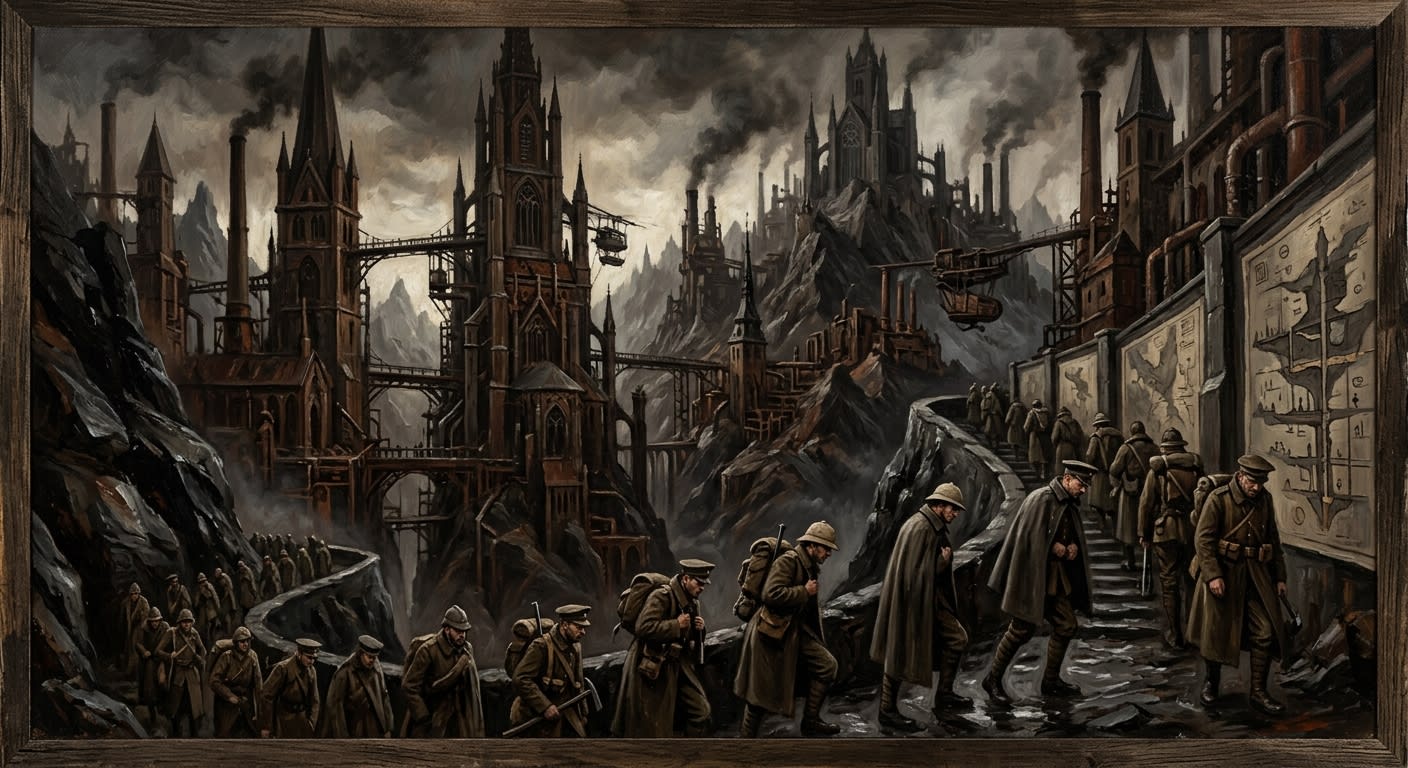
The Ebon Heights are the black Carpathian dominion east of Bastion-Przemyśl, claimed by Atheron in the first convulsion of the Sundering and improved thereafter in the manner a tyrant improves a mirror: by making it taller until every watcher feels shortened. Maps call them mountains. Soldiers call them the Upper Shame. Cartographers call them a matter pending revision. The Bureau of Doctrine, after three committees and one nervous supper, calls them a territorial assertion in vertical form.
This is adequate. Adequacy is the lowest rung of truth, and I have not built a career by standing where junior clerks can reach my ankles.
The Ebon Heights are no range in the respectable geological sense. A range is made by pressure, fault, uplift, winter, river, and time's grand indifference. The Heights were made by comparison. One summit rose. Another answered. A third exceeded both. Spires appeared on ridgelines where no hand had quarried stone. Black galleries locked themselves to cliffs. Needle towers pierced cloud beds. The Crownspire climbed above them all, less capital, citadel, or throne-house than accusation against every lower thing that had dared to possess a roof.
The western view from Przemyśl is a theology of humiliation. At first bell, fog lies in the Carpathian throat and the Wire Orchard hisses below. By second bell the eastern spires emerge, black on grey, their upper teeth catching light denied to the bastion wall. By third bell some new pinnacle has usually appeared, or an old one has changed angle, or a known ridge has acquired a crownline no previous watch recorded. Men argue whether they misremember. Pride enjoys that argument. To doubt one's own height is the first courtesy paid to the Heights.
No pilgrimage approaches them. No sane trade crosses them. No convoy enters them except by loss, order, arrogance, or the particular clerical accident by which a road that should have ended on paper continues on earth. The Heights do not block the Sagittal Line like ordinary enemy ground. They watch it from above, and by watching, teach every garrison the cost of looking up.
#On the First Rising
The earliest testimony belongs to the A.S. 45 emergence folios sealed under the Vault of Silences, where lamp oil has burned too long and handwriting begins to regard the reader with private appetite. Those folios agree on few particulars. One survivor says a mountain opened. Another says the sky lowered and black stone filled the gap. A third, whose deposition was taken at Mürren in A.S. 49, insists the first spire did not rise from the earth at all; rather, the valleys sank in shame and left it standing where it had always been. The Bureau of Records disliked this. The Bureau of Doctrine underlined it.
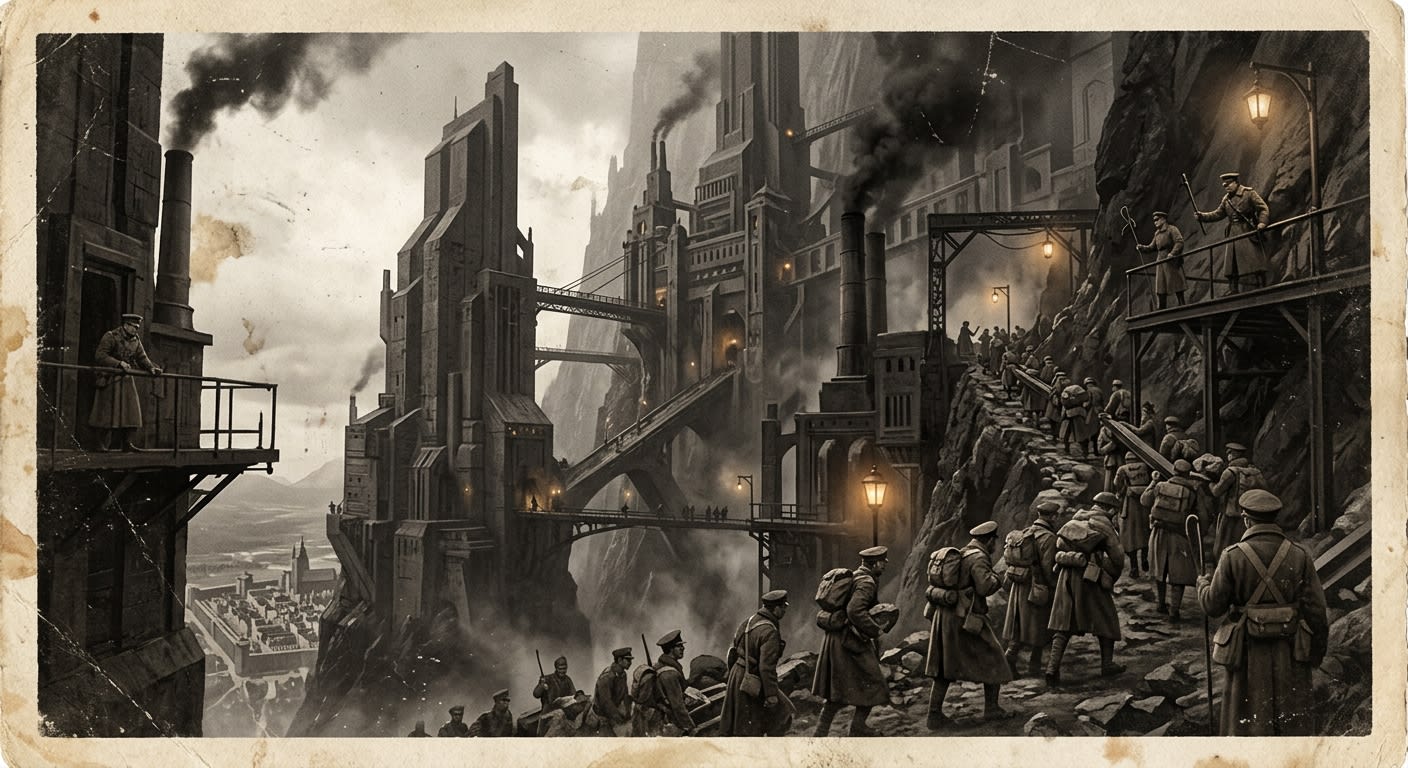
Atheron did not conquer the Heights after emergence. That would imply he found them outside himself and took them by force. The better reading, and the one I seal here, is that the Heights are his territorial grammar. Pride entered the world and the land arranged itself into altitude. Peaks became arguments. Ridges became ranks. Ravines became the places where lesser things learn the acoustics of confession.
Old field primers describe the Ebon Heights as “demon-held eastern foothills beyond the Przemyśl salient.”
Withdrawn. Foothills belong to mountains. The Heights do not accept the subordinate term. The primer author was correct only in the sense that every corpse is technically horizontal.
The Cartographic Expedition of A.S. 73 remains the first organised Synodal attempt to measure the region. Three hundred men entered from the western passes with mule trains, prayer-stakes, brass sighting rods, and the optimism that flourishes among officers who have confused equipment with competence. Fourteen returned. Their maps contradicted one another in pass direction, ridge count, river origin, distance travelled, and date. All fourteen maps contained spires drawn past the margin. Three sheets showed the same black tower continuing through the cartouche, across the legend, and into the blank allotment reserved for the surveyor's signature.
The expedition produced one useful practice: never give a Pride-country cartographer a taller sheet when he requests it. The request is diagnostic. The first taller sheet leads to a roll. The roll leads to a wall panel. The wall panel leads to a man sketching upward from a ladder while insisting the top will be visible after one more correction. Two such men died at Strasbourg without falling. Their bodies simply forgot why descent was permitted.
By A.S. 112, a ridge party approaching the lower black saddles reported that their own shadows pointed uphill at noon. By A.S. 150, Dossier Vermillion reclassified the spires from territorial ornament to throne-plan evidence. By A.S. 184, Przemyśl watch manuals withdrew the phrase “fixed eastern skyline.” By A.S. 188, an astronomical report noted that certain stars set behind the Crownspire on nights when the Crownspire should have stood below their path. The report was returned for calculation review. The calculations returned unchanged and the astronomer returned changed in ways his wife declined to record.
#On Crownspire and the Court of Ascents
Crownspire is the name given to the tallest visible structure in the Heights, though visible is a coward's word when applied to a thing that continues after sight has failed. It rises from the upper black massif as a citadel, tower, spear, ladder, cathedral, and insult. Its base occupies an area large enough to hold a city. Its summit is unavailable to every instrument used by men who expect numbers to behave. Some reports state the top disappears into cloud. Others state clouds detour around it. One artillery glass from Przemyśl in A.S. 196 showed its upper balconies continuing above the moon. The operator was reassigned to supply inventory, where his mistakes became less cosmic.
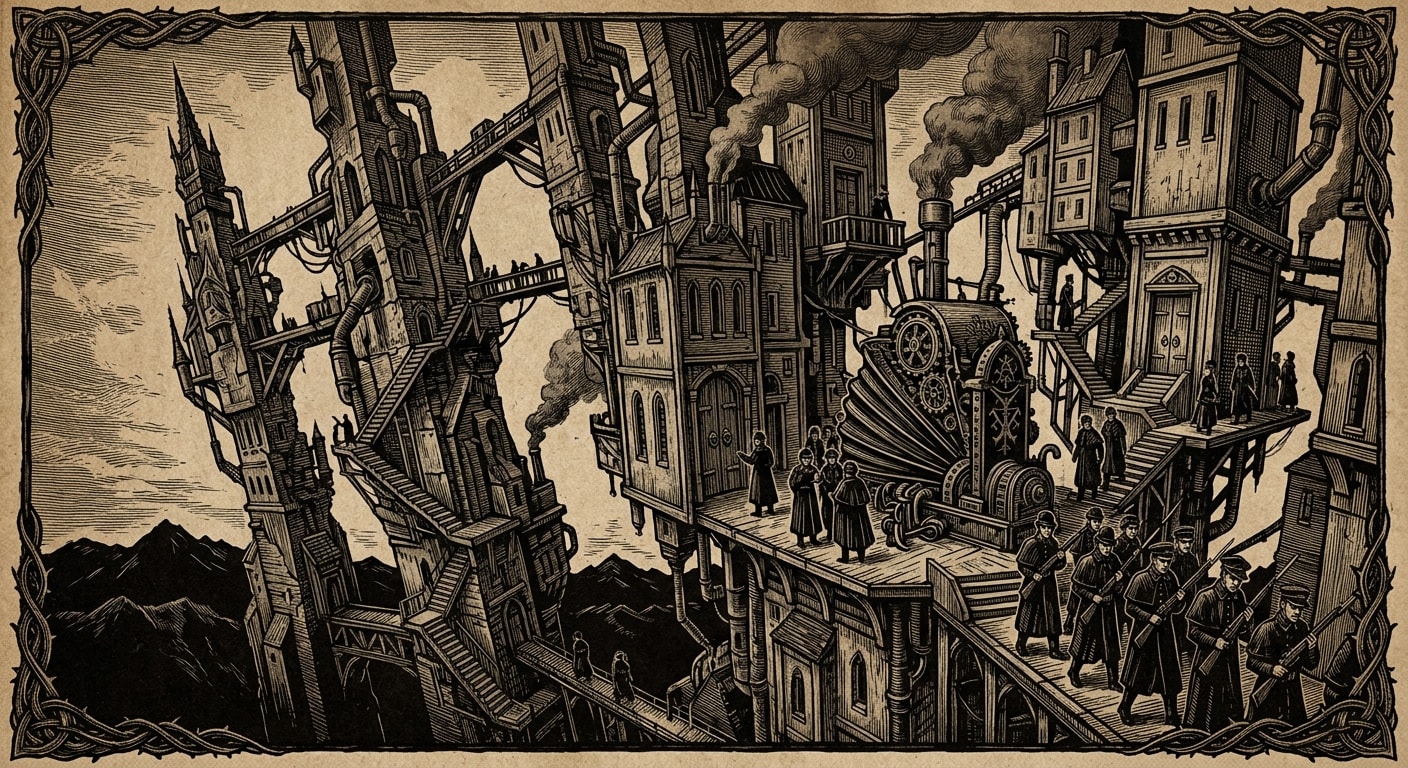
Around Crownspire stand the lesser ascents: needle keeps, banner galleries, black stair-citadels, oath terraces, mirror courts, empty triumph arches, and balconies built for processions that have no floor beneath them. Each exists to exceed a neighbour. A tower in the northern saddle gains one tier; by dawn the eastern gallery has doubled its finials; by noon Crownspire has produced a new crownline, rendering all local victories provincial. The Heights are full of defeated monuments still standing proudly because Pride prefers subordination to destruction. A ruined tower cannot envy. A lesser tower can.
The Court of Ascents (Unregistered), named by Inter-Infernal Analysis and cursed by every map drawer assigned to it, appears in survivor accounts as a terraced city below Crownspire's west face. Its streets climb in switchbacks too steep for carts and too ceremonial for use. Captured proclamations list titles there: Lord of the Upper Passes, Crown Above Crowns, Summit Without Source, First Height of the Enemy, Unlowered Sovereign. Each title corresponds to a stair, a gate, a dais, or a prisoner platform. The purpose is not residence. It is rehearsal.
No verified account places Atheron physically in the visible court, and this absence accords with proper doctrine: the Sin-General is weather, not a dinner guest. Yet every balcony is built as if for an audience already in session. Every black window faces west. Every stair appears to await a footstep that would validate its entire existence. Pride does not need to arrive where all architecture has already knelt.
WATCH GLASS TRANSCRIPT — PRZEMYŚL, A.S. 198 Operator reported seven figures ascending an exterior stair on Crownspire. Witness B observed no figures, only shadows “too proud to match bodies.” Operator then described his own rank as insufficient for the view and attempted to promote himself in the log. Page sealed. Operator's chair found on top of the observation mast before dawn.
The Crownspire's danger lies less in height than in invitation. It makes ascent feel moral. It teaches the viewer that up is better, higher is truer, lower is shame, and shame can be cured by climbing over whatever body has been placed beneath one's foot. This is Atheron's sermon in stone. It requires no priest.
#On the Lower Slopes and Their Uses
The lower Ebon slopes are pass country, though the word pass flatters them. A pass connects. These clefts accuse, delay, mislead, and return men to places from which they had already departed. Black scree fields shift under boot. Ravines preserve voices at different heights, so a patrol may hear its own rear guard speaking from above an hour before the rear guard dies below. Snow settles grey on Synod ridges; on the Heights it lies dark, as if ashamed to be white in public.
Atheron's forces use the lower slopes as mustering galleries. Crownguard Titans descend through ceremonial defiles where banners strike rock and leave gold flakes burning in cracks. Sun Spear ranks drill along dawn shelves, casting radiance into Przemyśl's range glass until spotters cannot tell target from afterimage. Mirror-Lords wait near thaw pools and broken ice, where a soldier's reflection can be persuaded to hold a higher opinion of itself than its owner deserves. The Heights do not hide troops in the ordinary fashion. They display them at distances chosen to injure judgement.
The land resists horizontal movement. Roads climb when they should bend. Tracks that appear level leave men breathing as if after a stair. A mule convoy sent in by mistake during the A.S. 72 supply winter was later found arranged in a circle, animals alive, wagons absent, seals unbroken, men gone. The official entry reads terrain-induced attrition. I have read worse lies, but not many with such tidy boots.
The Heights produce materials coveted by fools and required by strategists: black basalt that holds heat too long, oath-iron that takes inscriptions only when the writer stands, glassy pride-slag used by heretics as mirror backing, banner wire recovered from abandoned Titan camps, and stone chips that cause masons to build lintels one inch higher than ordered. The Bureau forbids salvage, licences salvage, denies licensing salvage, and purchases select samples under sealed requisition. The circle is familiar enough to require no sermon.
A.S. 184 Przemyśl quartermaster records list recovered black basalt as “ordinary construction stone, enemy origin irrelevant.”
Corrected. Ordinary construction stone does not lengthen chapel steps, reject kneeling rails, or cause a junior mason to refer to a privy arch as “the upper work.” The basalt is to be handled under humility supervision and never used in thresholds.
Villages once existed in the lower saddles. Their names survive as scratched entries in refugee family books and as captured Atheronic title-stairs. The inhabitants fled west during the Great Retreat, were killed, bent knee, or became the grey servitor populations that still tend procession roads under banners too heavy for human dignity. A few signals appear at night: three lamps in a triangular pattern, a shutter flash, smoke shaped against the wind. Przemyśl records them. Rescue parties do not go. Mercy without capacity is theatre, and the Heights sell tickets dearly.
#On the Inhabitants Who Remain Below the Banners
The Heights are not empty. Empty country has the decency to kill only through weather, hunger, falling stone, and the little administrative mistakes by which rescue arrives as inventory. The Ebon Heights contain people, or the remnants of people, or those obedient arrangements of bone, will, and habit that Pride permits to continue because a procession needs bearers and a throne looks foolish without witnesses.
The lower servitor villages appear in reports as grey terraces under black roofs, built into ravines where no roofline may rise above the road of its local tower. Chimneys are short by decree. Bell-cotes are sawn flat. Door lintels slope downward toward the street so every exit becomes a bow. Children are taught to carry water uphill with their eyes on the bucket, never the summit, because looking too high without permission is punished, and looking too low without conviction is also punished, and a childhood spent finding the approved angle becomes adulthood before mercy can intervene.
The servitors tend banner roads, polish mirror courts, haul basalt chips, recut stair edges, scrape gold flakes from Titan standards, and sing height-counts during processions. Their songs are monotonous little ladders: first height, second height, third height, each verse raising the note until the singer's throat fails. Failure is recorded as devotion. A strong voice is promoted to upper terraces and ruined faster. A weak voice remains below and lives longer. This is the sort of mercy Hell can offer without lying.
Prisoners are kept differently. Captured officers, proud clerks, ambitious chaplains, overbright engineers, and artists with unfortunate talent are placed where they can see Crownspire through a slit too narrow for comfort and too wide for sanity. They are not tortured in the ordinary sense. They are asked to improve things: a stair proportion, a title, a captured banner's hang, a throne platform's rhetorical weight. Pride makes collaborators by offering critics an audience. The first correction is small. The second correction is better. The third correction uses the word we.
RETURNED PRISONER INTERVIEW — PRZEMYŚL MEDICINE ANNEX, A.S. 196 Subject: former artillery draughtsman. Statement repeated: “The western batteries would look nobler if raised.” Hands restrained after subject attempted to redraw Platform Casimir from memory with enemy stair ratios. Drawing burned. Ash arranged itself in █████ parallel steps before dispersal.
A few inhabitants resist. Their signs are modest because modest signs survive in Pride country. A reversed stair scratch beneath a water trough. A lintel cut one finger lower than regulation. A child's cup left on the upper side of a table so an overseer must reach down to take it. The Bureau of Doctrine calls these gestures spiritually insufficient. The Bureau of War calls them operationally irrelevant. I call them human, which is neither sufficient nor irrelevant, and inconveniently hard to requisition.
The most credible refugee account from A.S. 197 describes an old woman in a lower saddle village who kept a garden beneath a fallen banner pole. Nothing in the garden grew tall. Beans crawled sideways. Herbs were cut before flowering. She told the refugee that anything tall in the Heights is eventually recruited. The refugee laughed, then stopped when the old woman broke every bean-stake and buried the pieces in separate holes.
Przemyśl sometimes receives escapees. They arrive with neck muscles rigid, eyes trained to mid-height, and a hatred of stairs that no chaplain should try to cure quickly. The Taghouse clerks process them as refugees, intelligence sources, contamination risks, labour bodies, and inconvenient proof that people remain alive under Atheron's banners. The order varies by staffing. The insult remains.
#On Przemyśl's View and the Injury of Looking Up
Bastion-Przemyśl was built to sort flesh, stop passes, and make the Carpathian throat obey paper. The Ebon Heights were built, or grew, or declared themselves, to make Przemyśl feel low. This relationship is the defining wound of the sector. Brest fears the flat approach. Shipka fears sleep. Constantinople fears fire and appetite at the hinge of seas. Przemyśl fears the morning view.
The garrison maintains height discipline. Watch crews rotate before admiration can take root. Observation posts use low stools. Officers are forbidden elevated lecterns during eastern briefings. Sermons in the Chapel of Counting include the Humility Sequence after any confirmed Crownspire change. Knee splints are issued not only for Crownguard processions but for long skyline watches, because men who kneel without noticing are easier to save than men who stand too tall with the same vacancy in the eyes.
The injury is cumulative. A new sentry sees black peaks. A veteran sees which peak was not there yesterday. A watch-sergeant sees which soldier noticed first and which tried to pretend he had not. Pride rarely enters through awe alone. Awe is blunt. Atheron prefers comparison: why their tower and not ours, why their banners and not mine, why that officer above me, why this desk below my talent, why should I bend to a man whose mind is plainly lower? The Heights supply the visual catechism. Human vanity supplies the ink.
The Bureau of Purity's quarterly Humility Assessments began as a response to officer contamination and soon became another theatre in which officers compete to appear least competitive. This is not failure. It is policy performing in the presence of its enemy. Men rehearse humility under supervision, then boast privately about their restraint. Chaplains condemn ambition from pulpits raised six inches above the nave. Provost clerks stamp warnings on forms printed in larger type than the warnings of rival departments. The Heights need only be visible. The rest of the work we do ourselves.
Przemyśl's artillery crews have learned to fire without admiration. This is harder than firing without fear. Fear makes hands shake; admiration makes them hesitate. During the Nine-Hour Rubric of A.S. 195, when the Spire-Crusher advanced from the lower Heights and reached nine hundred feet before the outer wire, three batteries lost target discipline because spotters reported height instead of range. Platform Casimir's bell crew struck the Humility Sequence until hands split. The tower fell only after the forward pier entered the charged Orchard and the gunners stopped watching the summit long enough to kill the foot.
#On Cartography, Measurement, and the Sin of Better Paper
No map of the Ebon Heights remains accurate long enough to justify the ink used upon it. This has not prevented mapping. The Bureau of Records would map the inside of its own coffin if given a pencil and two witnesses. Current doctrine uses layered uncertainty: fixed western reference points, probable ridge families, prohibited upward projections, witness mood marks, and a delightful little symbol meaning “cartographer attempted to continue line beyond page; intervention successful.”
Measurements are taken from Przemyśl's towers, from captured range plates, from dead scouts' notebooks, from astronomical occlusion, from shadow length, from artillery calibration, and once from a child in Taghouse Row who drew Crownspire with twelve balconies before the twelfth had been reported. She was praised, frightened, examined, and placed in a counting school where her talent could be made less interesting.
Height reports carry spiritual risk. Numbers invite comparison; comparison invites rank; rank invites Pride. The A.S. 198 Engineering advisory requires double-entry humility marks beside every vertical measurement. A tower may be recorded as 2,300 feet only if the clerk also writes a prescribed diminution: “height without authority,” “altitude without sanctity,” or the older soldier phrase, “tall bastard, still target.” I prefer the last. It has range-table clarity.
Dossier Vermillion stores the best maps in a cabinet whose key is kept lower than the lock. This is not symbolism. It is engineering applied to doctrine. Readers must stoop to open the cabinet and must remain stooped while withdrawing the folio. A junior analyst once proposed a sliding drawer at chest height. Haugen wrote in the margin: “Found him.”
Records Circular 77-P proposed a grand composite wall-map of the Ebon Heights for instructional display.
Cancelled. Composite display produced elevation fixation in three clerks, competitive pointer use in two officers, and one argument over who deserved to stand nearest Crownspire. The remaining proof has been cut into strips and filed horizontally.
The finest map remains a crude soldier sketch from A.S. 197, drawn on ration wrapping after a failed ridge probe. It shows Przemyśl at the bottom as a dark rectangle, the Heights above as serrated black, Crownspire as a line leaving the page, and in the margin a single note: “Shoot lower.” The Bureau of War adopted this as tactical principle without admitting the source. For once theft improved doctrine.
#On Present Pressure
As of A.S. 201, the Ebon Heights are active, expanding, and insolent in the calm manner of things certain they will be looked at. Crownspire's west face has acquired three new exterior stair bands since the A.S. 198 advisory. The lower saddle below the old Cartographic Expedition route now bears a procession road paved in alternating black stone and polished metal, producing mirror flashes at dawn that have increased Przemyśl eye injuries by nineteen percent. Crownguard banners appear more often in pairs, suggesting rehearsed descent routes. Sun-Spear detachments drill at sunrise and late afternoon, the hours when light most enjoys betrayal.
Inter-Infernal Analysis reads this as throne rehearsal. Bureau of War reads it as attack preparation. Doctrine reads both and adds a third: the Heights may be teaching the western witnesses how to expect ascent, so that when Atheron's next vertical engine appears, the first defeat has already occurred in the neck.
OBSIDIAN ANNEX — SIGHTING SERIES, A.S. 201 Three Przemyśl observers independently report a new stair visible on Crownspire descending westward rather than upward. Each used the phrase “for us.” Observers separated before debrief. One later denied the word us and wrote “for me” in correction. Correction sheet sealed. Observer reassigned to floor inventory.
No assault has yet matched the Spire-Crusher in spectacle. This comforts fools. Pride repeats nothing unless repetition can be made taller. The next engine may not walk. It may descend as proclamation, appear as a bridge of banners, unfold from a captured oath, or require only that Przemyśl's officers decide their own wall deserves improvement at any cost. The Ebon Heights do not need to cross the Line if they can persuade the Line to imitate them badly.
The current order is simple: watch low, shoot lower, file horizontally, interrupt admiration, mistrust every desire to raise the platform by “only a little.” The Wire Orchard remains ugly, low, practical, and alive. The Heights remain beautiful in the way a drawn sword is beautiful when pointed at someone else's throat. At dawn their spires catch light first. At dusk they keep it last. Between those two insults, Przemyśl counts rations, checks knee splints, oils guns, stamps tags, and teaches recruits that a target above them is still a target.