
#On the Tower That Refuses Completion
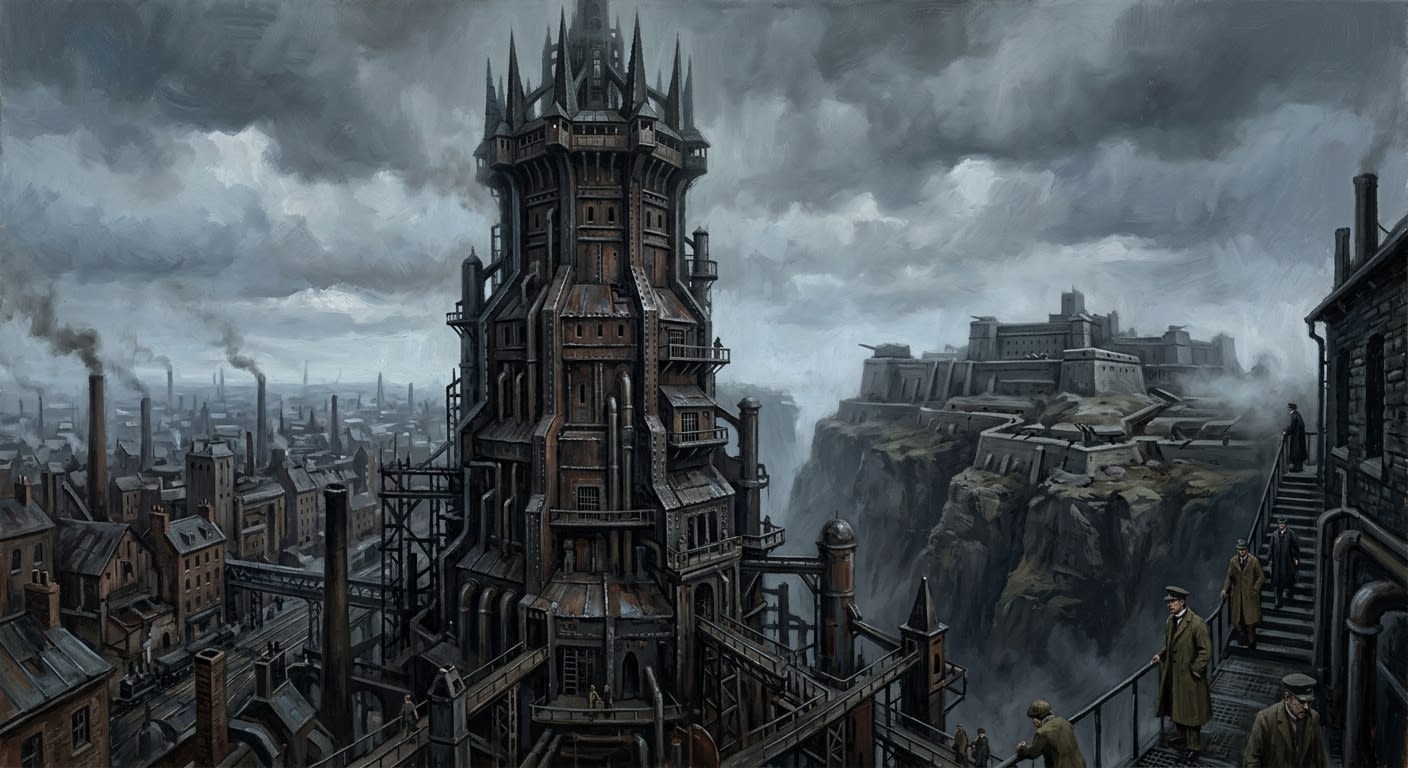
Crownspire is the highest visible blasphemy of the Ebon Heights, Atheron's seat by common report, Atheron's ladder by better report, and Atheron's confession by mine. The Bureau of Cartography calls it a citadel because cartographers require nouns that can be placed beside scale marks. The Bureau of War calls it an enemy command structure because soldiers prefer targets, even when the target has already insulted range. The Bureau of Doctrine calls it an architectural manifestation of Pride. I call it a tower that has mistaken altitude for title and has been rewarded for the error.
It rises from the black summits east of Bastion-Przemyśl, beyond the wire, beyond the forward ridge-signals, beyond the last hill a sane scout should climb without a warrant signed by a dead man. No Synod survey has reached its base and returned whole. No measurement remains correct after the ink dries. Every account agrees on one fact with the dreary unanimity that makes horror administratively useful: Crownspire climbs.
The first sealed testimonies of A.S. 45, preserved in the Vault of Silences, describe a summit already above the surrounding world when Atheron emerged from the rupture. Later witness folios speak of black peaks raising spires after dawn, then taller spires after noon, then still taller spires before dusk, as if the mountains had been ordered to correct themselves in public. By A.S. 73, the Cartographic Expedition had drawn spires beyond the margins of every recovered map. By A.S. 150, Dossier Vermillion ceased treating those vertical marks as ornament and began treating them as a throne-plan.
Crownspire is the final mark in that plan, unless it is the first. Pride enjoys such inversions. It places the crown above the head, then insists the head existed only to bear the crown.
#On Its Reported Rising
No founding date can be assigned to Crownspire without offending chronology, geography, and at least two Bureaus whose officers become peevish when the world declines their forms. The safe entry is A.S. 45: the Sundering, Atheron's emergence, the first summit-testimonies. Yet the oldest reports do not say Crownspire was built. They say it was noticed. That distinction matters. A built thing has a builder, sequence, material, scaffolding, labour, failure, and vulgar dependence upon lower stages. Crownspire appears in the reports as an achieved height whose method has been withheld from inferiors.
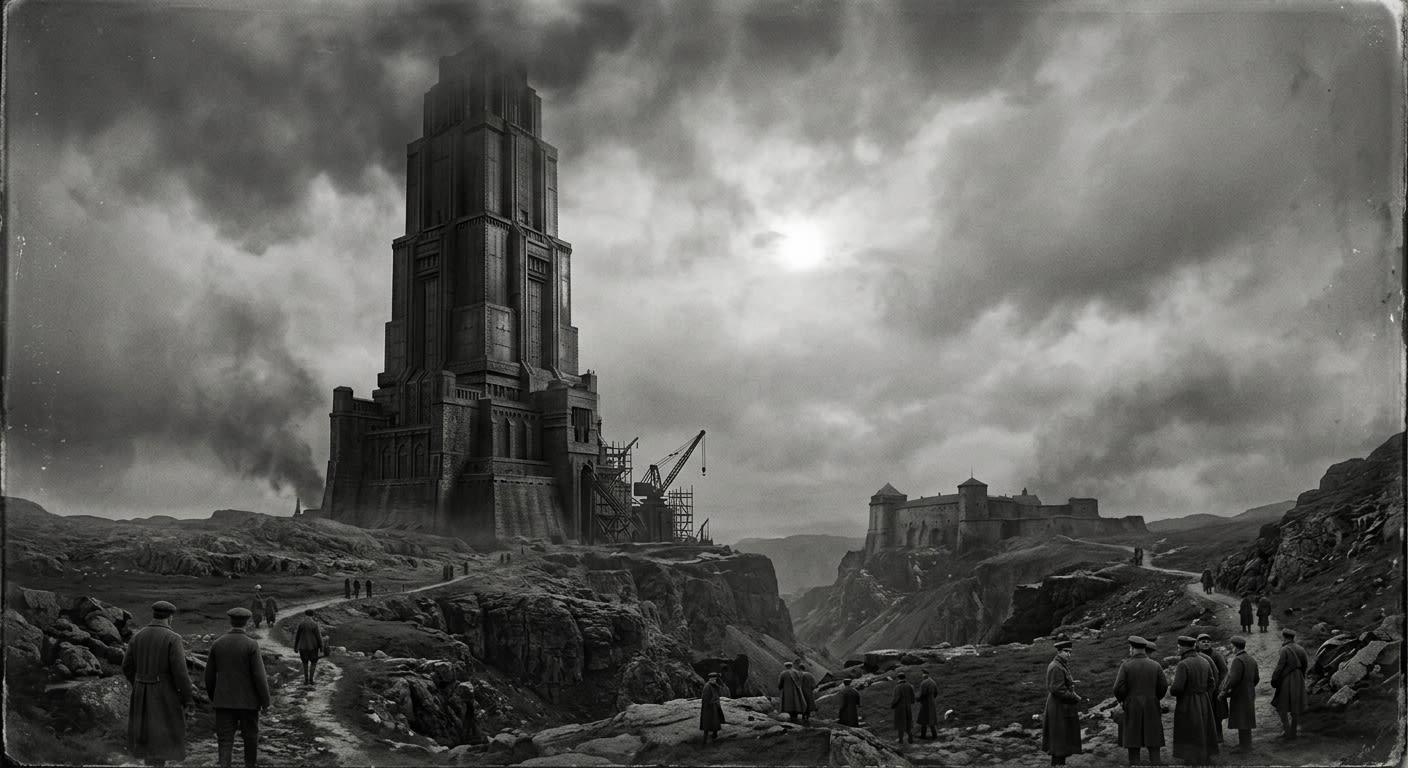
The A.S. 49 Mürren deposition, filed under restraint, speaks of refugees looking east and seeing “a crown of towers where the morning had been.” The line has been challenged by three generations of sceptics, all of whom had the advantage of writing in warm rooms west of artillery. The A.S. 73 Cartographic Expedition advanced farther. Fourteen survivors returned. All fourteen drew the same impossible feature in different hands: a central spire rising past the top edge of the page. One cartographer continued the drawing onto the table, then the floor, then the boot of the interrogating officer. His hand was broken to stop the line. The line continued for three inches in blood.
Early field summaries described Crownspire as “the principal tower among multiple Atheronic ridge-fortifications.”
Withdrawn after Dossier Vermillion review, A.S. 150. Crownspire is not one tower among many. The lesser spires refer to it, answer it, compete beneath it, and fail in its direction. Calling Crownspire principal is like calling the gallows an elevated carpentry sample.
The Ebon Heights are not stable ground. Each ridge makes claims against its neighbours. Towers rise to shame towers. Balconies overtop balconies. Stairways climb into cold air and continue after visible support has ended. Crownspire gathers this quarrel into one line. It exceeds the surrounding heights and condemns them by existing. A lesser spire is not short until Crownspire gives it something to be short beneath.
Atheron's armies imitate the same structure in flesh and metal. Crownguard Titans march taller than the ranks behind them. The Sun Spear Legion blinds from ordered altitude. Mirror-Lords manufacture internal thrones inside the skull. The Spire-Crusher brought Crownspire's argument to the Wire Orchard in A.S. 195: grow until resistance feels small, then call smallness surrender. The engine fell after nine hours. Crownspire did not notice, or noticed as a king notices a cousin's failed hat.
#On the Architecture of Ascent
Crownspire's lower sections, if the lower sections in the reports belong to the same object at all, appear as black buttresses thrust from a mountain face polished smooth by hostile weather. The stone is said to be basalt, iron, glass, bone-lime, pride-hardened slag, or a material that bruises the eye when named. Bureau of Engineering refuses the last category. Bureau of Engineering is wrong with graph paper.
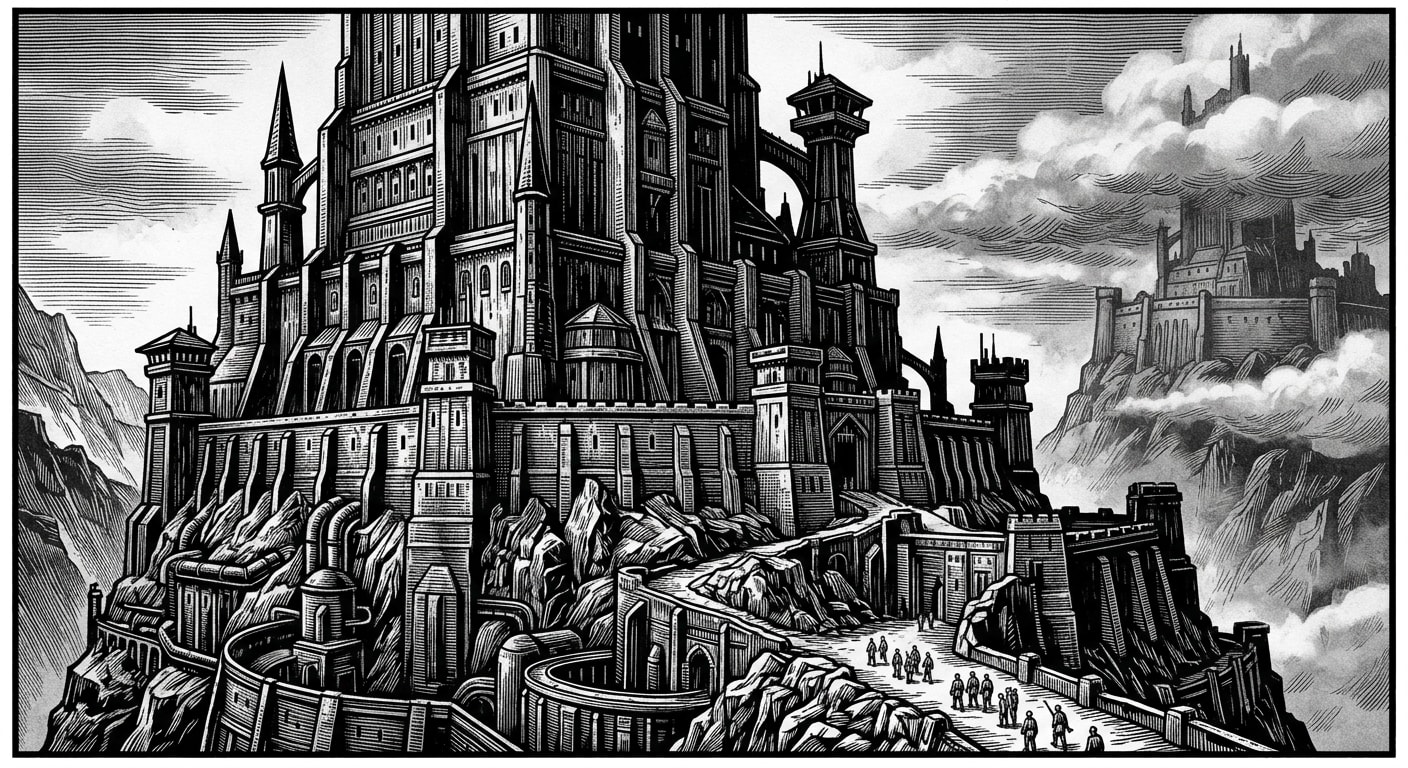
The base consists of terraces stacked into ceremonial severity: parade platforms, judgment ledges, throne-balconies, empty galleries, and blind colonnades where captured banners hang in wind that does not disturb them. Some ledges are large enough for armies. Some narrow until a single figure must walk sideways. Every change in width has meaning. The wide spaces proclaim power before crowds. The narrow spaces educate the individual body in exposure. No one who walks Crownspire is allowed to forget that beneath exists.
Above the terraces rise the shaft-courts: clustered towers fused by bridges of black stone and silver glass, though “bridge” implies utility and these spans seem more interested in insult. They connect heights already hostile to one another. They pass over voids deep enough to turn prayer practical. Witness sketches show processional ramps climbing around the exterior, each ramp lined with niches containing figures in coronets. Some may be statues. Some may be former servants. The Bureau prefers “figural ornament.” The Bureau often chooses mercy when the alternative requires rescue funds.
The middle reaches are worse because they refuse scale. A balcony drawn beside a ridge appears small; the next witness describes the same balcony holding a host. An arch noted as thirty feet across is later reported as wide enough for weather. A stair counted at four hundred and eleven risers acquires a four hundred and twelfth when the counter boasts. A silent rule governs the site: measurement is tolerated until it becomes proud of itself.
Near the upper reaches, accounts break. The shaft splits into needle-spires. The needle-spires bend inward and upward toward a crownline that never arrives. Light behaves badly there. Dawn strikes the top before the sky has admitted dawn. Sunset leaves it last and then returns to it, like a courtier summoned after dismissal. Stars appear behind it in patterns inconsistent with approved calendars. One sealed astronomical report from A.S. 188 states that three stars seemed to arrange themselves around the upper crown for eleven minutes, as if composing a title. The report was moved from Astronomy to Doctrine, then from Doctrine to Purity, then into a drawer with no label, which is how an office screams quietly.
#On the Courts Below the Crown
Crownspire is not empty. Emptiness would be a humility and Pride cannot afford it. Reports from deserters, captured auxiliaries, dream-interrogations, and two scouts whose bodies returned without their sense of left and right describe lower courts where rank is the weather and precedence is the law of motion.
The Court of First Looking lies at the lowest confirmed terrace. Every visitor is seen, measured, named, and placed. No guard is visible in some accounts; in others, a hundred Mirror-Lords stand behind black glass panes, each reflecting the entrant at a slightly altered station. A captain sees himself as marshal. A clerk sees himself as dust beneath the filing desk. A priest sees himself in a mitre, then in ashes, then in a mitre made of ashes. Entry ends when the visitor accepts one image. Refusal, according to witness K-17, causes the floor to rise until the body accepts height as judgement.
DREAM-INTERROGATION EXTRACT — PRZEMYŚL CAPTURE, A.S. 196 Question: “What did the Court ask?” Answer: “It did not ask. It arranged.” Question: “Arranged what?” Answer: “My betters above me. My lessers below me. Then it removed the middle.” Subject expired after attempting to stand on the examination table. Spine lengthened █ inches after death.
Above it sits the Gallery of Proper Names, where titles are stored as weapons. A name spoken there seems to acquire additions. Hans becomes Hans of the Lower Step, then Hans Who Was Permitted Witness, then Hans Who Saw Height and Failed to Rise. Captured proclamations from Atheron's host likely draw from this gallery, each title a little hook set in grammar. Dossier Vermillion tracks the growth of such titles the way physicians track fever. Crown Above Crowns. Summit Without Source. First Height of the Enemy. He Before Whom the Seat Learns Vacancy. Haugen circled that last phrase because she has the rare gift of knowing which words are claws.
The Balcony of Corrected Peers appears in three independent accounts. Here stand effigies or captives resembling rival powers: a serpent belly-down in beaten gold for Velmora, a furnace-beast without crown for Maldrake, a swollen maw chained beneath a table for Kargath, a veiled couch left empty for Velkara, a fog bank sealed in glass for Syrion, and a hundred faces of Morwen scratched away and redrawn each hour. None of this proves Atheron rules his peers. It proves he rehearses their reduction, which is more useful to know and less pleasant to imagine.
At the highest mentioned court, beyond confirmable witness, lies what reports call the Unoccupied Throne-Room. This title should chill the reader more than if it were occupied. An occupied throne has a claimant. An unoccupied throne has a schedule. Dossier Vermillion treats every reference to this chamber as Black Throne material. The Bureau of Inter-Infernal Analysis maintains that Atheron covets the Black Throne of the Great Deceiver. Crownspire, read correctly, is the receipt.
#On the Light and the Eye
Crownspire stands above the Przemyśl front and watches by being visible. The garrison of the Wire Orchard has learned this unpleasant distinction. A fortress may look at a mountain without being watched. A man may look at a tower without entering relation. Crownspire denies that courtesy. To see it clearly is to feel placed beneath it, and placement is the beginning of Pride's grammar.
The effect worsens under clear winter dawns. The upper crown catches light before the ridges do and casts a pale line across the eastern sky. Soldiers call it the High Glint. Official orders forbid that term because nicknames are unauthorized taxonomy. The term survives, as all useful words do, in laundry rooms and ammunition lifts. Men exposed to the High Glint report straightening their backs, adjusting collars, apologising to superiors not present, and feeling sudden contempt for nearby comrades who slouch. Such symptoms are mild until praised.
A.S. 184 Przemyśl watch manuals instructed sentries to maintain steady visual assessment of Crownspire during clear conditions.
Withdrawn. The manual now instructs intermittent observation through smoked glass, paired witnessing, inventory speech, and immediate interruption of any sentry who begins describing the tower as beautiful, rightful, inevitable, or “better proportioned than our own works.” The last phrase cost two men their watch privileges and one architect his friends.
The eye prefers height. This is not sin; it is anatomy. Pride converts anatomy into jurisdiction. A tower above the horizon becomes an argument before the mind has time to draft objection. The Bureau's countermeasure is deliberately humiliating: sentries assigned to Crownspire watch must recite inventories of base things while observing. Socks, nails, spoiled onions, cracked mugs, lice combs, latrine brushes, boot grease, rope ends, turnip sacks. The lower the object, the better. The practice began as mockery among veterans and was later adopted as doctrine, which is how the Synod acquires half its wisdom: it waits for the living to improvise and then stamps their survival as policy.
This protocol irritates officers with refined sensibilities. It saves lives. A lieutenant who says “latrine brush, cracked boot, turnip, spoon” while looking at Crownspire may feel foolish. A lieutenant who says “magnificent” may soon require a dais and six men with ropes.
#On the Black Throne Question
Crownspire is best understood through its ambition, not its stone. The structure rises because Atheron's pride cannot stop at tactical advantage. If all he wanted were command over the Carpathian passes, shorter fortresses would serve. If all he wanted were spectacle against Przemyśl, his Spire-Crusher and banners suffice. Crownspire aims beyond the Line. It aims upward through Hell's own hierarchy.
Dossier Vermillion's A.S. 150 register named the pattern: aspirational usurpation. Each conquered oath becomes a step. Each captured title becomes a riser. Each spire in the Ebon Heights becomes preliminary architecture for a seat above the Great Deceiver. The Bureau of Doctrine dislikes writing this because it grants a Sin-General too much interiority and grants Hell too much politics. The Bureau of War dislikes writing it because a quarrel inside Hell tempts strategists into optimism. Inter-Infernal Analysis writes it because Haugen is paid to be troubled and has chosen excellence.
Crownspire's upper crown is never described as complete. This is the most important architectural fact. A completed crown could be worn. An incomplete crown demands addition. Every new height creates the need for another height above it, lest completion imply limit. Pride cannot accept a final storey. The final storey would confess that ascent had ended. Crownspire continues because Atheron cannot survive the theological consequences of a roof.
The Black Throne remains symbol, object, nexus, seat, wound, or lie according to which sealed office has annoyed the reader most recently. Crownspire treats the matter as practical. It climbs toward a vacancy it intends to define by occupation. If the Throne is symbolic, Atheron builds a symbol taller. If the Throne is object, he builds toward it. If the Throne is authority-wound, he offers height as bandage and blade. Such sentences sound mad in an ordinary room. Crownspire is not an ordinary room. It is a policy memorandum written in altitude.
The danger to mankind lies in the moment of attempted enthronement. Atheron's rebellion may fracture the Shadow Court. It may distract the Seven. It may purchase the Line breathing space measured in seasons, years, or the length of one shell-loading hymn. It may also unite what rivalry currently divides, as every rival discovers that Pride's private ascent threatens the lower kingdoms of Hell. The Bureau's current answer remains insufficient data. In ordinary offices this phrase means delay. In Vermillion it means nobody knows which catastrophe to pray for.
#On Synod Temptation
Crownspire offends the Synod because it resembles the Synod in silhouette. There: the sentence has been written, and some future censor may enjoy spilling ink across it while pretending ink changes architecture. Our towers rise from Strasbourg. Our hierarchs sit above courts. Our Bureaus classify, rank, elevate, diminish. We dress authority in height and then express surprise when Pride reads the uniform fluently.
This does not make the Synod Atheronic. Spare me the tavern philosophy. A knife and a surgeon both cut; only an idiot throws away surgery because murder exists. Hierarchy may serve Order. Rank may bear duty. Height may permit signal, watch, bell, and prayer. Crownspire's blasphemy lies in severing height from service. It rises for rising's sake. It commands because it is above and is above because it commands. The circle closes. The tower feeds on its own logic.
Przemyśl's soldiers understand the distinction better than Strasbourg's theorists. A watchtower exists so a sentry may see danger and warn others. Crownspire exists so others may see it and remember inferiority. A pulpit exists so doctrine may be heard. Crownspire preaches itself. A bell tower exists so bells may carry order. Crownspire tolls without bells, and the sound is posture.
The Bureau of Purity has begun Crownspire screenings among officers returning from the Carpathian front: posture checks, title-resistance interviews, forced seating at low stools, mandatory correction acceptance, and the notorious Potato Examination (Unregistered), in which an officer must peel tubers while a junior clerk reads aloud three criticisms of his latest field report. Officers hate the examination. This recommends it. Two major cases of pedestal fixation were caught after subjects refused to sit below a window. One colonel passed the examination by weeping into the potato bucket. He was returned to duty with commendation withheld for dignity reasons.
#On the Failed Surveys
The Synod has tried to survey Crownspire four times in forms sufficiently official to leave invoices. Unofficial attempts belong to taverns, grieving widows, and officers who thought courage was a substitute for authorisation. The Ledger does not count those. This is not cruelty. It is mercy with columns.
The first formal effort belongs to the A.S. 73 Cartographic Expedition, whose surviving spire-margins remain the oldest operational warning against allowing a draughtsman too much paper. The second, A.S. 112, dispatched a three-man ridge party from Przemyśl under the excuse of weather triangulation. They returned with barometer tubes full of black dust, no matching bearings, and a shared conviction that the eastern horizon had been “raised.” The phrase entered no public report. One surveyor later joined the Bureau of Bells and refused to climb towers.
The A.S. 150 Dossier Vermillion review sent no bodies east, which makes it the most successful survey. It measured Crownspire through enemy proclamations, refugee dream residue, Sun Spear angle variations, and the number of captured officers who used upward metaphors before execution. The method was ugly, indirect, and useful. Haugen's predecessor concluded that the tower’s growth could be inferred from the lengthening titles in Atheron's documents. Engineering objected that titles are not structural data. Vermillion replied that near Atheron titles are load-bearing. Engineering had no answer that survived committee.
The fourth attempt, A.S. 198, is the one Przemyśl remembers with the least humour. Four scouts crossed the eastern saddle during a three-day fog thick enough to conceal ordinary stupidity. Their orders were modest: confirm sightline markers, recover two old bearing plates, avoid contact, return before second night. Modesty is not protection. Modesty is merely ambition with its hat removed.
Two scouts returned at dawn on the third day with identical sketches drawn in different notebooks. Each sketch showed Crownspire from the same angle, including thirteen balconies, nine exterior ramps, a crownline unfinished at the same broken tine, and a small dark aperture midway up the shaft. Neither scout remembered drawing the aperture. When the sketches were placed together, the aperture appeared deeper. The papers were separated. The effect ceased. The papers were brought together again under Purity witness. The aperture appeared to contain a stair. The witnesses stopped the experiment, which proves that even Purity sometimes recognises a mouth before inserting a finger.
The third scout returned without sketch, compass, or usable humility. His neck had stiffened so severely that surgeons had to lower the examination table rather than lower his head. He answered every question from a slightly upward angle and insisted that the survey had failed because his companions “lacked suitable elevation.” He was treated for Atheronic contact, recovered partial flexibility, and now files quarry height tables under supervision. This is considered therapeutic, though the quarries complain.
The fourth scout did not return. His line in the register read “advancing for improved angle” for six months. Records dislikes changing active language to death language without proof, a scruple that would be touching if it did not also preserve payroll confusion. At last the line was sealed. His family received the standard frontier stipend, two cancelled ration claims, and a condolence letter whose first draft described him as “elevated beyond retrieval.” The phrase was corrected before dispatch. Someone in Records still has a soul, or at least a functioning ear.
After A.S. 198, the Bureau suspended direct survey and returned to safer methods: witness comparison, artillery angle drift, title-length analysis, and sentry dream logs burned after extraction. Safer does not mean safe. It means the casualty occurs in the archive instead of the saddle. I prefer archives. Their dead are quieter and easier to alphabetise.
#On the Present Condition
As of A.S. 201, Crownspire remains visible from selected high stations at Bastion-Przemyśl under clear conditions, though visibility reports vary with weather, witness rank, glass treatment, sleep deprivation, and the moral vanity of the observer. Its base remains unapproached by authorised Synod personnel since the last aborted ridge survey of A.S. 198, when two scouts returned with identical sketches, one scout returned with no sketch and a neck too stiff for sleeping, and the fourth remained listed as “advancing for improved angle” until Records tired of optimism and sealed the line.
The tower has grown in all long-baseline comparisons. The Bureau of Engineering refuses to certify this because the measuring points are inconsistent. The Bureau of War accepts it because artillery officers have become accustomed to enemies changing size while trying to kill them. Doctrine accepts it because Pride without growth would be more alarming, not less. Purity accepts nothing, which is why Purity sleeps so poorly and deserves part of its reputation.
Current countermeasures are unsatisfying and useful: smoked glass, paired observation, low-object inventory, no solitary sketching, no elevated lecterns during Vermillion review, no crown imagery in Przemyśl command dugouts, no officer to retain personal telescope without witness seal, no architectural praise within earshot of junior ranks, and immediate reassignment of any man who describes Crownspire as inspirational.
The tower remains there, black against dawn, higher when the air is cold, absent in fog, present in dreams, filed in Vermillion, cursed in Przemyśl barracks, measured in cancelled numbers, and worshipped by no faithful man who intends to remain one. At fifth bell the sentries look east through smoked glass and speak their approved inventory. Boot nail. Onion skin. Latrine brush. Broken spoon. Turnip sack. The High Glint touches the crownline. Somewhere beyond the ridge, a tower continues its ascent with the patience of a sin that believes patience is for lesser things.