
#On Their Nature
"Et surrexit imago eius contra eum." — Bureau of Doctrine, gloss on the Przemyśl contact register
Atheron conducts war as a coronation, and every coronation has an order of service. The Crownguard Titans process first and teach the garrison's knees their station. The Sun-Spear Legion follows with its lances of judgement. The Mirror-Lords convene court in every buckle and bayonet. Then the banners pass, and the men of Bastion-Przemyśl stand up, scrape the mud off their knees, and begin (the Creator forgive them) to feel rather pleased with themselves for having survived.
That is when the Ascendant Shades arrive.
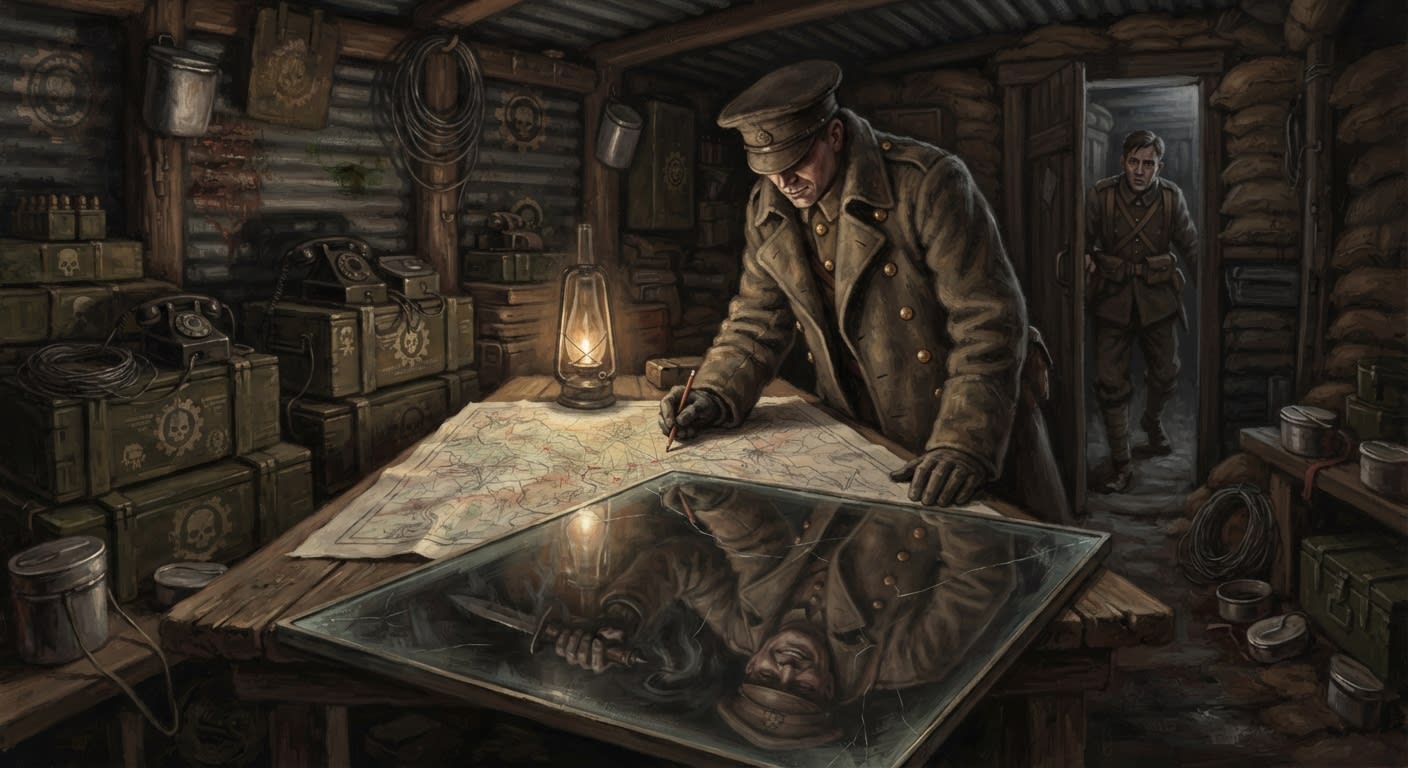
They are Atheron's assassins. The old Bestiary summary gives them a single line, and the line is sufficient: assassins who strike from the victim's own reflection, turning vanity into execution. A commander bent over a lamplit map watches his shadow rise from the table half a breath before he does. A sentry glancing into his polished breastplate sees the man in the steel draw a blade the sentry does not hold. The blow always comes from below, out of the reflection or the shadow or some other lesser image, and it comes with the unhurried confidence of an understudy who has learned every line.
The wound is ordinary: a throat opened from under the jaw, or a thrust driven upward beneath the ribs from a height no standing attacker could occupy. Surgeons find nothing strange in the damage. The strangeness is theological, and Doctrine has spelled it out with unusual candour. The man was killed by a copy of himself, and the copy was sufficient. It needed no rank, no name and no record of service. His outline and his reach were enough, and everything else he had believed about himself turned out, in the final audit, to be surplus.
That is Pride's verdict on the individual. Atheron's host is a ladder running down from the Crownspire, and his contempt descends every rung until it reaches the self, which it also divides into upper and lower. The upper self is the one a man admires in the glass. The lower self is the one that kills him.
Keep the Shades apart from their cousins. Morwen's servants steal faces, voices and names so that they can walk into a dead man's life wearing it. A Shade takes nothing. It leaves the corpse where the reflection stood and departs, because no replacement was ever required. Velkara's Mirror-Stalkers move through glass on the current of desire and kill the beloved. The Shade kills the admired, and the admirer is the same man. Lust hunts through the glass. Envy climbs out wearing the face. Pride leaves the face where it was and proves it redundant.
#On the Reflection Below
The mechanism is disputed. I file it as disputed.
The Shades are demons, and demons are physical. They have bodies, they cross ground, they can be shot, and they cannot possess a living man. The Bureau of War holds that a Shade is present in the flesh when it strikes, crouched in the dark beneath the lamp or behind the angle of the surface, and that it uses the victim's image as a prepared aperture at arm's length. Doctrine holds that the reflection is the weapon and the demon merely its bearer. Both Bureaus agree on three points. The Shade must be near. The surface must be prepared, whether by Mirror-Lord contact, by cult hands, or by a battlefield that has spent the day polishing itself for parade. And the victim's hands remain his own to the end. His arm never raises the knife. The arm in the glass does.
Polished spoons in the Palatinate are safe. The Shade belongs to the passes of the Carpathians. A Shade in interior Synod territory would be a major incident, and it would trace back to Atheronic contact, a cult cell, or an officer who carried Przemyśl home in his kitbag.
Field signs, as compiled from survivors' testimony:
- the shadow moves before its owner, or stays still when he moves;
- the reflected hand in breastplate or range-glass rests on a hilt the man is not touching;
- shell-hole water shows the watcher lower than he stands, as though he knelt;
- lamplit map-glass returns the officer with a steadier hand and better posture;
- the reflection smiles first.
The last sign is the worst and the least reported, because the men who see it seldom file.
The Shade gets in through the victim's own posture of command. Take the officer who studies the map alone after midnight with the lamp drawn close and his chin lifted, rehearsing the report in which he is the hero. He has arranged a stage, a mirror and an audience of one. The sentry who spends his watch admiring the shine on his cuirass has built the Shade a doorway and polished the hinges.
Early Przemyśl contact cards instructed personnel to "avoid mirrors when Shade activity is suspected."
The instruction is withdrawn. Mirrors are the least of it. Personnel will avoid every surface that returns them improved: breastplate, bayonet, lamp-chimney, map-glass, range-glass, chapel pane, boot-toe, standing water, and the eyes of subordinates who have learned what the officer likes to see.
#On Their Place in the Pride-Host
The Shades rarely open an engagement. They work the ground the rest of the host has prepared. The Crownguard's banners leave men kneeling in the wire, and a kneeling man looks down into puddles. The Sun-Spears leave survivors half-blind and fumbling for any surface where they can check their faces for burns. The Mirror-Lords panel every trench wall in accusation and leave each officer convinced that his comrades stand beneath him or above him. An isolated officer is the Shade's natural quarry. Nobody else is watching his reflection.
After the Spire-Crusher fell in the Nine-Hour Rubric of A.S. 195, the garrison could not stop looking at the sky. A man staring upward is not watching the water at his boots. The Bureau of War has attributed no death of that week to the Shades, and it has not explained all of them either.
#On Incidents at Przemyśl
The Shades have no clean record. No specimen has been recovered whole, and no first sighting has survived the arguments over what was sighted. The Bureau of War keeps a file of attributed cases from the eastern salient and the Wire Orchard. It releases them undated, because the dates would identify the dead to their families before Doctrine has decided how they died.
One case will serve. A battery captain on the salient stayed in his dugout after the evening conference to finish a fire plan. He was competent and decorated, and disliked in the accurate way competent men are disliked. He had the lamp brought close. He had laid a sheet of glass over the map, against Circular 192-M, because glass kept the grease off his range-lines and he liked his range-lines clean. His runner came back within a quarter-hour and found the captain sitting upright at the table with his throat opened from beneath the jaw. His pistol was still holstered and his knife still sheathed. The map-glass was cracked from the underside.
Runner's statement, as taken: "He was looking at the map. The one in the glass was looking at him. I saw it put the pencil down. The Captain never put his pencil down, sir, he still had it. ███████████ it was smiling like it had been promoted ██████ I didn't look at the lamp after that. I don't look at lamps."
The runner is alive. He was transferred to the Chapel of Counting as an inventory clerk, where he refuses lamps and writes by grey window-light. His handwriting has deteriorated. Nobody regrets this.
#On the Countermeasures
The doctrine is ugly because beauty is the way in.
Reflective kit near the salient is smoked, scratched, tarred, or rubbed with ash and mud before dusk. Buckles are blackened. Range-glass stays hooded between readings. Puddles in occupied trenches are covered with duckboard or sacking, or stirred to a brown froth by the sentry every time he passes. The Orchard's hanging paper-fruit spoils clean reflective planes, and the garrison is forbidden to tidy it.
No officer studies a map alone by lamplight. After dark, every map-table needs a second witness, placed to watch the officer's reflection while the officer watches the map. Circular 192-M requires witnesses of mutually contemptuous temperament for every essential surface, and the rule applies here. Men who dislike each other watch each other closely, and the garrison has never lacked suitable pairs.
A sentry who catches himself admiring his kit recites the Humility Sequence: boot, mud, ration, wire, cartridge, number, name, breath. A man listing his inventory has no attention left over for admiring it.
If the reflection moves, spoil the surface. Put a boot through the puddle, throw the lamp, or fire into the breastplate on its peg. Gunners at Przemyśl have been decorated for shooting their own mess-tins. A shattered surface closes the aperture. The Bureaus still argue over whether it also ends the Shade, and the men do not wait for the ruling.
The last line on every Przemyśl contact card is set in the largest type the press would allow: Do not admire a clean line. It covers trenches, uniforms, fire plans and faces.
#The Ratification
I have read every attributed case. With few exceptions, the dead were good at their work. They kept tidy kit and accurate maps. Somewhere between the lamp and the glass they came to believe the tidiness was themselves, and Atheron sent something to show them that a lesser copy could hold the pencil just as well.
The Bureau of Doctrine requires me to state that the Creator made each soul singular and irreplaceable. I state it. I also record that I wrote this entry with a blanket over my inkwell and the window unwashed, and with Subdean Fossick seated where he could watch my shadow. It has not moved. Fossick says it slouches.