
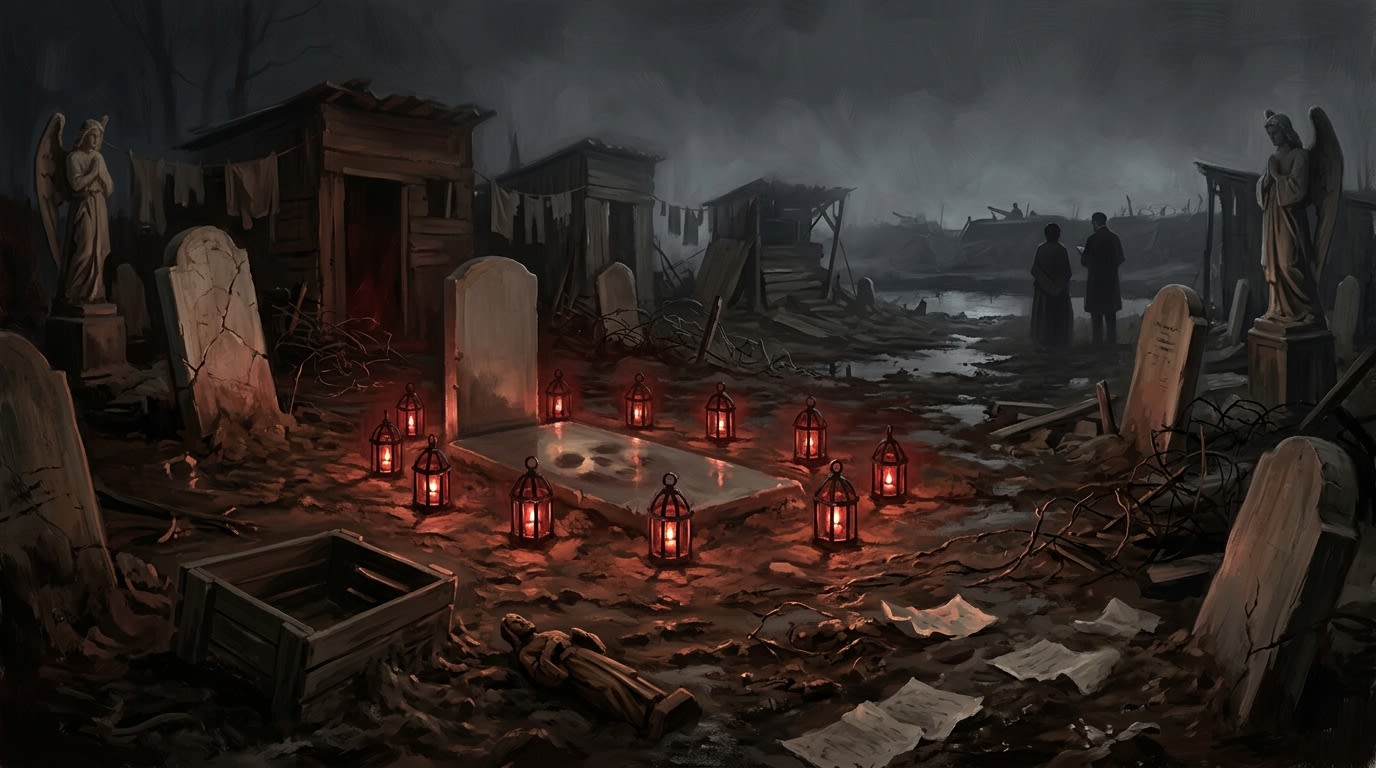
#On the Lamps Given to the Poor
The Târgu Child-Lamp Incident began as all efficient atrocities begin: with surplus inventory, a clean seal, and the serene permission of the Synod to call danger by a harmless name.
A grave-ring outside Târgu received forty-six lamps from a Bureau of Engineering depot under the label SURPLUS ECCLESIASTICAL ILLUMINATION — LOW HEAT — CEMETERY USE. The crate bore a clean seal. The broker signed for it with a caretaker mark. The parish warden accepted three lamps for chapel aisles, two for the ossuary shed, one for his private room, and the remaining forty for lanes where the living slept between the dead and called the arrangement shelter because hunger had already taken the better words.
Children found the lamps first. Children always find what adults misfile.
The devices were small, iron-caged, and fitted with cloudy glass reservoirs filled with a pale oil that neither froze nor smoked. They burned without wick-trimming. They shone through fog. Their light made inscriptions on old stones briefly legible, which pleased the elders until the elders noticed that several newly legible names belonged to men not yet buried. By then the children had discovered the trick: hold the lamp beneath the chin and the skull glowed red through the cheeks, the eye sockets, the teeth. A carnival face. A saint’s lantern. A game played under the jurisdictional eyelashes of Records and Settlement, neither of which blinked.
#On the Grave-Ring at Târgu
Târgu already possessed a reputation, which is to say the Bureau possessed files and the residents possessed warnings. The Murmur Line stood there, or near enough that soldiers used the name as a general curse for walls that answered back. In A.S. 128, thirty-one men had been immured by sentence masons for collective hesitation, and the wall repeated the Creed until bombardment interrupted its lesson. The district learned, thereafter, to treat masonry as a listening category.
The grave-ring lay along a trench approach used by reserve companies moving between the inner road and the forward ditches facing Wrath. It was not a town in the old sense, though old maps indulged the fiction. It was a cemetery with tenancy habits: plank shacks between markers, cookfires on cracked slabs, laundry strung from angels whose faces had been worn smooth by smoke, children playing boundary games with chalk stolen from Stake Runners. The Broker who held Lane Seven called himself a Caretaker Saint on invoices and a practical man in private. Both claims were profitable.
The lamps made Lane Seven safer for three nights. Patrols could see the ground. Mothers could count children after curfew. Men returning from trench labour did not trip over stone mouths or open pits. The dead, if they objected, did so quietly.
Then the skulls began shining after the lamps were extinguished.
Initial ward testimony described the phenomenon as “children’s play with reflective cemetery glass.”
Correction. No reflective glass remained in contact with the affected children after the third night. Luminescence persisted beneath skin, bone, and eyelid. The Bureau of Engineering later proposed “residual devotional phosphor.” The Bureau of Doctrine accepted the noun and rejected the adjective.
#On the Children Lit from Within
The first child was Marka Vell, aged seven, daughter of a coffin-board cutter and a woman whose name appears in the rent rolls as dependent, untithed, disputed. At dawn her mother found the girl asleep with red light leaking from her nose. By Sext the glow had settled behind the teeth. By Vespers the skull showed through the skin whenever bells rang, every seam of bone limned in furnace rose, and the attending Mercy nurse had stopped pretending ordinary fever could be blamed.
The second and third were brothers. The fourth was a boy who had only watched the game. The fifth, according to the parish warden’s deposition, had never touched a lamp at all. This is the detail that moved the file from nuisance to doctrine: contamination without contact is theology with its sleeves rolled up.
The children did not complain of pain. They complained of seeing too far. One said he could see warm things through walls: rats, bodies, ovens, soldiers who had not yet come around the bend. One said the lamps had little voices and the voices were counting. A younger girl asked why the men in the trench had no faces while they were still alive. The attending Mercy nurse wrote this down, then scratched it out, then wrote it again in the margin because conscience, when cornered, becomes clerical.
By the fifth day, eleven children shone. Their hair looked dark against the internal light. Their eyes reflected lamp-flame when no lamps burned. Dogs followed them. Moths died on their cheeks. Grave inscriptions brightened when they passed, and one stone in the lower row began sweating wax from letters cut forty years before.
MERCY OBSERVATION — TÂRGU LANE SEVEN Subject M.V., seven years, asked whether her father had returned from the wire. Father recorded dead two months prior, body unrecovered. Subject pointed toward forward trench and stated: “He is standing where the hot ground opens.” Patrol later found █████████████████████████████████████ File sealed under joint Mercy/Doctrine warrant.
#On the Decision to Use Them
The Bureau of War discovered the children before the Bureau of Mercy could hide them. I phrase this with care. Mercy attempted a concealment, which is one of the few virtues it still practices competently. War required markers for a night approach across slag-wet ground after Maldrake’s seasonal artillery had turned the outer ditch into black glass and steam. Ordinary lanterns drew fire. Bell flares burned out too quickly. Phosphor stakes vanished in smoke.
Eleven children, visible through fog, obedient from terror, small enough to move between crater lips, presented themselves as a solution to a logistical inconvenience.
The order did not use the word children. It used “ambulant illumination assets.” The escort form did not use the word march. It used “forward placement.” The casualty schedule did not use the word death. It used “expected extinguishment.”
They were given grey wraps so the bodies would not shine too early. They were told they were helping the soldiers find the safe path. This was true in the narrow way a knife is true: it performs the function assigned by the hand holding it. The smallest child carried a wooden saint because she refused to move without it. The chaplain blessed the group twice, once in public and once under his breath after the sergeant told him to hurry.
At the forward trench, the wraps were removed.
Men who survived the night later testified that the children stood like red altar-coals along the approach, each skull bright under skin, each jaw visible when it trembled. Their light found slag pools hidden under ash. It revealed wire. It marked the edge of a crater whose bottom glowed with Wrath’s heat. For twenty-three minutes, the assault companies advanced by the radiance of stolen childhood.
Maldrake’s slag answered.
It came as a sheet of liquid iron across the ditch, slow enough to be watched and fast enough to be uselessly feared. The first three children vanished without sound. The fourth ran and left footprints of light that remained after her feet were gone. The fifth and sixth crouched together under a broken gun shield until the shield sagged. By the end of the barrage, no lamp-bearer remained visible. The assault took the forward lip. The report called the beaconing effective.
Bureau of War after-action summary: “No civilian casualties recorded during beacon operation.”
Amended. The eleven illumination assets were civilians. The fact that an asset has been renamed does not make it less dead, though it often makes the requisition easier to sign.
#On the Trial of the Broker
The Broker was arrested by noon. This displayed encouraging speed and total uselessness. His ledgers were seized. His lane was cordoned. His tenants were questioned about rents, lamps, grave claims, and whether any child had exhibited light-seeking behaviour before receipt of the crate. Three mothers struck a Purity clerk and were charged with grief in an aggravated posture.
The Broker defended himself with the only shield that matters in the Synod: paperwork. The lamps had arrived under Engineering seal. The transfer form bore a depot mark. The hazard classification was blank, which he argued meant safe. The prosecuting clerk argued that blankness meant unassessed. The Judge asked whether unassessed items may be distributed to children. The Broker replied that nothing in the caretaker shelter regulations classified children as distinct from residents. The court recessed for luncheon.
The Broker was released before Compline. His classification shifted from Caretaker, Interment — Auxiliary to Caretaker, Interment — Auxiliary, Suspect. A distinction invisible to victims and meaningful to assessors. Engineering declined comment, stating that surplus ecclesiastical illumination fell outside active operational inventory after transfer. Records accepted the transfer. Settlement denied the lane existed. Rites asked for the lamps back.
#On the Lamps Still Burning
As of A.S. 201, the Târgu lamps appear in three ledgers and no confession. Engineering lists them as depleted surplus. Grave-field Brokers list them as warning goods. Lane mothers list them by child, because mothers are less easily revised than inventories. The surviving lamps are said to burn low and red when children pass. This is not an official property. Official properties require a test, a table, a responsible Bureau, and a conclusion that does not make the room colder.
The incident remains a training example among Ossuary Allies and Caretaker Saints: do not accept clean lamps from dirty stores; do not let children play with anything the Bureau describes as surplus; do not trust a glow that makes the dead easier to read. Stone Sharks ignore the lesson unless the lamp rents well.
Târgu remembers by posture. Mothers turn lanterns away from sleeping faces. Children cup candleflame behind their hands and dare one another to look through their fingers. Soldiers crossing Lane Seven tap their helmets against the first marker in the row, where someone carved eleven small circles around a nameless grave.