
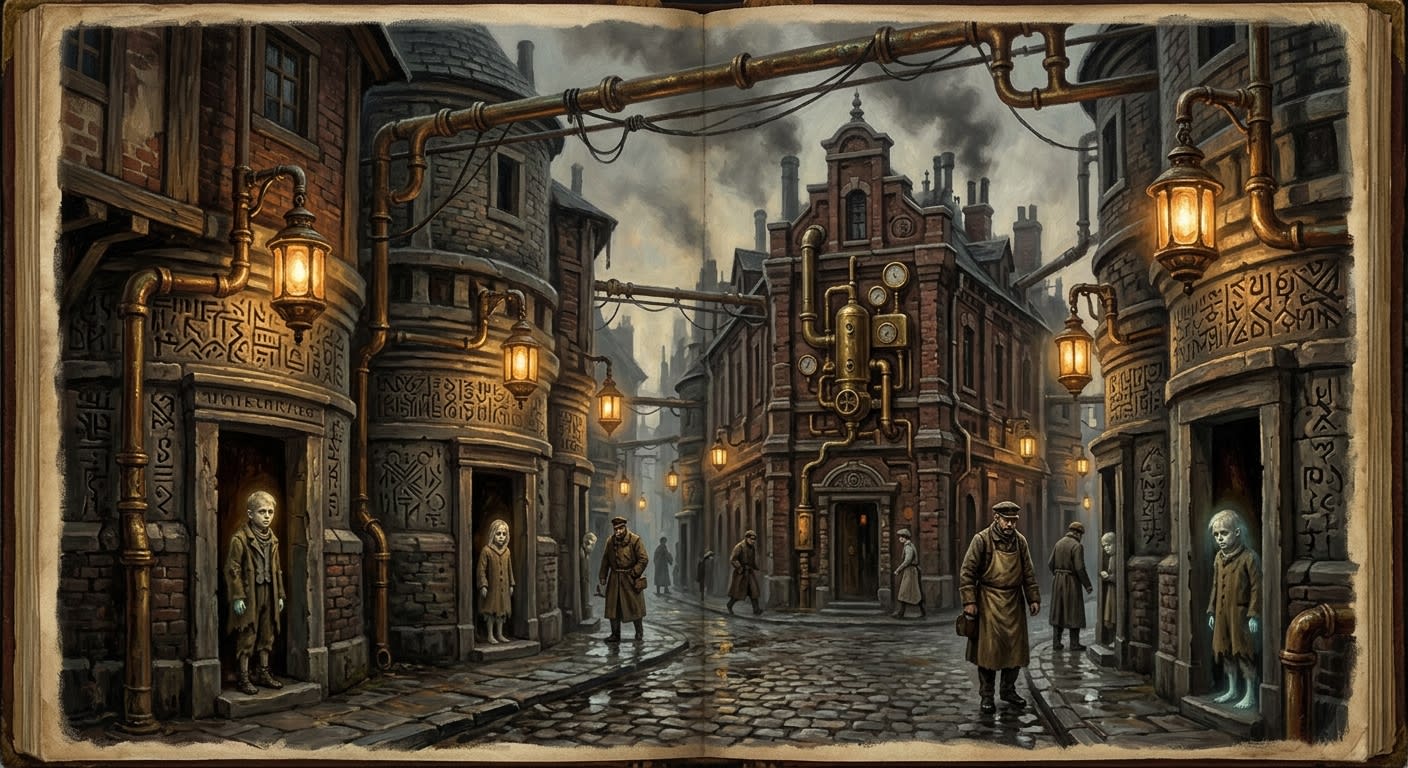
#On the Town That Learned to Listen Sideways
Târgu lies on the western approach to Bastion-Przemyśl, near enough to the Carpathian trenchward that artillery is weather, judgment is masonry, and a child may learn three kinds of silence before learning subtraction. Old maps call it a town. Newer ledgers call it an approach settlement, a grave-ring pressure node, a punishment-architecture district, a caretaker shelter field, and several other evasions by which the Bureau avoids admitting that people live where sensible geography gave up.
The place is small. That is the first mercy and the least useful one. Târgu occupies the ragged joint between road, cemetery, reserve trench, and bad memory. It began as a market halt serving the Przemyśl western road, became a staging hamlet when the Line hardened from retreat into refusal, then decayed into a grave-field suburb after the dead acquired more legal permanence than the living. Its lanes run between headstones. Its walls answer badly. Its children know lamps by weight, heat, and danger.
Târgu’s fame rests on two files, both ugly, both instructive, both filed too neatly for comfort: the Murmur Line, raised in A.S. 128 after thirty-one soldiers were immured for collective hesitation, and the Child-Lamp Incident, in which surplus Engineering lamps lit eleven grave-ring children from within before War requisitioned them as battlefield beacons against Wrath’s slag. A town may survive one atrocity as wound. Two become civic architecture.
#On the Western Approach
The western approach is the road by which respectability enters Târgu and leaves ashamed. Supply carts from deeper Synod territory pass under escorted schedules toward Przemyśl. Reserve companies tramp eastward by bell-order. Wounded men return westward under sheets if they are privileged, under blankets if they are loved, under numbers if the clerks are busy. Grave wagons move both ways, because war has never respected the directional logic of roads.
The approach matters because Târgu is neither bastion nor rear. A bastion may justify any cruelty by pointing at the enemy guns. A rear town may pretend its cruelty is administrative distance. Târgu has both excuses and neither protection. It is close enough to be used, far enough to be neglected, and poor enough to be described as resilient by offices that would not drink its water.
Before the files grew famous, Târgu sold feed, nails, candle ends, boot leather, rough bread, burial boards, patched uniforms, and the little false certainties that collect around soldiers awaiting orders. Its market was never clean. No frontier market is clean. A clean frontier market is either a lie or a trap maintained by Purity for instructional purposes. Târgu’s stalls leaned against cemetery walls, its inns kept shovel handles behind counters, and its parish bell was retuned twice after local masons complained it set old mortar sweating.
Earlier quartermaster glosses described Târgu as “minor civilian settlement west of Przemyśl, without independent strategic significance.”
Corrected. A settlement through which soldiers pass, lamps are distributed, bodies are housed, and punishment walls continue devotional response has strategic significance whether the quartermaster has noticed or merely survived by avoiding notice.
The geography teaches a citizen to angle the face away from direct inquiry. To the east: Przemyśl and the Wire Orchard, the fortress appetite, the counted road. To the west: the bureaucratic comfort of towns that speak of the front as if it were a fever in another family. Underfoot: graves. Overhead: lamps. In the walls: precedent.
#On the Grave-Ring
Târgu’s grave-ring is older than its current shame and younger than its oldest lie. The cemetery began as ordinary consecrated ground for road dead, trench dead, market dead, fever dead, and the occasional man executed so briskly that the burial certificate reached the parish before his last boot did. It expanded after refugee pressure and trench casualties made ordinary burial an arithmetic insult.
Where the dead own the ground, the living rent the pause. Grave-Field Shanty Brokers took root there under the classification Caretaker, Interment — Auxiliary, a phrase broad enough to cover mausoleum sweeping, corpse-adjacent tenancy, bribed parish stamps, and a Lane Broker deciding which family may sleep behind a stone angel with its nose shot off. The Bureau of Settlement denies residency because consecrated ground lies outside its clean jurisdiction. Records catalogues the dead. Tithes taxes the plot. Rites blesses the markers. Everyone notices the living just enough to collect from them.
The grave-ring is arranged by lanes rather than streets. Lane Seven appears in the Child-Lamp file. Other lanes appear in rent rolls, confession slips, punishment notices, and mothers’ private lists. Roofs are coffin-board, tarred cloth, pallet wood, slab fragments, and the stitched optimism of people too tired to call it hope. Smoke stains the lower angels. Laundry hangs between markers. Children play boundary games with chalk that ought to have marked graves. Dogs sleep against warm stones and growl before inspections.
Brokers in Târgu learned prudence early. Keep two ledgers. Rotate lamps. Pay the warden first. Never build above an unmarked grave unless the family can afford the apology. Never promise forever; forever belongs to the stone, and even stone in Târgu has been known to revise its position at night.
#On the Murmur Line
In A.S. 128, during a trench lull, a platoon was ordered forward and did not move quickly enough for doctrine. The Judge found all thirty-one men guilty of collective hesitation, contagious cowardice, refusal of forward motion under bell-schedule. The Sentence Masons worked nine hours. Thirty-one niches in a continuous wall. Shoulder-close. Breath-close. Plaque-close.
The wall began speaking before the mortar cured.
At first the nearby companies heard fists. Then mouths. By second watch, the sound had joined itself into the Creed, muffled through lime and stone, flattened into one instrument by the masonry that was meant to end the matter. Shellfire later broke upper courses and sealed several mouth-level voids. The public recitation ceased. Quarterly inspection records maintain the usual cowardly distinction between silence and reduced response.
The Murmur Line taught Târgu that walls listen, answer, and keep accounts. Boys press ears to plaques until sergeants teach them practical theology with boots. Mothers turn cradles away from masonry. Masons spit lime-dust downwind. Soldiers touch helmets to the first marker before crossing the lane, and veterans tell new men not to ask whether the thirty-one were guilty. Guilt, after sufficient mortar, becomes an architectural term.
QUARTERLY TAP-WALK — TÂRGU WALL, SEALED EXCERPT Fourth seam west of central plaque responded after Ninth Bell with two impacts, pause, two impacts, pause, one continuous scrape. Inspector wrote “thermal settling.” Assistant wrote “counting.” Assistant reassigned before dawn. Follow-up slate: █████████████████████████████████████.
The wall has no shrine charter. Candles appear anyway. Doctrine calls this local anxiety displacement, a phrase useful chiefly for proving no one from Doctrine has ever tried confiscating candles from a mother with a son under sentence. The candles return after every sweep. Some are ordinary tallow. Some burn low and red.
#On the Child-Lamps
The Child-Lamp Incident began with forty-six surplus ecclesiastical illumination units delivered from an Engineering depot under clean seal. LOW HEAT. CEMETERY USE. No hazard classification. Târgu accepted the crate as poor districts accept all gifts from higher offices: with gratitude, suspicion, and the knowledge that refusal will be interpreted as ingratitude rather than wisdom.
For three nights, the lamps helped. Patrols saw open pits. Mothers counted children after curfew. Men returning from trench labour avoided stone mouths, fence wire, and the little collapses by which the grave-ring tried to become more honest. Then the children began to shine after the lamps were out.
Eleven children developed red internal luminescence. Their skulls showed through cheek and eyelid when bells rang. They saw warm things through walls: rats, ovens, bodies, soldiers not yet around the bend. One child described lamp-voices counting. Another asked why men in the trench had no faces while they were still alive. Mercy attempted concealment. War found them first.
Initial ward testimony classified the lights as “children’s play with reflective cemetery glass.”
Corrected. Luminescence persisted without glass, wick, flame, or exterior fuel. The children were not reflecting light. They had become its prison.
War needed markers for a night approach across slag-wet ground after Maldrake’s artillery had turned the outer ditch into black glass and steam. Ordinary lanterns drew fire. Flares died. Stakes vanished in smoke. Eleven grave-ring children, visible through fog and too frightened to disobey, became “ambulant illumination assets.” They were wrapped grey and told they were helping soldiers find the safe path.
At the forward trench, the wraps were removed. For twenty-three minutes, assault companies advanced by the radiance of stolen childhood. Slag answered. None returned in War’s casualty language. Local names remained, because mothers are harder to redact than forms.
The Broker was arrested, displayed, questioned, and released. The lamps had arrived under Engineering seal. Settlement denied the lane existed. Records accepted the transfer. Rites requested surviving units for custody. The mothers carved eleven circles around a nameless grave. Bureau prose did not improve them.
#On the Present Condition
Târgu endures in A.S. 201 as a settlement of turned lamps and half-heard walls. Its citizens have developed disciplines that no office ratified: lamps angled away from sleeping faces; children forbidden to hold light beneath the chin; grave lanes swept before inspection and after nightmares; helmet taps at the Murmur Line; hush-powder purchased in packets that smell of lime and old fear; Broker ledgers wrapped in waxed cloth and hidden beneath stones whose dead are too poor to attract official visitation.
The town’s economy remains small and dirty. Candle sellers do well. Lime sellers do better. Brokers charge for seasonal quiet. Parish clerks sell confirmations of interment relationships with faces arranged into moral injury. Soldiers buy charms against wall-speech and lamp-glow, then mock one another for buying them. Mercy nurses pass through with covered baskets. Engineering inspectors arrive with measuring rods and avoid eye contact with children. War officers prefer the eastern road when weather permits.
No restoration has been proposed. Restoration implies a prior wholeness, and the files do not support so charitable a fantasy. Târgu is maintained as approach, warning, and convenience. The Murmur Line stands. Lane Seven remains inhabited in altered form, though residents avoid the old lamp posts. Grave-field tenancy continues under caretaker fiction. Children still play in chalk, under stricter eyes, drawing circles, gates, helmets, and once, according to a confiscated slate, thirty-one little boxes in a row.