
I've read the continuity, voice and lore sources. Here is the article.
#On the Two Name-Givers
"A clean name is a leash." — Registrar idiom, current in every intake house I have inspected
The street calls every Orphanage Registrar a Name-Giver. A mother at the foundling wheel says it the way she would say bailiff. A boy in a roundup wagon says it the way he would say knife. The usage is crude and correct: every Registrar gives names, and giving one is the first thing a grey coat does with ink.
Inside the profession the plural is narrower. The Name-Givers are Registrars who believe the name issued at the desk does more than file a child. They hold that it replaces the child. In their view a lawful identity, issued under the Bureau of Mercy, entered with the Bureau of Records and enforced by repetition, will in time push out whatever came in through the door with the child: mother, surname, parish, and loyalty to a household the Index Damnatus struck from the rolls overnight. Paper, discipline, and enough hunger. Those are their words, and they mean all three.
No charter has been granted to them, and none was needed. A Registrar becomes a Name-Giver the way a confessor becomes severe: by practice first, then by reputation.
#On the Claim of Remaking
The doctrine is simple enough to fit on a stamp. A child is what the Ledger says the child is. Lineage is a column, and a column can be ruled through. A girl received as the daughter of a condemned cooper leaves the desk as Sabin, Mercy transfer, ration class assigned, and the Great Ledger of Souls can find no father for Sabin. The Name-Givers say this is the whole matter, or will be once the girl agrees.
The agreement is manufactured. Bells divide the day. The catechism is answered in rows, and each answer starts with the assigned name, so the child speaks it aloud a dozen times before noon. The ration disk is drawn against the name disk, and in a Name-Giver's dormitory broth is served by roll-call. A child who answers only to the old name holds, as an administrative matter, no present claim on supper. The faction will not call this starvation. Its members call it recognition. The child learns that the Synod sees them under exactly one name, and that being seen is how one eats.
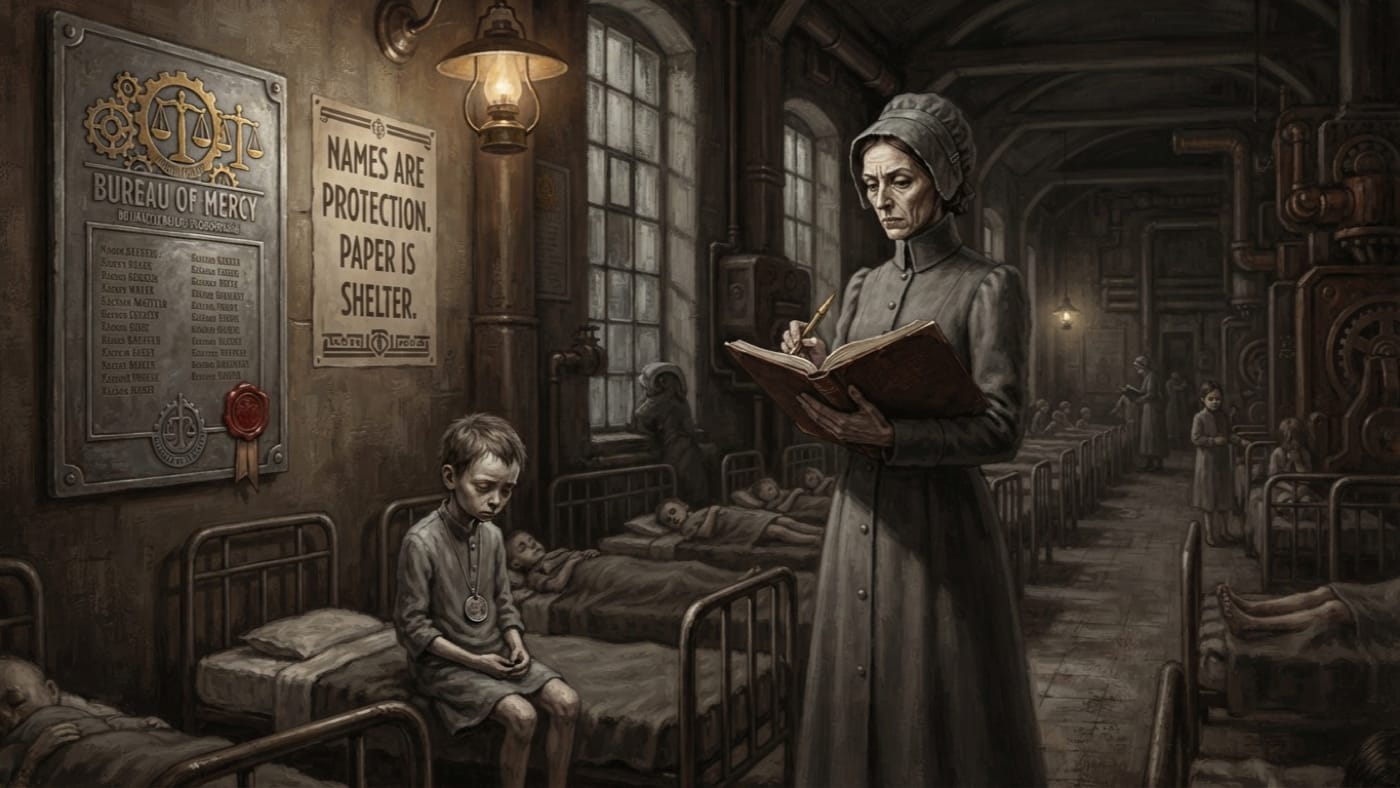
Mercy's posters say Names are protection. Paper is shelter. The Name-Givers believe the posters, and their sincerity is what makes them effective. An untagged minor is seized. A named one is fed. Few doctrines can point to a full bowl as evidence.
Their error, if it is one, lies in the next step. The law can change a child's name in the time it takes wax to set. The Name-Givers claim more: that the remembered child changes along with the lawful one, and that a girl who answers to Sabin for long enough no longer has a cooper's daughter inside her. That claim is the entire faction. Everything else they do is ordinary procedure.
"Once a ledger is reassigned, it cannot be unbound." — Bureau of Records, standing reply to petitioning parents
Corrected: the ledger cannot be unbound. Records has never certified the same of the child.
#On the Instruments of Replacement
The Name-Givers invented none of their tools. Each one belongs to the whole profession. What distinguishes the faction is what it expects those tools to accomplish.
Intake goes in the usual order. The child is washed and deloused. Age is read from the teeth and the measuring rod. Scars are mapped and dialect is marked. Belongings are listed one by one: a button, a bread token, a saint card, a scrap of lullaby in a mother's hand. A Hawk reads that list as evidence of descent. A Name-Giver reads it as an inventory of things to be outgrown.
Then comes the provisional name, drawn from an approved list, the district or the date of intake. Every Registrar is allowed some judgment here, and the Name-Givers use theirs deliberately. They prefer names with nothing to grip. A child called Rose will remember being loved. A child called Ward-Seven will learn faster. The faction has no binding naming code, though it has a reputation for avoiding flowers.
The Three-Tag System credited to Saint Moriah does the rest. The name disk, the ration disk and the labour disk hang from one cord, and none of them carries the old name. After that the work is repetition: roll, catechism, broth, cot, roll again. The Name-Givers keep the old superstition against taking a provisional name from a child's first spoken word with unusual care. A first word, they say, is a remnant, and a remnant left in the name will grow back.
Placement follows, because the system requires it. An apprenticeship, ward work, a choir dormitory, a Records annex, a militia line. A Name-Giver hands on a child who answers promptly to a short name and claims no relatives. Guild masters pay for that.
#On the Quarrel with the Hawks
The Bloodline Hawks are the faction's chief opponents, and the dispute is older than anyone's patience for it. The Hawks study what they call inherited signs: cheekbones, remnants of dialect, fragments of lullaby, which hand the child favours, how the child sleeps. To a Hawk, heresy lives below the name, where paper cannot reach. To a Name-Giver, what the Hawks call blood is habit, and habit can be broken with bells.
The Order of the Root supplies the hereditary doctrine and the hardest intakes: children of condemned households, delivered with witness ribbon at the wrist and names already suspect. The Bureau of Purity enforces whatever classification the intake ends in. Both factions work beneath that pressure, and both accept its first premise, which is that the child's kin claim must be removed. They disagree only on whether removal succeeds. A Hawk's failed child confirms a prediction. A Name-Giver's failed child is a disciplinary problem. In the dormitory the difference is smaller than the minutes suggest.
The Bureau of Doctrine has not ruled whether heresy travels in the blood, and I will not anticipate my own Bureau in a document it is going to seal. Root says that it does. The Name-Givers act as if it does not. Both get their quotas.
I have chaired committees between the two factions. The Name-Givers bring testimonials from guild masters. The Hawks bring corrections to my spelling of condemned surnames. I have found the Hawks less sentimental, which is nearly praise.
The quarrel should not be confused with the separate one between Shelterists, who keep children alive first, and Pipeline Purists, who count them as resources. A Name-Giver may hold either view. So may a Hawk. Anyone who claims to have mapped the memberships has mistaken gossip for a register.
#On the Children Who Keep Their Names
Memory is the faction's enemy, and memory is stubborn.
A girl from a scorched ward gives a name found in no current roll and tells the Registrar, with the patient contempt of the very young, that it has been spelled wrong. A boy sings the lullaby his mother sang during the shelling, though the song has been forbidden since. Three siblings separated before noon are tapping the same pattern on the dormitory walls by evening. An old surname comes back at roll, a beat ahead of the assigned one, the way a hand flinches before the mind decides.
The manuals call these residual attachment behaviours. The ward-hands call them hauntings. I call them evidence that the child remembers, and nothing more. Doctrine has not certified either a demon or a bloodline behind them, and I decline to file one on its behalf.
Classification is what follows, and classification is not gentle. To a Hawk, the remembered surname is proof. To a Name-Giver, it is a failure of instruction, and the remedy is more instruction: a closer roll, a shorter name, a re-issued disk. Re-tagging is the first thing an Audit Master flags. A dormitory full of re-issued disks looks like fraud from the far side of the ledger. When the remedy has failed often enough, the Name-Giver faces the same choice as everyone else in grey: a placement far from the siblings, or a lineage flag after all.
#On the Present Application
As of A.S. 201 the faction works wherever Registrars work, from the bastion orphanaria of the western heartland to the intake stations that take in what the Sagittal Line sends back. The pressure is plain. Famine sends children west. Purity operations deliver scorch-extracted minors by the wagon. The Index sends more amendment strips each month, and each strip makes some child's memory newly unlawful. Guilds want apprentices younger and quieter. Conscription watches the dormitories as a creditor watches a sickbed.
The Name-Givers offer the bastions what the bastions want: children who answer promptly and claim no one. The profession's auditors are unimpressed by philosophy. They trace disk to ledger entry, ledger entry to ration draw, ration draw to placement order. A new name exempts neither child nor Registrar from that chain. A beautiful remaking that will not reconcile with the adjacent column is simply a sour ledger.
At the night roll in a Mercy dormitory, the Registrar reads the assigned names down the cot row. Thirty-one answer. The thirty-second answers late, with another word first, then the right one. The Registrar marks the delay in the margin of the minor ledger, where the Records audit will find it, and calls the next name.