
#On the Doctrine of Diseased Blood
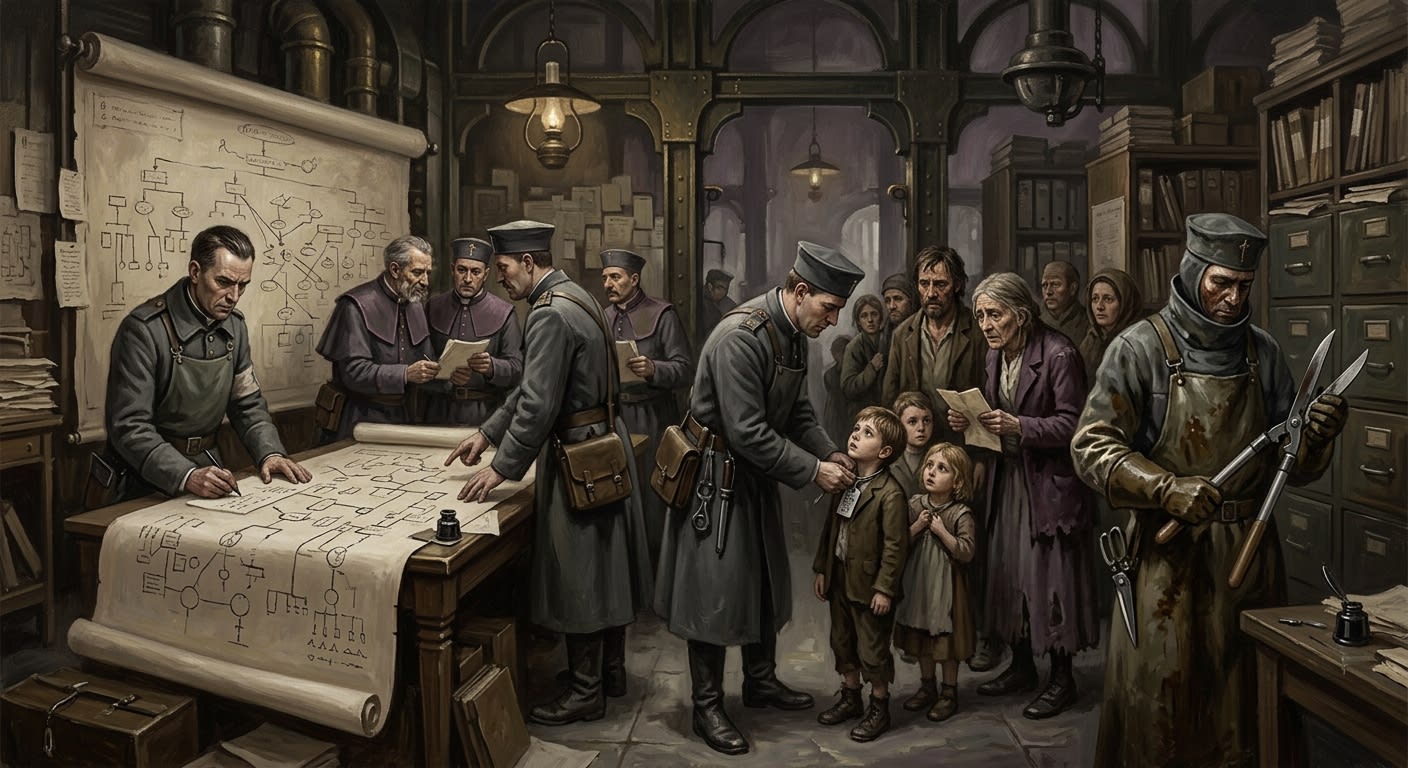
The Order of the Root is what happens when a theologian stares too long at a family tree and begins to hear pruning shears.
Its formal doctrine is mercifully short: heresy is hereditary. Error enters the blood, travels by crib, lullaby, cheekbone, left-handedness, parish accent, supper habit, silence before certain hymns, and the small private loyalty by which a child, being naturally wicked, remembers a condemned mother with affection rather than fear. The Order considers the individual heretic a symptom. The family is the infection. The bloodline is the file.
The Order belongs to the inquisitorial fringe of Purity and the intake machinery of Mercy, that wretched blessed border where salvation, custody, and disposal share a desk. It is a private order in the grand ceremonial style of the Order of Ash, whose virtues are smoke, certainty, and excellent silhouettes. Root works with registers, kinship charts, witness ribbons, child tags, midwife rolls, confiscated lullabies, and the wet arithmetic of resemblance.
#On Uprooting
The verb is theirs. To uproot is to condemn a whole domestic organism: parents, grandparents, older siblings, infants, servants who share beds or bread, lodgers whose names appear in the soup ledger, godparents, wet-nurses, and any neighbour whose testimony arrives too warm. A family may be uprooted after a formal heresy conviction, after Administrative Dissolution, after an Index amendment strip marks a lineage for review, or after Root's own examiners decide that three generations of obedience have acquired the suspicious smoothness of rehearsal.
The adults are processed according to the severity of the case. Burning remains popular among traditionalists. Dissolution pleases the clerks. Silence has its advocates. The children are sent to the Orphanarii, where Mercy washes them, Records renames them, Purity observes them, and Root returns at intervals to ask whether the old blood has learned its new paperwork.
Mercy primers describe Root transfers as “family rescue intakes.”
Corrected. The family has already been destroyed by the time the intake occurs. What is rescued is usable childhood, tractable muscle, and any future tithe the condemned line may still be made to pay under a cleaner surname.
Root examiners carry genealogical forks: narrow ivory pointers used to trace descent lines across parchment without touching the ink. They wear brown cuffs beneath their Purity whites, a concession to horticultural symbolism so ugly that one almost admires its commitment. Their field kits contain lineage tablets, blood-prick lancets, hair envelopes, tooth charts for children too young to answer questions reliably, and devotional cards bearing approved replacement names.
#On the Wintering of Ghent
Root's favourite internal case is the Wintering of Ghent (Unregistered), conducted by Ordinary Carmina before her elevation. An entire quarter was sealed for a season after three families were accused of preserving Rationalist catechisms inside bread ovens. Root expanded the accusation by kinship, lease, baptismal witness, marriage debt, and market proximity until the map resembled a diseased lung.
The quarter was closed at first frost. No weddings. No baptisms without Root witness. No funerals except under sealed cart. Every family line with suspected dissent was cut, frozen, and hauled to the mortuary kilns. When the thaw came, the quarter reopened under revised names. Orphans received fresh surnames. Baptismal rolls were rewritten. Household saints were exchanged for approved plaques. Harvest reports improved by summer.
Doctrine called the improvement miraculous. Records called it a correction. Ghent called it winter and learned to lower its voice.
CARMINA FIELD ADDENDUM, GHENT WINTERING: “Children below speaking age present the cleanest soil. Older children require ███████████████, especially where grandmothers remain alive in memory. Recommend removal of all songs before reseeding.” The attached song list remains under Seal Brown-Three. Four melodies later appear in Orison's prohibited nursery index.
#On the Orphanarii and the Four Per Cent
Root supplies the Orphanarii with their hardest intakes. This is the phrase Mercy uses when it wishes to sound burdened rather than complicit.
The children arrive with wrists tied in witness ribbon and names already suspect. The Ward-Sisters wash them first, because cleanliness has a wonderful talent for impersonating mercy. The Registrar assigns provisional names, ration tags, lineage codes, and reeducation schedules. Root's Bloodline Hawks then inspect the file for residual contagion: repeated gestures, forbidden dialect, inherited songs, night terrors oriented toward the old house, prayers spoken for parents who have been corrected out of existence.
Official doctrine states that reeducation is universal. The child is not guilty of the parent's heresy; the child is merely endangered by it. Root says this in public with grave faces and well-washed hands.
Unofficial practice is filed in a locked cabinet beneath the Strasbourg Central Orphanarium. It records a culling rate of approximately four per cent among Root intakes: children deemed irredeemable, too old, too attached, too fluent in the condemned household's memory, too likely to carry the old name forward like contraband under the tongue. Mercy's official position is that the cabinet does not exist. My official position is that I have the key.
A Bureau of Mercy briefing of A.S. 199 stated: “No culling of Orphanarii intakes occurs under Mercy authority.”
Clarified. The statement is accurate if “Mercy authority” excludes Root recommendation, Purity countersignature, Records disappearance, night transfer, failed reeducation classification, and all rooms without windows.
#On Rival Orders and Present Use
Root quarrels beautifully. The Order of Saint Ephrath calls them butchers with spreadsheets. Root calls Ephrath actors with knives. The Order of Ash says Root leaves too many witnesses. Root replies that Ash mistakes smoke for policy. The Shroud finds Root offensively visible; Root finds the Shroud sentimental about secrets. These rivalries are not scandals. They are competitive audits conducted with theology and dead households.
As of A.S. 201, Root's field work has expanded under the pressure of unregistered births, Pale Kin smuggling, wartime displacement, and the general refusal of families to become as legible as the Synod has ordered them to be. Joint suppression teams carry Root examiners into warrens alongside Records clerks and Purity guards. A child without paper is a vacancy. A family with too much memory is a grove. Root enters with forms, cuffs, lancets, and that appalling serenity peculiar to men who believe children are seedlings in a state garden.