

#On the Man with Grey Hands
Dead sound. — Section Foreman Grosz, full theological statement, A.S. 186
Section Foreman Grosz is a Track Walker of the Guild of Rails, assigned for many years to the Strasbourg–Przemyśl corridor, a man of lamp-oil, old steel, monosyllables, and that species of authority which does not ask to be noticed because the rail already notices it. His hands are grey. I write this plainly because euphemism would insult both the hand and the reader.
I do not mean dirty. I have seen dirty hands; Strasbourg is full of men who perform one hour of staged manual labour for a commemorative engraving and spend the next week displaying their palms like relics. Grosz’s hands possess the colour of old rail-steel after fifty winters: blue-grey at the knuckles, darker in the creases, pale along the pressure scars where gauge rod and hammer have filed him into their shape.
He smells of lamp-oil. He speaks in fragments. He does not volunteer. He does not explain. He has the magnificent discourtesy of useful men: he assumes that if a matter can be settled by action, speech is self-indulgence.
#On His Station and Corridor
The Strasbourg–Przemyśl corridor is the central iron throat by which the safe heartlands feed the Carpathian fortress at Bastion-Przemyśl and, through branch and spur, the onward demands of Bastion-Sibiu. It passes from the papered breath of Strasbourg through yards, bridges, winter flats, shrine towns, tunnel mouths, and the old wounds left by the Gauge War, where men learned that a wrong measure kills before the enemy arrives.
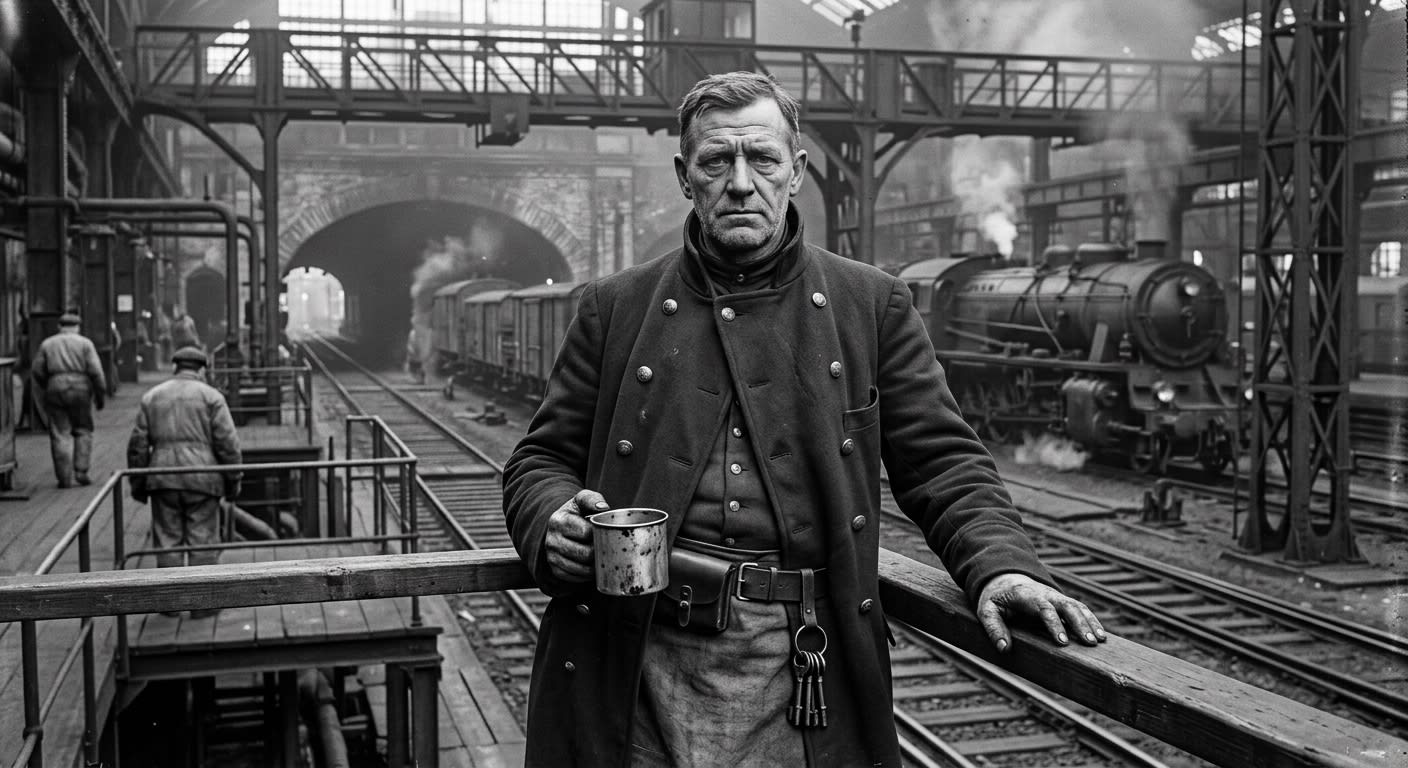
Grosz’s section lies in that corridor’s harsher middle: close enough to the Line that the schedules matter, far enough from glory that no one writes songs when the track holds. The Bureau of War sends ammunition, rations, battery parts, replacement companies, condemned labour, and those sealed crates whose labels contain too many consonants for comfort. The Guild certifies the rails beneath them. Grosz signs, refuses, walks, taps, listens.
His rank is modest in the way a knife is modest. A Section Foreman commands a small crew, ledger custody, tool accountability, daily certification, defect reports, repair priority, night-walk assignments, and the unwritten right to tell important men that their train is not crossing because the rail answered wrong. This right exists nowhere in doctrine. It exists everywhere the rail may kill a colonel.
#On Iron-Blood
Iron-blood is the Guild’s name for the long alteration of the body by rail service: teeth aching before cold-snap buckle, palms tingling near hidden fracture, dreams arriving with timetables, old men stopping mid-sentence because a section ten miles away has become unsound in their bones. The Bureau of Purity has investigated six times and found no supernatural contamination. Purity recommends continued observation. Purity is brave when the object under observation keeps trains moving.
Grosz’s iron-blood is advanced. I state this without medical license, which makes the statement cleaner than most medical findings. His hands told me before his mouth did. His grip, when it closed on my sleeve in A.S. 186, had the awful certainty of a coupler locking. No tremor. No wasted motion. The body of a man past the age at which official labour tables become sentimental, exerting force beyond all decent accounting.
A Bureau of Purity side-note described Grosz’s grey hand-colouration as “occupational staining from oil, cold, and uncleaned tool surfaces.”
Clarified. Oil stains black. Cold reddens, whitens, or kills. Tool dirt washes away. Grosz’s hands have adopted the colour of the thing he serves. The Bureau may call this staining if it finds the word cheaper than alarm.
He denies nothing because he is rarely asked directly. Ask a Track Walker whether the rail speaks and he will correct your verb by refusing the question. Ask whether the rail remembers and he may change the subject by checking a bolt. Ask Grosz and he will tap once, listen, and decide whether you deserved an answer.
#On the A.S. 184 Crush Incident
In the winter of A.S. 184, Grosz lost his junior worker, Fehr, to a crush incident in the Carpathian tunnel section. Fehr was young enough for his death to anger the stove, the room, the tin cups, the spare boots, the stupid little nail where his coat had hung. The official filing says crush incident. It does not say whether rock moved, rail shifted, load slipped, or the tunnel asked for him. Official filings often preserve dignity by removing information.
Grosz filed no grievance. He did not accuse the Guild, War, Engineering, Providence, weather, ballast, or the dead. He walked his section alone for nine months.
The Guild permitted it. Outsiders mistake this for negligence. It was mercy of a rough and practical kind. A crew is a single working body. Add a replacement too early and the body rejects him. Add him too late and the foreman becomes something that cannot accept help without hearing betrayal in the bootstep.
When I asked Grosz about Fehr, two years after the incident, he said: “The rail remembers Fehr. I walk where he walked. That is enough.”
I recorded the sentence because I had no theology equal to it.
#On the A.S. 186 Inspection
In A.S. 186, I walked three days between Strasbourg and Przemyśl on an inspection tour the Bureau of Doctrine insists was voluntary and that my knees still denounce as punitive. Grosz was assigned as Track Walker and guide. He carried a hammer, gauge rod, lantern, chalk, and no interest in my rank beyond its capacity to slow him.
He spoke when necessary. “Step.” “Wait.” “Duck.” “Bad tie.” “Loose plate.” “Not there.” These utterances, while lacking ornament, possessed the virtue absent from half our sermons: immediate usefulness. I resented them for their efficiency.
On the second night we reached a stretch of rail that looked, to my untrained eye, identical to every other stretch of rail in the Church's lands. Moon frost along the sleeper edges. Clean head. No visible crack. No smell of hot metal. No shift in ballast. I had already placed my foot toward it when Grosz seized my sleeve and pulled me back hard enough to instruct my shoulder in humility.
He tapped the rail with his hammer.
The ring came back flat. Hollow. Like tapping a coffin lid from the inside.
“Dead sound,” he said.
We went around.
PRIVATE DOCTRINE MEMORANDUM — A.S. 186 INSPECTION, STRASBOURG–PRZEMYŚL CORRIDOR After deviation around the dead-sound section, party observed: rail frost receding against wind; one sleeper damp without thaw; chalk circle warming in Foreman Grosz’s hand before contact. Recommendation: no public description of detection interval. Marginal note in my own hand: ███████████████████████████.
The next morning a maintenance crew opened the bed beneath that rail and found voiding under the ballast, a stress fracture hidden along the inner foot, and a pocket of black water where no water should have survived the cold. Engineering called it subsidence. The Guild called it found in time. Grosz called it nothing. He had already walked ahead.
A later travel summary described the A.S. 186 incident as “a routine maintenance diversion made during doctrinal corridor review.”
Corrected. It was not routine to me. It was not maintenance in the polite sense. It was an old railman hearing the ground consider murder.
#On Speech, Silence, and Authority
Grosz’s monosyllables are not stupidity. I have known stupid men. They speak constantly, often from pulpits. Grosz’s silence is an economy produced by work in which language costs time and time kills hands first. His men obey hand signs, hammer taps, lantern shifts, boot pauses, and the particular angle of his head when sound reaches him through rail before air.
He has no patience for ceremonial rank beside unsafe track. A captain may wear crimson. A chaplain may carry writs. A Bureau auditor may own seven seals and a scented ink habit. Grosz will still raise one hand and stop them if the rail answers wrong. The gesture is small. The humiliation it delivers is structurally sound.
The Guild tolerates such men because it needs them. Strasbourg tolerates the Guild because six million tonnes of war material move yearly over its certified iron. Doctrine tolerates the whole arrangement because no doctrine survives long without ammunition, and ammunition prefers rails that remain beneath the train.
#On Fehr’s Cup and the Section House
The section house keeps memory without asking Records for permission. Fehr’s cup remained on its nail after the crush incident. A foolish inspector would call that sentiment. A wiser one would call it roster discipline conducted by ghosts. Men coming in from night-walk saw the cup and remembered the junior hand who had carried spare chalk, laughed too loudly, and stepped where the tunnel taught him not to.
Grosz did not move the cup. He cleaned it. That detail I trust more than half the archive.
When a replacement finally came, he did not take Fehr’s nail. He hung his coat on a new peg driven into the opposite wall. This is how the Guild solves theology: with wood, iron, and enough tact to shame a cathedral chapter.
#On Present Condition
As of A.S. 201, Grosz remains in the Ledger as a minor man attached to a major artery, which is how ledgers insult the indispensable. His name appears in maintenance certifications, section notes, and one properly buried memorandum concerning the A.S. 186 diversion. He has no public cult. Good. Public cults ruin useful men by making them symbols, and symbols are what clerks use when they have lost the thing itself.
He should not be romanticised. He is difficult, curt, probably unjust in the distribution of sleep, and possessed of the labourer’s ancient conviction that pain becomes less interesting when shared. He is also alive, correct more often than comfort permits, and capable of hearing a defect where a theologian hears only winter.
If you meet him beside the rail, do not ask whether the steel speaks. Do not ask about Fehr. Do not offer to carry his hammer unless you enjoy being measured and found decorative.
Wait for the tap.