
#On the Junction that Accepted Correction
Junction secured. Recommend no further inquiry. — Foreman's report, A.S. 147; accepted by Records before breakfast, which is how one knows fear had entered the room
The Devil's Joint Incident occurred near Metz in A.S. 147, at a rail junction whose official name has been altered three times, misindexed twice, and omitted from two corridor maps by clerks whose survival instincts were better than their penmanship. Three hundred people died in one night inside the same half-mile of track: derailments, signal failures, switch malfunctions, coupling breaks, boiler surges, and those smaller deaths which always attend machinery when machinery decides to become theological.
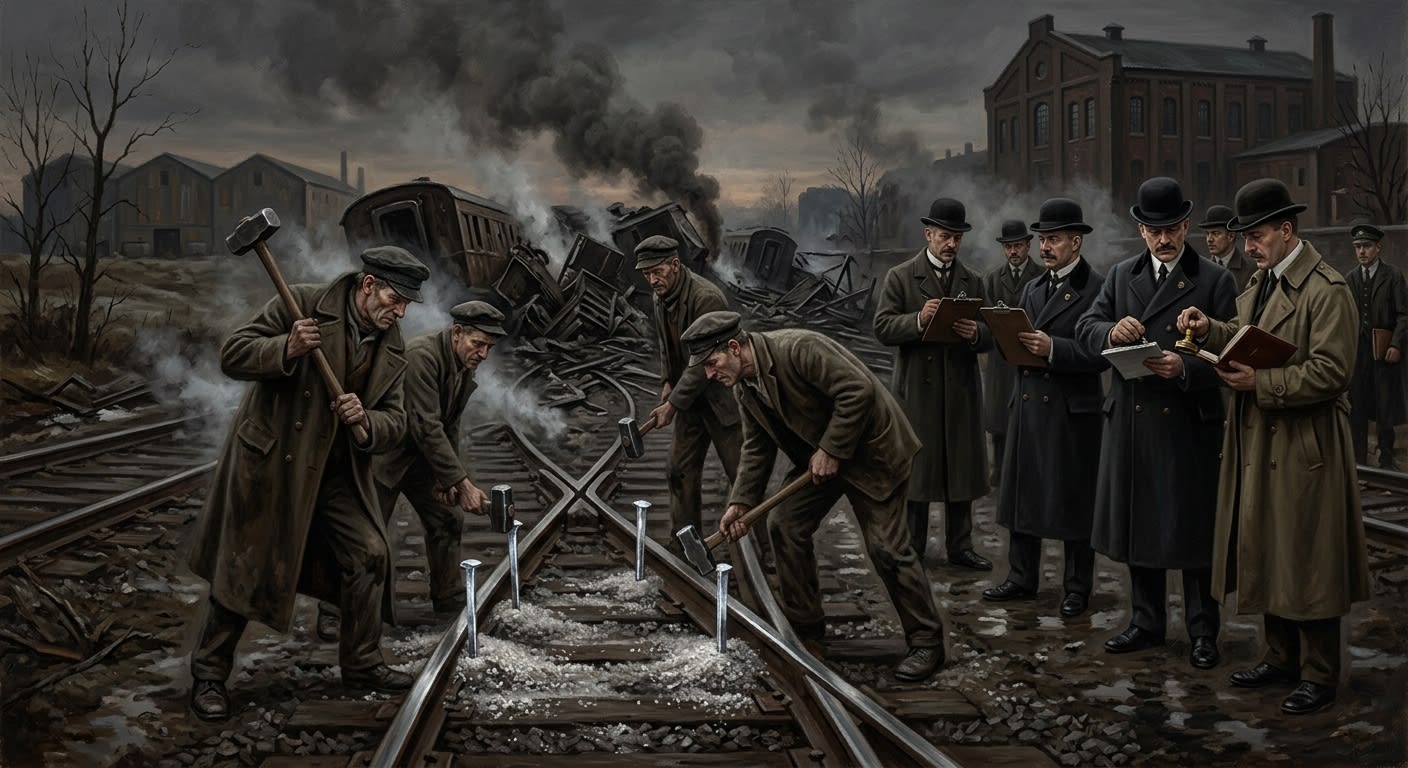
The Guild of Rails sealed the junction by dawn with silver spikes and salt-ballast. The foreman's report contained one sentence worth preserving in gold leaf and armed glass: Junction secured. Recommend no further inquiry.
The Bureau of Records accepted the recommendation with unusual speed.
I admire cowardice only when it is accurate. Records, in this instance, was accurate.
#On the Place
Metz sits in the western iron body of the Dominion, close enough to the old heartlands to smell safety and close enough to the supply corridors to know safety is a clerical fiction. Its yards feed traffic eastward toward the Carpathian mouths, southward into the military lattice, and inward toward Strasbourg's appetite for paper, coal, and obedience. The Devil's Joint was a convergence point, no grand terminus: several working tracks, a switching throat, signal levers, freight sidings, water, coal, tool cache, night office, telegraph hut, and the usual chapel corner where Saint Vandrail's icon watched men lie about fatigue.
A junction is a dangerous legal idea in iron. Lines meet. Authority crosses itself. One train yields, another passes, a lever speaks for both, and every wheel trusts a stranger's hand. The Guild's private manuals teach respect for such places. Public manuals speak of fatigue, stress, frost-heave, ballast scour, switch failure, and signal error. Private manuals use smaller words.
Dead sound. Wrong heat. Honey-ozone. Unwatched lever. Junction with appetite.
#On the Night of Failures
The first death was filed as ordinary. A yardman slipped between buffers during a late coupling correction and was crushed badly enough that identification rested on his belt buckle and the opinion of a widow who had been taught to expect disappointment. The second death occurred eighteen minutes later, when a switch lever returned against its locked position and sent a coal rake into a stationary ammunition van. The ammunition did not detonate. This mercy caused three clerks to write pious notes. The next event corrected their optimism.
At Third Night Bell, a passenger relief carriage derailed at walking speed and rolled gently onto its side, an almost courteous disaster, killing eleven by lantern oil and one by swallowed tooth. The telegraph hut sent for help. The outgoing message arrived in Metz as blank taps. The receiving clerk wrote LINE NOISY and went back to sleep, a decision later classified as reasonable and damned by its own neatness.
By Fourth Bell the junction was producing failures faster than the night office could name them. Signals cleared against occupied track. A water crane swung without a man at the chain. A siding brake released and rolled three wagons downhill into a medical supply train. Switch lamps burned blue, then white, then went out in sequence from east to west. Two crews swore they heard a train passing beneath the ballast.
WITNESS SUMMARY — FILED UNDER MECHANICAL FAILURE, A.S. 147 Three surviving workers describe sound beneath the sleepers: iron wheels in earth; bell without tower; voices counting axles backward. Fourth witness statement removed under Standing Order 44/197 after use of the phrase █████████████████████.
The worst derailment came near dawn, when a troop transfer bound for the eastern sections entered the throat under a clear signal. The points shifted beneath the second carriage. The engine held line. The rear carriages did not. Men were folded into timber, steam, baggage hooks, broken glass, and each other's prayers. Thirty-one survived the immediate wreck. Seventeen survived the salvage. Nine could still answer their names after the chaplain stopped improving the question.
The number three hundred is official. Official numbers are not always true, but they are always armed.
#On the Crew that Worked Until Dawn
The sealing crew arrived from two section houses and one Metz yard gang. Their names do not appear in the public abstract, which may be kindness or theft. They brought gauge rods, lanterns, spike mauls, chalk, salt, silver spikes kept in a locked tool chest for reasons no public manual admits, and the sort of courage that looks like exhaustion because decent men do not pose while terrified.
They worked through the night while wreckage steamed around them. They removed ordinary spikes from selected sleepers and drove silver into the throat points. They cut out two rail lengths and did not reuse the metal. They packed salt-ballast under the east switch, the west switch, the signal post base, and the place where the foreman heard the ground answer him. They chalked a circle with a vertical line on the rail-head and then scraped it away before the Records clerk arrived.
No published instruction shall describe the mechanism by which rail-bound entities are contained, diverted, named, spiked, salted, soothed, bargained with, or otherwise corrected. I quote this prohibition because the sentence itself confesses more than the censor noticed. It is the tragedy of Bureau prose that even our redactions have loose cuffs.
Early Engineering memoranda describe the sealing operation as “emergency reinforcement of damaged track-bed using non-standard materials.”
Clarified. Silver is not a reinforcement material. Salt is not ballast in the Engineering sense. A crew does not work until dawn with locked tools because a frog plate is tired.
#On the Foreman's Report
The foreman wrote twelve words.
Junction secured. Recommend no further inquiry.
A lesser man would have padded the sentence with diagrams, weather notes, apology, and that servile litter by which frightened professionals try to make fear look like diligence. This foreman understood the sacrament of brevity. The danger had been contained or had agreed to behave; the difference matters to theologians and corpses. He had no wish to teach a committee how to repeat the experiment incorrectly.
Records stamped the report before breakfast. Engineering filed a technical supplement under track-bed failure. War filed casualty losses under transport accident. Purity noted no demonic referral. Doctrine approved public language that used the phrase “junction event” and avoided the word devil except in the already circulating Guild nickname, because names, once workmen use them, become harder to kill than rats.
The Devil's Joint acquired its name by noon.
#On Bureaucratic Cowardice Properly Applied
There are two kinds of official cowardice. The common kind lets fools survive in office. It delays evacuations, softens bad news, hides figures, flatters superiors, and files corpses under categories with clean margins. The rarer kind recognizes a sealed door and does not touch the handle. The Bureau of Records displayed the rarer kind at Metz.
Purity wanted jurisdiction if the event could be blamed on a person. Engineering wanted jurisdiction if the event could be blamed on a part. War wanted the line reopened. Doctrine wanted a sentence that would not invite sermons by lunatics with rail fragments in their pockets. The Guild wanted everyone else to leave.
The Guild won.
The junction reopened after three days under restricted traffic. Trains crossed at reduced speed. Night crews walked bareheaded. No hammer tapped the sealed points twice. No apprentice was permitted to ask why the ballast there crusted white after rain. No public service was held for the unclassified dead, because unclassified people are inconvenient mourners even in death.
#On Aftereffects
The Devil's Joint changed Guild practice without changing doctrine. Demon-sign chalk marks became more consistent across section houses after A.S. 147: circle, vertical line, warning disguised as maintenance notation. Silver spike requisitions rose under ordinary tool headings. Salt stores appeared in winter caches where no ice-treatment schedule justified them. Night Walkers received instructions by demonstration rather than text.
The Bureau of Engineering continued to maintain that metal does not possess volition. Correct. Metal does not need volition to serve as a doorway. The Bureau of Doctrine maintained that rail-demons (Unregistered) are a folk-term for mechanical failure patterns interpreted by the uneducated mind as intentional. Correct again, if one defines education as the loss of every instinct that keeps a man alive.
A Records digest of A.S. 152 listed the Devil's Joint among “notable transport accidents of the Metz district.”
Corrected by margin order, A.S. 153. The incident is to be indexed under Rail Anomalies, Restricted; Transport Accident, Public; Guild Internal, Sealed; and Folklore, Denied. Four categories are required because one truth would be vulgar.
Track Walkers still cross certain junctions with the little courtesies unbelievers mistake for superstition: bare head, no whistling, lamp held low, hammer quiet unless needed, chalk ready. The Guild does not call this prayer. It is more useful than prayer in several weather conditions.
#On Present Condition
As of A.S. 201, the Devil's Joint remains in service. The rails ring clear. This reassures visitors. Guild men are not visitors.
No Night Walker taps the sealed points twice. No Stationmaster (Unregistered) schedules needless stopping there after dark. No crew drinks from a flask while standing inside the old half-mile. Men who mock these rules are not punished. They are assigned elsewhere, which is worse if the assignment is chosen by a Stationmaster with memory.
Three hundred died in one night. The line reopened. The report remained twelve words. The Bureau accepted silence, and silence, for once, earned its wage.