

#On the Hammer-Fisted Saint
Saint Vandrail is the patron of track, spike, gauge rod, section house, night patrol, and every practical man who has ever told a bishop to stand back from the rail before the rail explained manners in blood. The Guild of Rails venerates him with oil, chalk, bent nails, broken hammer handles, and the private tenderness of men who would rather lose teeth than admit they possess a devotional life.
Doctrine has not canonised Vandrail. Doctrine has not denied him. This posture is cowardice refined into policy, and, for once, the cowardice is intelligent. The Guild moves six million tonnes of war material each year. A tolerated saint who carries six million tonnes acquires theological mass. Push him too hard and trains begin experiencing “inspection delay.”
Guild icons show Vandrail as a giant with rails for fingers, a spike-maul in one hand, a gauge rod in the other, boots planted across sleepers from the Baltic to the Bosphorus. His beard is usually iron-grey. His eyes are often shown as rivet heads. His halo, where painters dare include one, is a rail wheel. Bureau of Heraldry dislikes the wheel. The Guild keeps painting it. Civilisation lurches onward under protest.
#On His Alleged Life
The older Guild books place Vandrail before the Concordat of Strasbourg, before the A.S. 94 Codex Ferrum, before the Guild had law, payroll, or the sublime arrogance to call a frozen switch “jurisdiction.” This is convenient. Saints placed before charters cannot be cross-examined by Records. Dead men make excellent founders because their signatures improve under pressure.
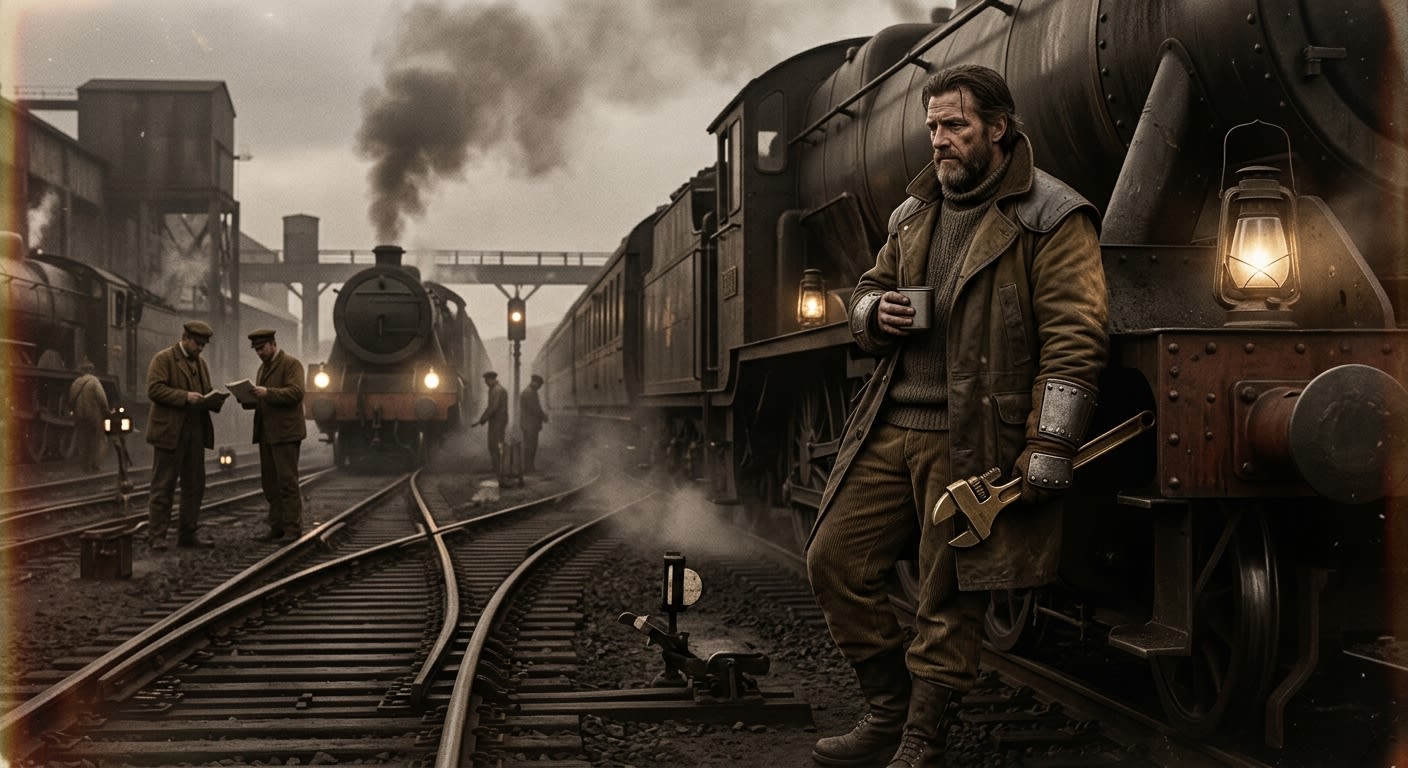
His life, if life is the word, begins in a workers’ camp along the first military railbeds laid after Vienna’s salvation. The account is impossible at once, which saves time. Vandrail is said to have been born beside a rail stack during a winter so cold that hammers shattered on spike heads. His mother warmed him in a coal scuttle. His father, a track gang foreman, had arms ruined by frostbite and still drove six spikes before breakfast. The infant did not cry. He clicked, according to shrine-books, like a cooling rail.
As a boy he learned measure by footstep. Three sleepers, one breath. Five sleepers, hammer turn. Twenty metres, gauge check. The legend says he could hear rotten ties under snow, sense bridge sag through boot leather, and identify rival gauges by the ache in his jaw. This last miracle I accept without difficulty. Anyone who has listened to Engineering committees discuss millimetres knows the jaw has theological receptors.
The first named miracle occurs at a ravine crossing where a military train carried flour, shells, fever blankets, and two sealed relic crates toward the central corridor. The bridge plate had cracked beneath frost. The engineer saw nothing. The inspector saw nothing. Vandrail placed his ear to the rail, struck once with his bare fist, and ordered the train stopped. The plate split across the span before the locomotive entered. The train survived. The commanding officer demanded an explanation. Vandrail held up his bleeding fist and said, “It told me.”
#On the Rails for Fingers
The rails-for-fingers image entered the cult during the Gauge War, when the Dominion had one Creed, seven corridors, nine gauges, and a talent for dying at transfer stations. Local widths bred local kingdoms. Northern lines used Prussian military measure. Southern spurs obeyed harbour contractors. Mountain sections kept emergency widths laid by men who had counted survival as precision. City yards defended private gauges with the piety of misers defending mistresses.
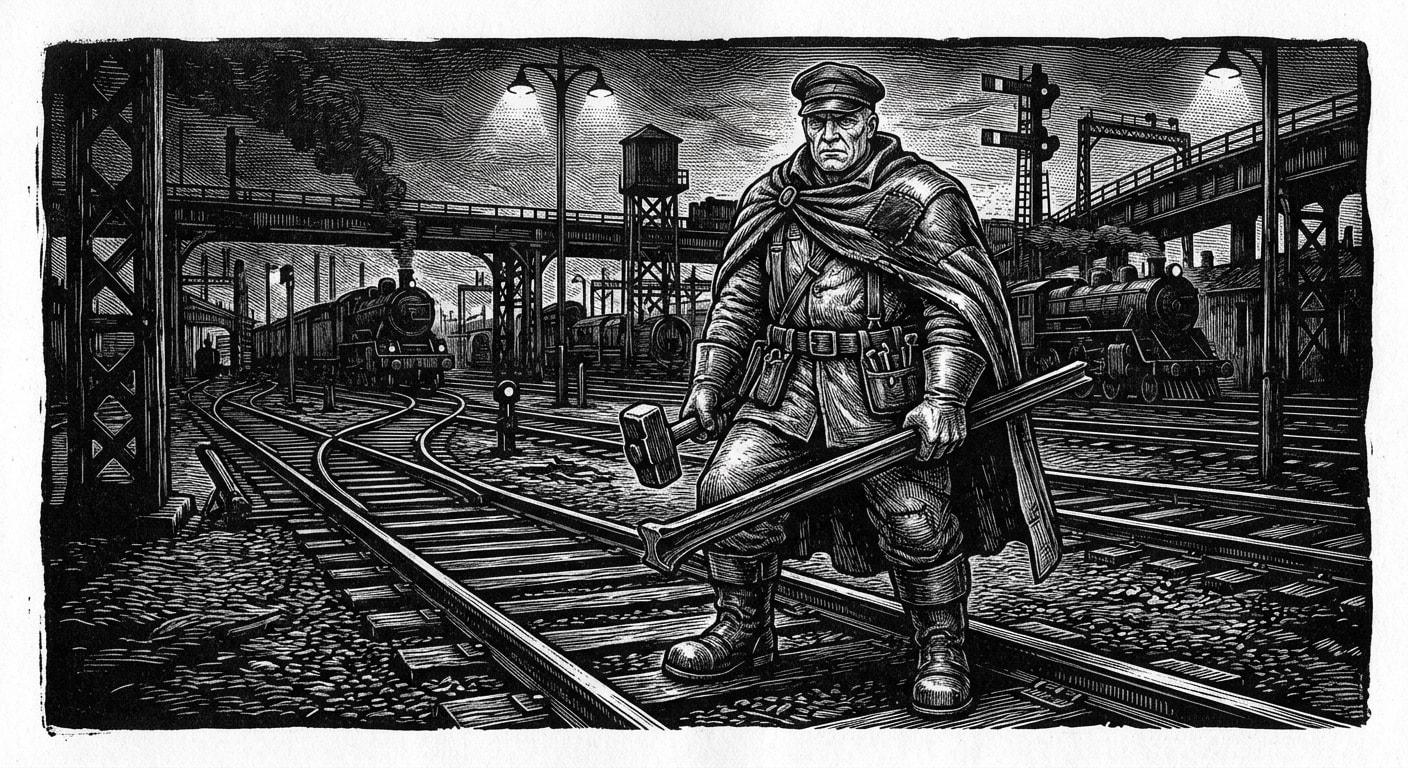
Vandrail’s hagiography expanded to fit the quarrel. He became the saint large enough to hold incompatible rails in both hands and squeeze them into a single law. In one shrine tale, he stood at the Three-Measure Yard at Bratislava, placed one iron finger on each gauge, and closed his fist until the rails shrieked into agreement. In another, he walked the Przemyśl Split at midnight and drove every wrong spike backward out of the earth with his heel. The Bureau calls these impossibilities. The Guild calls them teaching pictures. I call them propaganda with good boots.
The phrase “Vandrail’s Grip” appears first in section-house margins during the middle years of the Gauge War. It meant a clamp used to hold rail sections under tension while a crew reset the width. The clamp was crude, heavy, and fond of removing thumbs. Later, veterans used the phrase for the saint himself. Tool became relic-name. This is sound theological development. Every saint should begin as equipment.
A children’s catechism claims Vandrail personally ended the Gauge War by laying one perfect rail from Strasbourg to Constantinople.
Withdrawn. Engineering ended the quarrel by decree. Track crews ended it by relaying iron until their hands bent. Vandrail received the prayers because committees do not answer widows.
#On the Codex Ferrum and the First Lie
The Codex Ferrum was filed in A.S. 94: ink, seals, engineering witnesses, Records countermarks, and enough financing to purchase a minor bishopric. It chartered the Guild from Prussian military rail battalions, civilian navvy gangs, requisitioned surveyors, heartland labour bosses, and men whose ears could tell cold steel from cracked steel before a clerk had located a chair.
Guild shrine-books attribute that charter to Vandrail’s own hand, pressed into iron-leaf by fist and prayer. Charming. False. Useful.
The charter was mortal. Vandrail entered later because a guild made from rival measures required a founding figure broader than its quarrels. Secular engineers do not console crushed apprentices. Prussian officers do not make widows light candles. Surveyors do not look well over a section-house stove after midnight. A hammer-fisted saint with rail fingers does.
Doctrine’s refusal to decide Vandrail’s case has lasted long enough to become its own liturgy. Canonise him and the Bureau must admit the Guild’s private rail rites carry holy force. Condemn him and the Guild will continue moving trains while every Stationmaster discovers new defects near important schedules. Silence is cheaper. Silence, sealed properly, can pass for wisdom.
#On Iron-Blood
The railway men speak of iron-blood: the slow alteration by which long service near rail makes the body answer steel. Teeth ache before frost-buckle. Palms tingle near hidden fracture. Old Track Walkers wake from dreams of trains that have not departed. Grey hands appear among the longest-serving men: blue-grey, old-rail grey, the colour of iron that has endured fifty winters and forgiven none of them.
Vandrail is the saint of this condition because his body, in Guild theology, completed what theirs begins. His bones became sleepers. His fingers became rail. His fist became hammer. His breath became the ring by which steel confesses soundness. This is heretical if stated in a classroom and obvious if stated in a section house after the stove dies.
BUREAU OF PURITY OBSERVATION NOTE — IRON-BLOOD FILE, SIXTH REVIEW Subject reports “the rail remembered my name before my mother did.” Hands: grey to second knuckle. Dental response to passing freight: severe. Prayer response: Vandrailite; tolerated. Recommendation: no contamination found; continue observation; do not assign subject to █████████ junction after dusk.
Purity has investigated iron-blood six times and found no supernatural contamination. This is the sort of conclusion Purity reaches when the alternative would require it to close half the rail network and explain to War why ammunition is now a theological question. The Guild reads the findings aloud on feast nights and laughs into its cups.
#On the Devil’s Joint
The Devil’s Joint Incident of A.S. 147 made Vandrail harder to deny. At a junction near Metz, three hundred died in one night through derailments, signal failures, switch malfunctions, coupling breaks, boiler surges, and the smaller deaths that attend machinery when machinery decides to become ecclesiastical. The public record says transport accident. The Guild says Devil’s Joint. The rails there still ring clear, which reassures visitors and insults professionals.
The sealing crew worked until dawn with gauge rods, lanterns, spike mauls, salt, demon-sign chalk, and silver spikes kept in a locked tool chest for reasons no public manual admits. They cut out two rail lengths and did not reuse the metal. They packed salt-ballast beneath the throat points. They chalked the circle with the vertical line, then scraped it clean before Records arrived. Their foreman wrote twelve words: Junction secured. Recommend no further inquiry.
Records accepted the recommendation before breakfast. I admire cowardice only when it is accurate.
Guild oral tradition insists the foreman invoked Vandrail before the first silver spike. He did not kneel. He set the spike in the throat point, touched hammer to forehead, and said, “Hold it straight.” This is an excellent prayer because it asks for one thing. Most liturgies fail by becoming shopping lists.
After Metz, Vandrail’s icon gained a new mark: a white chalk circle with a vertical line, half-hidden on the rail beneath his boot. Bureau of Heraldry attempted to ban this addition as unregistered symbolic drift. The Guild filed the objection under wall insulation in six section houses.
#On Night Walkers
The Night Walkers belong especially to Vandrail. They are drawn from senior Railway Track Engineers and sent between dusk and dawn with lantern, hammer, gauge rod, notebook, oil rag, spare wick, and chalk warm in the breast pocket. Publicly, they inspect nocturnal stress contraction. Privately, they hear what daylight denies.
A Night Walker may mutter to Vandrail before leaving the section house. He may also trim his wick, test his hammer, and check his boots. The wisest do all four. The Guild says no man should pray in a way that makes him forget equipment.
The male requirement for Night Walkers remains unexplained. Always men, the Guild says. Emphatically men, Stationmasters say. Inexplicably men, every Bureau inquiry says before discovering lunch elsewhere. Wives sew spare wicks into coat hems and leave salt in pockets. They do not ask what happened on the third mile. The Synod, by rare good sense, has not subpoenaed them.
Vandrail’s night prayer is short:
Disappearances are officially fewer than one per annum. The Guild keeps another number. The Bureau has declined to request it. Mutual restraint is among the Dominion’s least celebrated peace treaties.
#On Offerings and Section-House Rites
Vandrail’s chapel is the section house: stove-poor, oil-stinking, tool-proud, eight to twelve kilometres from the next human argument. His icon hangs above the ranked tools with hammer, rail-fingers, and the expression saints acquire when later institutions have made them responsible for payroll. Offerings collect beneath him: oil tins, chalk nubs, bent spikes, cracked gauge rods, teeth, hearing plugs forbidden by older foremen, and sometimes a hammer handle from a dead man’s kit.
No priest supervises the rite. This makes it more honest and less taxable.
At supper on the anniversary of the A.S. 136 decree, hammer veterans set a gauge rod across the table. No one eats until the oldest relaying survivor lifts it. Young men keep their hands visible. The rod is not sacred in the official sense. It merely contains four thousand dead by implication, which is more than many approved reliquaries manage with paperwork.
There is also the Broken Maul observance for crews who lose a member. The dead man’s hammer is cracked across the head, wrapped in oilcloth, and hung behind the stove for one winter. During that winter the crew leaves his cup in place. At spring thaw the handle is burned. The head is buried under ballast at the nearest safe section. Records dislikes this because the burial is unregistered. The Guild dislikes Records because it asks where grief is filed.
#On the Bureau’s Position
The Bureau of Doctrine’s case file on Saint Vandrail is a cathedral of postponement. The saint’s miracles are excessive. His origins are contradictory. His cult contains folk-mechanics, iron-blood claims, private signs, and a suspicious lack of clerical dependency. His followers maintain the war’s circulation. Each of these facts is troublesome. Together they form policy.
Canonisation would place Vandrail inside official doctrine, where questions must be answered. Denial would place him outside, where trains might become thoughtful. The Bureau has adopted the language of tolerance: guild observance, occupational patron, local devotion, no formal ruling. These phrases are sandbags around a flood.
A draft Doctrinal opinion of A.S. 188 called Vandrail “apocryphal, mechanically infected, and unsuitable for public invocation.”
Engineering distrusts the cult because engineers prefer steel to remain dead until animated by approved force. War tolerates it because trains arrive. Records resents it because Guild oral instruction survives without forms. Purity watches it because warm chalk in a pocket offends their sense of ownership over terror. Rites pretends not to care and cares deeply.
The Guild says nothing official. It hangs Vandrail’s icon in every section house and lets silence do the litigation.
#On Drax’s Inspection of a Vandrail House
I inspected a section house outside Metz after a corridor audit, escorted by one Engineering clerk, two War officers, and a Stationmaster who treated us as weather with hats. The stove smoked. The coffee insulted baptism. Four hammers hung above the door, heads oiled, handles dark from palms. Beneath Vandrail’s icon lay a bent spike, a chalk stub, a brass tooth, and a child’s mitten stiff with old soot.
The Engineering clerk asked whether the icon was officially permitted. The Stationmaster said, “It has not delayed traffic.” This answer defeated three departments at once. I nearly applauded.
A Track Walker showed me the gauge rod and invited me to hold it. It was heavier than doctrine. He said the measure was simple. I said simple things are often cruel. He smiled without warmth and tapped the rail outside once with his hammer. Clear ring. Then he tapped again. Dead sound.
The officers stepped back. The Engineering clerk asked what the difference meant. The Track Walker said, “First one was for you.”
AUDIT NOTE — METZ OUTER SECTION HOUSE Second tap produced dead sound on visually sound rail. Chalk mark warmed before application. Stationmaster ordered temporary hold. War objection recorded. War objection withdrawn after █████████ passed beneath sleeper line from east to west.
We waited ninety minutes. A freight train carrying coal and flour cursed us from a siding. The Track Walker lifted one spike, packed a fistful of salt under the plate, drove the spike back, and tapped again. Clear. He crossed himself in the Vandrail manner: forehead, hammer hand, rail head. The Engineering clerk pretended to examine frost damage. The Stationmaster pretended not to notice. I pretended nothing. I was enjoying myself.
#On the Present Cult
As of A.S. 201, Saint Vandrail remains uncanonised, undenied, overworked, and more politically secure than several living archons. His icon watches section houses from Hamburg to Constantinople, from the northern frost routes to the southern shrine spurs, from the Carpathian corridor to the Metz approaches where the Devil’s Joint still behaves because someone once told it to hold straight and meant it.
His devotees are rough men and rougher women by day, though the Night Walker rule remains male and sealed behind Guild teeth. They know gauge by hand, defect by sound, weather by scar, grief by cup left untouched, and authority by whether it stands too close to the rail. They are loyal to the Synod in the precise way rail men are loyal: they will keep the train moving if the track is sound, the order sane, the crew paid, and the dead not insulted beyond endurance.
Doctrine may one day canonise him. It will do so with committees, seals, corrected legends, approved icons, a cleaned feast prayer, and a tariff for pilgrims who wish to touch an old spike under supervision. The Guild will attend, hats in hand, faces blank, then return to the section houses and keep the real rites where they belong: above the stove, beside the tools, under the rail, in the hand that taps once and hears whether iron has decided to tell the truth.
#On the Women at the Stove
The public iconography lies by omission. Vandrail’s most visible devotees are male Track Walkers and male Night Walkers, because the Guild enjoys appearing more simple than it is. Yet every section house contains women somewhere in its working circumference: cook-clerks, signal widows, ledger wives, lamp-menders, stitchers of coat hems, station sisters, black-coffee tyrants, and those elderly mothers of the rail who know which apprentice will die before the apprentice has learned where the spare wicks are kept.
The Guild does not call them clergy. Practical men are capable of idiocy in familiar forms.
They keep Vandrail’s domestic rite. They mend fingerless gauntlets with red thread hidden under black. They tuck salt into cuffs. They draw the chalk sign on the underside of lunch tins. They know which hammer belongs to the dead and which hammer may be loaned without insult. They prepare the cup left empty after a crush death, wash it every evening for one winter, and say nothing while men pretend not to look at it.
The male rule for Night Walkers stands. The women do not dispute it in public. They merely prepare the men who obey it, judge the men who survive it, and sometimes refuse to let a husband leave because the lamp chimney cracked in a way they dislike. Stationmasters have learned to respect such refusals under other names: wick irregularity, domestic delay, fatigue concern, supply of oil disputed. Bureaucracy offers many cupboards in which wisdom may hide.
#On Vandrail Against the Sin-Generals
Vandrail is a heartland saint, but his rails run to the mouths of Hell. Every bastion corridor carries his rites under coal dust. The northern trains toward Bastion-Königsberg and Bastion-Brest use his spike blessing before frost season. Central convoys toward Bastion-Przemyśl and Bastion-Sibiu chalk his sign under tarpaulins where Atheron’s pride and Velmora’s bribes cannot admire it properly. Southern traffic toward Bastion-Irongate, Bastion-Shipka, and Bastion-Constantinople carries little iron charms stamped with gauge numerals, sold illicitly in station yards and confiscated by Purity whenever Purity wants to lose popularity fast.
The Sin-Generals do not fear rails as objects. They fear arrival. A demon host can rot a field, cloud a pass, murmur through sleepers, bribe a clerk, drown a road, or make a village forget which way east lies. A train with sound track has less poetry and more consequence. Shells arrive. Bread arrives. Relics arrive. Replacement sons arrive in coats too large for them. The Line continues its vulgar miracle of not yet falling.
War officers call these rites superstition until their ammunition is delayed. Then they call them morale. Morale is the officer’s word for superstition that has become operationally useful.
During the A.S. 191 Constantinople relief, a Military Track Corps crew worked ahead of the Sepulcher Locomotive while the southern sky burned and rails held heat long after cooling should have taken them. The crew’s foreman nailed a Vandrail icon to a temporary sleeper and ordered every man to tap it with the hammer haft before entering the smoke. One man remained beside the ballast when the shrine-train passed. The conductor did not stop. The timetable had priority. The icon was later recovered, half-charred, spike still straight.
#On False Vandrails
Useful saints attract counterfeiters the way exposed meat attracts flies. Since the Gauge War, at least nine false Vandrails have been exposed: wandering hammer-preachers, rail mystics, switch prophets, chalk-sellers, and one appalling fellow in Mannheim who claimed that Vandrail had returned as a municipal tram inspector. The Guild beat him with procedural restraint. Records called the assault “labour correction.” I admire mercy when it has bruises.
The common fraud sells certainty. He promises that a whispered prayer will prevent derailment, that a chalk circle under the tongue will cure iron-blood, that a bent spike hung above a cradle will make a son immune to military requisition. The real cult promises nothing so clean. Vandrail does not keep men safe. He teaches them to hear danger early enough to choose which part of themselves to spend.
A Pilgrimage broadsheet once advertised “Vandrail’s Safe Passage Nail,” guaranteed to protect any traveler on Guild rail for three journeys.
Condemned. The nails were coffin offcuts stamped with fraudulent gauge marks. Three sellers were fined, two were flogged, and one was hired by Tithes after demonstrating unusual commercial instinct.
The Guild’s own test for false devotion is brutal. Ask the claimant to tap a rail at dusk and tell whether the sound is live, dead, hollow, hungry, or lying. Most frauds choose live. The rail enjoys this. The Guild enjoys what happens next rather less, because paperwork follows.
FALSE VANDRAIL HEARING — METZ YARD ANNEX, A.S. 193 Claimant tapped sealed service rail and declared it “holy-sound.” Chalk in three witnesses’ pockets blackened. Claimant asked who was speaking under the boards. Proceeding suspended. Rail lifted at dawn. Findings filed under █████████, not fraud.
#On the Feast of Straight Measure
Vandrail has no official feast. He has several practical ones. The greatest is Straight Measure (Unregistered), kept in section houses near the anniversary of the A.S. 136 decree. The date varies because the Guild trusts weather more than calendars. A gauge rod is cleaned, oiled, and set across the supper table. No food crosses it. No young man touches it. The oldest hammer veteran says the names of dead crewmen he can bear to say and omits the rest with equal reverence.
Then the rod is lifted. Supper begins. Stories follow: the Przemyśl Split, the Sibiu Mouth, the Three-Measure Yard, the night Tunnel 8 answered back, the winter a bridge plate screamed before dawn, the foreman who drove spikes with two fingers missing and refused gloves because gloves made the hammer feel lonely. The stories contradict one another. This proves they are alive.
A clerk from Rites once proposed a standard feast text. The Guild thanked him, accepted the paper, used it to light the stove, and recorded the warmth as official benefit.
Vandrail’s feast ends without dismissal. Men rise when tools need cleaning. Women bank the stove. Apprentices carry water. The icon receives a dab of oil on the rail-fingers. Outside, trains pass in darkness, wheels striking the standard measure again and again, the whole Dominion briefly honest by force of iron.