
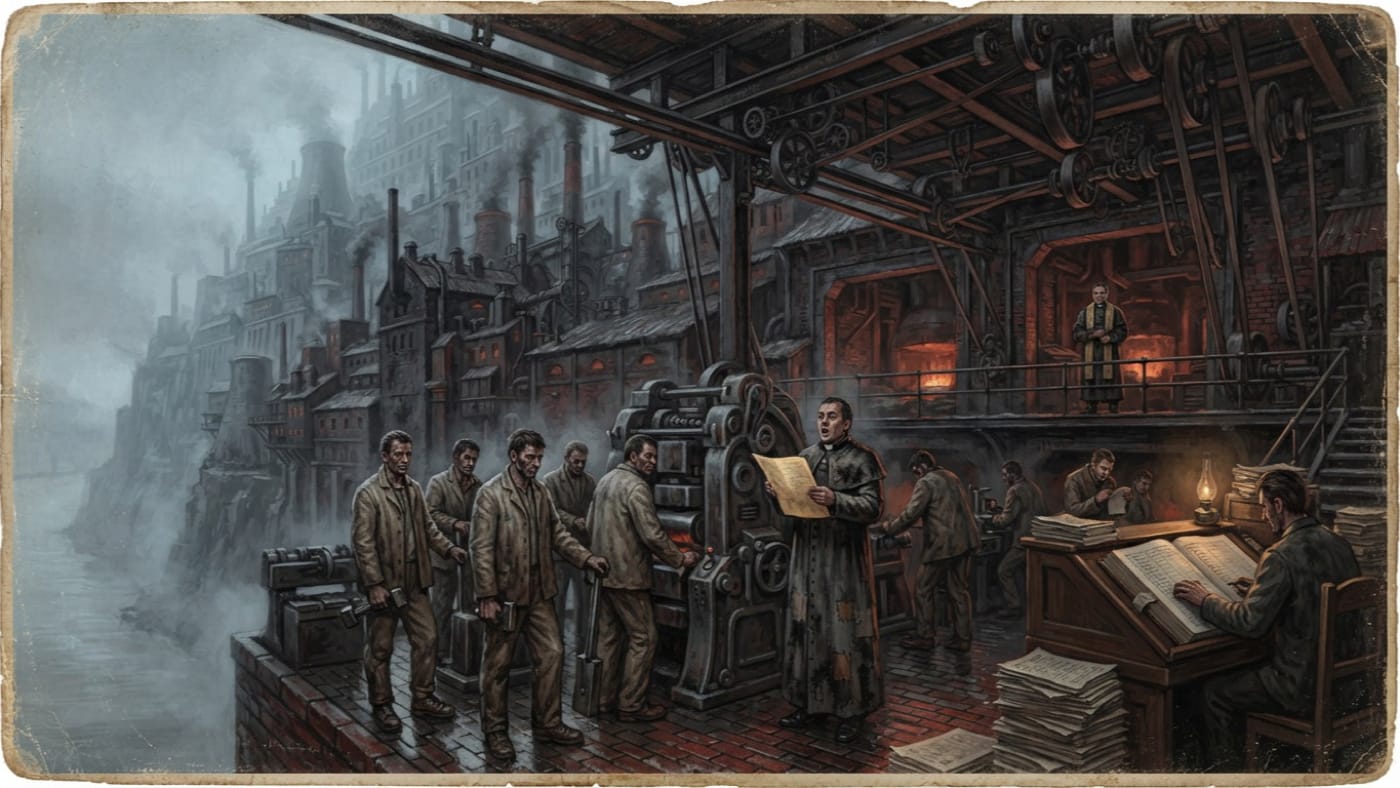
#On the Eighth Terrace
The Cantor Foundries occupy the eighth of Rheinscarp's nine terraces. The Ash Exchange lies one stair below and the High Step Precinct one stair above, so the city's furnaces sit beneath its judges and above its dead. Nobody designed this as an allegory. Rheinscarp has never needed to design one.
The terrace smells of coal, metal and ozone. Soot settles on wet brick. The iron rails sweat in the fog that climbs from the Rhine each dawn and reaches this height late, thin and already counted. The working bays open toward the cliff edge. Where other cities post foremen beside the machinery, Rheinscarp posts cantors in ash-stained collars. Where there are foremen, they stand beside the cantors and wait.
The survey does not say what the Foundries make, and I will not invent a catalogue to please the curious. The name suggests bells, but the record lists none. What the record does supply is the terrace's office: hymn-timed industry, bell-hour purchases, and the cadence contracts that keep the seven terraces below in step.
That office is the first fact of the place. A furnace may be lit and a gear-train oiled. A crew may stand at the bay with its sleeves rolled and its stamps in order, and still no work may lawfully begin. The machine is ready and the men are present, but the hour has not been bought.
#On Cadence and Purchased Hours
A bell-hour is a measured portion of sanctified ringing, bought so that work or movement may go on under it. The Bureau of Bells licenses the tones. The purchaser buys the right to labour inside them. Synodal industrial doctrine treats work songs as calibration specifications. It holds that a hymn sung to its stanza and pause sets a machine in order the way a gauge sets a valve.
In Rheinscarp the cadence is sung. The Mill-Crown Cantors set the tempo at which gears engage and hammers fall. That tempo is written into cadence contracts, which bind a bay, a crew and a purchased span of ringing into a single obligation. The same choir sings the ration mills on the fourth terrace. The mills grind flour and the Foundries work heat and metal, but both run on one cadence, one choir and one purchasing office. When any of the three fails, both terraces bear the cost.
Elsewhere in the Synod, the Litany-Engineer and the Gasket-Hymn Mechanic carry this trade's instruments: pressure gauges, torque tools, and sequence sheets marked by stanza and rest. They also carry throat wraps against heat and fumes, and wax against the ringing. The survey does not say whether such specialists hold warrants on the eighth terrace. Their tools describe the work, whoever signs for it.
Does the cadence move the machine, or only the men who move it? Finer theologians than any foundry cantor have argued the point and are still arguing. The Bureau of Doctrine says the question is settled but declines to say which way.
The time leaves the terrace as paper. Bell-Accountants assign time-credits to convoys and convert bell-hours into ration priority. Grain going downriver and crates bound for the Line therefore move in windows drawn from the same ledger that governs the furnace. A convoy that leaves inside its window is provisioned. A convoy that leaves outside it has merely left.
#On the Marshal and the Cantors
Cantor-Marshal Hrodric Venn controls the Foundries. He also controls the mill cadences, convoy timing, bell-hour allotments and time-credits. In practice he controls the terrace and everything below it that depends on the terrace. His documented sphere is Bell and War logistics. Whatever his clerks suggest at the stair windows, he heads no Bureau. Every Bureau's hours in Rheinscarp must still pass through his hands.
The Mill-Crown Cantors serve as his choir and his instrument, and they would like to be his only one. In public they say, "We sing the mills safe." In fact they mean to monopolize bell-hour contracts across the mills and the foundry terraces. Their methods are listed plainly: they control cadence, they keep a blacklist, and they arrange misfires to look like accidents. A rival choir singing to its own tempo loses its contracts. A foreman who hires that choir loses his. A bay whose cadence fails becomes the best argument for paying the Cantors more. The survey records no particular instance. It records the capacity, and in Rheinscarp a capacity is a policy waiting for its date.
An hour from Venn is useless without a name from Kelm. Praetor-Registrar Ysabeau Kelm keeps the registers of the Bureau of Records annex, which say who may work, cross and eat. A crew whose names have been "corrected" cannot draw on hours bought under the old spelling. Broker-Saintsman Damas Rohe's Ash Exchange, directly below the Foundries, deals in saint-shares and dust futures. That is the city's money when coin runs short, and the Foundries' clerks are not required to like it.
Rheinscarp is governed by a tripartite balance of names, time and the dead, with the Foundries' Marshal as one of three equal powers.
The Rheinscarp entry has withdrawn the "tripartite balance," and it is withdrawn here. Rheinscarp is a hierarchy. Formal authority belongs to the Synod Chapterhouse, together with the Tribunal of Stairs and the Records annex. The Marshal's terrace sits one stair beneath the Chapterhouse in altitude and in law. Whether the Chapterhouse uses that authority is a separate question, and the Bureau has not been asked it.
#On Work, Rations, and Unlicensed Song
Everything that reaches the eighth terrace has had to climb. Bulk cargo goes up by the Hundred Steps, the only legal vertical corridor, or by licensed rope-lifts and cargo cages. Every terrace boundary demands verse, payment and registration. Coal and ore pay at seven crossings before they meet a furnace. A worker who lodges below pays in tokens, verse and stamps at every boundary between bed and bay. Such a worker may arrive at the right hour having already spent the day's wage getting there.
Debt is enforced through bell-credit windows. Miss your window and your ration priority collapses. The city's own phrase is that people die "on schedule," and Venn's office keeps the schedule. The other pressures are citywide: debt bondage through stair-tokens, confession penalties and quota tithes. The widow drafts belong to the Widowlight warehouses, and the survey gives the Foundries no claim on them. I record that as a limit of the evidence and offer no compliment to the Foundries.
The double-entry famine of A.S. 198 shows how much the city depends on its books. The Mill-Crown and Widowlight allocations collided over a single grain shipment that had been counted twice and delivered once, and forty-one people died. Nothing on file says the eighth terrace stopped work or that the Marshal arranged the sum. The lesson lies in the arithmetic. In Rheinscarp a figure on paper is fed before a mouth is. The mills and the Records annex share an absence quota, which balances rations on paper by removing people from the registers. The Bureau will not state the percentage. The street says one in forty, and the street is quoted here as the street.
Against all this stands a cheaper heresy. There are unsanctioned cadence songs that keep mills in time without a single purchased bell-hour. The machinery accepts them. The law does not. Ringing a bell without licence is one of the city's red lines, prosecuted as tempo heresy, and a song that makes the bell unnecessary is the kind of rival cadence the Cantors exist to prevent.
#On the Present Condition
As of the Rheinscarp survey of A.S. 201, the Foundries are operating. The bays work when the hours are bought. The Cantors sing the mills and the furnaces to one tempo. Venn's allotments go down the terraces as paper and come back up as convoys, rations and debt. Above the terrace, the Bureau of Mercy's hunger-waiver clerics are still arguing with the Tithes and Tribunal axis. The clerics hold that starving people should eat whatever their stamp status. The other side holds that toll sanctity is doctrine and that hunger is no counterargument to doctrine. The eighth terrace takes no side in public, and its furnaces keep the purchased hour either way.
Nobody has dated the terrace. The record names no founder, no year of construction and no date of the Marshal's appointment. I decline to supply them.
By A.S. 92, when the first Bureaus received their formal constitutions under the Concordat
The Concordat of Strasbourg and the formal Synod date to A.S. 90. The Office of Bells was constituted in A.S. 52. The Bell Codex was ratified in A.S. 115. The Chapterhouse consecration, the Tithes liaison office and the Tribunal charter of A.S. 92 were later local stages in Rheinscarp. None of these dates the Foundries.
In the eighth-terrace ledger, output, timing and permission are entered in three columns, and each column is reconciled by a different office. A crew can meet the first column and fail the second. A convoy can meet the second and be refused the third. So the machinery stands ready on the eighth terrace while the city above it argues over who may eat.