
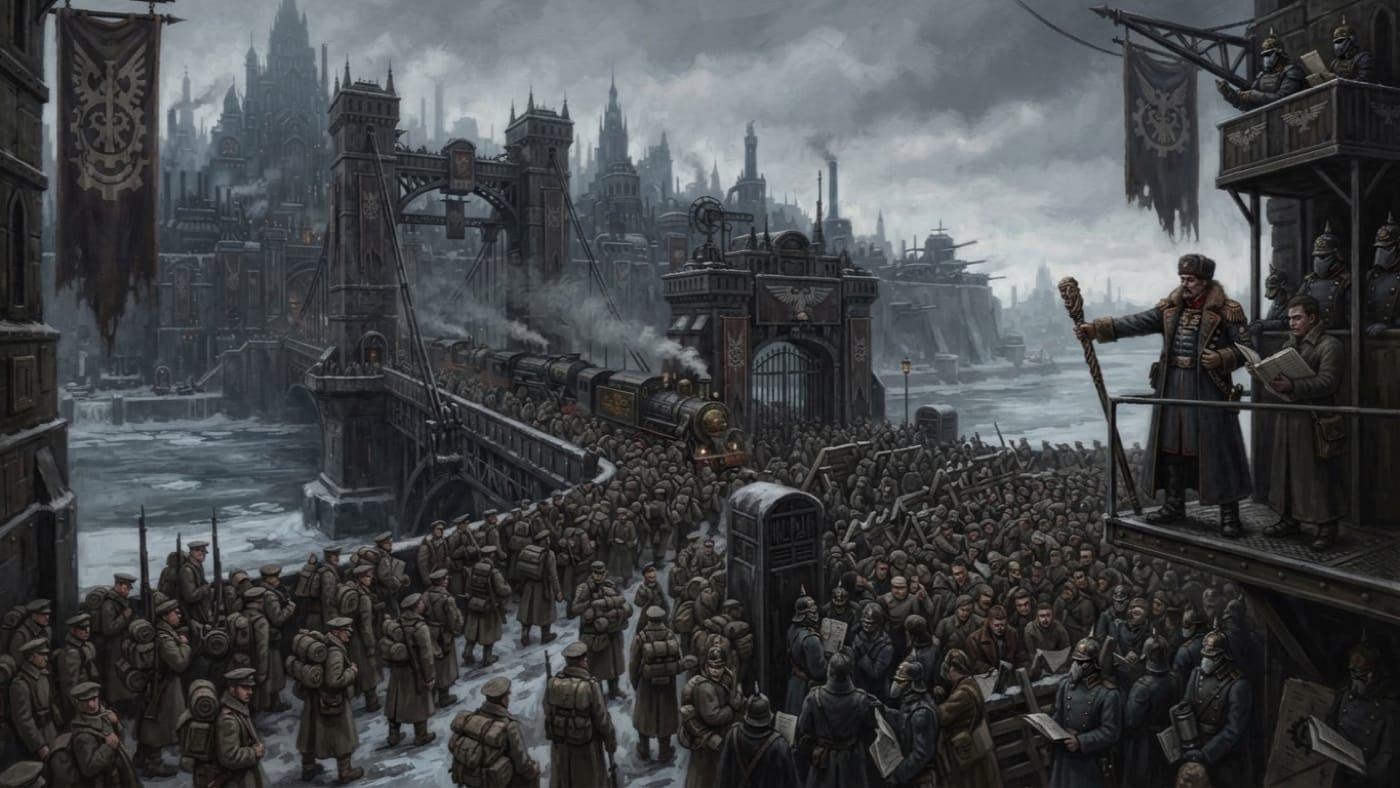
#On the Northern Requirement
"Brest does not break soldiers. Brest files them." — Gun-Cantor Marshal Vonn
The phrase "northern levy" entered this Codex in lower case, and I intend to keep it honest. No charter within my reach founds a Northern Levy. No regiment carries the name on its colours, and no feast-day keeps its first muster. What exists is a requirement. It recurs as the seasons recur, with considerably less charm: Bastion-Brest consumes soldiers, and the north supplies them.
The garrison of the Ribs is drawn primarily from the sons of the Polish lowlands, of Warsaw and Kanzleiburg and the flat agricultural belt between them. Primarily is the Bureau's word. I preserve it, because the rolls at Brest hold men from elsewhere, and a tendency is not a boundary. The Bureau of War justifies the arrangement with a principle of admirable economy: soldiers raised on flat ground fight best on flat ground. No trial of this principle has crossed my desk. A rail map has, and on it the flat ground nearest Brest is also the flat ground cheapest to ship men across.
The Bureau calls this doctrine. The quartermasters call it a timetable.
#On the Households and the Roll
"Once a ledger is reassigned, it cannot be unbound." — Bureau of Records
The machinery that delivers a northern son to the Bug is older and wider than the north. Every household of the Church contributes coin, crop or child to the defence of the Faithful. That is the general settlement, and the lowland farms obey it exactly as the southern vineyards do. At baptism a child is entered in the Book of Promise, which assigns him a future (levy, choir or ledger) before he has an opinion on any of them. The Mothers of Plenty keep the ration halls and the birth registers, and among their duties is the pre-designation of male infants for future levy categories. The desk that issues a mother her bread chits also records which of her sons the Bureau expects to collect.
The Continental Levy supplies the arithmetic: a tenth of every household's sons, by the decree of the First Continental Levy. I state that fraction as the general rule of the Church. I have found no northern schedule that alters it, that rounds it for the cottager with a single boy, or that tells the farmer which of three brothers the officer prefers. Those questions are answered somewhere, by someone, with a stamp. No folio I have been permitted to open answers them.
What I can attest is the ceremony. Parents are instructed to kiss their sons before handing them to the levy officers, and to smile while they do it. The Bureau of Doctrine records this as sanctity. The farm records it as one fewer pair of hands at the spring sowing, and no form exists on which to write that down.
An earlier marginal gloss on the First Continental Levy, preserved in the inherited Lore Book, rejoiced that "the Synod devoured ten sons per household."
The decree beside which that gloss was written demanded a tenth of every household's sons. The annotator multiplied where the decree divided. The Bureau of Records has filed the discrepancy under Clerical Exuberance and declines to say whether anyone was ever billed at the gloss's rate.
#On the Replacement Columns
"Faith provides the flame, but War bears the sword." — recitation of the faithful
Every man bound for Brest passes through Warsaw. It is the principal staging city of the Polish lowlands and the largest rail hub outside the heartlands. Everything that supplies Brest and Königsberg goes through it: shells, grain, stamped passes and boys. Behind it stands Kanzleiburg, once Berlin, the administrative brain of the northern theatre and the great junction of road and rail that feeds the Polish corridor. I do not claim Kanzleiburg houses a Northern Levy headquarters. I claim only that a northern recruit who reaches Warsaw has already been counted in Kanzleiburg, by men who will never see the Bug.
From Warsaw the replacement columns go out on the northern rail toward the spur that feeds the Ribs. In my survey of Brest I called them chronically understaffed, and I see no reason to revise the adverb. A column leaves short of the strength it was ordered to carry. Some of its men have not yet arrived from the farms. Others have been diverted to a more urgent shortage elsewhere. The rest exist only as an expectation in a register of male infants filed a generation ago.
The convoys are chronically delayed. Delay is the native climate of the Sagittal Line, and the northern rail bears its full share: freight and flesh compete for the same wagons, and the quartermasters, I am told, favour the cargo that does not complain. The Bureau of Records enters the result as a column "in transit." That status may describe a train in motion. It may also describe a platform of recruits sitting on their kit in the rain for a week. The Bureau does not distinguish.
#On Arrival at the Ribs
"No sin, no step." — Proverb of the Ribs
A recruit arriving at Brest carries two kinds of authority, and the bridge honours them one at a time. The first is his assignment: a sealed order of the Bureau of War posting him to the garrison. The second is everything the Crossing Bureau requires of anyone who would move upon the span. That means a confession receipt stamped against his identity file, an absolution token from the booth assigned to his declared sin category, and a transit seal certifying that what he has confessed agrees with what he confessed before.
The assignment says he must cross. The paperwork decides whether he may.
Seal-Registrar Hett Ruis controls the stamps, the identity files and the writs. Presiding Judge Elsbeth Krail of the Bridge Tribunal rules on every discrepancy among them. Neither commands the levy, and neither needs to. A posting from the Bureau of War grants no exemption from the Confessional Lanes. The Bureau of Doctrine, which co-seals the northern assessments, would regard such an exemption as heresy with a requisition number.
So the recruit confesses. He confesses something small and safe, as the bridge's children learn to, and the scribe records it in duplicate. If a clerk somewhere upstream copied his name with one letter wrong, the receipt will not match the file. If his confession today sits poorly beside the ones already on record, the transit seal cannot certify consistency. Either fault sends him to the Tribunal. There his perfectly valid orders lie on the bench beside his perfectly invalid crossing file, and the Judge, in her voice like old linen, determines which document is lying.
Brest's own chaplains report that convoy seals arrive altered and that writs pass inspection bearing signatures the dead once used. Every such report makes the Registrar more thorough. The honest recruit pays for the forger's diligence, and he pays in days.
#On the Rotation
"The river forgets; the ledger doesn't." — Proverb of the Ribs
The nominal posting at Brest is six months. I write nominal deliberately, because the Bureau of War extends tours routinely. The cause is a sequence I have already described: the columns from Warsaw arrive short and late, and the lanes that receive them are backed up. A soldier cannot be relieved by a man still sitting on a platform in Warsaw, or still standing before Judge Krail with his identity in dispute.
In my entry on the bastion I recorded soldiers who entered the bridge on a six-month posting and emerged fourteen months later. Eight of those months went to waiting for a crossing writ, which their confession files had invalidated through a clerical error in the third booth. I offer the case as a specimen of failure, never as a measure. I hold no figure for the usual length of a Brest tour, nor for the longest. When asked for either, the Bureau of Records supplied the phrase "administrative processing."
The rolls blur one further distinction, and I will not. Rotation out of Brest relieves a man of a posting. His obligation to the levy continues. The soldier who finally crosses westward with a valid seal has finished his time at the Ribs and nothing else. The terms of his wider service sit in another ledger, and that ledger boards the train with him.
The garrison at full strength numbers some eight thousand combat troops and four thousand support personnel. Those are the bastion's figures. They say nothing of how many northern sons pass through in a year, and I decline to forge an intake from them. The chaplains do report on the men who remain. In their careful phrase, they hold "a sustained posture of theological exhaustion," which is what a man becomes when his relief has been in transit since the thaw.
#On the Present Return
"Which rib keeps you warm?" — Shibboleth of Brest
In this year of A.S. 201 the northern requirement stands where my survey of Brest left it. The lowland farms still yield sons to the roll. Warsaw still marshals them into columns that leave short, and the northern rail still delivers them late. The Ribs still receive them one confession at a time, at the pace the Tribunal finds proper and the war does not.
I have read the replacement returns co-sealed by my own Bureau. They record men levied, men entrained and men cleared, in that order. Nowhere do they record the interval between, and that interval is populated: platforms, processing pens, the bench of the Absolution Hall. Its residents are soldiers whose papers are complete and whose bodies remain on the wrong side of the stamp.
The return is sealed. Its subjects remain in transit.