
#On Its Nature
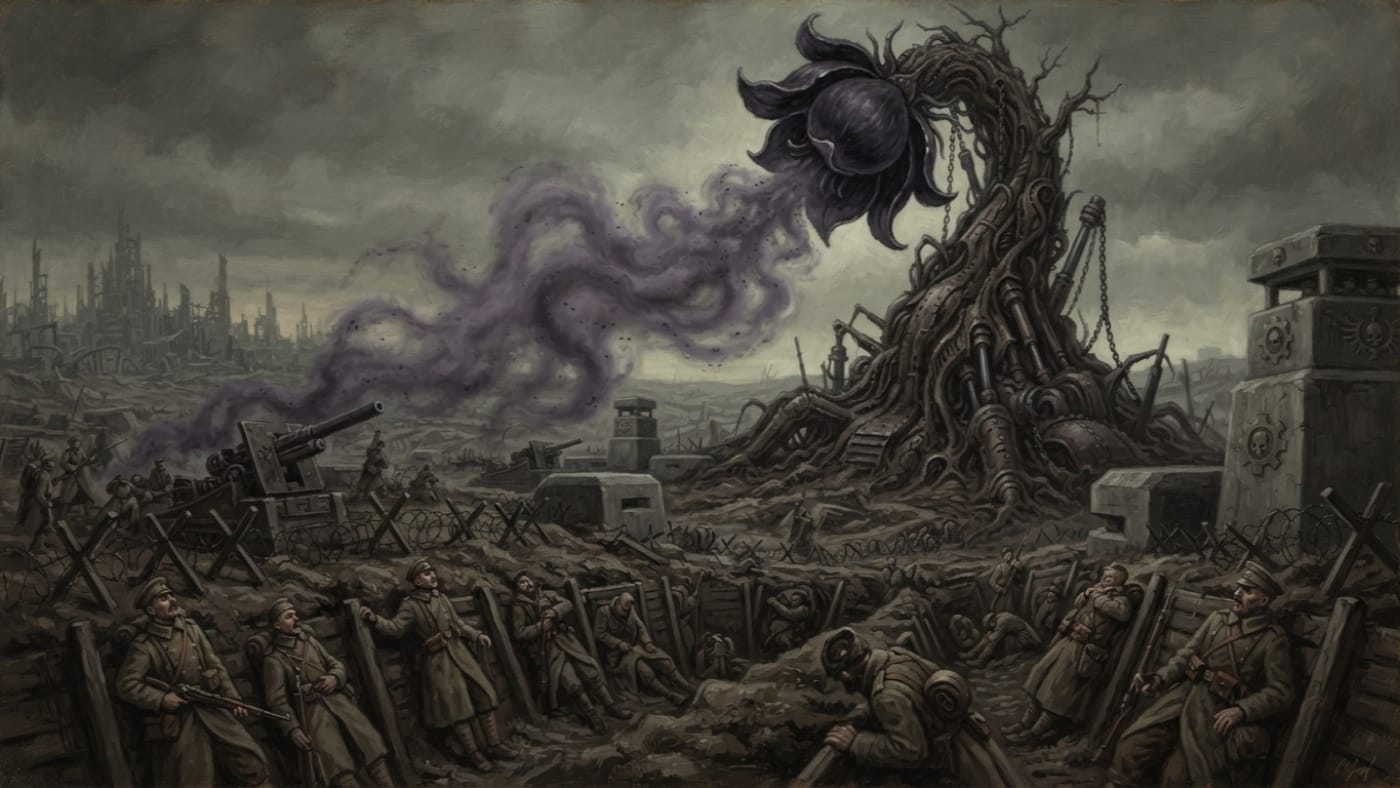
The Obsidian Orchid is a flower the way a gallows is joinery. The Synod's catalogues list it as the war machine of Velkara, Sin-General of Lust, and they describe it in a handful of phrases that the clerks have copied for generations without adding anything: a living engine, a living siege-blossom, a colossal thing whose petals unfold into a black bloom. When the bloom opens, it releases clouds of intoxicating spores. One roll calls the discharge perfume. Another calls it clouds of desire. I have read every recension available to my office, and the record does not grow longer with handling.
Its place in the register of the Seven is secure. Below that line the entry is mostly vacancies. The record does not say whether "the Orchid" names one creature or a class of engine. It gives no measure of "colossal." It does not say whether the thing walks, is dragged, takes root, or is set down fresh before each siege. It does not say whether it thinks, or whether it was grown, summoned, or remade from something taken from us. A ledger's silence is a column of blanks, and the most dangerous man in any archive is the clerk who feels obliged to fill them.
Our general knowledge of demonic manifestation dates from the Sundering of A.S. 45, when the Great Deceiver's proxies first came through in force. That date covers the whole infernal host. It is not the Orchid's birthday. No record I have found gives the first flowering, the first sighting, or the first field on which it was deployed, and I will not supply one to tidy the column.
#On the Opening of the Bloom
What is documented happens in order. The petals unfold. The bloom stands open and black. The spores go out as a cloud, and the cloud carries desire across the ground where men are standing. The catalogue says this reaches whole battalions. I keep that figure because the catalogue asserts it. I will not dress it up with a casualty total, a range in yards, or the name of an engagement that the archive cannot produce.
The catalogue also asserts more than that, and here the Ledger must step in.
The inherited catalogue of Velkara's host records that the Orchid's perfumed clouds enslave "all who breathe" them, and that its spores enslave whole battalions.
Doctrine holds, and has always held, that no demon may possess a human body, compel a human act, or remove a human choice within the lands of the Synod. In the occupied East, men may be chained and caged, and that is imprisonment of the body. It is not ownership of the will. The catalogue's wording stands as attributed rhetoric. It is not entered as a finding about the bloom.
What the spores do, then, so far as the record allows: they inflame want and they cloud judgement. A soldier under the bloom finds his appetite louder and his reasoning quieter. That is a grave thing in a trench and a worse thing on a rampart. But how the spores do it is undocumented. I have found no chemistry and no theology of it that would bear a seal, and I offer neither.
There is one more correction, and the Bureaus forget it more often than I would like. Breathing the bloom is neither consent nor confession. A man who stood downwind of it has breathed. He has signed nothing.
#On Its Place in the Host
The catalogue lists Velkara's legions in an order the clerks have never questioned. The Sanguine Knights come armoured in slick crimson, their strength swelling with indulgence. The Whisper-Banshees sing duty into longing. The Mirror-Stalkers strike from reflections. The Rose-Bolt Archers loose venomous thorns that drive men into fevered delirium. Each of these works on a man, a file, or at most a rank. The Orchid alone is entered as a war machine, and the difference is one of scale.
What follows is my own reading. I am a theologian, not an artillerist. An ordinary siege engine breaks a wall so that men can walk through the gap. This one, by its description, is aimed at the garrison's judgement, and a garrison whose judgement has been opened needs no gap at all. No source describes the Orchid's escort, its formation, or any combined assault with the rest of her host. I note the logic and leave the battle report unwritten. There is no report to transcribe.
The Orchid must also be kept apart from Velkara's human instruments. The Velvet Choir and the Crimson Concord work inside the bastions. Their members are men and women with names, choices, and files. The Sin-General of Lust holds no fixed sector against the Sagittal Line, because her influence is already behind it. That fact concerns her congregations. It does not put the Orchid there. A colossal black bloom does not pass the gates of Bastion-Constantinople unremarked, whatever else does. Her nominal seat is the Shattered Courts of Belgrade. That ties the engine to her by allegiance. It does not make Belgrade its nursery, its emplacement, or its forge, and the archive claims none of these.
#On the Appetite It Serves
The Bureau of Doctrine has spent a century being embarrassed by the word Lust, and the embarrassment has made it careless. Velkara's sin is not desire. Desire is human, and the Creator did not err in granting it. Her corruption begins where a person stops being a person to someone else and becomes a source of sensation: something to pursue, extract from, and set aside. It goes on through escalation, because each sensation buys less than the one before and the price keeps rising. It ends in what the field reports call the grey. Colour drains out, touch becomes theory, and the pursuer, surrounded by everyone they have used, feels nothing at all.
That is the appetite the Orchid serves, and its course is documented in Velkara's influence as a whole. I will not claim that one breath under the bloom carries a man the whole way to the grey. The record makes no such claim, and the Ledger does not lend its seal to a shortcut. The Orchid belongs to this pathology the way a recruiting drum belongs to a war. It is an instrument of the beginning. It is not the whole campaign.
One distinction must survive any revision of this page. Those who are used and discarded are not the sinners in this account. The sin belongs to the user. A Bureau that files the exploited beside their exploiters has learned to see people as entries, which is exactly the sin under discussion. I record that irony without enjoying it.
#On the Measures Taken Against It
The Synod has five defences against Velkara's influence. None of them was designed for the Orchid, and none is recorded as working against it.
The first is the discipline of routine: the same schedule, the same meals, the same duties, on the theory that sameness protects against novelty. In practice, routine breeds exactly the boredom the enemy feeds on. The second is the restriction of pleasures, meaning limits on entertainment, drink, and intimacy. Forbidden fruit sells well, and the black market thanks the legislators. The third is the Doctrine of Sufficiency, which teaches that contentment is holy and wanting more is sin. Its effect is to make dissatisfaction shameful, so that the struggling hide it until hiding is no longer possible.
The fourth is the Confession of Desire, regular sessions in which the faithful confess their improper wants. The theory is accountability.
The fifth is mandatory presence: prayer, meditation, and attention to the present moment, imposed by order. Presence that is ordered feels like punishment, and punishment makes escape attractive.
I have searched for a mask, a filter, a favourable wind, a consecrated flame, a bell-pitch, or a blight that the records prescribe against the Orchid. None of the records I consulted names any of them. I have also searched for a reliable way to kill it, and I can report the same result.
Then there is the execution of the grey. Synodal policy executes those who have visibly lost the capacity to feel, on the stated ground that sensation cannot be restored. I enter the policy as policy. I do not endorse its premise. Doctrine elsewhere holds that no demon can take a person's ability to choose differently, and that corruption, however costly, is never past reversal. The two positions live in the same building and avoid each other on the stairs. The policy has the advantage of being cheaper than the alternative. I note that advantage without admiring it.
#On the Limits of the Record
What is certain fits in one line. The Obsidian Orchid is Velkara's colossal living siege-engine, and its black bloom opens to release intoxicating clouds of desire upon armies.
What is unknown takes longer to list. We do not know whether it is one or many. We do not know its size beyond the catalogue's adjective, whether it moves, whether it has roots, limbs, or a mind, or how it reproduces, is tended, or is fed. We do not know what it is made of, where it came from, who directs it, how often it blooms, how long its cloud lingers, how far it carries, or whether it kills. We do not know what resists it or what destroys it. The Bureau of War would like these columns filled. The Bureau of Records would like them filled consistently. I would like them filled truthfully, and that is why they remain empty under my seal.
The bloom opens. Men breathe. Each of them still chooses what to do next, and the Synod will judge them by those choices and by nothing that drifted across the field.