
#On the Palace That Refuses Geography
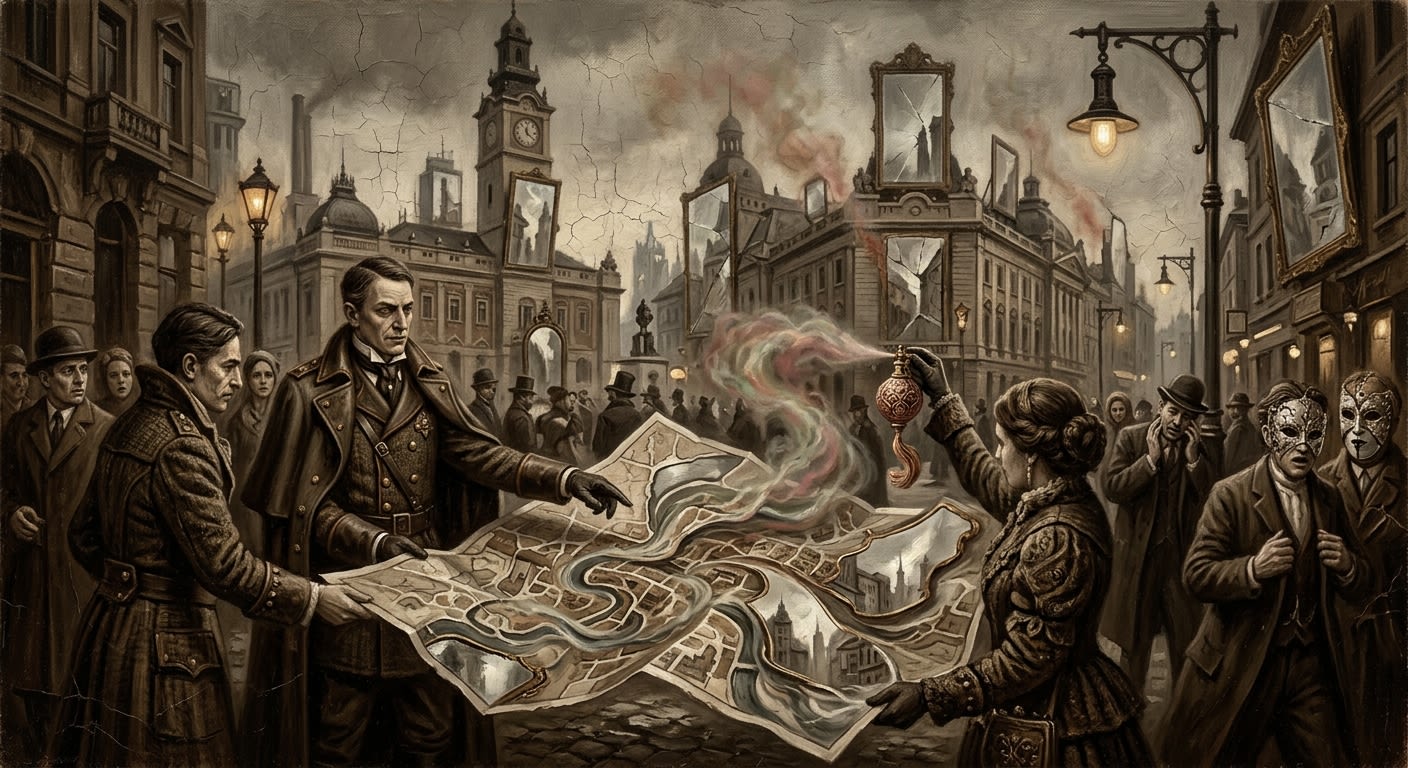
The Shattered Courts are Velkara’s nominal seat, a phrase the Bureau of Records uses because it owns no approved word for a palace that behaves like a scent, a wound, a rumour, and a jurisdictional insult with mirrors. They are associated most firmly with Belgrade, where Lust’s court opened through glass, perfume, noble ruin, and the defeated vanity of old houses; yet every map that attempts to place them has failed with expensive neatness. The Courts occupy Belgrade the way a confession occupies a mouth: present, formative, hard to weigh, and liable to escape as soon as an official asks for exact boundaries.
Their earliest reliable western references arise from post-Sundering Balkan collapse reports, where Rationalist battalions describe perfume fogs, blinded survivors, reflected passages, and palace interiors appearing in buildings that had possessed no ballroom the day before. The Synod prefers the A.S. 117 Budapest surge as the first useful exterior proof, because by then we had clerks, seals, air assessors, and enough cowardice to call Hell an atmospheric event. The Courts were older. Belgrade knew them first. Belgrade paid the first rent.
The approved definition is terse: the Shattered Courts are a Lust-sorcerous palace-complex, associated with Velkara, seated in or through Belgrade, composed of unstable halls, mirror-gates, perfume atmospheres, courtly hunting grounds, trophy chambers, gardens of thorn and velvet, and interior distances that reject ordinary survey. This definition is correct as far as a mortuary label is correct. It identifies the corpse and misses the scream.
No pilgrim seeks the Shattered Courts and remains a pilgrim. No scout enters and returns with the same appetites indexed under the same names. No mirror recovered from the district reflects a room with the honesty expected of furniture. These are sufficient facts. More would flatter the place.
#On the Raising of the Courts
Velkara came into Reality as a perfume on the wind, soft enough that courts inhaled before armies noticed the standard had fallen. The official documentation states that whole dynasties fell by sigh rather than sword; vows soured into longing; borders melted; temples emptied; soldiers killed one another over a glance. The phrase is theatrical. It is also archivally supported, which is one of those conditions by which theatre becomes prosecution.
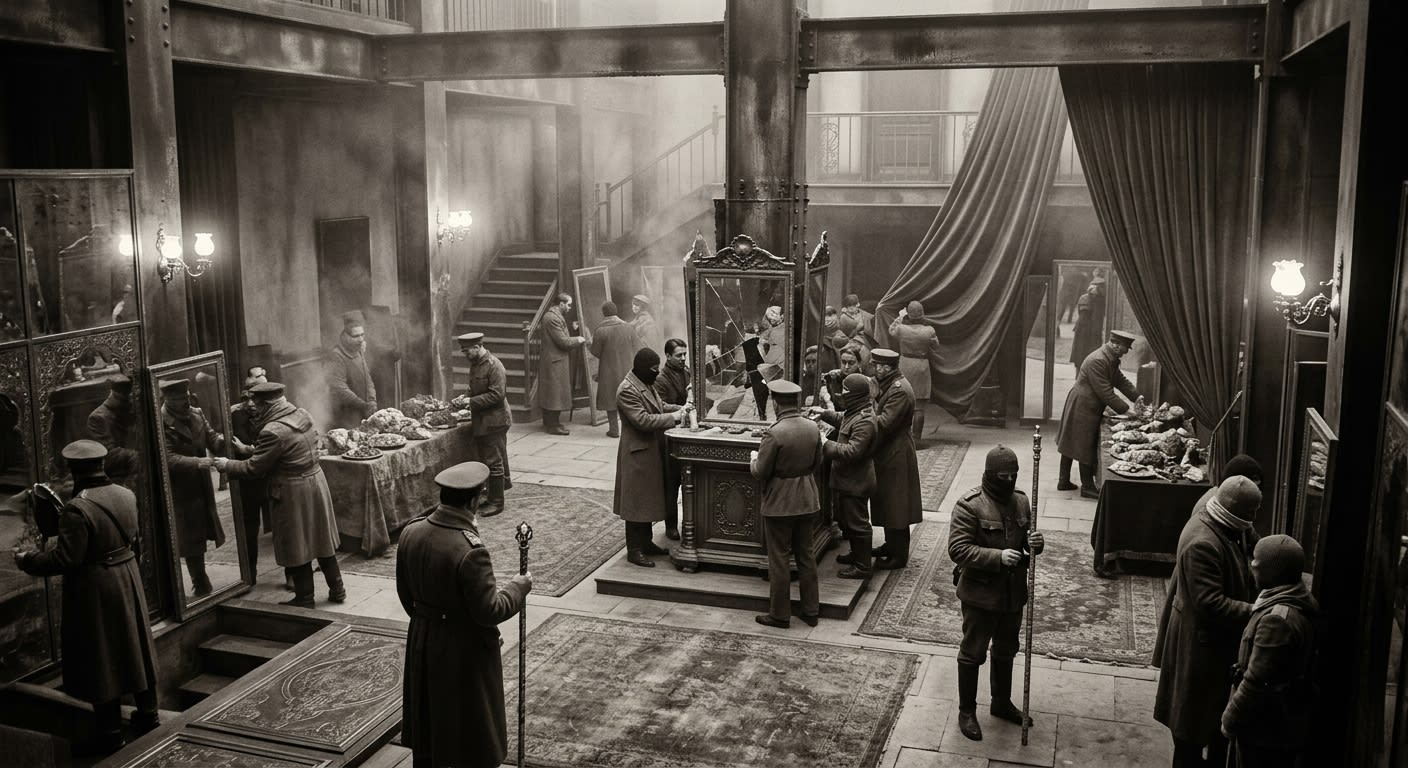
Belgrade, set at the Sava-Danube confluence, had always been a city of thresholds: river to river, empire to empire, tongue to tongue, oath to convenient revision. Such places tempt calamity by possessing too many meanings. After the eastern wars shredded the old civic order, the surviving palaces, noble houses, glass-fronted ministries, theatres, military residences, and salons made excellent tinder for Velkara’s form of sovereignty. Lust requires surfaces. Belgrade offered polished doors, gilt frames, cut-glass chandeliers, powder rooms, military shaving plates, ballroom floors, and enough cultivated unhappiness to feed a cathedral full of confessors.
The Courts did not rise as stone rises. They accreted. A drawing room acquired a second door visible only in the mirror. A ballroom lengthened between dances. A winter garden appeared behind a cracked pane and shed rose petals onto a floor already burned. Servants laid tables for guests whose invitations had never been written. Officers found their quarters connected by corridors that crossed no intervening room. A widow opened a wardrobe and heard applause. Belgrade’s domestic architecture began accepting additions from a country no surveyor had ratified.
By A.S. 117 the Courts could breathe westward. The Budapest Perfume Fog carried their influence across both banks of the Danube: eleven days active saturation, months of residual scent, Purity sampling through A.S. 120, and Pest’s later abandonment wearing the perfume of inevitability. The Bureau called it localised atmosphere because atmosphere cannot be court-martialed. The scent disagreed and entered the files anyway.
Several provincial teaching folios describe the Shattered Courts as Velmora’s pleasure citadel.
Corrected. Velmora buys, mortgages, lends, and owns. Velkara invites, uses, discards, and makes the discarded grateful for having been noticed. Confusing Greed and Lust is common among clerks who think all ruin with velvet upholstery belongs to the same office.
Belgrade’s A.S. 120 miracle later confused the record. During the Miracle of the Danube’s Turning, Maldrake’s Wrath-host broke against relic artillery, saintly apparitions, and that startling hydrological obedience by which the Danube reversed its own argument. Pilgrimage seized the victory. War gilded it. Records canonised it. Yet beneath the miracle’s smoke, the Courts remained. Soldiers quartered among broken noble houses still found mirrors breathing. Perfume still gathered in powder magazines. Reflections still attended meals after their owners died.
#On the Architecture of Appetite
A normal palace is arranged for command: gate, court, stair, hall, chamber, bed, chapel, treasury, privy, servant passage, exit. The Shattered Courts are arranged for pursuit. Their rooms do not serve a ruler. They serve a sequence: glimpse, invitation, delay, nearing, loss, sharper glimpse, renewed pursuit, capture, vacancy, appetite reborn.
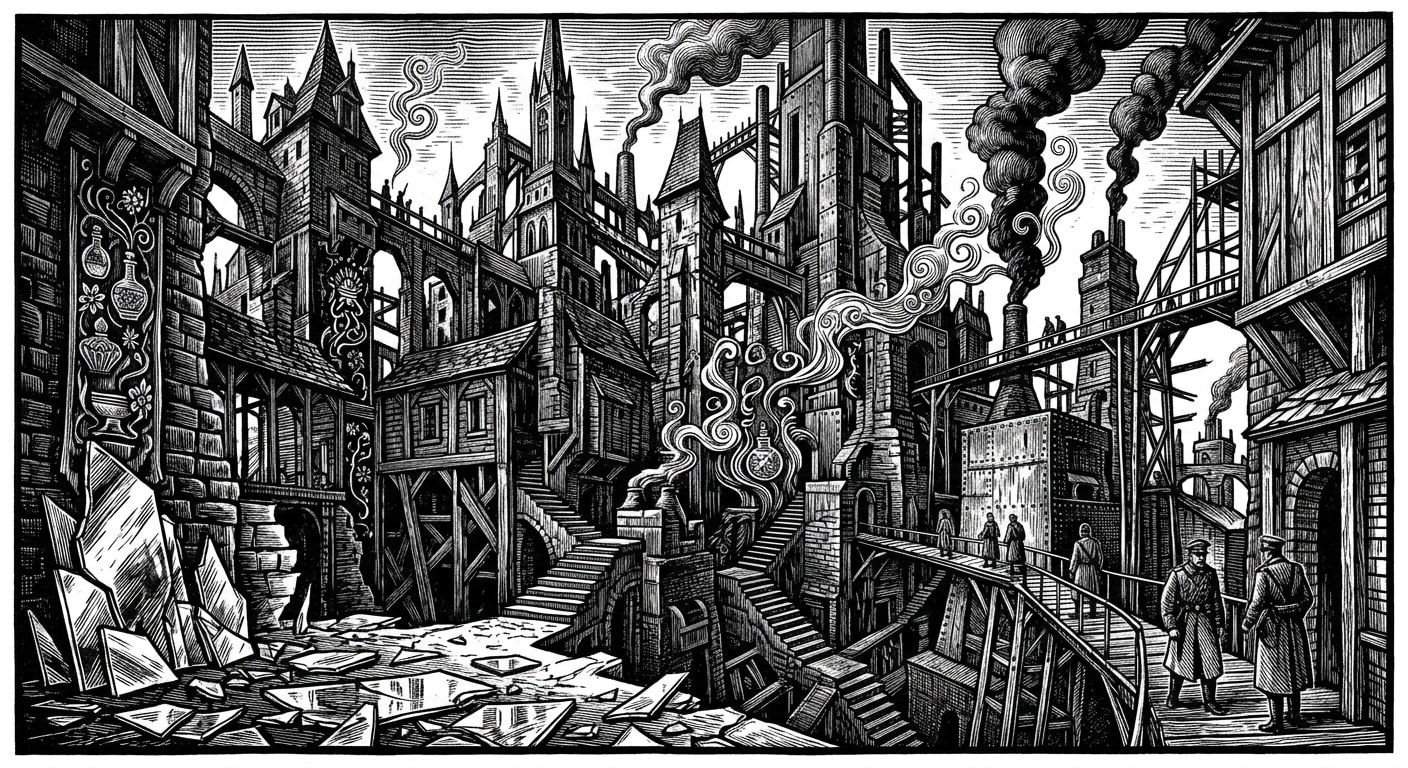
The Bureau of Engineering’s recovered A.S. 156 interior elevation shows Art Nouveau columns twisting like vines, iridescent glass ceilings, spiral staircases ascending into architectural discretion, and tiny figures placed at absurd distances along balconies that curve back toward their own origin. The cartographer wrote that the building “grew rather than stood.” His second sketch disagreed with his first. His third contained a room none of his companions remembered. His fourth was confiscated because it showed the inspection team from behind.
Mirrors form the Courts’ principal grammar. Wall-glass, hand-glass, window, polished silver, black canal-water in a basin, the eye of a dead horse under ballroom rubble: each may become passage or permission. A mirror-gate is the crude form, useful to frighten recruits and justify iron fixtures. The subtler form edits the room’s consent. A guard sees himself admitted before he has opened the door. A penitent sees the confessor smiling before absolution. A captain sees a beloved face behind him and turns, creating the betrayal the reflection has already filed.
Perfume supplies the second grammar. Rose, ambergris, lavender, hot iron, wet hair, bread, a dead mother’s scarf, the skin of someone one had no right to remember: the Courts do not scent rooms with pleasure alone. They scent them with association. They make warning smell like shelter, command like insult, confession like tryst, danger like recognition. A man retains choice. He chooses from a menu the air has already marked.
The gardens beyond the halls have been described by survivors as thorn and velvet, roses that bleed when admired, walks that lengthen when two persons approach together, bowers where sound arrives scented, fountains whose water reflects rooms instead of faces. The phrase “gardens” is too pretty. These are outdoor interrogations conducted by horticulture.
#On the Five Recognised Districts
Purity recognises five districts or conditions inside the Shattered Courts, though it disputes whether these are places, stages, moods, or pedagogical lies told to junior inquisitors so they stop asking for floor plans.
The Pleasure Palaces (Unregistered) are the first and least honest face. They resemble the old courts of the Balkans completed by permission: salons, baths, gaming chambers, galleries, music rooms, perfumed chapels, supper halls, bedrooms, antechambers, corridors where servants never interrupt and consequences wait outside like unpaid bills. Everything is available. Every appetite receives answer. The dreadful feature is service without friction. Excess can exhaust itself. Desire grows monstrous when the world stops saying no.
The Hunting Grounds (Unregistered) extend beyond and beneath the Palaces. Pursuit becomes law there. Lovers begin willing, hunters begin radiant, quarry begins flattered, and the chase possesses enough ceremony to disguise the disappearance of mercy. The hill conceals, the forest delays, the clearing reveals. The pursued are caught, dropped, remembered briefly, forgotten carefully, and left to wait for another hunt because waiting is the first grey room.
The Grey Wastes (Unregistered) are the mature wound. Reports agree that colour drains. The Bureau of Engineering confirms altered light behaviour in captured sketches and one photographic plate from A.S. 187 whose emulsions paled around living figures but preserved their formal clothing with almost legal courtesy. In the Wastes, inhabitants perform sensation as office-work: dancing, feasting, coupling, laughing, hurting, apologising, beginning again. Nothing registers except the fear that nothing will ever register.
The Trophy Halls (Unregistered) preserve faces. Some are mounted in glass. Some appear only when the viewer passes. Some whisper tally numbers. The Mirror and Perfume Arts make identity porous enough that a face may survive the person whose face it was, and Velkara’s collectors prize the looked-at portion above the inconvenient remainder. The Bureau of Purity teaches this as objectification. The word is accurate and too small.
The Escalation Courts (Unregistered) lie deepest in every account and nearest in every nightmare. There pleasure has failed, beauty has dulled, conquest has become bookkeeping, and intensity remains the last instrument. Pain, fear, humiliation, spectacle, confession, and surgical novelty are arranged like liturgical offices for a congregation that cannot feel ordinary prayer. I shall describe no more. The Bureau forbids it, and for once the Bureau’s prudery has wandered into wisdom.
RECOVERED NOTE — BELGRADE COURTS, SOURCE UNCERTAIN “After the third arrival the room no longer applauded. After the fourth, the mirrors turned away. After the fifth, the surgeon asked whether I wished to be the knife or the table. I answered before I understood the question.” Witness status: ██████████████. Object recovered with note: one ivory glove, perfumed after boiling.
#On War by Interior Means
The Shattered Courts do not field armies in the ordinary sense, though ordinary sense has a short life east of the Line. They produce habits, operatives, fragments, cells, and human arrangements that become military facts after respectable officers have finished denying them.
The Velvet Choir carries Court-method westward in diminished form. A Choir operative may know no demon-name and possess no visible mark. She may be a widow with lavender cuffs, a soap seller to garrison infirmaries, a clerk whose attention feels like absolution, a musician whose chord remembers the listener’s first kiss. The fragment works under self-knowledge. The victim calls it kindness. The file calls it compromise. Purity arrives late and scorches the room.
The Crimson Concord represents the same principle adapted to command structures, especially around Bastion-Constantinople and the southern theater. A Concord agent enters the staff table as a convenience, a liaison, a supplier, a confessor’s assistant, a quartermaster’s favourite, a soldier who hears without judging. Afterward, orders soften. Reports delay. A patrol route shifts by one street. A bridge inspection is postponed. A sealed recommendation names the wrong man and everyone feels relief.
The Courts have also demonstrated logistics. At the Brașov Flood of A.S. 110, Velkara’s host crossed the Danube on fifty thousand drowned Ash-Fodder after Kargath consumed Brașov proper. The strongest were driven in first, the light above, the mouths weighted, the current obstructed, the body converted into causeway. The Shattered Courts teach appetite as architecture. Brașov proved the syllabus could be exported.
War College diagrams once filed the Brașov causeway under Kargathite consumption precedent.
Corrected. Kargath ate the city. Velkara used the remainder. Consumption made waste; Lust made infrastructure. The distinction is hideous and necessary.
Belgrade remains the more private demonstration. During the A.S. 120 miracle campaign, soldiers quartered among Court-adjacent ruins dueled shadows they swore were beloved faces. One artillery sergeant confessed to murdering a daughter who was alive in Lyon. His confession was sincere, false, and operationally damaging, which is a threefold accomplishment few theologians manage before breakfast.
#On Witnesses, Fragments, and Failed Maps
The Bureau’s evidence for the Courts is infuriatingly rich and structurally unusable. We possess air samples from Budapest, mirror fragments from Belgrade, perfume-residue tubes, confessional transcripts, Engineering elevations, Purity interviews, War casualty annotations, recovered garments, wedding rings bearing unfamiliar inscriptions, masks whose inner surfaces show faces in dust, and one fragment of palace glass that reflected seven rooms while lying wrapped in black cloth inside a lead box.
We lack the thing every junior clerk demands and every senior clerk has learned to distrust: a stable plan.
Cartographic attempts fail in repeating patterns. First, exterior approaches diverge. A street shown leading to a theatre on one sketch leads to a winter garden on the next. Second, interior dimensions exceed exterior shells. Third, routes followed in pairs differ when drawn separately. Fourth, maps made from memory acquire rooms the witness swears he never entered, usually bedrooms, chapels, or dining rooms, which tells us something tedious about mankind. Fifth, maps stored near mirrors alter faster than maps stored in darkness. Sixth, maps stored in darkness begin to smell of powder and rain.
Recovered fragments are worse. Glass from the Courts does not merely preserve sight. It preserves preference. A shard may show the observer an ordinary room made gentler, a dead person made available, an enemy made desirable, a superior made forgivable, a subordinate made usable. The Bureau of Purity orders such glass wrapped in linen, sealed in wax, boxed in iron, blessed by Rites, recorded by Records, and dropped into deep water when practical. Three fragments have returned after disposal. One appeared in a captain’s shaving kit. One in a Mercy ward mirror. One in a child’s toy theatre in Strasbourg, which is why the toy theatre trade now enjoys the Bureau’s close affection.
Witnesses do not agree. This increases rather than weakens their value. The Courts customise harm. One survivor reports velvet stairs and rose blood. Another reports cold kitchens and a mother’s perfume. Another reports a barracks corridor leading into a chapel where his own wedding was being rehearsed without him. Consistency would imply ordinary architecture. Contradiction is the more damning brick.
#On Countermeasures and Their Failure
The official countermeasures are iron mirrors, vinegar cloths, ash-salt plugs, scent-coffins, supervised ventilation, reflective-surface restriction, communal recognition drills, vow-pins, counter-orisons, cold baths, and immediate confession of persons remembered with sudden tenderness. These measures are neither useless nor sufficient, which is the most expensive category a measure can occupy.
Iron mirrors deny flattery but cannot deny longing. Vinegar cloths roughen the air but do not erase association once breathed. Ash-salt plugs protect the nostrils and make officers irritable, which Purity considers a tolerable improvement. Scent-coffins contain confiscated oils until some fool dreams of the name stamped on the lid. Vow-pins secure loyalty through pain, since pain remains harder for Velkara’s subtler arts to counterfeit without attracting notice. Counter-orisons flood desire with obligation. Obligation is useful, but it has never made a lonely man less lonely.
The strongest defence is communal witness: someone honest enough to say that a kindness feels too perfect, a room too familiar, a reflection too obedient, a scent too precisely aimed. This is the defence the Synod damages daily by reducing persons to files, ranks, vouchers, penances, and ration categories. We train men to hide desire, then act astonished when desire becomes an enemy agent. We isolate clerks, soldiers, widows, nurses, penitents, and officers, then hand Purity a broom after Lust has furnished the house.
Do not mistake me. Pleasure restriction has its place. So does fasting, cold water, ugly furniture, iron fittings, and the firm clerical habit of leaving a room before the room becomes interesting. Yet no order survives by teaching its servants only terror of wanting. Wanting denied without instruction becomes a tunnel. Velkara has excellent tunnel crews.
#On the Court’s Servants and Those Who Mistake Service for Reward
The Shattered Courts keep servants in the old style: footmen, ushers, perfume-bearers, mirror-polishers, musicians, garden hands, chamber attendants, hostlers, heralds, scribes, physicians, confessors, hunters, quarry-keepers, face-curators, and those pale functionaries whose titles sound decorative until one discovers that decoration in Velkara’s house is a form of custody. Many began human. Some remain human by anatomy. The rest retain enough human practice to make recognition painful.
A Court servant is not necessarily chained. Chains would flatter him with clarity. He is retained by gratitude, shame, appetite, terror, memory, and the awful convenience of a place that always knows what he wants before he asks. The usher who admits guests may believe he is sparing them confusion. The perfume-bearer may believe the vial she carries comforts the frightened. The mirror-polisher may believe clear glass prevents accidents. The scribe may believe the invitations would write themselves without him, which is sometimes true and never exculpatory.
Service in the Courts proceeds by small permissions. First a person agrees to remain one more evening. Then to guide another guest through a harmless hall. Then to conceal a door from a man not ready for it. Then to open the door for a woman who is. Then to speak a name into a silver basin. Then to forget that the name was not his to speak. The Courts reward each step with relief. Relief is one of Velkara’s finest instruments. Men will sell their souls for pleasure only in sermons; in practice they sell them for a cessation of pressure, a pause in humiliation, a minute in which no one asks them to choose.
This is why redeemed Court-servants are rare and politically inconvenient. The Synod prefers corruption to be loud, branded, and easily burned. A recovered usher with no horns, no fangs, no visible mark, and a perfect memory of the routes between rooms creates more trouble than a demon-corpse on a table. He can testify. He can weep. He can name officers, priests, quartermasters, noble refugees, and Bureau staff who entered the Courts willingly enough to keep their guilt alive. Purity calls such witnesses compromised. Doctrine calls them dangerous. Records calls them difficult to index. I call them evidence, which is why everyone becomes nervous when I am allowed near the interview room.
Court music deserves its own condemnation. The orchestras play without fixed instrumentation: strings where no strings are visible, breath through flutes whose players have no mouths, handbells that ring inside the listener’s wrists. The melodies do not compel movement. They make stillness feel ungrateful. A guest rises because remaining seated would insult the room. A soldier steps forward because refusal would shame the woman he remembers, though the woman is dead, fictional, or safe in Lyon and entirely unaware that her memory has been drafted into enemy service.
The kitchens are worse. The Palaces feed hunger after the mouth has ceased to want food. Banquets arrive according to memory rather than season: childhood broth, wedding oranges, officer’s mess coffee, illicit sugar, a mother’s burned bread, the ration one stole and never confessed stealing. Guests eat what absolves them. Later they discover the meal has eaten something in return. Taste is one road to obedience. The Bureau of Mercy, which has spent a century making broth into law, should understand this better than it does.
The Court chapels are worst of all. They contain no stable altar. One visitor sees a saint. Another sees a lover. Another sees himself forgiven by the superior he betrayed. Candles burn with scents rather than light. Confessions are received by screens that remember the sin before the penitent speaks. The absolution given there is never doctrinally valid and always emotionally convincing, which makes it more dangerous than honest damnation. An invalid absolution can still unburden a man enough to make him useful to Hell.
#On the Bureau’s Instructional Abuse of the Courts
The Synod uses the Shattered Courts as warning, example, recruitment poster, engineering case, Purity sermon, War exercise, and domestic threat. This is necessary. It is also indecent in the manner of most necessary things.
War colleges teach Brașov as hostile logistics and Belgrade as morale contamination. Engineering schools teach Court geometry under the heading Non-Compliant Interior Expansion, a title so bloodless that I briefly admired it before remembering the blood. Purity academies teach the Courts as evidence that desire must be confessed early and punished often. Doctrine teaches them as proof that sin does not merely break law; sin builds rooms. Records teaches young clerks that unstable testimony can remain valid when corroborated by recurrence, residue, and casualty pattern. The clerks hate this lesson, because it suggests truth may arrive without proper margins.
Popular sermons simplify the matter into useful falsehood. The Courts become brothels with better mirrors, Velkara becomes a painted harlot in a red dress, and Lust becomes what happens to other people after wine. These sermons fill benches. They also recruit for Velkara by leaving half her method unnamed. A soldier who has never sought a brothel may still be undone by the smell of his daughter’s hair in an empty barracks. A widow beyond bodily appetite may still follow a reflection that promises her husband has been waiting in the next room. A fasting monk may still mistake perfect spiritual consolation for grace. The Courts do not require vulgarity. They require longing.
I have argued this point before three committees. The first asked whether I was softening doctrine. The second asked whether I was overcomplicating field instruction. The third asked whether examples involving daughters and dead husbands lowered morale. I answered yes to the third, because truth lowers false morale by design. The minutes record that I was “spirited.” I prefer “correct,” but Records allows itself little luxuries of cowardice.
The Bureau’s finest instructional card is also its shortest: Beauty is not evidence. Comfort is not acquittal. Recognition is not return. It should be printed above every mirror west of the Line. Instead it appears in restricted manuals, because publicising the sentence would require admitting why the public needs it. The Synod would rather citizens fear perfume in garrisons than tenderness in their own rooms. The second fear is the accurate one.
Court-contamination drills now include paired testimony, ugly-room meetings, scentless soap, iron fittings, mirror cloths, and the recitation of household facts before entering any abandoned noble structure near Belgrade. Name your mother, your birth parish, your current duty, the last meal you ate, the person you are forbidden to forgive without confession. The list sounds absurd until the room answers first.
The Shattered Courts remain the enemy’s academy in how persons are made usable. Our academy must be better. It is not yet. I have filed the recommendation. Someone has placed it under review, where good recommendations go to acquire dust and enemies.
#On the Present State of the Courts
As of A.S. 201, the Shattered Courts remain confirmed, active, unstable, and insufficiently mapped. Belgrade is ruined-contested, officially remembered for the Miracle of the Danube’s Turning and privately watched for Court recurrence. Pilgrims go under licence and return with medals, approved stories, and occasionally dreams that smell of closed theatres. The southern theaters continue to report mirror irregularities, scent memories, Choir fragments, and Concord-adjacent staffing coincidences that no one in command wishes to name before dinner.
The Bureau of War wants coordinates. The Bureau of Engineering wants a floor plan. Purity wants names. Records wants stable categories. Doctrine wants language sharp enough to wound without becoming bait. The Shattered Courts grant none of these. They offer instead a palace that grows in recollection, a garden that bleeds for the admirer, a mirror that tells the guard he is already forgiven, a perfume that files treason under home.
The Courts are Velkara’s house and her argument against walls. A fortress says: outside and inside. A court says: invited and excluded. Velkara wins when the faithful confuse invitation with mercy, exclusion with cruelty, appetite with truth, and arrival with salvation. The Shattered Courts have no need to breach a gate whose keeper has begun to want the guest.
At Belgrade, glass still surfaces in mud after rain. Some panes reflect rooms with candles burning behind them. Some smell of lavender. Some show nothing at all, which is often worse. The instructed soldier breaks them with rifle butt or stone. The uninstructed soldier looks twice.