
#The Designation
The Bureau of War lists the ground north of Bastion-Constantinople in its theater register as Operational Zone Ferrum-North, contested. The men who hold it call it the Plate. Both names cover the same open approach, and only one of them came with a requisition number.
Geographers will tell you that the Thracian Plain lies north and west of the Bastion. They will describe old grainland, cavalry roads, market fields and shrine pasture, and they are welcome to all of it. Theirs is an article about soil. Ferrum-North is the Plain as an officer sees it through a trench periscope. It is a field of fire, a range in yards, a quantity of wire per furlong and the direction the next attack will come from. It is also the most direct landward road to the southern anchor of the Sagittal Line, and so it is the road most worth closing.
The Records do not say when the designation was first written down or who wrote it. The Bureau of War has never explained Ferrum. Iron is the obvious reading. The Church calendar also keeps a month of that name, so I asked twice which one was meant. The first office sent me to a second office. The second office replied that the question was not operational.
#The Ground
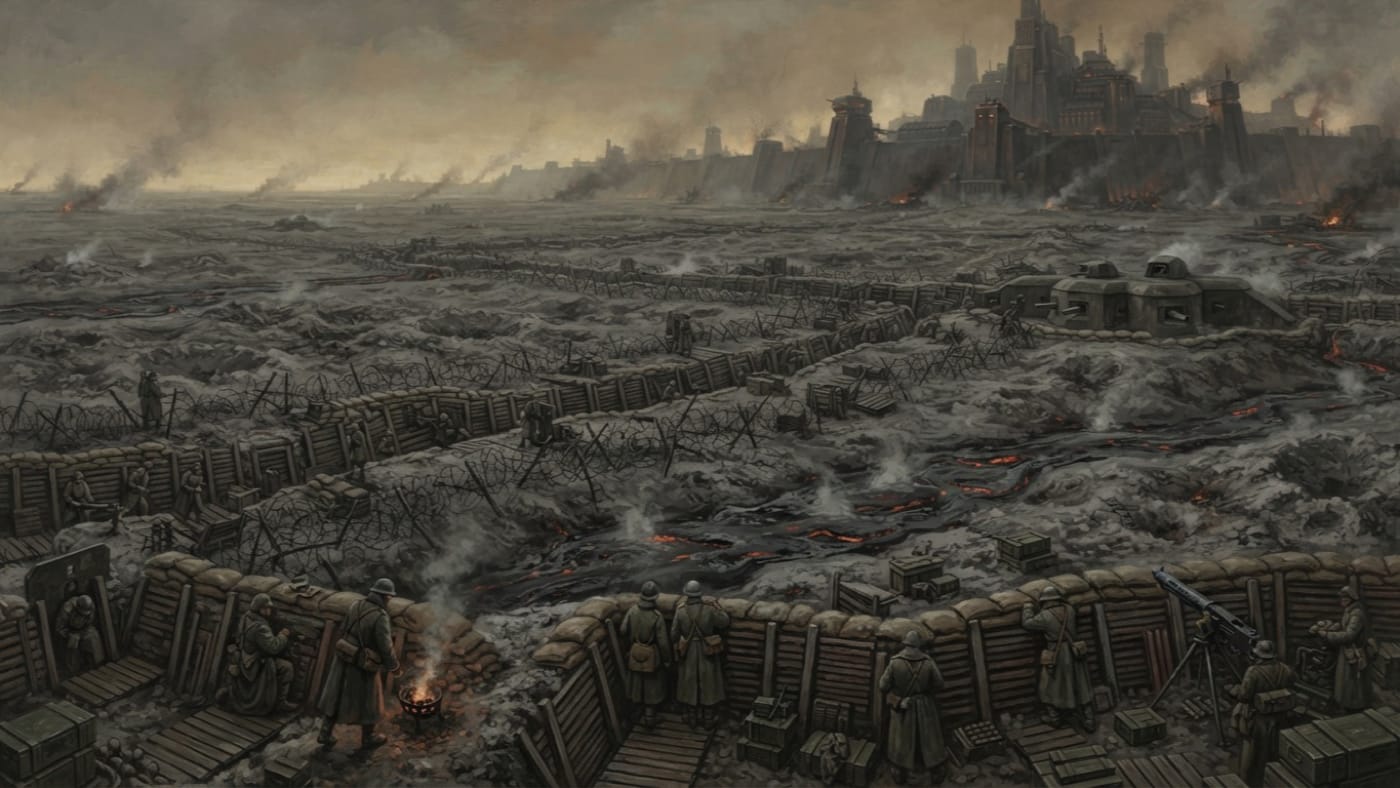
The published account gives sixty miles of flat approach running north from the walls before the terrain does anything of interest. The figure comes with no surveyed perimeter, width or area, and I am not going to supply them. Across those sixty miles the ground stays open. It is cratered by shells and dusted with ash. Trenchwork and wire cut across it, mines are sown through it and battery positions sit on it. At intervals it is crossed by the slag-rivers that Maldrake left behind after earlier campaigns. A slag-river is a ditch you did not dig, running hot in a direction you did not choose. Sappers route their drainage around them and wire parties measure their distances from them. A trench that runs into one stops there.
The flatness is the whole difficulty. Nothing on the Plate hides an army, and nothing slows one down. Formations that would have to string out in the Balkan passes can deploy here in line, in depth and in daylight. That is how they come.
The Ravelin of Vigilance is the northernmost of the Bastion's six outer works. It faces this ground, and it faces the Knife-Mile beyond its parapet. Its watch-face, its low artillery platform and its listening-recesses all point the same way. The maps disagree about where the Knife-Mile's gnawed stakes end and the open wire of the Plate begins. I will not settle the question by drawing a line that some unlucky sapper would then be ordered to defend.
The registry separates the contested apron from fallen Thrace behind it. The apron is the ground our artillery can reach and our patrols sometimes come back from. Fallen Thrace is where the forge-country begins, and where the Bureau's interest becomes purely a matter of watching. Ferrum-North is the apron. Nobody files requisitions for the far side.
Older plates of this Codex styled the fortress at the head of these approaches "Bastion-Lorraine," crown of the Bosporus and Western Anchor of the Line.
The fortress is Bastion-Constantinople. It stands at the Bosphorus as the southern anchor of a Line that runs from north to south, and it anchors nothing in the west. The retired name survives only as a redirect, which is more courtesy than the Bureau of Records shows most retired things.
#The Bunker Beneath Fortitude
The Thracian theater is commanded by Marshal-Elector Galien Vaubret. The papers I am permitted to see do not explain how the electors elect him, or exactly how his reports reach the desk of Governor-Praelate Hugo. They record only that they arrive.
Marshal Vaubret commands from a reinforced bunker beneath the Ravelin of Fortitude. That ravelin faces nothing in particular, which makes it the most sensible place from which to face everything. I have attended his briefings. He speaks of the Plate in contour lines and wire-gauge specifications, in enemy formations and the expected drift of slag, with the calm of a man pinning beetles to card. He never raises his voice. The maps on his wall do that for him, in red pencil.
Most of the work on Ferrum-North is repair. Shellfire cuts the wire, and it is relaid at night. Trenches fill with ash and slump, and they are dug out by men who will dig them out again within the month. Battery platforms sink and are jacked level. Every one of these tasks becomes a line in a return. The returns reach me as figures: yards of wire, man-days of spadework, and losses entered in a column headed Wastage. The Bureau of War uses that column for sandbags and for men, and it sees no reason to keep two.
The Bureau of Records keeps its own tally of shells fired against the Thracian approaches. As of A.S. 201 it stands at twelve million four hundred thousand, and some. The and some is part of the official figure. The figure records what was spent and says nothing about what it achieved. I have learned not to ask the Bureau of Records questions whose answer would only be a longer number.
Marshal Vaubret does not pray during his briefings. His subordinates pray for him, quietly, at the back of the room. For years the Bureau of War and the Bureau of Doctrine have disputed whether this counts as devotion by delegation or dereliction by proxy. The Marshal has declined to comment. What he believes alone in his bunker at night is not entered in any ledger I keep, and I will not invent an entry to please either bureau.
#What Faces North
Maldrake the Wrathforged, Sin-General of Wrath, values the Plate for exactly the reasons we fear it. Visiting theorists from the rear like to say that Wrath is blind fury, and that a demon who marches in the open must be a fool. The men at the wire do not say this. Maldrake's war is ordered the way a hammer is ordered against an anvil. Each blow is deliberate, each is repeated, and all of them are meant to exhaust. He does not hurry, and he has no need of cover when he has this much room.
The Hellbow Legion musters on this ground. Its archers fire bolts of molten slag that burst when they strike. A bolt that misses the man still finds his sandbag, his duckboard and the timber of his revetment, and sets all three alight. Pyre-smiths move among the enemy ranks and brand their own soldiers with burning runes, so that a branded demon bursts into fire when it falls. On the Plate, even a dead enemy is a charge that still has to be cleared.
Somewhere out on the grid is the Flameheart Colossus. At the briefing I attended, Marshal Vaubret placed it at grid reference four-nine-seven and remarked that it had not moved. In his judgment, that was worse than if it had. His staff wrote this down. Nobody in the room offered a reason, and I offer none here.
To the north-east, the marshes facing the Ravelin of Purity belong to Kargath the Devourer, Sin-General of Gluttony. He presses the Bosphorus from the Black Sea and spoils whatever convoys he can reach. His reeds meet Maldrake's slag at the edge of the theater map. Sharing a border does not put them under one command, and I have seen no order of battle that combines them. The parent record calls them rivals as much as allies, and the Bureau has not improved on that wording. Velkara's agents work inside the city and Velmora's corruption works through its accounts. Those are miseries for other articles. The Plate belongs to Wrath.
#Ash, Moss and the Moving Slag
In A.S. 143, the Year of Ash Rain, Maldrake set fire to the Thracian forests, and ash fell on Constantinople for nine months. Crops failed across the eastern prefectures, and the Ninth Bell Famine followed. No wall was breached and no gate was forced. The officers of Ferrum-North drew their own conclusion: the ground in front of the fortress can be used against its granaries without anyone coming near the walls. The ash has never been entirely cleared. It still lies in the trench floors. It still settles over the Ash Gardens after each fire-season. The gunners on the Vigilance platform still brush it out of their breeches before the morning bell.
Nothing useful grows in the soil of the Plate. In hexagonal patches, though, it grows an iron-gray moss that smells faintly of sulfur and rings like struck metal when the wind moves across it. The engineers handle it warily. The Bureau of Doctrine has classified it as "meteorological debris not requiring doctrinal response." I was instructed not to send samples to the Bureau of Purity for analysis. The instruction arrived before I had submitted the request. I record that timing and nothing beyond it.
The slag requires greater care, because it reaches the Codex only through the Registry of Unsubstantiated Claims. The supplemental memorandum filed there, which is unconfirmed, reports that engineers on Trench-Section 14 of the Thracian trenchlines first noticed the trouble through their drains. The drainage works kept failing in sequences too regular to be chance. Bureau inspectors were sent. They reported what they called "routing behavior" in the slag beneath the works: it moved toward some points and away from others. The inspectors were recalled before their survey was finished, on grounds the Bureau of War has filed under operational security. They never established where the slag was going.
The official position of the Bureau of Doctrine is that this is the natural thermodynamic behavior of cooling magmatic material. I wrote that position. It stands as the explanation of record. The memorandum stands in the Registry. Both are filed, and neither has been closed.
#Present Condition
As recorded for A.S. 201, Ferrum-North is contested and actively defended. Shells cross it in both directions, and Vigilance watches it at every bell. The wire is relaid each night, and the Bureau of Records goes on adding to its count of shells. Grid four-nine-seven is still marked on the Marshal's wall. The Bureau of War keeps the Plate on its register as an operational zone. In practice, that means more men go out to it at dawn.