

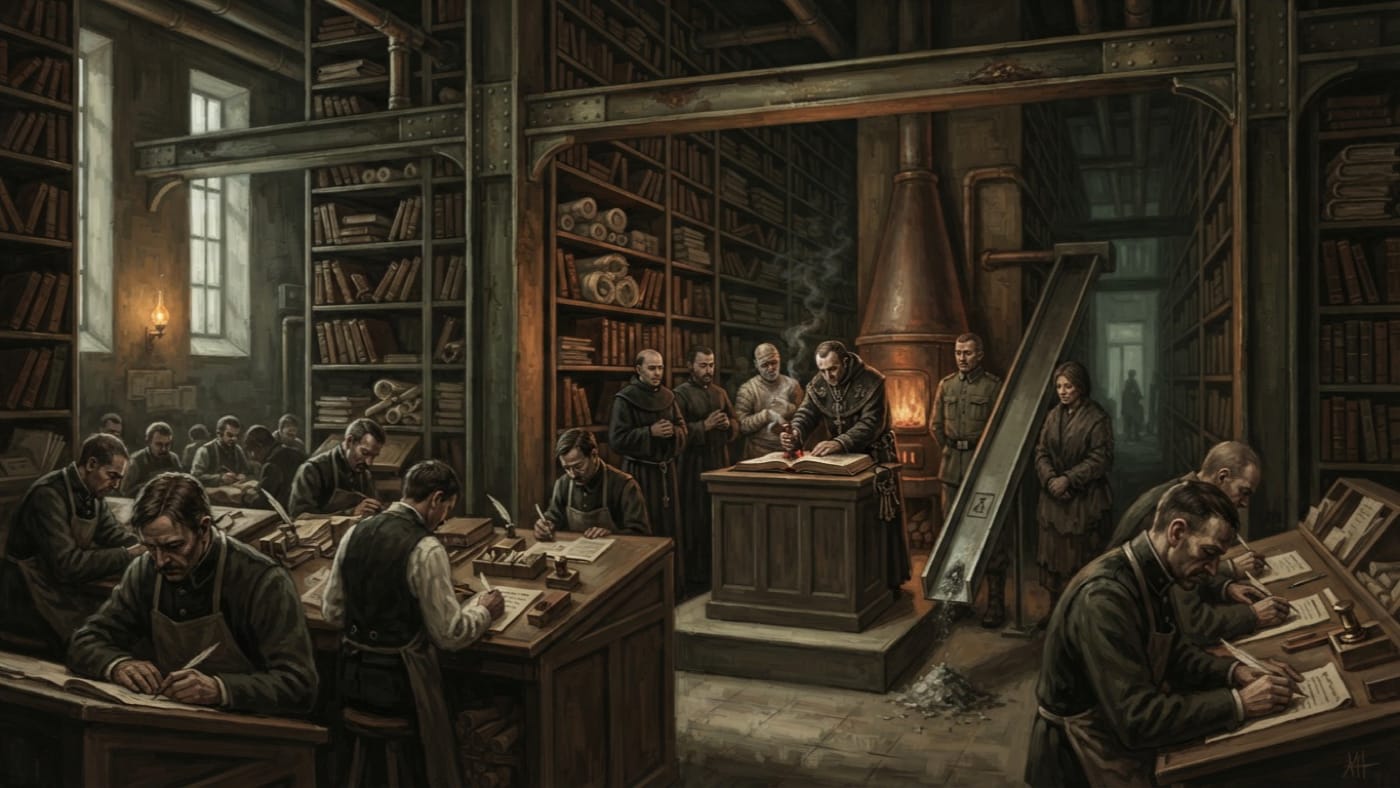
Compiled for the Bureau of Doctrine in A.S. 201 / 1911 CE. That is the year of this compilation. It is not the year the doctrine began, and it marks no edition, inspection or event.
#On the Question Before the Court
A household cannot eat historical truth. It eats bread bought with arrears, and arrears are paid against a record. Every quarrel about the doctrine called original by ratification ends up back at that ugly little sum.
The doctrine answers one question. When the Church's papers contradict one another and someone still has to be paid, buried, charged or released, which paper governs? Abbot-Registrar Solene gave the answer: a corrected copy, witnessed and sealed, which is then treated as the record from which legal consequence flows.
That is all the evidence supports. Readers who came for a statute of forty articles, a seal formula and an appeals ladder may leave by the gatehouse. I have not found those instruments, and I will not forge them for your comfort. On this subject forgery is a professional discourtesy.
#On the Origin
The Concordat of A.S. 90 made contradiction intolerable. Six years later the Church built a house in which to suffer it. The Hollow-Script Scriptorium of Nemea went up in A.S. 96 under a writ of the Bureau of Records, on a chalk ridge in the inland heartlands, over Benedictine rubble left by the Atheist Wars. Three provinces counted the same households three ways. Martyr lists disagreed about bones, and command rolls promoted the dead.
The Bureau of Records was freshly constituted in A.S. 96 and built Nemea as its first labour.
CORRECTED. Records was transformed under Archon Veyrault in A.S. 78, out of wartime record networks older still. Nemea centralised an apparatus that was already running. The scriptorium dates from 96. The Bureau does not.
Veyrault sent Solene of Lyon to the ridge as first Abbot-Registrar. Her dossier says she carried authority to declare a copy original where necessity required it. I note the phrase. Necessity is a limit, and a limit is the first thing a successor forgets. Nothing in the surviving account makes the power automatic, general or unbounded. It was a registrar's remedy for particular papers, heard before particular witnesses.
#On the Substance: Odran Pell
The dossier gives one case in full and calls it the first. A wagon-master named Odran Pell was alive in the tax ledgers and dead in the troop rolls. A tribunal copy, made by a clerk who had never seen his face, found him guilty of desertion. That makes three records for one wagon-master.
Solene summoned two chaplains, a quartermaster and Pell's sister. She also summoned a man missing three fingers who remembered loading Pell onto a fever cart in A.S. 51. That year belongs to the cart. The account gives no date for the hearing, and I will not supply one for the account's convenience.
She declared Pell dead. She paid his arrears and voided the desertion. She ordered the contrary copies burned.
Here is what the case establishes. A family that was owed money received it. A charge that would have followed a dead man's name through every register was struck. The witnesses were of named kinds (clerical, military, familial and one mutilated carter), and their testimony was weighed against the papers before the wax went down.
The case does not prove that Pell died on that cart, or that every detail of the corrected copy is accurate, or that the burned rolls held nothing true. The burning settled that question badly. Once the contrary copies were ash, no one after Solene could test her against them. The family's relief and the loss of the evidence came in the same act, under the same seal. A ratified original is the record the law will obey. History may still disagree with it, though after a burning history has little paper left to argue with.
#On the Fire of A.S. 103
Seven years after the founding, fire consumed the west scriptorium wing and half the novice dormitories. The ink survived. The names did not. Clerks rebuilt the books from memory and fragments, and they could not always swear whether a family they remembered was real or a counterfeit of their own making. Veyrault's Bureau declared the reconstructed records original by ratification. Veyrault was still living then and still directing Strasbourg.
Original by ratification was invented in answer to the A.S. 103 fire.
AMENDED. Solene practised it before the fire. After 103 the Bureau applied an existing remedy to a whole rebuilt archive. No document before me says whether that declaration was itself a formal statute, or in what words.
What changed was the scale, and the character changed with it. Solene heard witnesses over one wagon-master. The Bureau ratified whole shelves at once. A collective declaration over reconstructed books tells us those books would govern. It does not tell us which families were restored correctly to the Great Ledger, which were lost, or which an exhausted clerk with a good memory invented on a bad night. I have looked for a register of individual outcomes. Either it burned or it was never kept. A bureau rarely writes down the people it failed to rescue.
#On Custody, Challenge and the Glass
A doctrine that lets one copy govern lets its keeper govern. At Nemea the keeper is Abbot-Registrar Maelen Voss, who holds the Chapterhouse seal and the keys to the originals. The Margin Court decides disputes of record, and it hears certified copies, because the leaves in the under-vaults are Voss's to show or withhold. A Margin Judge may rule on what a document says without ever seeing the document.
Before a certificate reaches the bench it must pass the Silence Test Collegium under Silence-Master Rhu Tern. Its testers read under lamps and mirrors by a classified protocol. I cannot describe that protocol and will not pretend to. The lamps and lenses come from Lampglass Row. The Row's Compact also sells, to discreet buyers, lenses said to reveal hidden names written in counter-ink. No authority has certified that those readings are true. A lens can sell a reader a name, but it cannot make that name govern. Only the seal can do that, and the Compact does not hold the seal.
The consequences fall lowest in the Novice Barrens. Novices give up their birth-names at the Silence Gatehouse. They work under quotas and vow contracts and run up page debt. That debt is paid by night shift, by confession, or by surrendering a family name to correction. No source explains how the surrender at the gate relates in law to the later one, and I will not invent the connection. No source says that each vow contract, intake designation or correction is a ratification in Solene's sense, either. They are documents held under the same custody. That gives a novice reason to be careful. It does not give a doctrine.
Then there are the contracts. In A.S. 198 the Chapterhouse classified the Night-Rewriting Contracts. Terms were reported growing longer overnight and debts larger, and witnesses were reported moving into the body of a text as debtors. When this began, and why, remains unresolved. The precautions are salt-lamp circles, mirror checks, silence tests and the standing order to burn the second draft. They are obeyed, and the documents are reported to keep changing. I set this anomaly beside the doctrine and refuse to merge the two. Ratification is a legal choice made by human hands. The rewriting is a documented anomaly claim, and no one has named whatever is doing it. If a sealed copy changes after sealing, the law faces a question Solene never answered: does it obey the seal or the morning?
#On the Present Application
Inquisitor-Corrector Sel Durn has been dispatched to Nemea this year. Dispatched is the word on file. No inspection, finding or judgment has reached my desk, and a dispatch is only a man on a road. When he arrives he will read certified copies by Row glass, under Voss's seal and past Tern's mirrors, and he will find what I have found. The Church can make a record govern. No instrument I have seen claims it can make the record remember correctly.
Solene paid a family. The Creator alone knows whether Odran Pell died on that fever cart, and the Creator files no copies with the Margin Court.
Compiled A.S. 201. The compiler ratifies nothing here except his own signature, and that remains under review.