

#On the Collegium's Warrant
"Read the line. Say nothing else." — instruction at the Silence Gatehouse, spoken by every tester and credited to none
Every document that enters Nemea must pass a silence test. Every document that leaves must pass one too. The Silence Test Collegium runs both, and in a town that lives on paper crossing its gates, the order that keeps the gates keeps the town by the collar.
The charter puts Nemea under the Archive Chapterhouse and the Margin Court, and the charter is correct. The Abbot-Registrar holds the seal, the Court holds the disputes, and the correction bells ring on the Chapterhouse's schedule. The Collegium holds the gatehouses and the verification rooms. That is a smaller holding on paper, and in practice it reaches further than any of them.
Its public office is catching counterfeits. Silence-Master Rhu Tern commands it. It trades like a guild and conducts itself like a rite order, and the town fixes its testers below the senior scribes and above novice labour. They wear mirror pins. I cannot tell you how many of them there are, what grades they hold, or what vows they took, because the records I was given do not say. I did not ask the Silence-Master. A man who listens the way Tern listens is best left without questions he would prefer to answer with a pause.
Nemea was raised in A.S. 96 to gather up a Records apparatus that had already been reformed eighteen years before and was still choking on contradictory ledgers. The Collegium's own formalization shows up in the town's compressed annals as a reform after the fire of A.S. 103, and nobody has troubled to give it a year. I leave it undated. The Bureau of Doctrine does not invent birthdays for institutions that have shown no wish to celebrate them.
#On the Verification Rooms
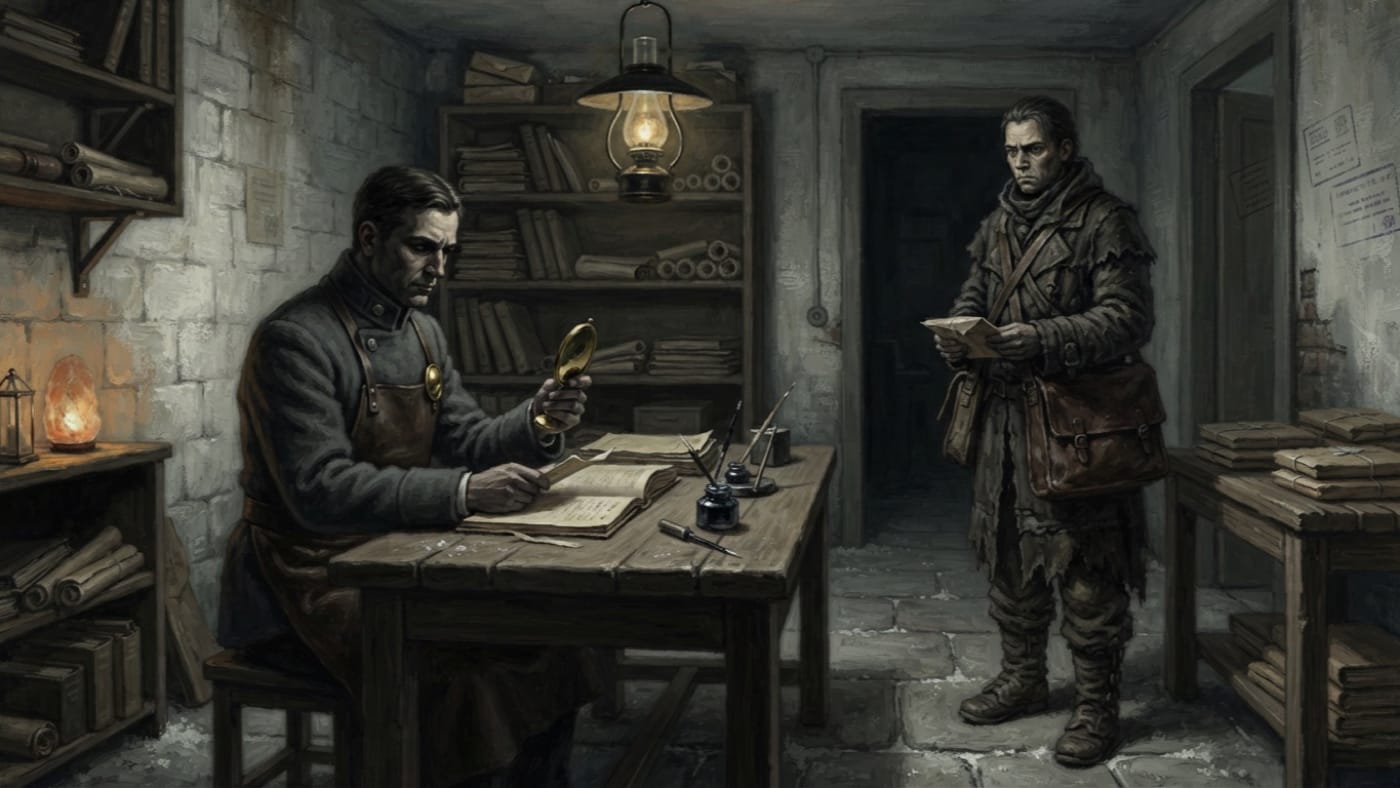
The rooms are cold. The stone is chalk, the floors keep a white grit that no novice's broom ever fully clears, and the air smells of lamp oil and vinegar ink. Sealed packets wait on a side table in the order they came in. The door is never shut, so the next courier stands on the threshold and watches.
The test calls for lamplight, mirrors, observation of the breath, and a controlled reading. The bearer reads a line aloud and must do it without casting what the gate clerks call a shadow-sound. I will not define the term. The Collegium has not defined it for me, and anyone who could reproduce the test from a codex entry would have no further need of the Collegium. The exact sequence is classified, and I respect that classification more than most. Nobody else in the room speaks while the test runs. The taboo holds as firmly as any rule in the stacks.
The mirrors stay under cloth until they are wanted. Tern insists on this, and his testers follow him. Nemea forbids carrying mirrors through its streets, because mirrors catch what the town calls living text. So the only uncovered glass in town belongs to the people who are paid to look into it. When a brass mirror is lifted from its cloth and held to a page, it shows any text that has shifted since the last certified reading. The page either matches its prior self or it does not.
A failed document goes no further. The courier's packet stays on the side table and the courier stays on the threshold. A novice's intake paper stays on the wrong side of the gate, and the novice has already given up a birth-name and not yet been issued an archive designation, which leaves them nobody in particular until the paper moves. What happens after that depends on whose paper it was and who is willing to dispute the failure. The Collegium has done its part. It has said no.
#On Custody and Refusal
Abbot-Registrar Maelen Voss controls the originals, the vault keys and the Chapterhouse seal. In Nemea that is the difference between an authority and a rumour of one. Tern has nonetheless failed documents that Voss wrote himself.
The two offices answer different questions. The seal certifies where a page came from. The test asks whether the page is still the page that left that place. A document can be lawfully sealed by the highest hand in the Chapterhouse and still come to a tester's table altered, so a sealed original can still fail. Nobody has shown that Tern holds a general veto over the Abbot-Registrar, and the Collegium has never claimed to outrank the Chapterhouse. It has only declined, on the occasions recorded, to pretend that the seal and the test are the same thing.
A lawfully sealed Chapterhouse document is exempt from silence testing, since the authority of the seal precedes and supersedes any inspection of the page.
CORRECTED. Every document entering or leaving Nemea is tested, the Abbot-Registrar's own included. The seal establishes origin and the test establishes present condition. The Bureau of Doctrine regrets the earlier wording and notes that it was believed sincerely by every official whose papers had not yet failed.
Others have their own stake in this. The Margin Court profits from deciding what is real, and every failed document is a dispute waiting to be filed. The Lampglass Row Compact makes the panes and lenses that every reading depends on. It sells to the Collegium and it also sells elsewhere, and its interest goes wherever its ledgers point. "Sister" Halvein, who has no title and does not need one, trades in redaction drafts, and a page held at the gate is a page someone will pay to have spoken of quietly. I cannot report any compact among these parties, and I report none.
#On Text That Will Not Remain Still
The Night-Rewriting Contracts were classified in A.S. 198. That is the year they were classified. Nobody has proved it was the year they began. Contracts in the vaults gain obligations overnight. Three years of service become five. A debt of forty ration-chits becomes sixty. A guarantor's name moves off the signature line and into the body of the text, and by morning a witness has become a debtor.
There are four standing countermeasures: salt-lamp circles burning over sensitive documents through the night, mirror checks, silence tests, and the order to burn the second draft, which means destroying at once any document that contains text missing from its certified copy. The Collegium runs two of the four and is consulted on the others. Some in the copying halls hold that pages kept under salted lampglass do not rewrite at all. I record that as a precaution the town takes seriously. Pages still rewrite. The order is obeyed and the contracts keep moving.
The Chapterhouse blames the Second-Draft Circle, a heretic cell that preserves originals and works to undo erasures. The Circle blames the ink. No one has proved the Circle guilty, and the earlier theory of one contaminated Inkhouse vat was given up once that vat turned out to be identical to the rest. The record of Tern's fear says he fears living text spreading, and he does not appear to care much who is doing the writing.
Two testers are stationed full-time in the Redaction Yards, where condemned records burn and the ash sometimes forms readable fragments, clauses and names in the air before the wind breaks them up. The Collegium has designated this a Category Two Textual Remnant. The testers write down what they see, and their transcripts are sealed. A remnant being legible tells you only that it can be read. The Church has burned a great many legible lies.
#On the Price of Verification
A verification room needs oil for its lamps, glass for its mirrors and lenses, and clean paper for its records. Nemea imports all three and has never had enough of any of them. The streets put it plainly: without light, nothing is provable. The Collegium is the body that decides what counts as proof, so every shortage of oil or glass reaches its tables before anyone else feels it.
At the gate the customary offerings are clean paper, lamp oil and blank leaves. I record that the custom exists. I found no schedule, no fixed rate, and no clerk who would admit to keeping one.
The cost falls on people who cannot leave their papers behind. A courier whose sealed packet is held carries the delay to the next tribunal and gets blamed for it there. A debtor whose contract grew overnight needs a mirror check to prove that it grew, and then has to watch the burn order applied to whichever draft the Chapterhouse decides is the second one. A petitioner asking the Court to recognise a name needs papers that will pass a test whose steps they are forbidden to learn. The town has a name for the rare forger said to get through by breathing wrong, which shows that the town has been studying the test as closely as the testers study the town.
The Collegium owns the mirrors, the procedure and the power to accuse. That is the monopoly. It is a competent one. It catches counterfeits, it has stopped the Abbot-Registrar's own paperwork, and it watches the Yards when everyone else would sooner look at the floor. None of that tells it whether the page in front of it is just. The test can say that a page has changed, or has not yet changed. It cannot say whether the page was true in the first place.
#On the Present Application
In A.S. 201 the gatehouses are open and the side tables are full. Documents still fail. Contracts still rewrite overnight while the salt lamps burn over them. The two testers in the Yards keep writing down what the ash spells, and the transcripts go into sealed custody unread by anyone outside the Collegium.
Inquisitor-Corrector Sel Durn has been dispatched from Strasbourg. The dispatch is recorded and nothing more is. When Durn reaches the Silence Gatehouse, the Inquisitor's warrant will be read aloud under lamplight, a brass mirror will be uncovered beside it, and no one in the room will speak.
The Bureau of Doctrine certifies the Silence Test Collegium as necessary, effective within the limits of its rite, and answerable to the Chapterhouse under charter. The Great Ledger will carry that certification as written. Tern, I expect, will test it.