
#On the Voice Sent Forward
"Clean carrier, clean conscience." — engineers' saying, east range, Cloister of Calibrated Breath
At a quarter past the dawn brief, a field kitchen behind the Sagittal Line waits on a horn. The cook has flour for two hundred and an order for three hundred and forty. The difference will be settled by whatever voice comes out of the brass. If the ration amendment arrives forward, the loaves are cut thinner and the garrison eats. If it arrives bent, the cook follows it anyway, because it carries the Hierarch's cadence and the correct seal-phrase. The garrison then finds the error with its stomachs.
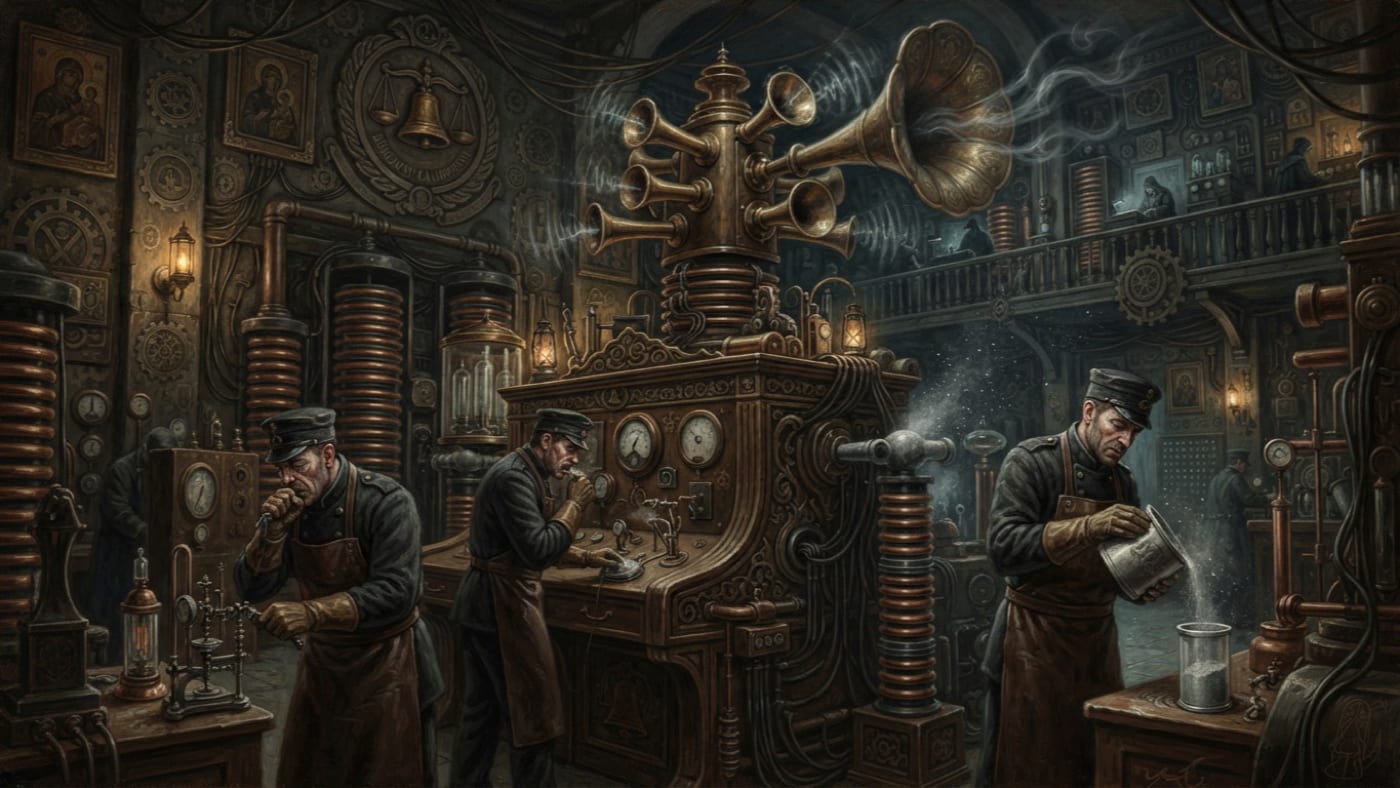
An Orison signal is the Synod's approved speech, sent over distance on a carrier laced with Saint-Dust to protect it from corruption. It carries prayer, ration schedules, casualty corrections, curfew notices, work instructions and military orders, often within the same hour and with the same reverence. The Orison Hour is its most famous use, and so the laity confuse the two. The Hour is one item on the schedule. The signal is the throat that carries it.
#On the Carrier and Its Custody
The Bureau of Orison and Song governs licensed voice under its charter of A.S. 92 and the licensing legislation of A.S. 94. Within it, the Broadcast Directorate administers transmission. Its holdings include copper lines, horn relays and coil rooms. It also runs fixed broadcast houses, hardened repeaters behind the trenches, fog towers at the ports, waystation transmitters along the pilgrim roads, and the aerial sermon-horns aboard the Vigil Arks. None of it is sold to the public. A receiver is issued, licensed, logged and audited, and a district that cannot hear the signal is presumed to have chosen deafness.
The Cloister of Calibrated Breath at Strasbourg houses the carrier rooms, the dust reconciliation and the Clean Carrier benches. The Bureau of Bells supplies authorized peals, timing and acoustic reference. The Bureau of Records keeps the paper in custody. That makes three offices, three seals, and a standing agreement that each will blame the other two.
The work belongs to the Orison Signal Engineers, called Dustcasters in the street and worse in the coil rooms. Their sequence is fixed. I reproduce it here because every later failure is the failure of one of its lines.
The dust is a blend of authenticated relic residue, bone ash, sanctified salts, grave wax and calibrated harmonic salts, graded and mixed under witness. No office has explained, to my satisfaction or its own, what it does inside the carrier. What it is observed to do is reduce parasitic inversion. Engineers do not claim that the powder itself travels into every horn in the province. They claim that the signal leaves the coil harder to bend, and the logs bear this out often enough for the Church to call it a sacrament.
The Clean Carrier certificate attests that a message arrived as it left. It says nothing about whether the message was honest, merciful or wise. A decree may be perfectly authorized and perfectly vile, and its certificate will be perfectly in order.
#On Inversion
Jamming is a nuisance. The horn hisses, the district hears nothing, and a runner is sent with paper. Inversion is what the Directorate actually fears. An inverted signal keeps its familiar voice, its seal-phrase, its cadence and its apparent authority, yet arrives meaning something else. A ration increase becomes a ration withheld. An order to hold becomes an order to advance. Comfort tilts into panic. Nobody riots at static. People obey inversion.
The main hostile source is the Pale Chanters, whose unhymns ride counter-frequencies into the sacred air. Formal reports call them counter-hymns. Sabotage, mimicry and rival transmissions account for the rest. Every Wirehand learns the warning signs before touching an urn: backward consonants, timing drift, chorus-phase anomalies. On bad nights, listeners report an under-voice beneath the Orison speaking their own names. The Directorate has recorded these incidents. It has not identified the speaker, and I decline to do its work for it.
The countermeasures are few and expensive. The engineer recalibrates the carrier and adjusts the dust fraction, lays a counter-orison overlay, checks against a Bells reference tone, then tests and reseals. Where a repeater may have been captured, the engineer kills it and the district goes deaf. The purists' answer is more dust. Overloading clogs the coils, ruins filters and produces choir-bloom, and after that the hallucination reports become the engineer's problem.
Engineers keep one teaching account, the First Unhymn Winter. In that account a rival city inverted ration broadcasts, and thousands are said to have starved in authorized panic before anyone traced the feed. The date, the cities and the count survive in no form I would sign. Novices are told the story anyway. It is the only lesson in the course that nobody sleeps through.
#On the Dust That Settles Wrong
"If it settles, it is true." — Grader's proverb, Mournwater
The Saint-Dust Cooperage of Mournwater is an important supplier of broadcast dust, though not the only one. Relic stock and battlefield salvage feed the reservoirs too. Mournwater's grading and certification connect directly to those reservoirs. A batch settles under the Grading Hall prayer and receives its White Steps seal. It then travels the River-belt in sealed casks and reaches a broadcast house as a line in a requisition table. From there it goes into the injector.
In A.S. 194 the Bureau of Alchemical Standards classified Crumble-Wrong, the Category Two Irregular Settling Pattern. Affected dust hangs, drifts sideways or arranges itself into bone-like shapes when it should settle. A.S. 199 brought Dish Twelve and the southern shipment cases. In A.S. 200 Alchemical Standards and the Bureau of Rites reviewed the matter together. In A.S. 201 the Cooperage operates under second-settling guidance: the dust is asked twice and believed on its second answer.
The Directorate's concern is narrow and exact. Two coil rooms reported rosary-shaped residue inside sealed injector housings, the chambers where dust waits before it meets the carrier. Nobody had broken the seals.
Orison requisition tables: Mournwater dust "stable under broadcast agitation."
Withdrawn. Two coil rooms found rosary-shaped residue inside injector housings whose seals were intact when inspected. The assurance promised that the dust would survive agitation. What was observed was dust arranging itself under agitation. Supply continues on a presumption of stability that is no longer printed.
Nobody has shown what such dust could carry into a signal. Private Orison memoranda fear that a compromised reservoir might broadcast "bone memory," teaching receivers to listen for the dead beneath the Hierarch's voice. That fear is written in Bureau ink. Ink is not a mechanism. The under-voices that speak names have not been tied to any Mournwater batch, and I will not tie them myself.
Upstream, the River-belt tells stories about what is being ground into the slurry, and whether all of it was dead when it went in. Those stories are suspicions. The Bureau of Doctrine endorses none of them in public.
#On the Price of Clean Arrival
A clean signal is paid for in lungs. Dustcasters breathe the work, and it costs them inhalation damage, the gray cough, fingertips burned on the coils, ears ruined by calibration tones and the exhaustion of the unhymn hours. Over all of it hangs the prospect of prosecution when a feed fails. A mask filter still white at the end of a shift is a mark of status. Most are not.
Scarcity makes the signal political. When dust runs short, allotments are diluted, and diluted dust makes a thinner carrier. Filters are rationed in the same ledger. Merchants and district bosses pay for better reception. Engineers who refuse them stay poor. Engineers who accept become useful to auditors later. The engineers say a clean feed is allocated, never earned, and they have the ledgers to prove it.
When a district hears its ration notice bent, Records audits attendance and Purity audits the crew. Someone junior is found to have broken a seal, and the runner is punished. The carrier is retuned by the same officer who certified it clean. Nobody audits the cask.
#On the Present Transmission
As of A.S. 201, the Orison signal runs throughout the Synod's reach under strained supply and continuing anomaly. Every transmission requires a Clean Carrier certificate. Every Mournwater cask bound for a broadcast reservoir requires second settling unless supply priority overrides it, and supply priority usually does. Injector housings are inspected more often and opened less willingly. The contamination risk remains unresolved. The Orison Hour has not been delayed once.
The kitchen behind the Line still waits on the horn at a quarter past the dawn brief. Nobody has told the cook about the injector housings. The cook has been told to listen.