
#On the Arm That Makes Distance Obey
The Broadcast Directorate is the long throat of the Bureau of Orison and Song, the office that takes a decree in Strasbourg and forces it into the ears of a cook at Bastion-Brest, a fog-clerk at Calais, a pilot under the Bosphorus guns, a widow in a ration queue, and a condemned boy standing beside a receiver with his cap in his hands. The Hymnal Directorate (Unregistered) owns printed sanctity. The War Directorate owns weaponised sound. The Broadcast Directorate owns reach.
Reach is empire. A sovereign whose voice cannot arrive is a rumour with guards.
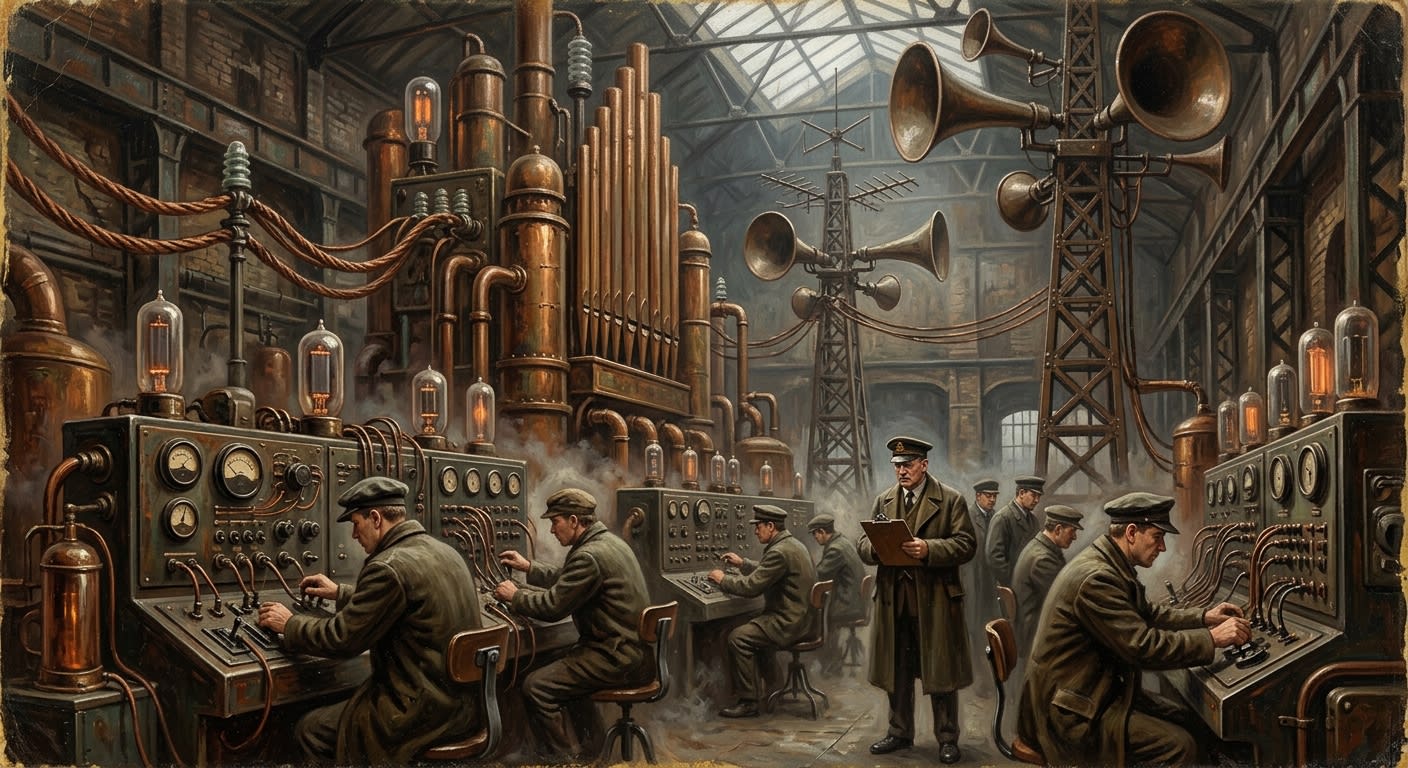
The Directorate sits within the Cloister of Calibrated Breath at Strasbourg, beneath vaulted rooms where copper coils sweat in incense-damp air and Orison Signal Engineers cough into black cloth with the resigned dignity of men being slowly converted into office supplies. Its seal is a mouth inside a halo of transmission rings. Its motto, used internally and denied publicly, is simple: Static is where the Enemy prays.
#On the First Need for Clean Arrival
Early broadcasts were honest machines. This was their defect. They carried sound and nothing more, as if the air were a neutral road and not a public latrine through which every rival cadence, hungry silence, foreign sermon, Pale Chanter phrase, and demonic little invitation might crawl with excellent manners.
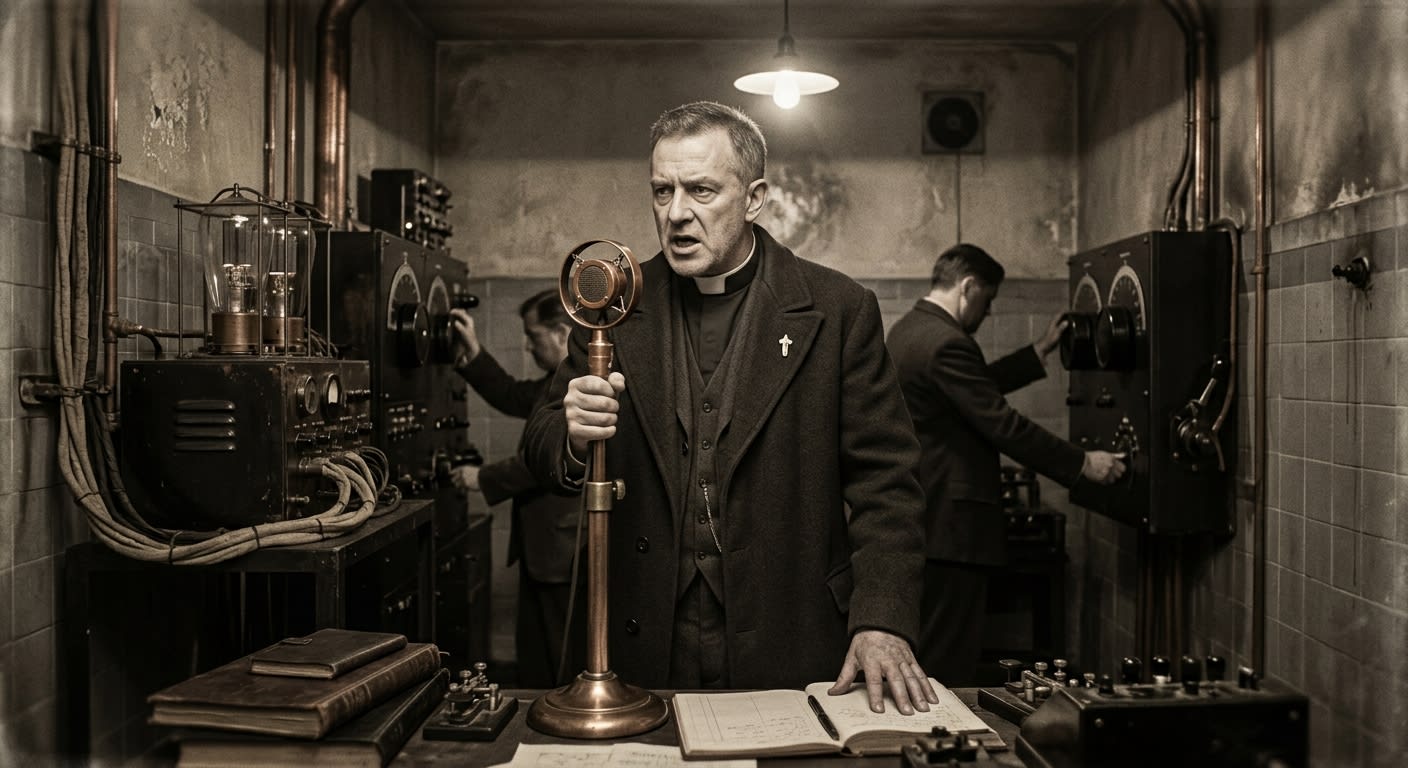
The first signal houses after the Concordat of Strasbourg carried catechisms, route notices, ration corrections, curfew changes, and war bulletins by copper line and horn relay. They served well enough in fair weather and obedient districts. Then the First Unhymn Winter taught Orison that a message need not be blocked to be conquered. A ration notice reached a ward clean in volume and rotten in intent. The words remained official. The meaning learned hunger. Families obeyed themselves into starvation because the signal sounded authorised, and authorisation is the Synod's most dangerous sacrament.
Early technical memoranda described the Directorate's founding problem as “interference.”
Corrected. Interference is what amateurs blame when the apparatus makes noise. The Broadcast Directorate was formed against inversion: the preservation of official wording while the soul beneath it is replaced. A jam is rude. An inverted command is treason wearing the correct uniform.
Field engineers answered before theologians found the right Latin. They mixed authenticated bone ash, grave wax, sanctified salts, and powdered martyr-scrap into carrier apparatus. The signal changed. The hostile cadence weakened. The words arrived forward. The Bureau saw the field hack, measured it, blessed it, monopolised it, and built a Directorate around the men who had been desperate enough to breathe their own solution.
#On the Apparatus and the Dust
A broadcast house is a crypt that learned to shout. The coil room smells of hot varnish, ozone, wax, salt, breath trapped inside masks, and saint-dust drifting from seals whose manufacturers have already sworn themselves innocent. Copper banks hum against stone. Tuning forks lie in velvet-lined trays like surgical relics. Urn cages stand under double lock. The operators wear respirators marked with tiny sigils of Saint Damaris of the Coil, a patroness whose historical existence is disputed by everyone except the men coughing up her supposed protection.
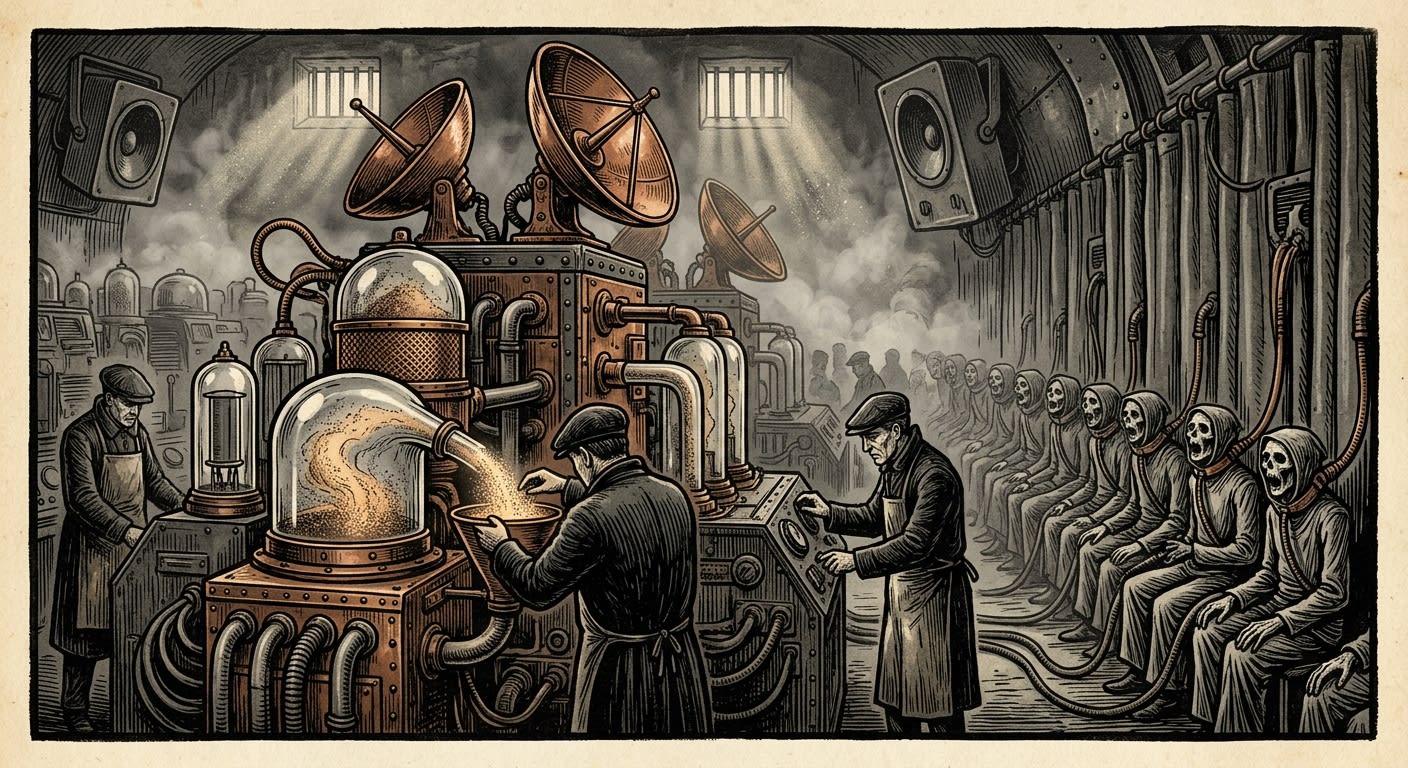
The process is liturgy because the Bureau distrusts naked technique. Message authenticity is verified by wax, cipher, witness mark, counterseal, and a clerk whose chief spiritual gift is suspicion. The dust blend is selected by class: saint-grade for doctrinal packets, front-grade for military orders, port-grade for fog towers, emergency ash for moments in which later prosecutions may require a convenient adjective. The carrier is calibrated: frequency, guard band, cadence spine. Dust is injected through venturi or coil-film method. A test prayer is cast. The engineer listens for backward consonants, sweetness in the teeth, delayed sibilants, names beneath the third verse.
Saint-dust is the Directorate's proudest poison. It works. That little sentence has murdered more objections than any Inquisitor. It also ruins lungs, clogs filters, contaminates cuffs, stains teeth, and turns veteran Orison Signal Engineers into men who sleep sitting up because silence at full length feels too much like burial. The Directorate calls this occupational devotion. The engineers call it the lung-tithe. Both terms fit. One has better stationery.
#On the Orison Hour
The Orison Hour is the Broadcast Directorate's daily act of conquest. Parish posters call it common prayer. School manuals call it unity. Records calls it scheduled transmission class 1-A. I call it empire checking whether Europe still has one throat.
At the appointed hour, every major transmission house releases the approved packet: prayer, ration advisory, curfew amendment, casualty roll, work quota correction, feast calendar, doctrinal notice, and the day's moral cudgel tucked inside a blessing. Repeater stations along the Sagittal Line catch and cast the packet forward. Pilgrim waystations bow their receivers toward it. Trench officers hold men still enough to hear. Kitchens wait to unlock flour. Mothers put infants down because even crying must learn precedence.
A clean Orison Hour steadies districts. A dirty Orison Hour fattens Hell.
Public primers define the Orison Hour as “shared devotional communion.”
Clarified for internal use: the Orison Hour is prayer, command, census pressure, ration discipline, casualty management, attendance instrument, and acoustical sovereignty. Communion is retained as the public noun because it photographs better than compliance.
The Directorate judges success by boredom. No riot. No reversed convoy order. No ward kneeling toward the wrong horizon. No widow answering a dead husband through the receiver. No fog tower logging pleasant variance while nine bodies walk into water. Boredom is expensive. Boredom requires dust, copper, discipline, fraud control, and enough fear in the operators to keep their cleverness from touching the chorus.
#On Repeaters, Fog Towers, and Field Reach
The Directorate's map is less a network than a nervous system with expensive tremors. Strasbourg commands the central houses. Bastion offices maintain hardened relays. Port fog towers manage wet static, gull interference, sea-cadence, and the regrettable fact that water carries prayer in ways the Bureau has not fully priced. Pilgrim-route transmitters serve waystations, toll chapels, and licensed martyr roads. Aerial assets, including Vigil Arks, carry sermon-horns over terrain too damaged for stable lines.
Each site has its own species of dread. At Bastion-Shipka, Syrionic fog deadens packets until stimulant hymns must be overlaid hard enough to make operators bleed from the nose. At Bastion-Irongate, the Gasket Choir interferes with carrier alignment and adds mountain-throat undertones that no one admits sound like a second congregation under the floor. At Bastion-Königsberg, the Grey has sung hymns before their scheduled transmission, which is either interception, prophecy, mimicry, or an insult of such elegance that I resent it professionally.
The port towers are worse because fog has no respect for doctrine. Sea-static enters the line as hiss, chant, gull-call, hymn-fragment, drowned bell, or a voice that sounds like one's own father asking for better reception. The Directorate keeps special port-grade dust for this work: heavier salts, harsher burn, lower risk of full inversion, higher incidence of operator dreams involving wet chapels. Such is maritime policy.
#On Signal Inquest and Blame
When a broadcast fails, the Directorate conducts a signal inquest. Urn seals first. Coil temperature second. Dust ledger third. Witness marks fourth. Listener testimony fifth, unless listener testimony contains names the Bureau dislikes, in which case it becomes crowd emotion and is handed to Purity for correction by heat.
A signal inquest is theatre with tools. Engineers produce logs. Records produces discrepancies. Orison produces jargon. Purity produces a room in which the jargon becomes confession. The Directorate prefers mechanical fault when money is needed, operator fault when blood is needed, enemy action when budget expansion is needed, and miracle when no other noun survives contact with the evidence.
BROADCAST DIRECTORATE INQUEST NOTE — PORT FOG TOWER 3, A.S. 200 Machine readings: clean. Dust ledger: reconciled. Listener reports: 417 personal-name undervoices; 62 receiver responses; 9 drownings; 1 infant repeating curfew decree in adult male register. Engineer log: “pleasant.” Disposition: ███████████████████. Tower status: active.
The worst failures leave perfect paperwork. Inversion visible in the logs can be explained. Inversion absent from the logs implies enemy competence, internal falsification, or divine contempt. Of these, falsification is the most comforting because it permits arrests. The Directorate is not cruel from appetite alone. It is cruel because cruelty produces clean causal lines where reality has behaved like wet ink.
#On the Broadcast of A.S. 199
The Directorate's present nightmare has a date: 3rd Argent, A.S. 199. The Vigil Ark Saint Barachiel flew routine patrol above the Bosphorus and began the Tuesday Exhortation (Unregistered) on grain duties. A respectable sermon. Mine, naturally. Four horns cleared by Bells, packet loaded, sermon register proper, carrier stable.
Then all four horns changed voice.
The transmission lasted eleven minutes and forty-three seconds. Witnesses described it as measured, sorrowful, familiar without identification, liturgical in register, human in acoustic profile. Several used the word apology, which I record only because the witnesses did and because their later assignments to contemplative facilities (Unregistered) lend their vocabulary a certain posthumous charm. The transcript was sealed under Hierarch's Seal before the final vibration died.
The machinery did not fail. Engineering found no fracture. Bells found no voice match. Orison found no inversion. War asked whether the Ark remained controllable, received yes, and stopped listening with the moral confidence of artillery. A name later appeared in the margin of the Great Ledger of Souls beside no entry, in ink no office could identify, migrating after redaction attempts with the impertinence of a saint or a debt.
The Directorate has never recovered from the insult. It has filed the incident as anomaly, irregularity, devotional character, sealed auditory variance, and several other names devised by officials attempting to hold a snake with gloves. Relay houses still know the date without opening the ledger. Engineers touch horn casings before launch and pretend the gesture is mechanical. Fog towers report soft inversions in colder language. Cold language is how institutions shiver.
#On Tone Review and Private Sound
The Directorate differs from the Tone Inquisitors; it breeds them, feeds them, and occasionally throws them scraps from the signal table. A public broadcast anomaly often begins as private cadence: an unlicensed lullaby under the Orison Hour, a work-song nested inside a ration queue, a forbidden interval that teaches a neighbourhood to breathe together while the official prayer passes overhead. The Broadcast Directorate detects aggregate drift. The Auditory Heresy Division kicks doors.
This division of labour is elegant in the way a trap is elegant. The Directorate says the Choir Rate in a quarter is wrong. Tone Inquisitors enter stairwells with bait-cadence boxes. The Directorate hears an echo under the public packet. Tone Inquisitors ask which mother stopped humming when the receiver warmed. Signal becomes suspicion; suspicion becomes patrol; patrol becomes tongue-crime.
The Directorate's moral wound lies here. A broadcast can command. It can also listen by noticing who does not answer properly. The receiver is a mouth in reverse. The Bureau does not admit this in public because citizens become fussy when told their prayer boxes have opinions about them.
#On the Directorate's Present Condition
As of A.S. 201, the Broadcast Directorate is indispensable, overextended, undertrusted, overfunded in theory, starved in practice, and beautiful in that repulsive way of institutions whose failures would kill more people than their cruelties already do. Its dust supply is strained. Its veteran engineers are dying by instalment. Its port towers report more soft inversions. Its northern relays fear the Grey. Its southern aerial assets remember Saint Barachiel. Its Strasbourg superiors demand cleaner signals, broader reach, tighter logs, fewer scandals, and lower dust expenditure, which is the administrative equivalent of asking a dying choir to sing louder while holding its breath.
The Directorate's internal factions gnaw at one another. Dust-purists want heavier blends and call every objection cowardice. Coil-pragmatists want lower particulate loads and call every purist a murderer with incense. Archive-loyalists want exact logs. Field crews want equipment that works while shells rearrange architecture. Night broadcasters sell ghost packets under official cadence, and the Directorate condemns them by day while purchasing their methods by emergency seal after midnight.
The Voice Prelate (Unregistered) knows all of this. The Voice Prelate signs anyway. Every morning the Orison Hour goes out. Every noon the ration notices move. Every dusk the curfew rolls speak. Every night the engineers listen for names under the authorized voice and write nothing when the name is theirs.