
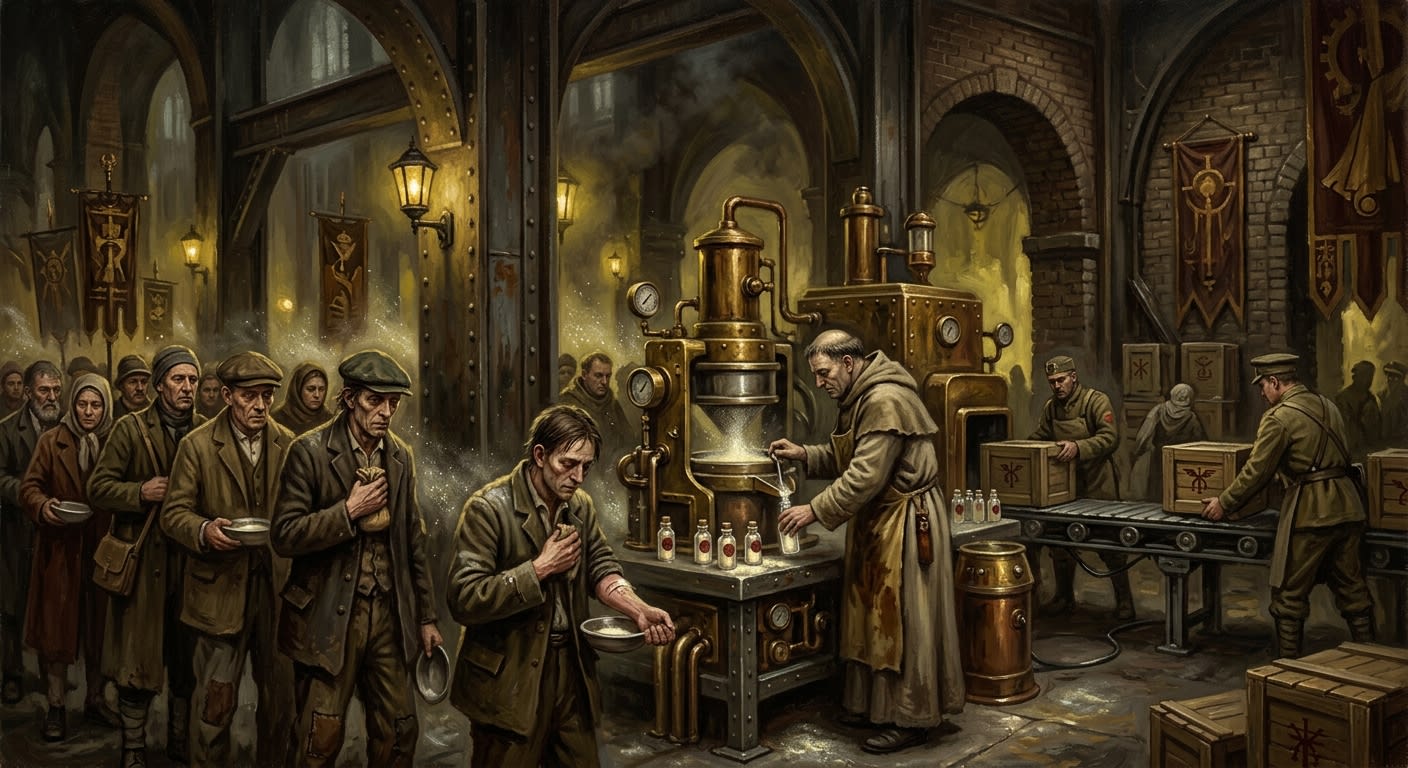
#On the Powdered Remains of Useful Holiness
Saint-dust is the name given to powdered relic residue, authenticated bone ash, sanctified salts, martyr-scrap, reliquary sweepings, river-borne holy particulate, chapel failures, and those pale substances whose provenance is too expensive to settle and too useful to discard. It is dust. It enters lungs, coils, casks, mortar, salves, ammunition, broadcast carriers, hymn-gaskets, and the little locked cupboards where frightened chaplains keep miracles in pinches because faith, like pepper, is more manageable when ground fine.
The Synod uses saint-dust because it works.
That sentence has murdered more objections than artillery. A signal laced with saint-dust resists unhymn inversion. A trench shrine dusted at dusk steadies men who would otherwise hear dead comrades asking for water. A wound dressed with certified slurry may close long enough for Records to catch the name before the body fails. A ward whitewashed with relic residue feels cleaner, which is often more valuable than being cleaner. Soldiers trust it. Engineers measure it. Tithes prices it. Purity distrusts it while requisitioning more.
Saint-dust is holiness after bureaucracy has learned to pour it through a funnel. A bone behind glass asks for pilgrimage. Dust asks for allocation. The first produces candles and tears. The second produces invoices, shortages, black markets, and a body count with better handwriting.
#On Sources and the River That Manufactures Evidence
The proper sources are respectable: authenticated relic filings, damaged reliquary fragments reduced under Saint-Bone Melting Acts authority, chapel sweepings from verified shrines, ossuary ash, powdered martyr-scrap recovered after bombardment, and sanctified salts blended under Alchemical Standards supervision. This is the clean table. It has labels. It has seals. It lies with excellent posture.
The dirty table is larger. Dust comes from salvage sorties in corpse-mud, collapsed trench chapels, river silt, battlefield ash-rain, shattered relic jars, Bone-Lime rejects, burned processional furniture, counterfeit-stock seizures, and the Saint-Dust Cooperage of Mournwater, where the river has been carrying sanctity downstream since A.S. 98 and has lately developed ambitions.
Mournwater began with forty-two broken reliquary jars. The river absorbed what the jars surrendered. Barrels drying on the wharf soaked it in; headaches vanished, a limp corrected itself, twins were conceived, and commerce, that most pious of scavengers, arrived wearing clean cuffs. By A.S. 104 the Cooperage Compact had made saint-dust into industry. By A.S. 110, casks of holy slurry moved east with seals bright enough to blind a poor man.
The Ossuary Shoals upriver provide the official raw bed: pale banks, relic mud, broken jars, bone particulate, ash residuum, the ground remnants of saints and almost-saints mixed with whatever drowned there before a Bureau thought to count it. The maps call it sediment. The salvage crews call it a mouth. Both terms have merit.
The unsettling fact, filed and muffled since A.S. 194, is that some dust now appears without sufficient prior saint. Casks warm themselves. Floodwater leaves residue on skin. Settling dishes form bones with dental specificity. The river sends Mournwater material no manifest placed in it. Doctrine has made no public conclusion, which means every conclusion has become useful.
#On Grading, Settling, and Certification
Saint-dust becomes lawful through descent.
At Mournwater and lesser grading houses, samples are placed in shallow glass dishes beneath the Settling Bell (Unregistered). The hall falls silent. Graders wait with chalk cuffs, vinegar lamps, calipers, and the expression of men watching a verdict assemble itself grain by grain. Proper dust settles into rosary strata: ringed layers, pale, even, obedient. The pattern is a certificate before ink touches paper. If it settles true, the batch may pass. If it hangs, drifts, climbs, writes, or arranges itself into bone, the room learns how expensive truth can be.
Grades differ by application. Saint-grade dust serves doctrinal broadcast, high relic salves, Vigil Ark apparatus, and emergency chaplaincy. Front-grade goes to the Sagittal Line: trench shrines, prayer packets, signal repeaters, field salves, grave sealing. Port-grade serves fog towers, ship chapels, quarantine sheds, and those places where salt air has already made purity negotiable. Low devotional ash goes to provincial chapels too poor to ask why the cask smells of river iron.
Each grade carries a seal. Each seal carries a tariff. Each tariff carries opportunity. Dust is cut with chalk, ash, powdered lime, river salt, bone from persons whose sainthood was aspirational, and counterfeit residue produced by men who understand that the market cannot taste provenance until it is too late. White Steps certifiers (Unregistered) catch some fraud. Backchannel boatmen carry the rest.
Earlier public primers described certification as sufficient proof of purity.
Corrected. Certification proves that a recognised office accepted responsibility up to the instant the seal dried. Purity after transit remains a separate doctrine, priced separately.
#On Orison and the Dust in the Voice
The Bureau of Orison and Song made saint-dust imperial.
A.S. 92 gave Orison its charter; A.S. 94 gave it licensing teeth; field necessity gave it the rest. Early broadcast carriers were honest, a defect fatal to any machine entrusted with doctrine. Pale Chanters bent them. Rebel towers copied them. Foreign choristers jammed them. The Enemy learned that a prayer transmitted without ballast can be turned at the third syllable into hunger, surrender, grief, or a dead husband asking to be let in.
Then forward engineers mixed relic powder into the apparatus. Bone ash, grave wax, sanctified salts, martyr-scrap: a little grey holiness fed into coil, venturi, throat-plate, and carrier spine. The signal held. The inversion weakened. Men who had been about to obey the wrong voice heard the right one loudly enough to remain useful. The Orison Signal Engineer was born choking.
A saint-dusted broadcast does more than carry sound. It makes the official voice heavy. It gives the Orison Hour a grain, a settling, a little calcium authority in the ear. The faithful call this comfort. Engineers call it carrier stability. I call it powdered obedience, which is accurate and unpopular.
Every Orison house keeps urn cages under double lock. Dustcasters tap the urn, wash in saltwater, check masks, strike forks, run test prayers, inject dust, and listen for names under the third verse. Their first rule is famous: if you hear your name, log nothing. Their second rule is never open an urn alone. The manual calls the old stories apocryphal and still requires witnesses, because apocrypha with casualties becomes procedure.
BROADCAST DIRECTORATE INCIDENT NOTE — A.S. 200 Coil room clean by all machine measures. Dust ledger reconciled. Listener reports: personal-name under-voice, 417; receiver-answer attempts, 62; drownings, 9. Residue inside injector housing formed █████████████████. Engineer logged variance as “pleasant.” Tower remains active.
#On Commerce, Shortage, and the Lung-Tithe
The saint-dust economy is a chain of white appetites. Salvagers gather. Graders certify. Coopers seal. Lock provosts tax. Tithes assesses. Purity suspects. Orison requisitions. War complains. Hospitals beg. Chapels hoard. Smugglers thin, swap, rebrand, and sell. Somewhere at the end, a sick man breathes easier, a signal holds, a garrison kneels, or a corpse crumbles into evidence.
Demand outruns supply because every Bureau has discovered a use for powdered holiness. Orison needs dust for carriers. Bells wants adjacency for prayer-jam counterwork. Alchemical Standards wants samples. Medicine wants salves that keep terminal men narrating. War wants relic-shot and charge lacing. Relics wants custody control. Provincial chapels want enough visible powder to reassure widows. The poor want miracle. The rich want certified miracle. The difference is packaging.
The workers pay first. Dust graders cough chalk-white. Slurry loaders develop cracked lips and pale gums. Orison engineers acquire saint-dust lung (Unregistered), that slow reliquary of the chest by which a man becomes the container he once handled. Masks clog. Seals leak. Coil blooms drive powder through cloth and nostril and tooth-gap. Old Dustcasters spit black in the morning and call it proof of service, which is the kind of phrase a Bureau loves because it converts compensation into pride.
Shortage breeds fraud with the speed of mould in damp vellum. Casks are cut. Condemned slurry is routed through Silt-Rook channels (Unregistered). Low-grade ash is dressed in high wax. Futures clerks in Mournwater predict garrison deaths with more accuracy than War predicts battles. A man who knows a shipment will fail can buy ruin in the morning and sell panic by dusk. Tithes calls this improper speculation when unpaid and market correction when taxed.
#On Crumble-Wrong
Crumble-Wrong is the dust’s objection filed in matter.
The first confirmed classification came in A.S. 194 at Mournwater. Proper dust settles. Crumble-Wrong hangs, drifts sideways, gathers against glass, and arranges itself into fragments: finger, jaw, clavicle, infant rib. These shapes are not decorative. A jaw-shaped dish preceded mouths found packed with powder. Hand-shaped dust preceded casks opening from within. Vertebral patterns travelled badly, by which lock provosts meant bargemen arrived bent backward while insisting they stood straight.
The Bureau says taint. The town says memory. I have heard worse doctrines from cleaner rooms.
A.S. 197 contamination memoranda blamed irregular settling on storage humidity and dockside negligence.
Withdrawn. Humidity does not form a lower mandible with three missing molars matching a martyr skull lost upstream. Dockside negligence lacks dental education.
Crumble-Wrong becomes most obscene after shipment. A certified cask arrives at a trench shrine, hospital store, field chapel, or broadcast house. Seal intact. Manifest balanced. Dust ordinary until it meets breath, steam, fog, or body warmth. Then it clumps, creeps, remembers shape. Applied to the dead, it may reduce them again: bone to powder, teeth to flakes, ribs to pale heaps that move with the air. The dead receive a second burial because the first did not satisfy the product.
Countermeasures include lime wash, salt bath, second settling, pitch smoke, sealed masks, quarantine, and silence. These work poorly and with admirable documentation. The true countermeasure is denial timed well enough to keep barges moving.
#On Doctrine, Blasphemy, and the Question in the Lung
Saint-dust is defended by three doctrines. First: sanctity may be divided without diminishment. Second: relic residue retains enough virtue to serve when properly certified. Third: industrial holiness remains holiness if the seal chain is clean. These doctrines are practical, profitable, and partially true, the most durable combination in all theology.
The blasphemy arrives in the body. A saint was once person, bone, story, wound, name. Dust makes the saint distributable. That distributability saves lives and ruins categories. A pinch in a coil. A smear in a wound. A cask in a chapel. A charge in a gun. A slurry barrel under lock. A line of powder at a quarantine threshold. The saint becomes medium, additive, ballast, medicine, commodity, hazard, and, in poor rooms, hope.
Orison’s private terror is the question every Dustcaster coughs around: shield or cage? Does saint-dust protect the Synod’s voice from hostile cadence, or has it trained Europe to accept only authority laced with the dead? Does the dust resist inversion, or does it create a taste for sanctioned invasion? A listener kneels because the prayer is true, because the carrier is heavy, because habit has calcified, or because powdered saints have learned the shape of obedience inside the skull.
The Bureau has declared the question unproductive. That means it is alive.
#On the Present Supply
As of A.S. 201, saint-dust remains operational, rationed, disputed, profitable, adulterated, watched, inhaled, prayed over, and transported east under guard. Mournwater’s locks remain open. The Settling Bell still rings most mornings. Orison houses still feed dust to coils. Vigil Ark sermon-horns still carry saint-laced voice over water, trench, ravelin, market, and fish that have received more authorised theology than several provincial bishops. Field hospitals still request miracle-grade powder. Blackchannels still move condemned casks. Purity still suspects the wrong people too late.
The Line consumes sanctity by the cask. The river supplies. The lungs receive. The ledgers reconcile what they can and price the rest.