
#On the Dust that Settles Wrong
"If it settles, it is true. If it rises, call Purity." — Grader's proverb, Mournwater, struck from training placards A.S. 200
Crumble-Wrong is the common name for the Irregular Settling Pattern classified at the Saint-Dust Cooperage of Mournwater in A.S. 194, reviewed jointly by the Bureau of Alchemical Standards and the Bureau of Rites in A.S. 200, and left operational in A.S. 201 because the Synod would sooner ship a questionable miracle than admit a profitable one has learned bad habits.
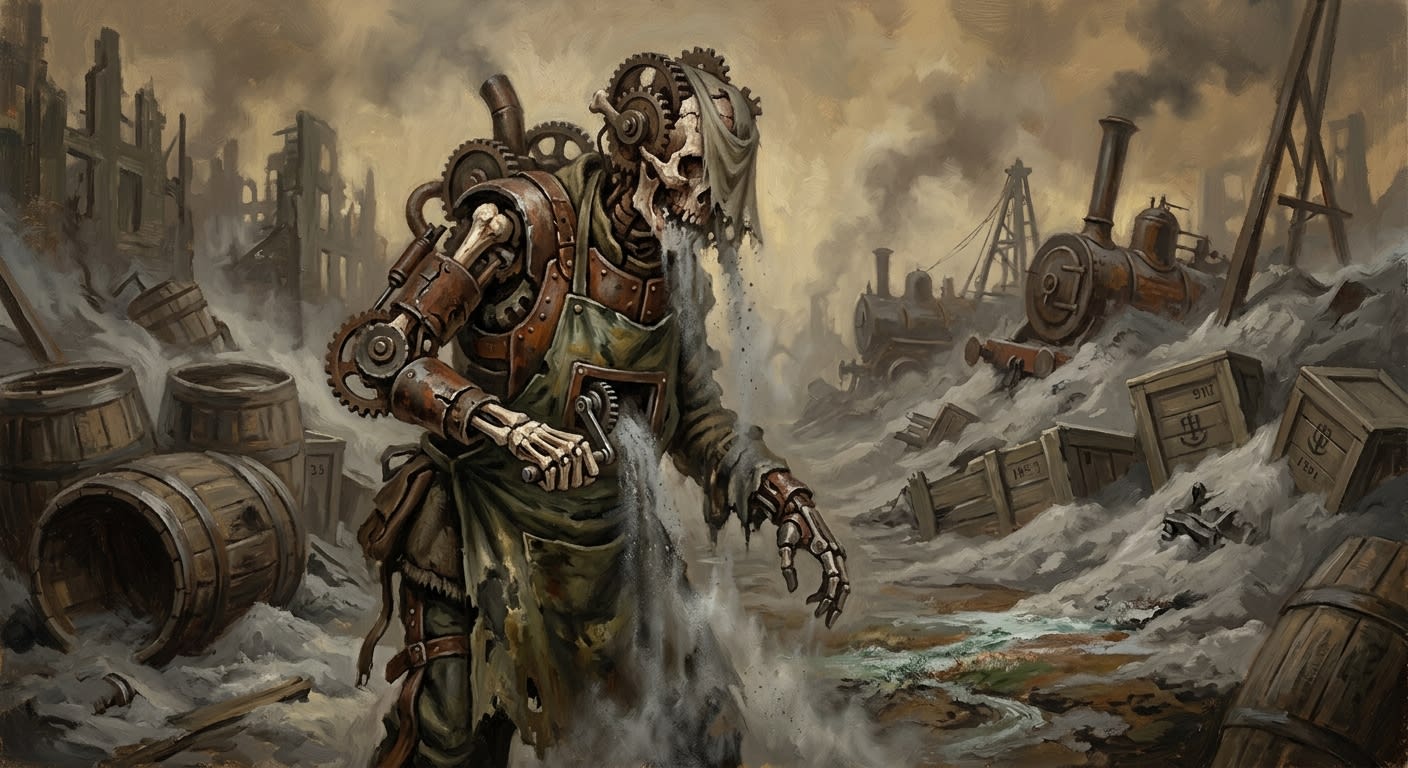
The phenomenon begins in saint-dust: powdered relic residue, bone ash, sanctified salts, river silt, and whatever unlicensed holiness the Mournwater current has begun manufacturing in its private churn. Proper saint-dust settles into rosary strata under the Grading Hall prayer. Crumble-Wrong does not. It drifts sideways, hangs in breathless air, gathers against the lip of glass dishes, and arranges itself into bone shapes with the patience of a clerk assembling evidence.
A finger. A jaw. A clavicle. Sometimes an infant rib, which causes even the White Steps (Unregistered) certifiers to lower their voices. The shape is diagnostic in the strong evidentiary sense avoided by provincial preachers. Dust shaped like a jaw has later been associated with mouths found full of powder. Dust shaped like a hand has preceded reports of casks opening from the inside. Dust shaped like vertebrae has travelled badly, by which the lock provosts mean that three bargemen arrived bent backwards and insisting they were standing upright.
The Bureau's doctrine is simple: the dust has been tainted. The town's doctrine is simpler: the dust remembers being a body and resents being merchandise.
#On Mournwater's Necessary Lie
Mournwater began as barrels. Oak staves, pitch, hoops, river mud. In A.S. 98 a barge capsized upriver carrying forty-two reliquary jars from the Ossuary Shoals, and the river brought sanctity downstream in the least dignified form available: slurry. Barrels absorbed it. Headaches vanished. A limp corrected itself. Twins arrived where doctors had failed for eleven years. Alchemical Standards confirmed residual sanctity, and every man in Mournwater who could spell profit began spelling it with a halo.
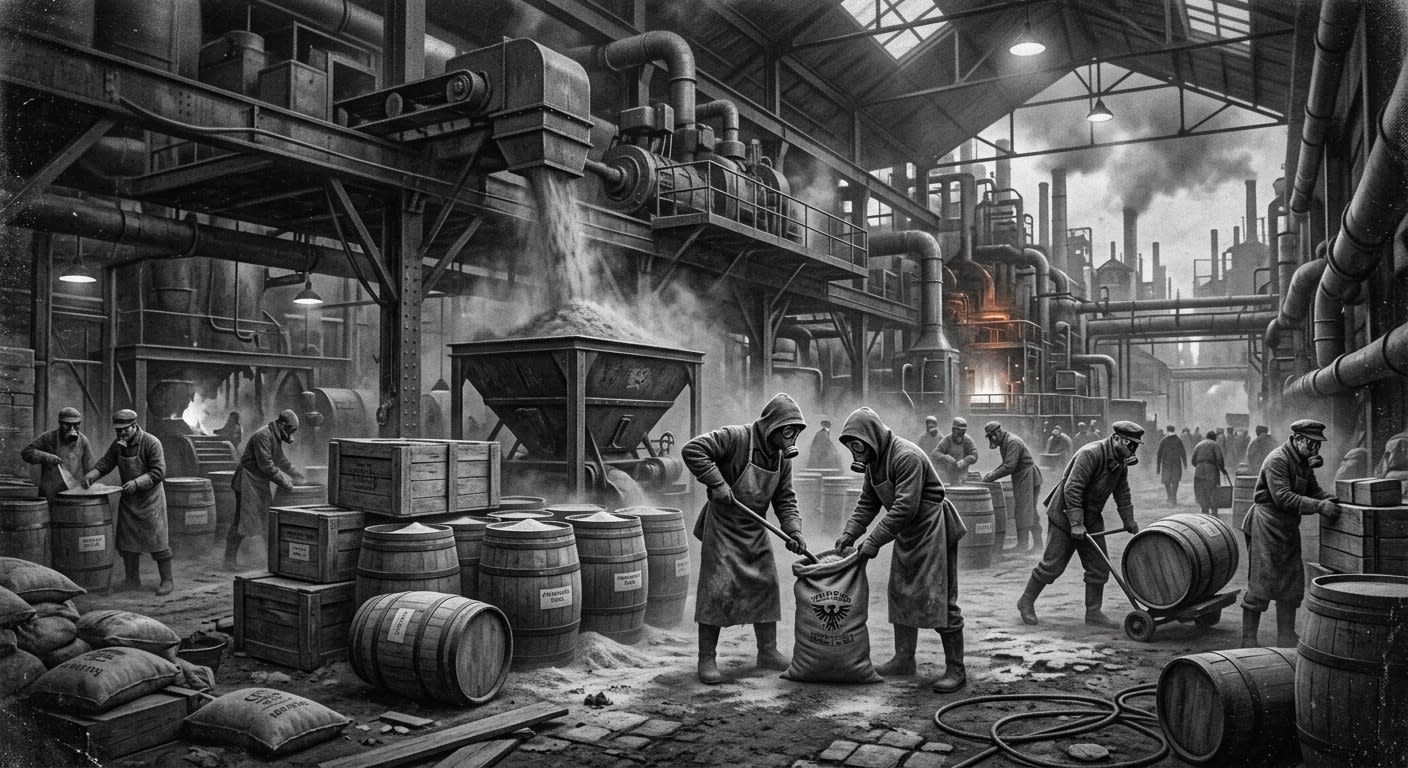
By A.S. 110, the town had become a reliquary port that happened to remember barrel-making. The Cooperage Compact made casks. The White Steps made purity. The Grading Hall made truth visible in shallow dishes. The Seal Locks made passage expensive. The futures clerks made death negotiable.
The necessary lie is printed on every clean certificate: Mournwater never ships tainted. The lie is useful, so it is sacred. Bastion chapels require slurry for trench shrines. Broadcast houses require saint-dust to lace Orison signals against unhymns. Field hospitals require miracle-grade residue for salves, poultices, and the small frauds by which dying men are persuaded to keep breathing until their names can be entered properly. The Sagittal Line consumes sanctity by the cask. Mournwater supplies it.
Crumble-Wrong threatens that exchange. A condemned batch is lost dust, lost futures, lost morale, lost broadcast ballast, lost chapel ration, lost profit, lost proof that the Synod can reduce dead holiness into usable powder without the dead objecting. The Graders' Quiet Union knows this. Sister Halvein (Unregistered) knows it. Master Cooper Vell Arno knows it. Silt-Rook Dema (Unregistered) sells the knowledge in the backchannels for prices that would make an honest man vomit and a Tithes clerk applaud.
A.S. 197 contamination memoranda attributed irregular settling to “improper storage humidity and dockside handling negligence.”
Revised. Humidity does not arrange sanctified particulate into the shape of a lower mandible bearing three missing molars matching a martyr skull lost upstream. Dockside negligence rarely displays dental specificity.
#On the Settling Bell
Every morning the Settling Bell (Unregistered) tolls and Mournwater shuts its mouth.
The rule is absolute. Coopers lower their mallets. Lock provosts stop extorting. Backchannel boatmen wait with poles planted in black water. Even the Crumble Ward Sisters pause beside beds where the quarantine poor cough pale grit into cloth. In the Grading Hall of Settled Light, dust samples rest in shallow glass dishes. The graders stand at the tables with chalk cuffs, vinegar lamps, callipers, and faces trained to reveal nothing until the second bell.
If the dust settles true, the bell rings again. The town exhales. Barrels move. Seals press. Scrip trades. The river resumes its work of carrying holiness away from the question of where it came from.
If the dust hangs, the bell stays silent.
A silent Mournwater is an ugly marvel. Commerce becomes prayer because prayer is the only activity that does not require speech. In A.S. 199 the silence lasted nine hours. No official explanation was issued. Unofficial accounts agree on two facts: the dust in Dish Twelve rose instead of fell, and the suspended grains formed lines resembling script. The Bureau of Rites denies that the lines were legible. The grader who read them aloud has not been seen since, which clarifies the denial nicely.
GRADING HALL INCIDENT 199-SB / DISH TWELVE: Settling failed at first bell. Particulate rose in vertical column, separated into pale strokes, and formed ███████████████. Witnesses reported sound “like teeth in a jar.” Grader Elian Voss spoke the phrase ███████ ███████ before collapse. Subsequent silence: nine hours. Body: unavailable. Dish: melted. Bell: no damage recorded.
The Settling Bell is treated as a siren, a sacrament, and a market instrument. Its second toll confirms commerce. Its refusal suspends price. The futures clerks track bell delays with obscene devotion: three minutes shifts cask rates; ten minutes moves quarantine scrip; an hour can make a man rich enough to purchase a certifier's conscience, assuming the certifier had one loose from prior sale.
#On Bodies Reduced Twice
Crumble-Wrong reveals itself most horribly after shipment.
A cask certified pure at Mournwater reaches a trench shrine, a field chapel, a hospital reliquary store, or an Orison broadcast house. The seal is intact. The manifest balances. The dust appears ordinary until humidity touches it: breath, river fog, chapel steam, the warm air above a body not yet cold. Then the dust turns. It clumps, creeps, and arranges. If applied to the dead — for preservation, sanctification, burial sealing, or the sentimental little rites chaplains use when they have run out of doctrine — the corpse crumbles.
Decay has manners. Rot has a timetable. Reduction is what remains when a body is treated as inventory and decides to become arithmetic.
Bone breaks into powder. Teeth shed enamel like chalk flakes. Ribs soften along old fracture lines. The body falls inward, then outward, then becomes a pale heap that moves with the air. Field reports describe powder tracking toward the living during night watch, gathering beneath infirmary cots, forming rosary loops around boots, climbing damp walls in thin finger-lines. Chaplains write that the dust seeks breath. Bureau of Medicine writes that air currents explain the motion. Bureau of Doctrine writes nothing until asked twice.
The southern corridor shipment of A.S. 199 remains the primary case. A garrison chapel received three casks stamped pure by Sister Halvein's office. Within hours of application, twelve recently buried soldiers crumbled inside their lime-sealed vaults. Sentries found powder gathered at the infirmary door before dawn. It had arranged itself into four complete rosaries and one shape the chaplain refused to describe in writing. The report was filed. The Synod denied receipt. Mournwater blamed handling. The garrison buried its dead a second time, deeper.
The dead, one notes, had already been buried properly once. The second burial was for the paperwork.
#On Source and Appetite
The Ossuary Shoals upriver are the official source. The term is sanitary. Shoals suggest accumulation, river action, sediment, the innocent physics of matter abandoned to water. The maps show a marsh of white banks and treacherous channels where relic jars, shattered reliquaries, battlefield ash, chapel sweepings, and ossuary overflow collect before salvage crews rake the sanctified residue into sacks.
The maps lie by omission. A map cannot cough.
The buried truth in Mournwater is that the saint-dust source is mixed with more than saints. Something upstream is grinding living relic-matter into slurry, or reproducing the semblance of relic-matter from whatever the river feeds it. The river spits up jars no one shipped. Floodwater leaves pale residue on skin. Casks are warm in the Backchannel Needleway. A lock gate jammed in A.S. 200 with a paste that looked like ground bone and pulsed once under a provost's boot.
Crumble-Wrong may be contamination. It may be counterfeit sanctity. It may be the defensive reflex of violated relics. It may be the river learning from a century of being fed saints by men who thought holiness could be industrialized without answering back. The Bureau of Doctrine favours no explanation in public. Private memoranda favour all explanations simultaneously, because fear is cheaper when distributed across departments.
The Bureau of Orison and Song worries for its broadcasts. Saint-dust laces its transmissions against Pale Chanters and their unhymns; each mote is supposed to ballast the carrier signal, weighing doctrine against corruption in the acoustic air. If Crumble-Wrong enters dust reservoirs, a broadcast may carry more than sermon and command. It may carry bone memory. It may teach receivers to listen for the dead beneath the Hierarch's voice.
A delightful prospect. Administrative nightmare. The difference, as ever, is whether one is paid to prevent it.
Orison requisition tables list Mournwater dust as “stable under broadcast agitation.”
Corrected after two coil rooms reported rosary-shaped residue inside sealed injector housings. Stability remains presumed for operational purposes. Presumption is the formal name for a bridge one is marching across while it burns.
#On Countermeasures and Fraud
The approved countermeasures are lime washes, salt baths, sealed-sleep masks, pitch burned at thresholds, second settling, third settling under Purity witness, and quarantine in the Crumble Ward. These measures fail at different speeds.
Lime slows mobile powder but does not halt it. Salt breaks some clumps and feeds others. Sealed-sleep masks prevent inhalation until the wearer scratches his cheek in dreams and wakes with grit on the tongue. Pitch smoke drives powder from thresholds into rafters, where it waits with commendable patience. Re-settling catches the obvious taint and misses the batches that turn in transit. The Crumble Ward contains the poor, the frightened, the useful, and whatever bodies the Crumble Ward Sisters have decided must remain evidence rather than persons.
The unofficial countermeasure is fraud. Cut the dust thinner. Dilute suspect slurry. Move questionable casks through Silt-Rook routes without White Steps seals. Rebrand condemned stock as low-grade devotional ash for provincial chapels too desperate to refuse. Sell futures against a batch one privately knows will fail and call the profit providential. Fraud is Mournwater's splint, holding the broken limb straight enough for inspection.
The Graders' Quiet Union has begun marking suspect batches with private signs in hoop grooves and wax ridges. The marks tell dock crews which casks to avoid, which to sell, which to “lose,” and which to pray over with real conviction. Sister Halvein pretends not to notice because noticing would force her to choose between admitting contamination and arresting the only people who can identify it. Master Cooper Arno pretends to notice only the marks that threaten profit. Silt-Rook Dema notices everything and sells interpretation by the phrase.
#On the Present Drift
As of A.S. 201, Crumble-Wrong incidents have increased in frequency, specificity, and export value.
Specificity is the true terror. Early dishes formed crude bone shapes: a curve, a nub, a line of teeth. Recent dishes form identifiable fragments. The Grading Hall's sealed red ledgers record a right index finger with a scar notch matching a missing hand reliquary from Essen-of-Hymnsteel; a jawline matching Saint Ottmar's (Unregistered) disputed lower face, authenticated twice and stolen once; a child's rib bearing three healed fractures that correspond to no catalogued saint but to a living patient in Crumble Ward, which everyone agrees is impossible and everyone has filed under “pending.”
Export value is the truer terror. Condemned slurry now trades through the backchannels at prices higher than certified dust because condemned dust can ruin certifiers, blackmail chaplains, panic garrisons, and move futures markets faster than a battlefield defeat. The dust that should have been destroyed has become a weapon of commerce. This development surprised no one with a pulse and no one without one.
The Cooperage Audit remains pending. The locks remain open. The Settling Bell still rings most mornings. The White Steps certify. The backchannels carry. The river keeps sending pale residue against the pilings, and the Grading Hall keeps asking dishes to tell the truth quietly.
One morning, the dust will answer aloud.