
#On the Post
Outpost Eleven-West was a minor forward observation post on the Shipka approach road, one of those ugly little boxes of concrete, corrugated iron, prayer cards, and wet blankets that the Bureau of War scatters along the margins of Bastion-Shipka and then pretends are fortifications. It watched the western fringe of Syrion's seepage, where fog crawls through reed roads, signal lines lose minutes, and tired men begin to find the thought of sitting down the most beautiful theology ever composed.
The post was not important. This is why the Incident became important. Catastrophe prefers offices beneath notice; it can work there without supervision.
The garrison roster listed one platoon attached in rotation to the outer watch, supported by two signalmen, one junior chaplain, one medic, and the usual equipment: bell-wire, stimulant tins, rope harness, black coffee concentrate, two sealed flare tubes, and enough devotional cards to wallpaper a latrine. The post was built to observe fog, not endure intimacy. The distinction matters. Fog at a distance is meteorology with teeth. Fog inside a man's memory is occupation.
#On the Hearth
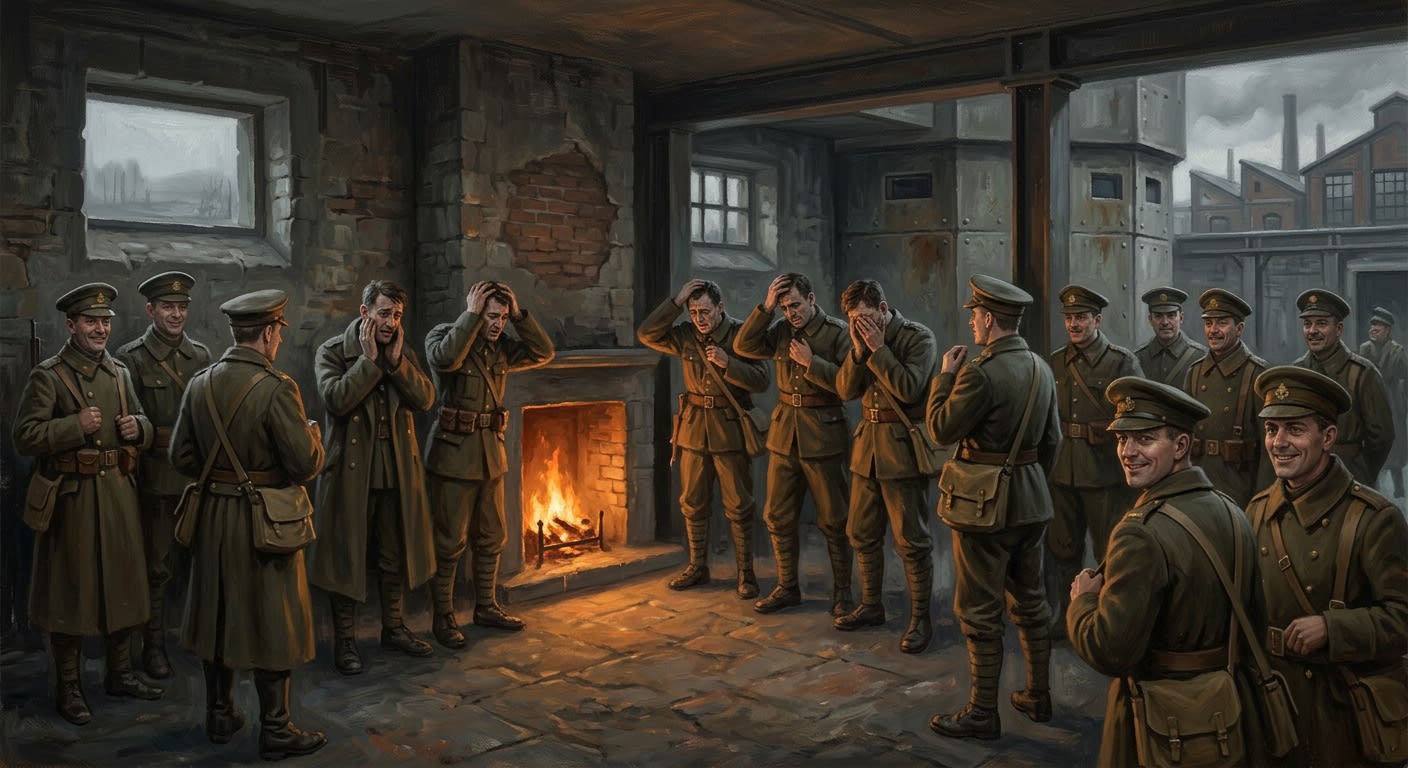
The recovery file says the patrol found them seated in a ring around a construct resembling a country hearth. The wording is cowardly. A construct resembling a country hearth means a fireplace stood where no fireplace could stand: on wet ground, outside masonry, under grey morning, emitting warmth without fuel and comfort without permission. There were stones. There was a low flame. There was a smell, according to the medic's deposition, of bread crust, pine smoke, and a wool blanket drying near childhood.
The men sat around it with their rifles laid aside. Eyes closed. Hands open. Faces at peace.
This is how the Cradled kill: by giving shape to relief. A chair in trench mud. A bed behind a shattered wall. A kitchen no soldier has seen since boyhood. A hearth at Outpost Eleven-West, round and patient, asking no oath, demanding no confession, offering heat. War trains men to withstand terror. The Line trains them to withstand hunger, bells, bombardment, vermin, orders, and the moral odour of other soldiers. Almost no one is trained to withstand kindness.
Initial field notation described the object as “unauthorised campfire, probable discipline breach.”
Corrected after flame samples failed to burn paper, damp straw, sleeve cloth, or the medic's glove, yet warmed all four. The author of the initial notation has been reassigned to a fuel inventory office, where ordinary fire may disappoint him at leisure.
Seven soldiers recovered after removal. Recovered is the Bureau's word. They woke vomiting, sobbing, cursing the rescue party, and in two cases striking orderlies who had dragged them away from what they called home. None could describe the hearth consistently. One remembered a stove from Varna. One remembered his mother's kitchen in a village that had burned before his birth. One remembered nothing except being forgiven, which is the most suspicious memory in the file.
Nine did not recover.
#On the Nine
The Nine were evacuated to the Bureau of Mercy facility in Sofia because Sofia was near, because the Constantinople wards were full, because Constantinople has sufficient horrors without importing smiling ones, and because no officer wished the post-incident photographs circulating through Shipka's barracks. They have remained there since A.S. 194.
They eat when fed. They swallow without prompting. Their hearts beat at a rate the physicians describe as optimal. Their eyes, when opened by medical staff, track motion but do not focus. They smile continuously. The facial muscles should have torn, cramped, slackened, or rotted into mercy. They have not. Seven years of smiling, as of the Sofia audit. A smile is a small thing until it refuses to end. Then it becomes a sermon by an enemy preacher.
The ward staff report ambient drowsiness after prolonged exposure. Orderlies assigned to the room rotate after forty minutes. Chaplains are forbidden to conduct private confession within earshot, since the Nine sometimes smile more deeply at absolution clauses. A junior physician in A.S. 197 recorded that Subject Five's left hand moved toward the chair beside his bed when rain struck the roof. This was classified as reflexive. The chair was removed. Subject Five continued reaching for it until the rain stopped.
WARD SEVEN OBSERVATION EXTRACT — A.S. 199 At 0314 all nine subjects exhaled simultaneously. Audible phrase reported by orderly: “Sit. It is warm.” Orderly found seated between Beds Four and Five at 0322, smiling. Recovery successful after bell application and facial slap. Orderly requested reassignment to laundry. Granted.
#On the Doctrinal Vacancy
The Bureau of Doctrine has issued no theological guidance. This is not delay. This is posture. Guidance would require choosing whether the Nine are victims, collaborators, relics, invalids, trophies, warnings, or men. The last category would complicate every other one, so the file remains open.
The official question concerns continuous involuntary smiling. Does it constitute demonic possession? Possession implies an invader within. The physicians find no second pulse, no voice-change, no blasphemous reflex, no aversion to relics. Does it constitute divine peace? Idiotic. The Creator does not express favour by rendering soldiers useless in a Sofia ward, though several committees have come perilously close to saying so when frightened by the alternative. Does it constitute neither? That answer is administratively safest and spiritually useless.
The vacuum has consequences. Mercy treats the Nine under long-term care protocol. War lists them as non-returnable. Records keeps their pay status suspended, because dead men do not eat, living men should answer roll, and the Nine do both badly. The families receive maintenance stipends under provisional compassion writs that must be renewed each year by clerks who hate themselves by Candlemas.
#On the Revision of Shipka Doctrine
Outpost Eleven-West forced revision without confession. Before A.S. 194, Shipka corridor seepage was classed as negligible Sloth influence, manageable through caffeine, bell density, and officer contempt. After A.S. 194, the phrase became persistent low-grade; active monitoring required. The Bureau did not concede error. The Bureau clarified. The dead appreciate the distinction less than the clerks.
The post itself was burned, rebuilt, renamed, and renamed back after Records objected to the map-work required by altered designations. The hearth site was salted, paved, blessed, measured by Hourglass observers, and fitted with three iron spikes driven into the ground in the pattern used for denying rest to contaminated soil. Soldiers assigned there are forbidden to sit during watch. Stools are contraband. Warm drink is issued standing. Any report of home-smell, childhood voices, hearth-glow, blanket warmth, or undeserved forgiveness triggers immediate rope extraction.
A War memorandum stated that “the entire platoon has not opened its eyes since the event.”
Corrected. Seven opened their eyes and returned to partial function. Nine open only when staff lift the lids. The original phrasing survives in barracks speech because terror prefers simple arithmetic.
#On the Present Lesson
The Nine remain in Ward Seven. Their former post remains on the maps. The Shipka fog still presses the road. The hearth has not reappeared, unless one counts three unconfirmed reports from sentries who smelled pine smoke during rain and refused, with admirable profanity, to investigate.
Horvath at the Sofia Filing Annex keeps the copies of the personnel files because Records central dislikes files that breathe. Dzhurova keeps the ward under garrison protection because Sofia knows better than to leave mysteries unattended. Mercy changes linens. War counts rifles. Doctrine waits for language large enough to hide fear.