
#On the Levy and Its City
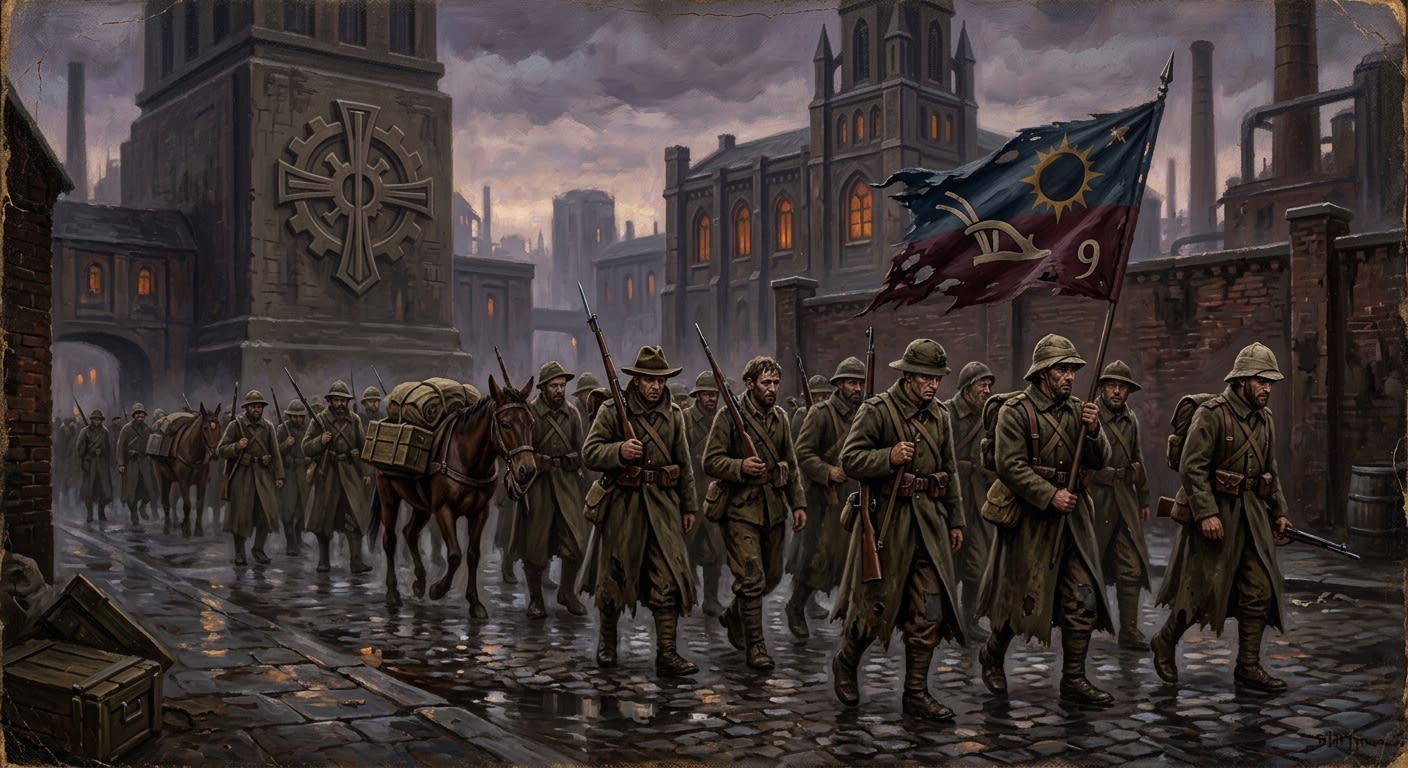
The 9th Southern Levy Division is the local spine of the Sofia garrison, which sounds complimentary until one remembers that spines may be bent, cracked, counted, requisitioned, and blamed for every motion of the body above them. It is a Bulgarian formation in Synodal harness: raised from the valley towns, the citadel districts, the western farms, and the stubborn families who have supplied sons to the walls since the emergency works of A.S. 68 taught Sofia that masonry is never neutral.
The Division is rated at full strength in several ledgers. It exists at sixty-two percent strength in the city. The difference between ledger and street is where the Synod keeps most of its theology.
The Division's badge is officially plain: Sofia gate, mountain line, three regulation chevrons, no animal device after the Beast Proscription made half of Europe discover that its grandfathers had been heretics in embroidery. Unofficially, soldiers chalk a black shovel inside the gate. The shovel has no heraldic standing. It means: dig, bury, repair, repeat. Heraldry has not yet noticed, or has noticed and decided that a shovel is too useful to condemn. These are the Bureau's softer miracles.
#On Composition
The soldiers are local. This fact explains their utility, their resentment, their discipline, their desertions, and the persistent failure of heartland officers to understand any of the four. A Sofia levy-man knows which ravine floods after two hours of mountain rain, which lane behind the market hides a stair to the inner wall, which shrine still receives candles after the Synodic altar was installed, and which aunt can obtain coffee from a rail clerk who has not yet been inspected by Tithes. No imported regular learns these matters in eighteen months. Many do not learn them in a lifetime. Most are reassigned before humility can set in.
The Division contains wall companies, gate companies, rail-guard sections, ravine patrols, stretcher squads, and local signal detachments trained to listen for the sleepy bells that creep westward from Shipka. Its officers hold Synodal commissions. Its sergeants hold the real maps. The Bureau of War has never liked this arrangement, because it places practical authority in hands that remember being conquered. The Bureau of War also has no replacement for it. One may dislike a bridge while standing on it.
Earlier instructional pamphlets described the 9th Southern Levy as “provincial militia of limited strategic sophistication.”
Corrected after three heartland regular patrols became lost inside Sofia's own second-ring service alleys during a daylight exercise. The local guides found them by following the smell of polished boots and doctrinal confidence.
The attached regular companies consider themselves punished by assignment to Sofia. They are correct. Officers arrive with letters of correction, failed promotion boards, too-accurate sermons, inconvenient audit records, or relatives in Strasbourg who have decided distance is the cleanest mercy. The levy watches them arrive. The levy watches them complain about food, cold, language, church bells, mountain roads, and Bulgarian silence. Then the levy teaches them where to stand when the eastern wind rises.
#On Discipline and Desertion
Desertion in the 9th Southern Levy occurs at a rate the Bureau of Records classifies as within acceptable parameters. That phrase is a little wax coffin for embarrassment. Men leave. Some return after burying a brother, moving a mother, warning a cousin, fetching a priest, or spending one night in a village where no bell tells them to stand watch against fog. Some do not return. Some are found at road shrines asleep with their boots still laced and their rifles wrapped against dew. Some vanish east, which is not always desertion and is never investigated with sufficient enthusiasm.
Colonel-Prefect Dzhurova treats desertion as terrain, which is to say she measures it before firing into it. A man absent for burial loses pay and returns to post. A man whose absence opens a wall rotation to danger is flogged before his company. A man selling gate times to smugglers loses more than pay. Her punishments are severe because Sofia cannot survive indulgence. They are selective because indiscriminate severity is the luxury of officers whose cities are elsewhere.
The Bureau of Purity argues for exemplary correction every quarter. It receives lists, tables, incident notes, and a silence that sounds like compliance until one reads the attached delays. The 9th is corrected enough to remain afraid, spared enough to remain useful, and watched enough to know who holds the leash. Dzhurova did not invent this balance. She merely has the unpleasant virtue of maintaining it.
#On Service Between the Bastions
Sofia lies between Irongate and Shipka, a city with two hands on two wounds. The 9th guards the rail terminus through which fourteen supply trains pass on obedient days: powder, preserved rations, coal, liturgical stores, medical crates, replacement men, and sealed dispatches whose seals are often more substantial than their contents. It escorts convoys along the trunk roads. It mans the inner and second rings. It supplies guides to regular columns who would otherwise mistake a drainage channel for a street and a funeral procession for a riot.
Shipka gives the Division its particular sickness. Time-bleeds touch the patrol rosters. Lullaby fog reaches the road. Men return from forward escort convinced they missed only an hour, while ration clerks have marked them absent for three days. Watch sections learn to distrust comfort, warm smells, humming, and the innocent wish to sit. After Outpost Eleven-West, no Sofia levy officer laughs at a soldier who refuses a chair.
SOFIA GARRISON MEDICAL NOTE — ATTACHED TO 9TH SOUTHERN LEVY Three sentries from East Wall Rotation Seven reported identical dream: mother calling from a kitchen under the wall. All three born in different districts. All three assigned standing watch for thirty days. One later requested transfer to the Filing Annex. Denied: “still functional.” Follow-up file sealed under Sloth-adjacent influence.
The levy knows the difference between cowardice and fatigue because it sees both before breakfast. It knows that an exhausted man may look disloyal while a traitor may look perfectly rested. This knowledge makes its sergeants invaluable and its officers hard to impress. Imported commanders mistake this for insolence. They are half right. Insolence is often competence with a local accent.
#On Sofia's Hatred in Uniform
The Division does not love the Synod. Love is not in the enlistment oath. It obeys because Sofia stands behind it, because the east is worse, because families live inside the rings, because the municipal council can file objections only while the walls remain upright, and because old women in the market know every soldier's mother and will spit on cowards with terrifying accuracy.
This hatred is useful. A man defending an abstraction runs when the abstraction grows thin. A man defending the street where his sister sells onions may endure artillery, Purity sermons, ration fraud, and the company chaplain's breath. The Synod calls this loyalty when it produces obedience and sedition when it produces questions. The 9th produces both. Efficiently.
The levy companies are the reason the city's compliance rate reaches ninety-seven percent without becoming surrender. They know how to obey exactly enough. They know how to delay incorrectly worded orders without refusing them. They know which road repair requisition can sleep under a stamp for six weeks and which ammunition request must run before ink dries. In a heartland regiment this would be called administrative unreliability. In Sofia it is citizenship with a rifle.
A Bureau of War morale circular stated that local levy formations “integrate provincial sentiment into Synodal purpose.”
Withdrawn in Sofia after the phrase was copied onto a latrine wall and annotated in six hands, four of them obscene and two grammatically superior to the circular. Provincial sentiment does not integrate. It reports for duty armed.
#On the Present Condition
As of A.S. 201, the 9th Southern Levy Division remains under-strength, overused, locally trusted, officially suspected, and operational. The regulars rotate. The Purity detachment prowls. The trains arrive when coal, weather, and the Creator stop quarrelling. Dzhurova keeps the rota tight enough to hold and loose enough not to snap. Records files the desertions. Mercy receives the cases that no rota can explain. The Bureau of War asks for cleaner numbers from offices west of the mountains.
The 9th answers with walls manned, gates opened, convoys escorted, graves dug, objections filed, rifles cleaned, and the black shovel chalked again where Heraldry has scraped it away.