
#On the Building
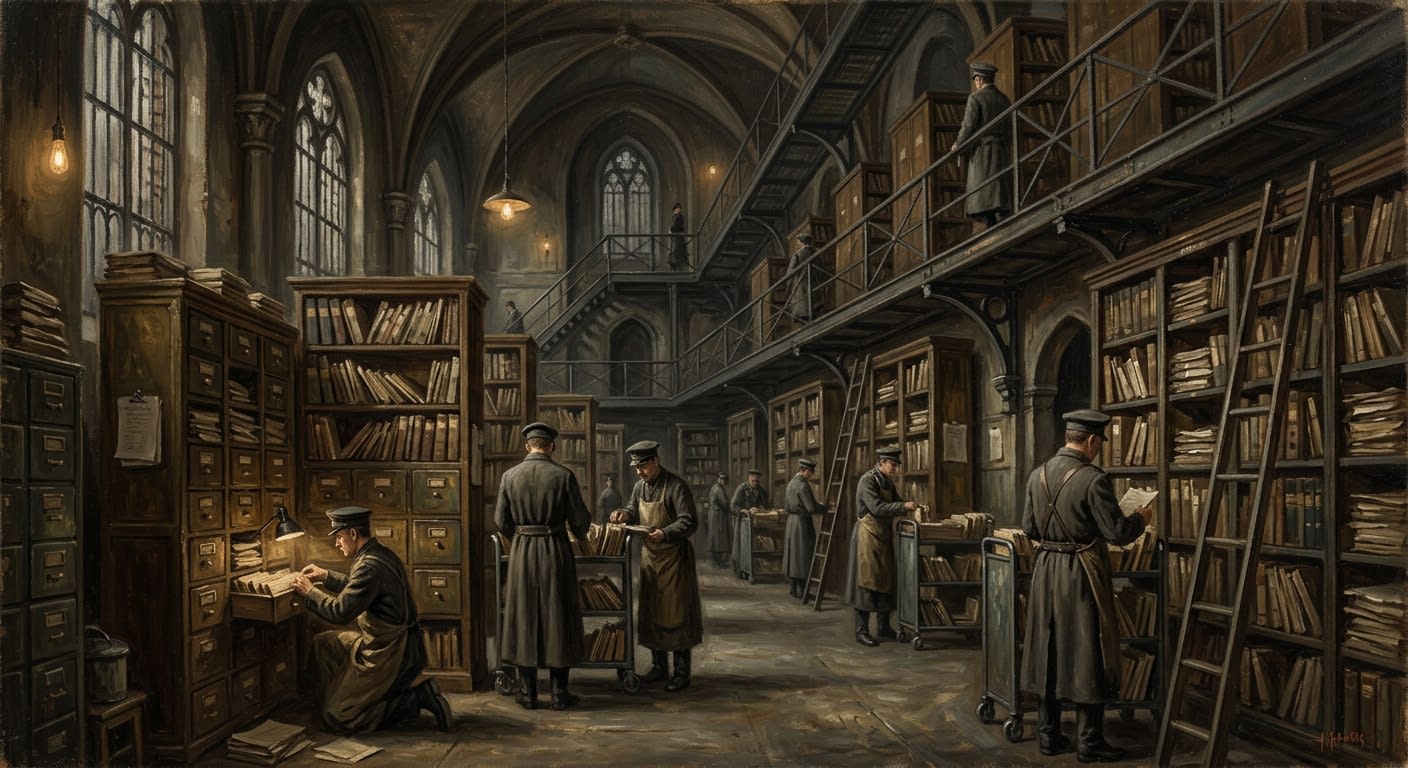
The Sofia Filing Annex occupies a converted seminary on Tsar Boris Boulevard, inside the third defensive ring of Sofia, close enough to the citadel that the garrison guns can hear its windows rattle and far enough from the Mercy facility that the smiling men of Outpost Eleven-West do not trouble the clerks at breakfast. The building is three stories of Balkan stone, narrow windows, thick walls, an internal courtyard, and the particular smell produced when old theology is scraped from plaster and replaced with damp paper.
The Bureau of Records identifies it as a southern-corridor personnel archive. This is accurate in the same sense that a reliquary is a box.
The seminary was seized after the second fortification programme of A.S. 94, when the city was being made useful in the approved Synodal manner: walls first, souls second, filing rooms wherever a chapel could be emptied without riot. For several decades it did nothing more sinister than collate levy rolls and misfile widow pensions. Sofia produced widows in sufficient quantity to keep any office pious.
#On Its Official Duties
Officially, the Annex processes the personnel debris of the southern corridor. Every soldier routed through Bastion-Shipka, Bastion-Irongate, the Sofia garrison, the Hintermark roads, and the smaller posts whose names vanish from maps before their casualty registers vanish from desks may pass, eventually, through an Annex folio. Transfers. Discharges. Missing classifications. Return amendments. Pension claims. Duplicate death notices. Triplicate corrections to duplicate death notices. The usual hymnody of administrative grief.
The work is real. This must be said because the Bureau adores disguising horror as paperwork and paperwork as horror until even honest men lose track of which ink is screaming. The Annex files genuine records. It reconciles dates from units dragged through Syrion's distortions. It decides whether a man who entered fog in A.S. 181 and returned in A.S. 196 has fifteen years of arrears, fifteen years of absence, or one very long morning. It corrects pension claims where widows have remarried husbands who have since returned younger than their sons. It keeps the southern corridor's arithmetic from openly confessing madness.
Earlier Records summaries stated that all Annex anomalies are “clerical complications produced by battlefield stress.”
Corrected. Battlefield stress causes errors. The Annex receives events. An error can be amended. An event must be housed until Strasbourg invents a name with enough Latin in it to feel safe.
#On Code Seventeen
The Annex's unofficial duty is Code Seventeen custody. The phrase appears on transfer orders as if it were a storage instruction, something between “keep dry” and “do not fold.” It means the transferee has seen, heard, counted, entered, survived, remembered, forgotten, or returned from something that the Bureau will not dignify with public category.
The Drag Corridor sergeant is here: 14th Bellwarden Cohort, entered the fog near Shipka in A.S. 181, emerged in A.S. 196, rations fresh, wife remarried, daughter discharged from service, face unprepared for pity. The Bellwarden with late-stage bell-sickness is here, counting pages because pages do not toll back unless the room has gone wrong. The soldier who sketched a Still One (Unregistered) is here, pension ledgers under his hands, no drawings in his drawer. A Cadence Examiner from Cologne is here, after identifying a Pale Chanter unhymn pattern in a street chorus that sang too perfectly for six hours.
Standard Form 17-C(MODIFIED) (Unregistered) prohibits night duty, forbids questions regarding prior posting, and requires housing within walking distance. The humane clauses were almost certainly inserted by accident, which does not lessen their value. Many good things enter law through clerical fatigue. Many bad ones enter sober.
#On Superintendent Horvath
Superintendent Horvath runs the Annex by refusing to pretend it is a hospital. Hospitals invite Mercy. Mercy invites diagnosis. Diagnosis invites Doctrine. Doctrine, arriving late and armed with vocabulary, ruins everything it touches and then requests a commemorative seal.
Horvath gives his clerks desks. He gives them lamps, blue pencils, linen envelopes, predictable hours, muffled clocks, and a courtyard garden whose tomatoes have done more for temporal injury than three committees and a devotional pamphlet. His no-bell rule is absolute. The building begins the day at Prime, but no bell sounds inside. Messages from the citadel arrive by runner. Runners learn quickly to walk softly.
The staff could be reduced. Every efficiency auditor has noticed this and every sensible auditor has gone home without touching the count. Forty-two clerks where six would suffice is waste, unless one understands that thirty-six are being prevented from becoming corpses, relics, witnesses, or legal questions. Waste is merely mercy before the accountant has been bribed into silence.
#On the Rooms
The ground floor holds intake: transfer folios, casualty abstracts, southern levy rolls, and the reception desk where visitors wait long enough to abandon curiosity. The old refectory is now the main file hall, each former dining bay converted into a clerk's stall. The second floor houses restricted indices: misdated service files, contradictory discharge rolls, and the locked cabinets for men who returned before orders sending them out had been signed. The east stack is barred after dusk.
The courtyard is the Annex's chapel, though no one calls it that. Tomatoes, beans, medicinal herbs, three fruit trees too stubborn to die, and a stone basin where clerks wash ink from their hands with the care of surgeons. No saint presides. No official icon hangs there. The garden's holiness lies in repetition: soil, sprout, leaf, fruit, rot, soil again. It is the only liturgy in Sofia that asks nothing from the throat.
ANNEX EAST STACK INCIDENT — A.S. 198 Seven transfer forms corrected themselves overnight. One listed Superintendent Horvath as transferee. Destination: ███████████████. Date of reassignment: prior to birth. Cabinet sealed under local order. Records central has not countersigned because Records central has not been told in language it can understand.
#On Its Present Condition
Colonel-Prefect Dzhurova exempts the Annex from billet seizure, night search, and emergency muster draft. This is no charity. Dzhurova understands working machinery when she sees it. The Annex returns her personnel summaries within the hour, resolves impossible service dates, and keeps men who have looked too long into fog from being dragged through military inquiry by officers who think trauma can be shouted into parade formation.
The people of Sofia leave baskets at the side gate: coffee, soap, repair needles, bread, unofficial saint cards, seedling pots, socks without requisition tags. The gifts are logged as local paperweights. The Bureau of Records has never objected, because objecting would require admitting the baskets exist, and admitting the baskets exist would require explaining why a personnel archive receives offerings.
A draft consolidation plan proposed moving Annex functions to the Budapest archive and selling the Sofia building as surplus ecclesiastical property.
Withdrawn after the first review committee discovered seventeen Annex files bearing dates that had not occurred, three pension cases attached to living widows, and one clerk who could identify Shipka fog casualties by the pressure of the paper. The building is no longer surplus. It is merely embarrassing.