
#On the Grain Country
The plain is flat the way a ledger column is flat. It runs down the page without incident until someone enters a loss at the bottom. East of the Danube the ground lay low and open, and the soil was the black, heavy sort that clogs a cart-wheel and repays the trouble at harvest. The wheat grew tall enough to hide a child. In spring the cattle went out onto the Alföld runs and came back in autumn fat enough to sell, and the drovers who followed them were paid on the weight of every beast.
Debrecen sat at the plain's eastern shoulder, and it kept the accounts. Its grain exchange set prices from the Danube to the Rhine. I accept that claim without a quarrel, because merchants remember a price long after they have forgotten their own children's names. Harvest caravans rolled west toward the Tisza crossings at Szolnok, and the orchards of the Tisza valley sent back plums, brandy and the debts that brandy produces. The older accounts say three empires drew bread from this plain. I will not name the empires and I will not count their loaves. A boast with a name attached is still a boast, and the Bureau of Records has no scale fine enough to weigh one.
The country goes by several names in the archive, and the archive has never reconciled them. The Lore-Clerks write Pannonia and the Pannonian plain. The drovers called the grazing country the Alföld. The zone maps of the present administration list western Hungary among the Forward Heartlands and speak of the east in harsher terms. These names overlap like the claims of three heirs to one estate. No surviving document fixes a common boundary for them, and enthusiasm will not fix one here.
#On the Loss of the Harvest
"…grain rotted in the barns of Pannonia and herds fell bloated in the fields." (Lore Book, the account of Kargath)
At first the losses were blamed on disease, because disease was the respectable explanation. Granaries stank. Sacks went into store sound and came out black and soft. Cattle lay down in the pasture with their bellies stretched tight as drumheads and did not get up. The old account sets these losses some time after the Eastern Silence of A.S. 38 and gives them no year, and I decline to give them one. A farmer who loses his barn does not date the loss for the benefit of historians. He buries his cattle, says his prayers and sows again, and for a while the plain still let him.
Then came the Sundering, on 1 November A.S. 45. That night the hunger of Kargath stopped passing itself off as bad weather. At Debrecen the provisions disappeared: granary and cellar, ration-store and baker's bin, the loaf on the table and the crumb in the pocket. The plain's wealth had been gathered where it could be priced, as wealth always is. The place where it was gathered became the place where it was eaten.
Two numbers belong to that night, and they must be filed in separate folios. The forty-two thousand were the townspeople of the A.S. 44 count. The hundred thousand were soldiers under arms on the plain, who ran when their stores were devoured. They are recorded as fugitives, not counted as a census. One day some clerk will add the figures together and announce a regional death toll of a hundred and forty-two thousand. That clerk will be wrong, and I will enjoy saying so in writing.
No Bureau recorded the loss. In A.S. 45 the Church was newly public in some provinces and still hidden in others, and its authority over the plain was uneven at best. The first record of the ruin is a record of men running away from it.
After that the ruin spread along the water. The Lore-Clerk's account sends the Maw south into the Drava and Sava valleys and west into the Carpathian marches, where seed is said to have turned to ash in the furrow. The account includes no surveyed route and no calendar. The spread moved the way ink moves through blotting-paper, and no one stood beside it with a rule.
Sermon-fed readers picture gluttony as a fat man at a table. Kargath is worse than that. He is need that grows with every meal. He eats the harvest, then the means of raising one, then any hope that a meal might end. The hungry of the plain did not sin by being hungry. They were his stock-in-trade.
#On the Occupied Ground
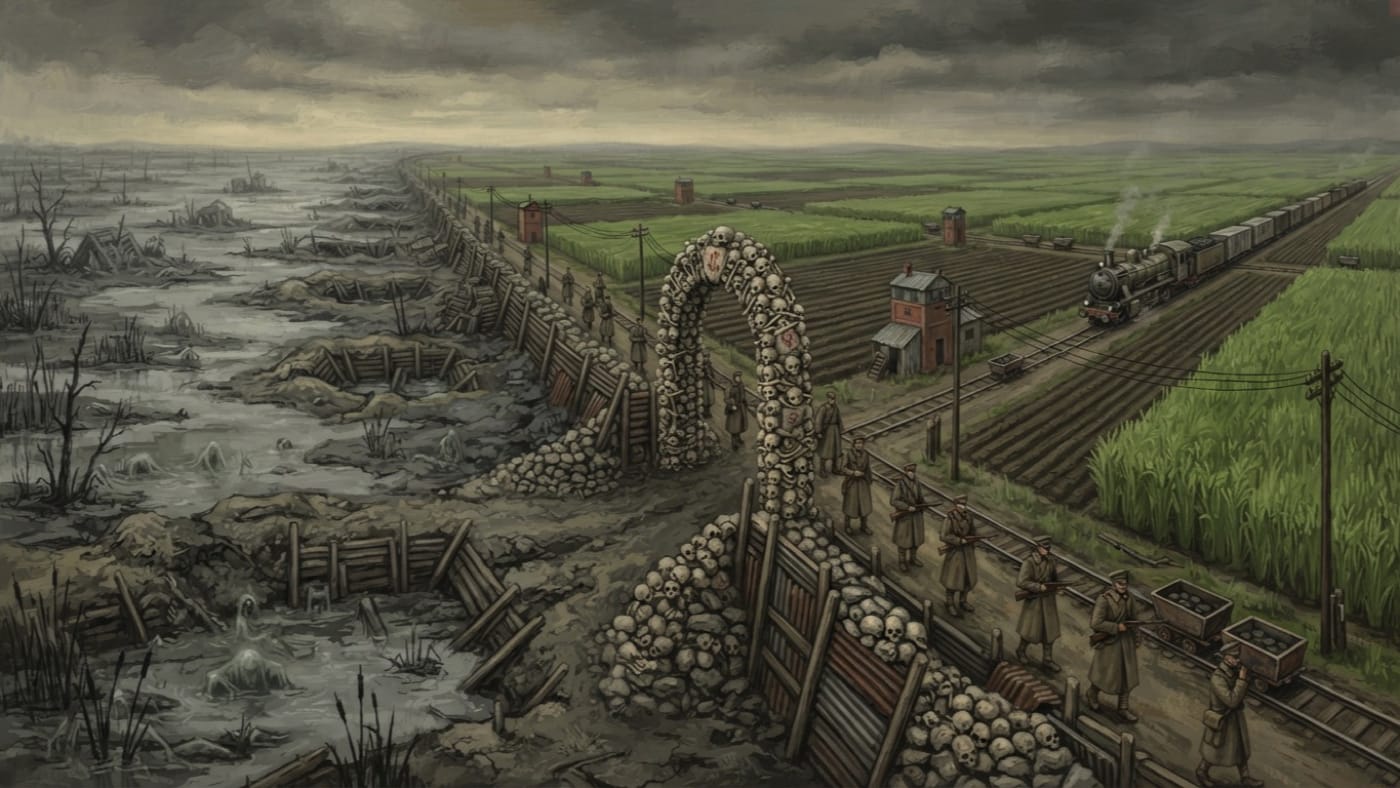
Where the best of the farmland lay there is now the Blightmarsh, with grey mud, grey water and a grey sky above them. The soil there was devoured, not exhausted. Something beneath the surface took it, and something beneath the surface is still moving. Mouths open in the mud and close on whatever crosses them. At its edges the Marsh creeps into farmland that was sound the season before. The Codex has elsewhere printed a figure for its yearly growth. I have found no independent support for that figure, and I leave it where it lies.
The Famine Pits are the graves of those who starved in the Sundering. They were dug in haste and filled the same way, and the hunger of the dead stayed in the trench with them. A man who has just eaten stands at the edge of a Pit and feels his stomach cramp as though he has fasted for a week. If he stays, worse follows. The Bureau of Medicine confirmed this residual hunger in A.S. 134, and it has not had to revise the finding since.
The other hazard is green. The Abundance Fields stand heavy with crops. The grain ripens, the fruit swells, and the harvest never ends. None of it feeds anyone. Refugees see that plenty from a mile off and walk toward it, and they eat until they die of hunger with full mouths. On the dry ground Blightbearers spoil the sacks and stores that were sound the day before. The result is that the two tests by which any peasant has always judged land, a full barn and a standing crop, prove nothing on this plain. A full barn may sit beside a Pit. A green field may be a grave with a crop on it.
The plain is not one corpse, and this entry will not lay it out as one. Western Hungary belongs to the Forward Heartlands and stages the supply that feeds the forward works. At Budapest the west bank of the Danube is Synod-held. The east-bank districts were abandoned after A.S. 120 and are contested ground. The Iron Plains, wherever the cartographers finally agree to put them, belong to Wrath and to a separate catastrophe. I mention them so that no student mistakes fire from a cloudless sky for mud that eats.
#On the Approaches
The Ossuary Gate stands where Hungary's plains narrow into the trench-lines. It was raised from the bones of three destroyed parishes. Its walls are mortared with skulls, and each skull is branded with a confession taken in the field. It is said that some of them change their testimony. In most of the West a changed confession would end in a tribunal. Out here it ends in a report.
Past the Gate lies the exclusion country. Under Standing Order 119-F, issued by the Bureau of War in A.S. 163, any patrol that finds cultivated land within ten miles of the Blightmarsh boundary must withdraw. The ten miles are measured from the Marsh. They do not mark the edge of the plain, and anyone who redraws the order as a frontier for all of Pannonia has misread a sentence the Bureau of War took some trouble to keep short.
The Mire Collapse of A.S. 172 showed what the boundary is for. A forward observation regiment posted to watch the Marsh was lost when the mud opened in fissures along the lines of the old city streets. The Litany-Engineers arrived too late for the regiment. They consecrated their trench and fired the final charge, and none of them came back. The Marsh closed over all of it, regiment and Engineers alike.
The Lore Book's older chronological entries record the disappearance of Debrecen in A.S. 133 and the Mire Collapse in A.S. 488.
Debrecen was consumed in A.S. 45, at the Sundering. The Mire Collapse occurred in A.S. 172. The plain lost its city once. A.S. 488 falls nearly three centuries after the present year. The Bureau of Records concedes that this is a long time to wait for a collapse.
#On the Present Account
The West now eats from what is left: the Forward Heartlands, the rear provinces and whatever the rail yards can carry eastward without the load spoiling on the way. The plain that once set the price of bread from the Danube to the Rhine sets nothing. Its eastern acres are classified, and its western acres are tasked. The difference between the two is the difference between a grave and a quartermaster's depot, and some winters it is hard to tell them apart.
Against the Maw the Church has its disciplines. Rations are fixed, and eating only what one is given is taught as a form of prayer. Fasts are compulsory across the Synod's territory. Meals are taken in common, so that no one hoards and no one starves alone where Kargath can find them. Provisions are blessed before they are handed out. Each measure helps keep order. Each also has a cost written beside it in the same ledger. A ration creates hunger, and hunger makes a man easy to buy. A fast weakens the body and teaches it to listen when food is promised. The Bureau of Relics holds that properly blessed food cannot carry Kargath's curse. Field evidence on the point is mixed. Produce from the Abundance Fields stays cursed however many times it is blessed, and the Bureau of Doctrine has not yet found a form of words that makes a starving refugee prefer his ration to the green field he can see from the road.
So the faithful of the West are trained in hunger as a defence against the lord of hunger, and they are posted along the edge of the country he took from them. The doctrine holds up. Its sentries are thin.