
#On the Gate That Still Confesses
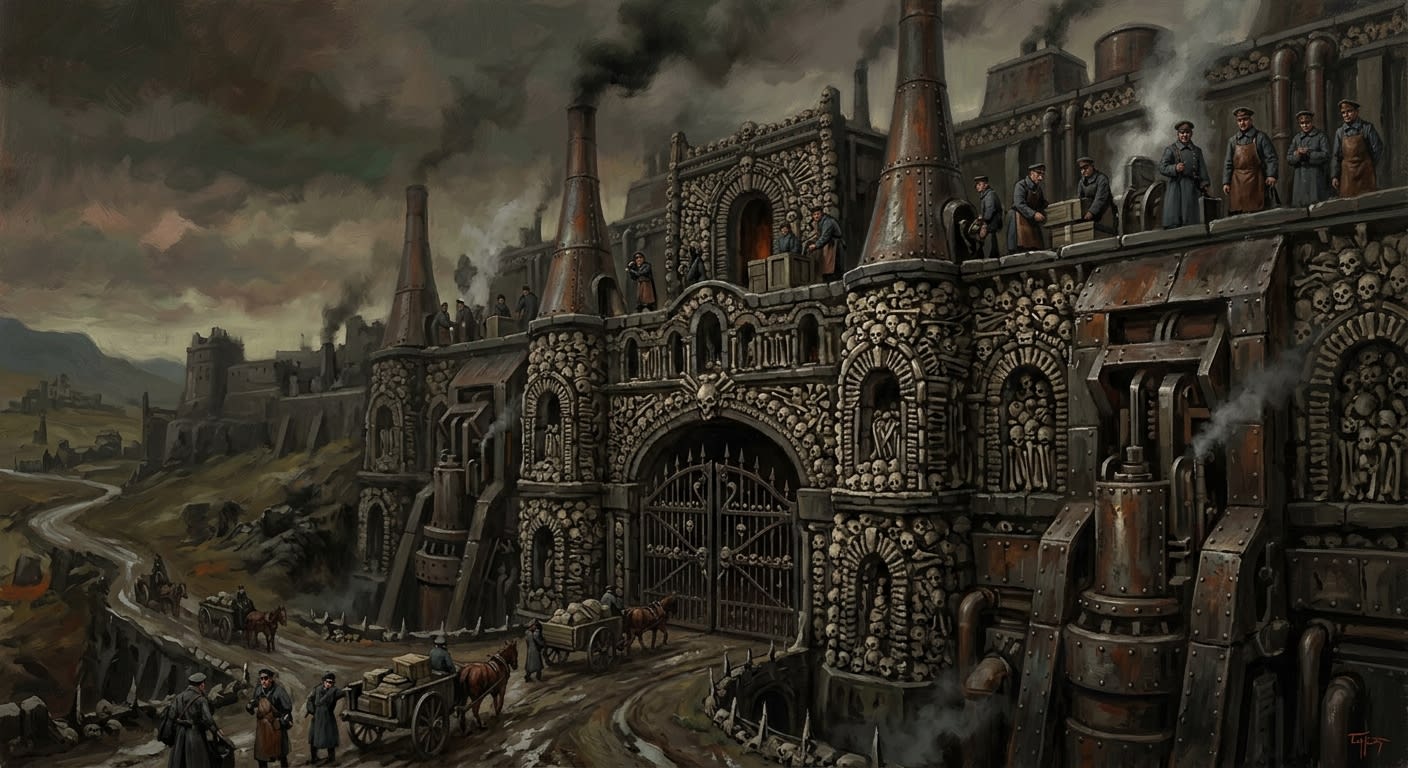
The Ossuary Gate of Debrecen stands where Hungary's plains narrow into the trench-lines, on the western lip of a country that Kargath taught to chew. It is a gate-fort, a warning, a customs office for the damned geography beyond, and the only arch in the Church's lands whose mortar may ask to revise its statement.
Its walls are raised from the bones of three destroyed parishes. Its skulls are mortared in facing courses, each branded with a field confession. Soldiers say the Gate tolls whenever a skull changes its testimony. The Bureau of Bells has dispatched two inspectors. The first filed a report. The second filed a hymn.
Debrecen behind it is gone. That word is already too clean. The city was eaten on All Saints' Day, A.S. 45: forty-two thousand souls, the garrison stores, every sack of flour within forty miles, the cattle-runs, the harvest promise, and the smug Rationalist confidence that hunger was a logistical inconvenience rather than a sacrament inverted. The Blightmarsh remains, grey and warm, with the appetite of a buried principality.
The Gate faces that warmth.
#On the Bones of Three Parishes
The Gate was raised after the first post-Sundering stabilization of the Debrecen approach, when the Synod discovered that ordinary boundary markers sank, rotted, walked away, or sprouted grain. Wood posts grew teeth. Iron posts sweated. Stone posts were found six feet east of where they had been planted, facing the wrong direction like guilty sentries. The Bureau of Engineering proposed brass pylons. The Bureau of Tithes asked who would pay for brass. The answer, as usual, was the dead.
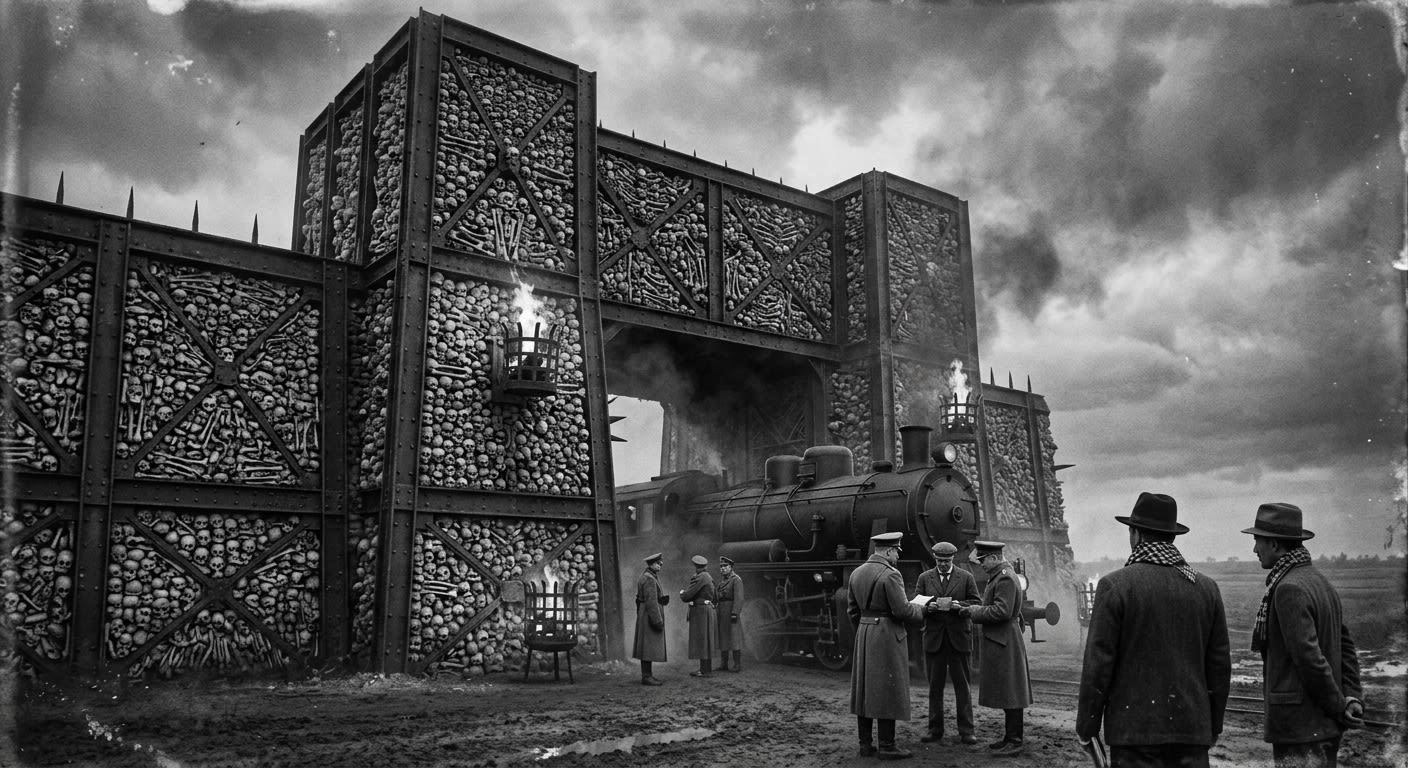
Three parishes destroyed in the eastern retreat supplied the material. Their names survive in the private ledger and in no public sermon, because the Bureau has never decided whether naming them would honour their sacrifice or invite their relatives to ask questions about transport accounting. Carts arrived under tarpaulin. Bones were sorted by size, age, structural promise, and confession status. Skulls were selected for the outer face. Femurs went into the jambs. Ribs served in the vaulting courses. Children's bones were officially excluded.
They are present in the acoustics.
Each skull received a brand before placement: brief confession, field mark, parish seal where known, and the initials of the chaplain or clerk who extracted the statement. The brands are burned above or across the brow. Some are single words: theft, despair, apostasy, withheld tithe, unlawful bread. Others are sentences so cramped that reading them requires a lamp, a ladder, and spiritual rashness. The confession was meant to fix the soul's final ledger entry before the skull entered service as masonry.
It worked. Then it continued working.
#On the Field Confessions
Field confession is an ugly instrument. This recommends it to history. A dying man in a retreat rarely possesses the leisure for polished contrition. He has mud under the nails, blood in the mouth, a priest kneeling on one side, a clerk kneeling on the other, and some officer shouting that the cart must move before the eastern fog learns names. The confession extracted there is short, hot, and often truer than a cathedral booth's five-page indulgence petition.
The Gate contains thousands of such statements. The exact number depends on which office is lying. War counts skulls by defensive frontage. Records counts by recoverable name. Rites counts by absolution category. Doctrine counts by usefulness. Bells counts only those that answer.
The last instruction has failed.
Changes began as soldiers' talk: a skull branded cowardice seen later as hunger; a skull branded blasphemy later showing mercy; a skull whose letters had cracked, filled, and settled into an unfamiliar script. The garrison laughed, then stopped laughing when the Gate sounded at Second Watch with no bell in motion and the watch-captain found three brands altered on the north cheek of the arch.
The first official inspection found soot movement, lime sweating, and no admissible miracle. The second found the word hoarder replaced by feeder on a skull from the southern parish course. The inspector touched the brand with a gloved thumb. The thumbprint remained in the bone after he withdrew it.
BUREAU OF BELLS INSPECTION — SECOND REPORT, EXCERPT SEALED Observed event: unstruck toll, low register, duration seven breaths Affected skulls: three confirmed; four suspected Most severe alteration: “I stole bread” revised to “I carried bread east” Inspector's final notation: “The Gate is correcting the archive.” Subsequent pages filed as hymn, not report.
#On the Tolling
The Gate has no central bell. It has hinges, braces, iron-shot reinforcement, two watch platforms, murder-slits, a winch, and a small chapel set into the western pier where soldiers place ration crumbs before patrols they do not expect to survive. It should not toll. The verb is impossible in the relevant mechanical sense. The Gate tolls anyway.
Witnesses describe the sound as a dull skull-deep note, less heard than received behind the eyes. Dogs flatten themselves. Horses refuse the approach. Men with recent lies in their mouths taste ash. The sound does not repeat like a bell sequence; it arrives once, settles into the stone, and leaves a new reading somewhere in the courses.
Earlier patrol manuals described the Gate's tolling as “wind-action within cranial cavities.”
Withdrawn. Wind does not amend testimony. The author of the phrase has been reassigned to a post where wind, skulls, and accountability may continue their conversation without troubling doctrine.
The Bureau of War attempted to silence the phenomenon by packing wax into exposed cranial openings. The wax melted, though the night was below freezing. The Bureau of Rites proposed a reconsecration. The first aspergillum water hissed on contact and steamed into letters no one present admitted reading. Bells asked permission to suspend three calibrated clappers from the arch and strike a counter-peal. Permission was granted. The clappers rang once by themselves before installation, and the work party resigned in a body.
Resignation was denied. Frontiers are not defended by men who resign from masonry.
#On the Approach to the Blightmarsh
Every patrol moving toward the Debrecen exclusion must pass the Gate, because the alternative approaches have been eaten, flooded, or promoted to map error. West of the arch lies Synod dirt: bad, rationed, measurable, blessed under protest. East lies warm grey mud, the Famine Pits, the Abundance Fields, and terrain that still files teeth under the name of geography.
The Gate narrows the road to a throat. Carts go single file. Infantry lower voices without orders. Radiant lamps burn blue under the arch, then return to ordinary light after the western marker. The garrison has learned to time crossings between Watches and never during meal prayer. Men who cross hungry hear chewing. Men who cross full become hungry before the third milestone.
Standing Order 119-F governs the exclusion zone beyond: no civilian traffic, no commercial salvage, no pilgrimage, no harvesting, no cultivated land approached within ten miles of the Blightmarsh boundary. The Gate enforces the order with guns, stamps, and a talent for making disobedience feel already witnessed. Smugglers have tried the arch by night. Three returned. One confessed to thefts committed after his death. One vomited wheat. One demanded his skull be placed facing east.
The request was denied. The skull was retained for study. It has since acquired a brand no living clerk admits applying.
#On the Garrison
The Gate's garrison is small because no large garrison remains large there for long. Rotations run short. Chaplains are changed before their handwriting begins to resemble the brands. Cooks are forbidden from serving marrow broth. Dice are permitted, cards are not; cards develop extra suits. The chapel stores consecrated salt, bell-wax, clean water, black bread, and a locked box of blank confession strips for patrols who return with more sins than pockets.
A Gatewarden's duties are simple on paper: inspect papers, count bodies out, count bodies in, record brand alterations, forbid songs after dark, and shoot anything that resembles a parish procession approaching from the east. In practice the post requires the hard tact of a man who can tell a starving soldier that the fruit tree beyond the boundary is not fruit, the road beyond the ditch is not road, and the voice calling his childhood name from the mud is not his mother, no matter how tenderly it has prepared the accent.
No one has explained the final instruction to my satisfaction.
#On the Latest Alterations
The most recent audited alteration occurred in A.S. 201, north pier, third course, skull N-3-114. Prior brand: withheld tithe. Revised brand: withheld name. Records objected, since tithe and name occupy different ledgers. Purity objected, since a dead parishioner revising a confession implies post-mortem agency outside approved categories. War objected because the toll woke the powder crews. Doctrine received all three objections and placed them in a single folder labelled Useful.
A second suspected alteration concerns one of the child-sized resonance gaps in the upper vaulting. There should be no child skulls. There are no child skulls. The gap sang during a fog crossing and every man in the patrol heard the same sentence: I was counted. Records has no entry. Records has many entries shaped like absence.
The Gate's present condition is stable in the way a loaded pistol on an altar is stable. Its arch holds. Its skulls remain fixed. Its tolling is intermittent. Its testimony continues to acquire refinements no office requested and no office can wholly suppress. Pilgrims are barred. Soldiers touch the western pier before crossing. Clerks pretend not to see.
A draft notice prepared by the Bureau of War proposed renaming the structure “Debrecen Forward Customs Gate” for administrative clarity.
Rejected before circulation. Clarity is not achieved by calling a skull-wall a customs gate. The clerk responsible has been instructed to spend one night copying brands under supervision.
Pass quickly. Do not read aloud.