

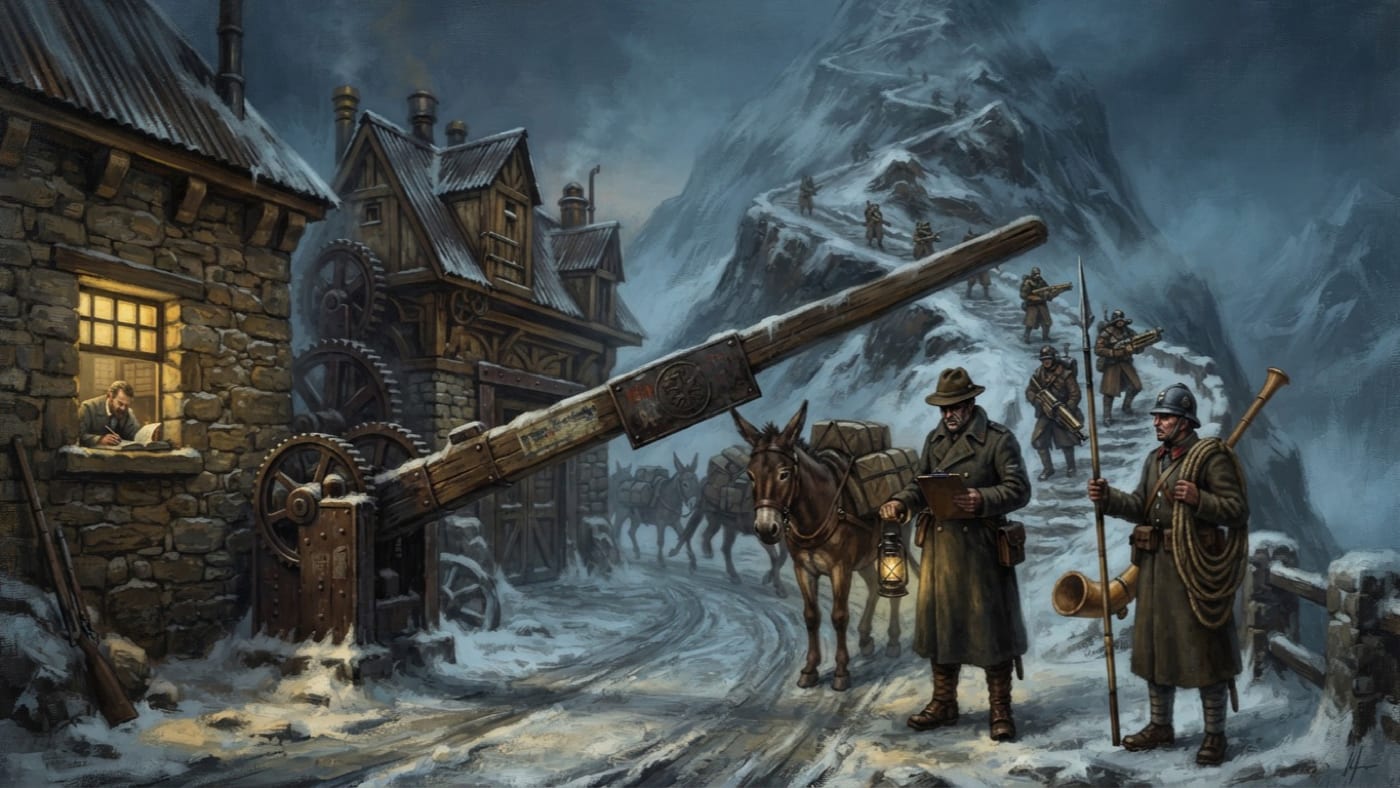
#On the Board Above the Gate
"Adequate." — the Bureau of War, as reported
This survey was compiled for the Bureau of Doctrine in A.S. 201, which is 1911 CE by the old reckoning. The year belongs to the survey and to nothing else on these pages. I hold no date for the settlement, none for the notice reproduced below, and none for the first Synodal seal nailed to the first Swiss toll gate. Readers who want a founding year may write to Records and wait with the others.
Pass Law is a heading in my entry on the Swiss cantons and a tag in the files that followed it. It is not the title of any statute. A traveller who climbs to a cantonal toll gate expecting a bound code will find a barrier, a warden, a seal, and a notice short enough to read while his mule relieves itself. That is the law as the mountain administers it. Everything else is commentary, and most of the commentary is mine.
The arrangement behind the gate appears under two names. Some files call it the Alpine Accommodation. Others call it the Mountain Obedience Schedules. They are one settlement, and no file I have read treats them as two, or ranks one name above the other, or records the first turning into the second. I have no complete instrument under either name and no list of signatories. The word Schedules promises tables ruled in red, and I have never seen one. My survey of the Accommodation took the settlement whole. This one stands at the barrier and records what can be enforced from there.
#On What Stays in Swiss Hands
On my reading, Synodal authority came into the cantons by licence because the other two roads were too expensive. Conquest would have drawn soldiers needed east of the Line into valleys that bury soldiers for free. Persuasion would have spent years the Synod needs everywhere else. That is my reading. I have no minutes of any negotiation, and I decline to furnish one with candlelight and grave Swiss jaws to make the argument look witnessed.
The reported terms on the cantonal side are three. The pass-wardens received recognition. The militias kept their pikes, their horns and their avalanche ropes. The cantonal councils went on sitting.
Read from the gate, these are the terms that keep the pass open. The recognized warden knows which ledge carries a loaded mule in the thaw and which one only pretends to. The horns call the militia, and the militia's ropes are what bring a courier out of a slide. The council decides which valley clears the road first after the snow comes down. Strasbourg left all three in local hands because no Synodal clerk could do any of them.
Cantonal militias kept pikes, horns, avalanche ropes, and local councils.
Corrected. The sentence appeared in my cantonal entry, and by its grammar it gave the councils to the militias as though they were a fourth item of kit. The militias kept their equipment. The councils kept their seats. Nothing in the reported terms puts either one under the other, and a Swiss notary has very likely been sharpening his quill over this since the entry was sealed.
#On What the Seal Requires
The councils gave up three things in return. They accepted Synodal seals on their toll gates. They admitted registry desks into the hospice houses. And they granted War priority over mule trains bound for the Italian and Danubian corridors.
The seal is the smallest of the three and does the most. A sealed gate is a Synodal gate whoever holds the key and whoever opens it. The warden lifting the bar is still Swiss, and so are his gloves and his opinions, but the gate he lifts it on now belongs to Strasbourg. Every passage through it is a Synodal act, whether or not anyone in Strasbourg ever learns that it happened.
The registry desk changes the hospice in the same way. A traveller who once gave his name to the prior with his bread now gives it to a ledger the prior does not keep. The soup is still the canton's. Where the names go after that is the business of the desk.
Priority is the term a muleteer actually feels. A switchback holds one train at a time. Whoever goes first gets the daylight, the packed snow and the dry stall at the hospice, and whoever waits gets the dark. Pass Law says War goes first on the corridors named. It says nothing more precise than that in any file I hold. I have found no table of exceptions, no appeal from the warden's decision and no record of what a council may do when a War writ arrives at a bad hour. What I do know is that the writ gets stamped, and that the pass-master may then wait for weather that comes, with great piety, exactly when local dignity requires it.
#On the Notice
The only text from the passes that looks like legislation is a pass notice, and it reaches me already abbreviated. I reproduce it as it appears in my cantonal account.
Abbreviated means something was cut, and I cannot say what. The notice gives no date of posting. It does not say whether all five lines went up together or whether some gate added the fifth in a later winter. It is a notice and not a charter, and I will not let it pose as one.
Every line has an office behind it. The relic line belongs to the Bureau of Relics, which has sound reasons to want declarations from mountains that once moved chalices under goat salt. The academic line is left over from the cantons' old habit of producing professors, and the toll house is where those manuscripts now stop. The shelter line and the wax line belong to the Bureau of Medicine and the offices it serves.
The bell line is the one the mountains keep breaking. Requiring avalanche bells to match the canton register is one thing. Making valley ringing match anything at all is another. Echoes come back late or doubled, or never come back. The Swiss keep local ringing tables. The Bureau of Bells files objections to those tables, and when winter shuts the passes it consults them. The Office of Bells was constituted in A.S. 52 and the Bell Codex was ratified in A.S. 115. Neither date tells us when any canton first entered a bell in a register, and I cite them only so that nobody files either one as the birthday of this notice.
#On the Readings
Each office finds itself in the settlement. The Swiss call it old liberties confirmed. Strasbourg calls it concord. Tithes calls it promising, which is what Tithes calls anything it has not yet finished assessing. War calls it adequate. Records calls it incomplete, and has been working on the incompleteness ever since.
My own reading I have given already. I add only that every one of these words describes the gate from the desk of whoever wrote it, and that none of those desks has to stand at the gate in February.
#On Present Application
Pass Law today is heaviest on the fifth line. The Bureau of Medicine keeps a sealed facility in the cantons, in an old hospice above a pass whose name is spelled three ways in three registries. I am not ruling on the spelling. Covered litters go up at dusk. A gate that honours wax opens without a question. The councils record timber allotments and bridge planks, and the minutes say no unusual business.
What the councils know about the wards I cannot certify. What they know is the road. My cantonal account reports that Medicine pays for cooperation in hard currency, salt rights, pass exemptions, winter grain priority and relief from certain levy quotas. These are benefits the cooperation pays now. Nobody has shown me that any of them was written into the settlement, and I have found no rates, no sums and no rule for how they are shared. Certain quotas means certain ones. I will not stretch the relief across every canton to make the page tidier.
After the Broadcast of A.S. 199 there was more traffic on these roads. The four civilian witnesses offered Swiss rest went up them, and so did those of the Ark's third crew who accepted their own separate offer. Sergeant Kael declined hers and went to the mud instead. Her refusal established no penalty and no rule of admission. All it showed was that one soldier could read a sealed gate as well as any warden.
The gates are sealed. The desks are staffed. War's trains go up first once the writ has been stamped and the weather has been consulted. The councils still sit and the ropes are still local, while the bells keep disagreeing with Strasbourg and keep being consulted. Records has the terms and an abbreviated notice. It does not have the instrument, and it does not have the year.