
#On the Mountains That Learned to Receive the Unreturning
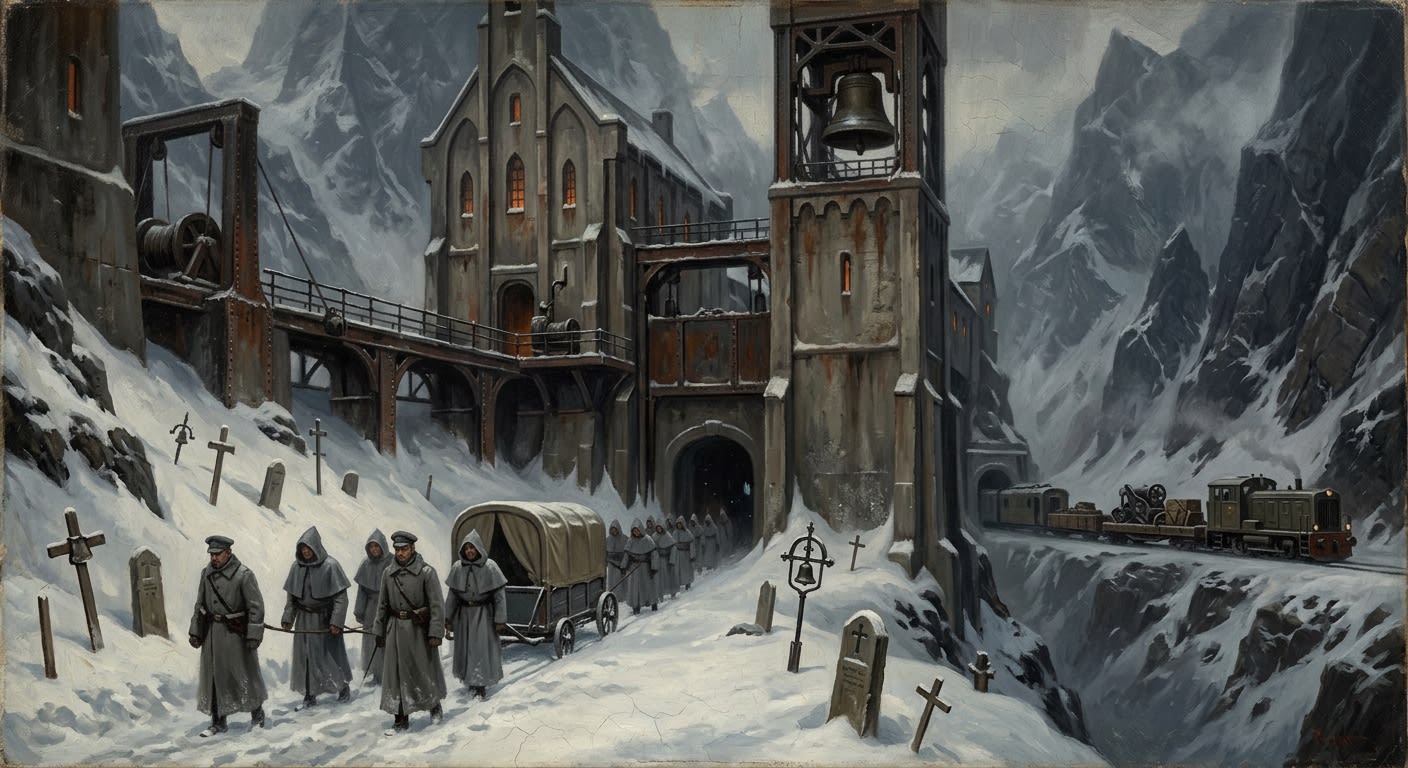
The Swiss cantons occupy the high interior between the Synod’s German body, the Italian approaches, the Burgundian roads, and the old Alpine passes by which fugitives, relics, professors, goats, and cowardice have moved with equal confidence since before the Ledger began counting the wound. In public maps they are a central-heartland mountain district: loyal, licensed, difficult to invade, expensive to maintain, piously stubborn in the lower valleys and commercially stubborn in the upper ones. In Bureau use they are something cleaner and worse.
They are where certain people are sent when Strasbourg wishes to say mercy while meaning silence.
A man may be posted there for rest after hearing the wrong sermon. A clerk may be sent there after repeating a sealed sentence in a harbour tea-room. A physician may recommend Swiss air for a soldier whose mind remains intact in every way except the way that would make him safe at supper. Families receive letters on thick paper: contemplative, improving, medically supervised, spiritually quiet. The letters are signed. The seals are correct. The patients do not return.
The cantons are more than this custody trade. I say so because some Swiss notary, smelling insult through three doors and a cheese rind, will otherwise file a correction demanding that I acknowledge timber, cattle, bells, hospice houses, pass-wardens, militia pikes, alpine rope law, and the production of medicinal syrups so bitter they make confession seem festive. Very well. Acknowledged. The cantons are inhabited. They trade, pray, graze, carve, tally, and object. Their usefulness to the Synod began long before the sanitarium gates acquired white paint.
#On the Old Faith in Barns and Avalanche Chapels
Before the Sundering, before the Concordat of Strasbourg, before Strasbourg acquired its present blessed habit of making obedience sound like architecture, the Swiss valleys were already a geography of concealment. The Rationalist searchers preferred cathedrals, libraries, bishop’s houses, and rich men’s walls. They came late to haylofts. They trusted ledgers more than goats. A civilized error, as I have had occasion to note elsewhere and shall continue noting until someone gives me a commemorative plaque.
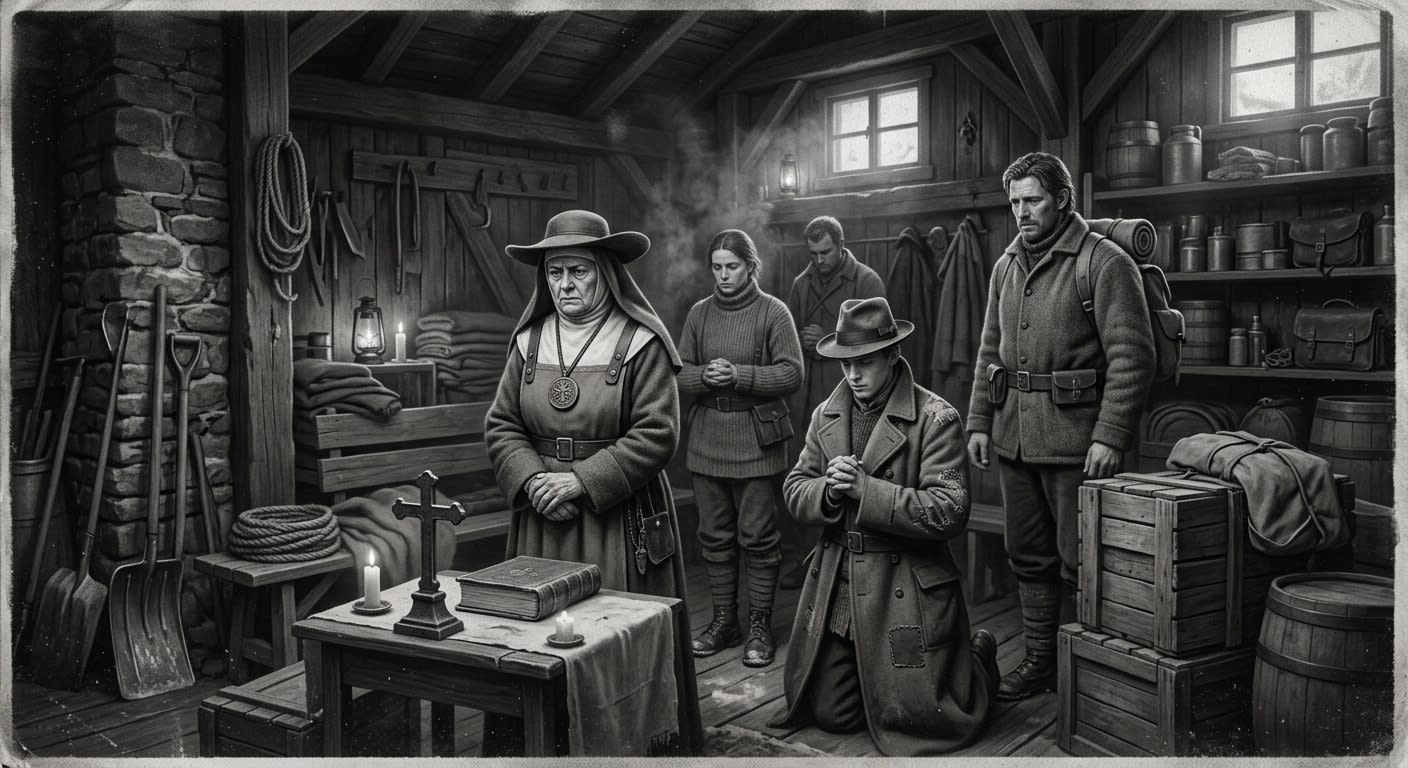
The Cellar Saints used the Swiss valleys as cold arteries in the underground faith. Chalices moved under sacks of salt. Parish registers crossed passes inside hollow cheese wheels, a storage method which offends dignity and preserves vellum better than one expects. Small Masses were sung in avalanche chapels where the roof beams bowed under winter and every voice sounded already half-buried. The Thread ran through Cologne cellars, Lyon catacombs, Innsbruck caves, Bavarian forest shrines, Palatine breweries, and Swiss barns whose owners swore they had no interest in theology while hiding reliquaries under goat salt.
The Bureau of Relics still lists Swiss valley holdings in the Unknown cabinet: rescued documents, cracked patens, bone packets with no surviving saint-name, candle stubs from Masses whose celebrants were shot, drowned, or married into silence. Unknown is the largest cabinet. Switzerland supplied a generous portion of that honesty.
Older provincial catechisms describe the Swiss valleys as “minor auxiliary shelters in the Cellar Saint period.”
Corrected. Minor shelters do not preserve altar stone fragments, three episcopal letter sequences, fourteen condemned missals, and enough parish seal impressions to make the Night of Black Decrees administratively plausible. Humility is admirable in saints. It is unhelpful in archives.
The cantons learned the first rule of survival under hostile reason: never become important in a way that can be easily counted. A monastery may be confiscated. A cathedral may be desecrated. A barn is a barn until the soldiers leave, at which point it becomes a chapel, a press room, a surgery, a storehouse, or a court depending on which latch is lifted. The Swiss did not invent ambiguity. They merely gave it good drainage.
#On the Rationalist Schools and the First Contamination of Clean Air
The same valleys that hid chalices also bred professors. This is the Alpine joke: one pass carries a saint’s finger west under wool; the next carries a lecturer east with a manuscript explaining why fingers cannot be holy. The Concordats of Ulm drew signatures and correspondence from German, Swiss, and Lowlands universities, then spread by letters, congresses, and the pompous little disease of men discovering that ink can make disbelief sound organized.
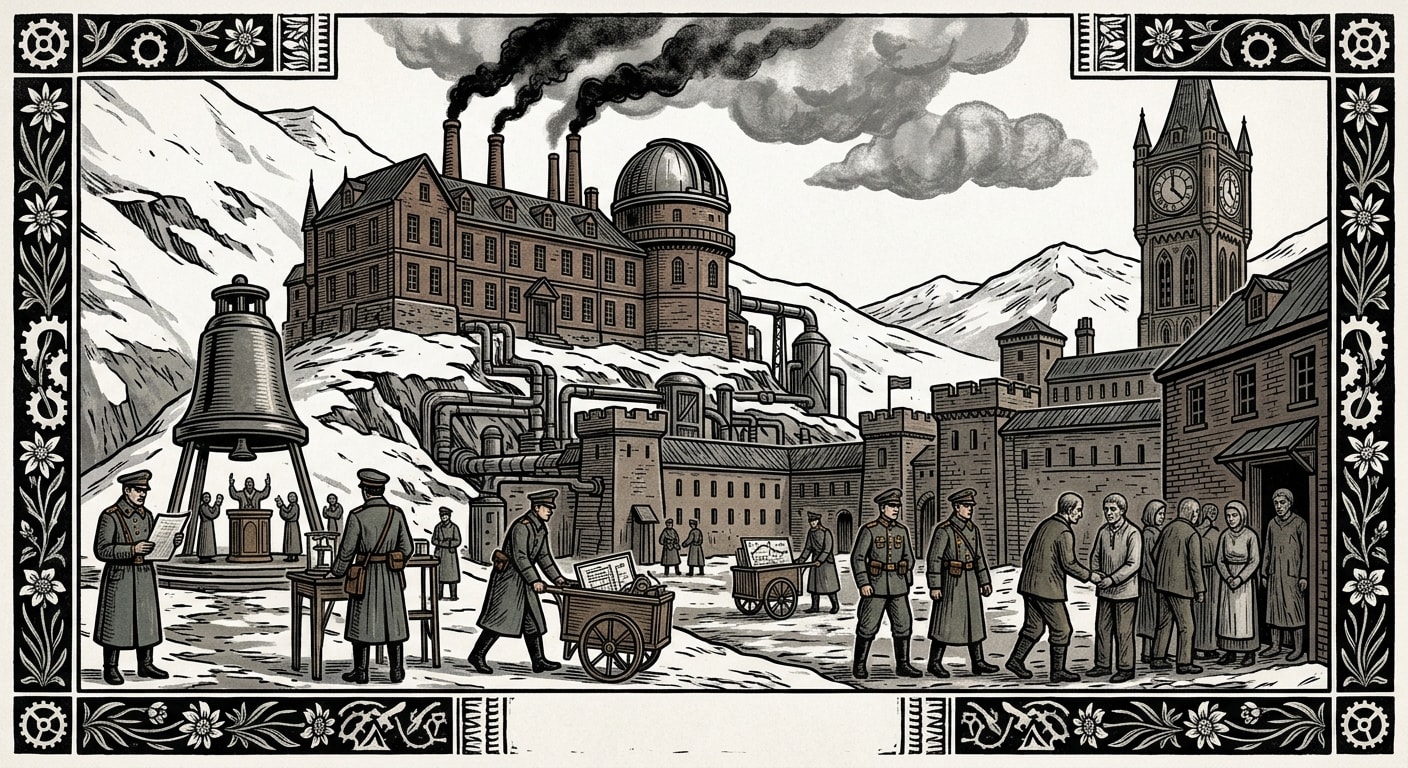
By –40 A.S. (1670 CE, before the Bureau’s calendar), the scholarly fraternity had reached institutions in the Swiss cantons. By –10 A.S. (1700 CE, still before the Bureau began numbering the wound) the Ulm congresses counted representatives across Europe, including Swiss men of severe jackets, narrow hands, and the intolerable calm of those who think mountain air has purified their conclusions. Some were harmless in the manner of academics: dangerous only when funded. Others fed the Rationalist ascent by correspondence, relic arithmetic, calendar mockery, and the early habit of treating the sacred as an error to be corrected by inventory.
The Atheist Wars did not leave the cantons clean. No region with roads remains clean. Rationalist cells hid in lecture houses. Faithful cells hid in barns. Valley councils issued contradictory oaths with the composure of men who had discovered that parchment can face two directions if folded properly. When Augustinus of Mainz began drawing Europe’s remaining faithful into a structure that would become the Synod, Swiss Cellar communities supplied routes, witnesses, saved seals, and the old habit of disobedience in holy clothing. When Kratz needed authentic scraps for the black writs, Swiss valley packets helped make false authority look older than sin.
Strasbourg has forgiven the cantons for helping us too well. This is the most suspicious forgiveness.
#On Pass Law (Unregistered), Militia Bells (Unregistered), and the Price of Obedience
Synodal authority entered the Swiss cantons by pass, bell, hospice, and tax. It could not enter as conquest without wasting soldiers needed east of the Line, and it could not enter as persuasion without wasting time needed everywhere. The answer, as usual, was licensing. Pass-wardens received recognition. Cantonal militias kept pikes, horns, avalanche ropes, and local councils. The councils accepted Synodal seals on toll gates, registry desks in hospice houses, and War priority over mule trains headed toward the Italian and Danubian corridors.
The arrangement was called Alpine Accommodation (Unregistered) in some files and the Mountain Obedience Schedules in others. The Swiss called it old liberties confirmed, which is what provincials call defeat when they have retained enough furniture to sit proudly. Strasbourg called it concord. Tithes called it promising. War called it adequate. Records called it incomplete and has improved the incompleteness ever since.
Bells matter in the cantons. Every valley has them: cattle bells, chapel bells, avalanche warning bells, militia bells, hospice door bells, little hand bells rung beside beds where patients are too gentle to shout and too watched to speak. The Bureau of Bells took an early interest and discovered, to its irritation, that local ringing patterns resist standardisation because mountains answer sound badly. Echoes return late, doubled, swallowed, or carrying words no ringer claims to have sent. The Swiss shrug and keep local tables. The Bureau files objections, then consults those tables when winter closes the passes.
The cantons learned to obey by preserving the form of objection. A council clerk will say yes in a tone that records six reservations. A pass-master will stamp a writ, then make the convoy wait for weather that arrives exactly when local dignity requires it. A hospice prior will open the upper ward to Bureau of Medicine custody and retain the lower chapel for cantonal rites, as if sound respects floorboards. This is infuriating. This is also why the mountains still function.
#On the Medicine Houses (Unregistered)
The Bureau of Medicine maintains a facility in the Swiss cantons. The public phrase is restorative retreat. The internal phrase varies by clerk, physician, severity, and cowardice. I have seen convalescent hospice, mountain quiet house, Alpine semantic ward, protected contemplation site, and, once, in a note by a junior surgeon later promoted for honesty and punished for timing, the place we send witnesses.
It is not the oldest Medicine facility. The Adriatic house has that honour and the smell of herbs drying over fear. The Swiss facility became important after the Bureau discovered that some patients do better where the air is thin, the winters enforce privacy, and every road down can be closed by snowfall, toll, militia drill, avalanche alarm, or an order written in calm blue ink. A seaside sanitarium invites rumours. A mountain house invites weather. Weather is cheaper than guards and less likely to talk.
The building itself is an old hospice above a pass whose name appears differently in three registries. Its chapel faces east. Its medical wing faces a rock wall. Its garden grows fennel, wormwood, alpine mint, and a white flower whose official name changes whenever a patient repeats it too many times. The upper windows are shuttered from outside. The bells are felt before heard. Letters leave on Tuesdays after review by Medicine, Mercy, and, when the case has acquired metaphysical stink, Doctrine.
BUREAU OF MEDICINE — SWISS FACILITY INTAKE ABSTRACT, A.S. 199 Source: Constantinople theatre. Patients: four civilians, two harbour clerks, two fishermen. Exposure: unauthorised repetition attempt following aerial broadcast event. Presenting condition: urgent speech pressure, liturgical distress, name fixation, auditory return under silence. Disposition: contemplative. Quarterly note: ███████████████████████████████. Family correspondence: approved, non-specific.
Do not imagine chains. Chains offend the Swiss sense of craft when subtler devices exist. There are white blankets, brass bedframes, mountain broth, supervised walks to a fenced overlook, chapel offices sung at the soft pitch used around snowfields, physicians with warm hands, sisters with colder eyes, and doors whose locks sound too small for what they prevent. Patients are addressed by courtesy titles unless their names have become symptomatic. Then numbers appear.
The Bureau of Mercy insists the facility is pastoral. Medicine insists it is clinical. War uses it when a soldier cannot be released and should not be shot. Doctrine uses it when a witness has heard a sentence that cannot be unheard without damaging the witness, the sentence, or the office that failed to prevent hearing. Purity uses it rarely and badly. Shadows uses it without admitting the road.
#On the Broadcast Patients and the Refusal of Sergeant Kael
The Swiss cantons entered the Broadcast file at the moment four civilians tried to repeat what the Vigil Ark Saint Barachiel had carried through its Sermon-horns on the 3rd of Argent, A.S. 199. Two fishermen. Two harbour clerks. Useful people, ordinary people, the sort of witnesses administrations prefer until witness becomes contagion. They were offered theological rest in the Swiss cantons, at Bureau expense. They accepted after the kind of conversation in which refusal has already been buried.
Their condition is contemplative. That word has done more work than half the lower clergy.
The third crew of the Ark received the same offer after the rotation was terminated. Honourable discharge. Full pension. Swiss posting. Eight of eleven accepted. Three declined. Sergeant Kael chose Blightmarsh observation duty at Kestrel-7, a choice so magnificently perverse that even War mistook it for morale. The Swiss facility offered warm rooms, white sheets, and supervised peace. Kestrel-7 offered grey mud, Kargathite hunger pressure, and a perimeter where men dream of bread that was never baked. Kael chose mud.
When asked why, she answered: Too quiet.
I record the answer because it is the finest clinical summary of the Swiss facility yet produced.
The eight who accepted are not named in public crew summaries. Their families receive pension notices. Their service is honoured. Their present condition is stable, contemplative, grateful, improving, retired, unavailable, and subject to no visits during winter. Winter in the Swiss cantons is long by geography and longer by policy.
Early War summaries described the Swiss posting as a routine post-incident convalescence option accepted by most of Third Crew.
Corrected for cruelty disguised as neatness. Routine convalescence does not require Hierarch-Seal transcript shielding, Medicine review, visitor prohibition, and a refusal later treated as field-relevant evidence.
#On Cantonal Complicity
The local councils deny knowledge with the poise of men whose grandfathers hid chalices from Rationalist inspectors and whose fathers hid Rationalist cousins from Synodal inspectors until the correct amnesty rate had been negotiated. They know enough. A mule train with covered litters passes at night. A valley bell rings twice instead of three times. The hospice laundry doubles. A clerk from Strasbourg arrives pale and departs paler. The council minutes read: snow maintenance, timber allotment, cheese levy, bridge plank, no unusual business.
No unusual business is the mountain version of Amen.
The cantons profit from the arrangement. Let us not perfume the goat. Medicine pays in hard currency, salt rights, pass exemptions, winter grain priority, and relief from certain levy quotas. Young Swiss physicians receive training in conditions that would have made earlier anatomists weep into their sleeves. Local sisters gain protection from Tithes inspections. Councils gain favour by silence. Families gain the ability to say their broken relatives are in the mountains, which sounds gentler than lost.
The cost is paid in the lower registers of civic speech. Children are told not to mimic the white wagons. Innkeepers keep rooms empty for officials who never book them. Bell-ringers learn a hush peal used only when litters cross at dusk. Militia captains salute Medicine wax before War iron, which they resent correctly and record nowhere. Priests in valley chapels preach on patience, discretion, mercy, and the virtue of not asking whether a man behind the shutter is praying, sleeping, or trying to forget a name that keeps returning through his own teeth.
The Swiss did not become collaborators through wickedness. Wickedness is usually less tidy. They became collaborators through the oldest Alpine bargain: keep the pass open, keep the village fed, keep outside power moving upward and inward under local hands, and pretend the mountain has swallowed the moral remainder.
#On Present Condition
As of A.S. 201, the Swiss cantons remain loyal in official language, accommodated in legal language, resistant in local language, and indispensable in every language that matters after the door is closed. Their pass-wardens move relic freight, wounded officers, sealed scholars, and Medicine patients through snowfields with the same blank competence. Their councils argue over timber and tolls while avoiding the names of facilities everyone can locate by not pointing. Their bells continue to defy standard tables when fog lies low in the valleys, and the Bureau of Bells continues to lose arguments with granite.
The Broadcast file increased traffic. So did Syrion exposure cases from the southern sector, Blightmarsh personnel who returned from Kargathite fields with hunger lodged in the grammar of their prayers, and Purity interrogators who learned too much from heretics and then began answering questions before they were asked. The Swiss facility reports capacity sufficient. Medicine reports contemplative stability. War reports no deployment concern. Doctrine reports nothing, which is occasionally the only honest report we issue.
The mountains receive them. Fishermen, clerks, soldiers, inquisitors, professors, damaged saints of the front, cowards who survived, brave men who shattered, liars whose lies became audible, and witnesses who mistook truth for something that could be repeated safely. They go up under blankets. The bells soften. The snow comes down. Letters descend in spring.