

#On the Names in the Cantonal Files
"Old liberties confirmed." — the Swiss reading, as reported
This survey was compiled for the Bureau of Doctrine in A.S. 201, which is 1911 CE by the old calendar. It covers one arrangement only: the settlement between the Swiss cantonal councils and Synodal authority. Some files call it Alpine Accommodation and others call it the Mountain Obedience Schedules. The year 201 is the year of this compilation and dates nothing else. No date of signing, promulgation, ratification or amendment has reached my desk. I will not invent one for readers who like their obedience to have a birthday.
Both names refer to the same arrangement. None of the files I have consulted treats them as two agreements, ranks one title above the other, or records an amendment that turned the first into the second. Nobody has produced a complete instrument under either title. The word Schedules has led junior clerks to imagine numbered tables and columns of provisions ruled in red. I have seen no such grid. What I have is my own entry on the Swiss cantons, the repetition of it in my survey of the Alpine Marches, one abbreviated pass notice, and the behaviour of the mountains themselves.
The Alpine Marches are a Procuratorial region under an appointee of the Concordat Hall at Strasbourg. They take in the Tyrol, the Inn valley and the Salzburg shelf. The Accommodation governs the Swiss arrangement at the western passes and nothing beyond them. Any clerk who files one as the other will be corrected in red ink, at his own expense.
#On What the Councils Kept
Synodal authority entered the cantons through licences, passes, bells, hospices and taxes. My earlier entry gave the reason, and I stand by it. Conquest would have pulled soldiers needed east of the Line into valleys that eat soldiers. Persuasion would have taken years the Synod needs elsewhere. That is my reading of the bargain. Nobody has shown me minutes of a negotiation, and I will not furnish a council chamber with good light and grave faces to make the reading prettier.
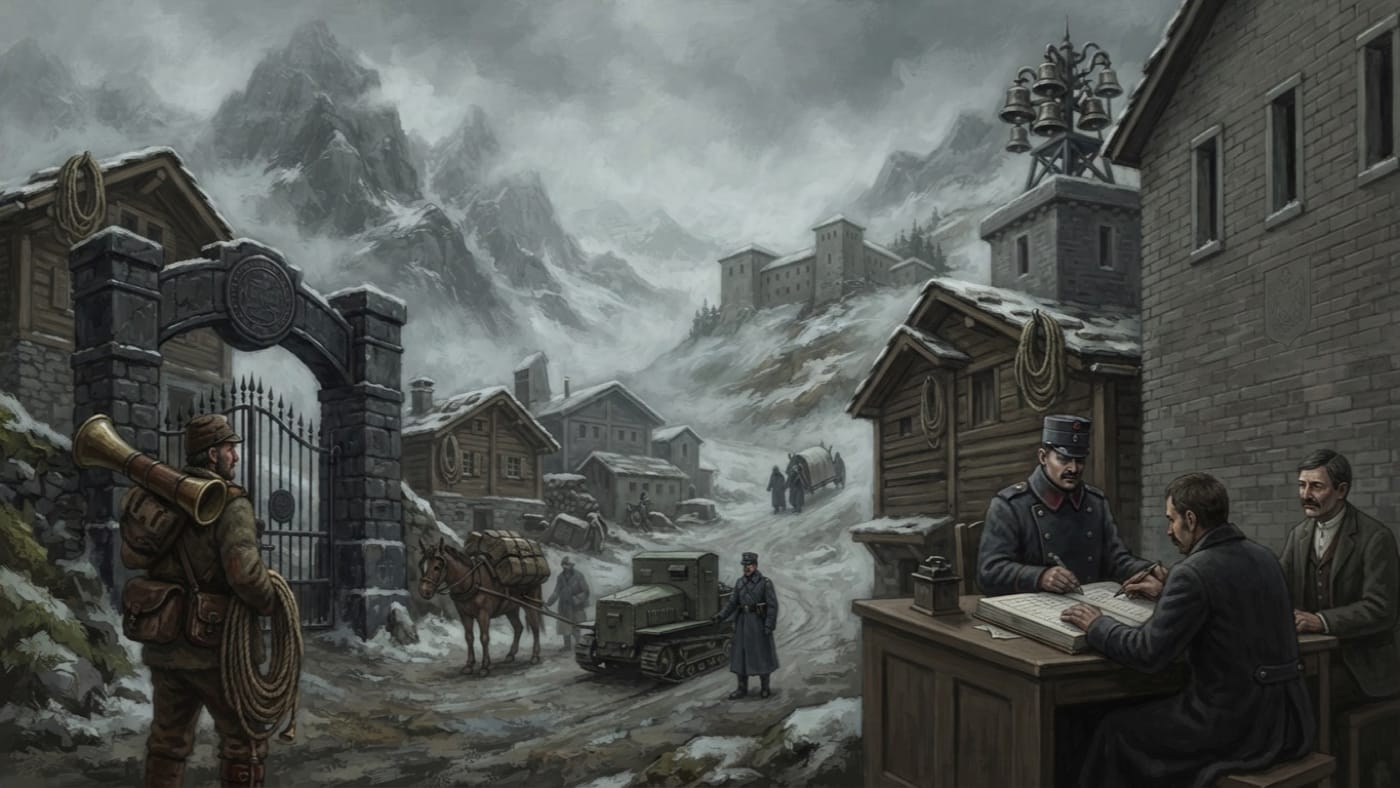
The reported terms on the cantonal side are few and plain. The pass-wardens received recognition. The militias kept their pikes, horns and avalanche ropes. The local councils went on sitting.
The Swiss call this the confirmation of old liberties. I have called it the provincial way of describing defeat while keeping enough furniture to sit proudly, and the phrase still pleases me. It is also incomplete, as my best phrases sometimes are. The recognized pass-warden is the man who knows which ledge will hold a loaded mule in the third week of thaw. The militia that kept its ropes is the only body in the valley able to dig a War courier out of a slide. The council that kept sitting knows which hayloft hid a chalice under Reason and which one hid a Rationalist cousin afterwards. Strasbourg did not leave these things in local hands out of tenderness. It left them there because nobody else could hold them.
#On What the Seals Required
The councils gave things up as well. They accepted Synodal seals on their toll gates. They let registry desks into the hospice houses, so a traveller who once gave his name to a prior now gives it to a ledger the prior does not own. They granted War priority over mule trains bound for the Italian and Danubian corridors. In practice, a cheese convoy waits on the switchback while the powder goes by.
These three are the clearest terms on record, and they are enough. A toll gate under seal answers to Strasbourg, whoever holds the key. Once a registry clerk sits at its desk, a hospice is an office of the Church that happens to serve soup.
The only text I can show the reader that looks like a schedule is a pass notice. It is abbreviated, and it reaches this compilation by way of my cantonal entry. It is not a charter. It does not say when its requirements were first posted, or whether all five were posted together.
Every line serves an office. The first belongs to the Bureau of Relics. The third is left over from the old quarrel with the Rationalist schools. The fourth belongs to the Bureau of Bells, and the second and fifth to the Bureau of Medicine and the offices it serves.
The mountains break the fourth line most often. Ringing patterns in the valleys will not standardize, because the echo comes back late, doubled or swallowed. The Swiss keep local tables. The Bureau of Bells, constituted in A.S. 52, saw the present Bell Codex ratified in A.S. 115, and it has filed objections every autumn since. Every winter it consults the local tables. Neither year says when the cantons began matching their bells to anything.
#On the Accounts of Obedience
Every office reads this arrangement and finds itself in it. That is what offices are for.
Strasbourg calls it concord. The Bureau of Tithes calls it promising, which is what Tithes says of any arrangement that has not yet paid its full assessment. War calls it adequate, which from War is praise warm enough to embarrass a quartermaster. The Bureau of Records calls it incomplete and has been improving the incompleteness ever since. The Swiss call it their liberties. Each reading is accurate from its author's desk, and no one desk can see the whole mountain.
The fiscal ledger needs care, because clerks cheat there most. My cantonal account reports that Medicine pays the cantons in hard currency, salt rights, pass exemptions, winter grain priority and relief from certain levy quotas. It also reports that young Swiss physicians get training, local sisters get protection from Tithes inspections, and councils get favour. These are benefits of the cooperation now under way. Nobody has shown me that any of them was written into the original settlement, and I will not let a later bribe pass itself off as an ancient clause. I have found no rate, sum, formula or payment schedule. The relief applies to certain quotas and is uneven. I will not make it uniform across the cantons to tidy the page.
The military reading has similar limits. The arrangement secures movement and shelter, and the militias keep their equipment and their local organization. I find no troop quota, no general exemption from service, no command table and no garrison clause. I also find no settled answer to who owns the toll revenue. Tithes would very much like that answer, and so would the councils.
#On Medicine Wax and Local Silence
The fifth line of the pass notice has acquired a building.
The Synod technically ranks the Bureau of Medicine as an operational directorate under Mercy and War. Medicine keeps a facility in an old hospice above a pass whose name appears differently in three registries. I will not rule on which registry is right. The prior admits Medicine custody to the upper ward and keeps the lower chapel for cantonal rites. I record this as the practice of one house. It does not prove any general right to reserve a chapel, any cantonal veto or any immunity, whatever the next Swiss notary to read this would prefer.
The house takes in people whose condition makes releasing them inconvenient or dangerous. I leave its methods to Medicine, which has not shared them with me and would not be believed if it did. Letters go down on Tuesdays, and the council minutes read no unusual business.
After the Broadcast of A.S. 199, four civilian witnesses were offered theological rest in the cantons, and they accepted. The third crew of the Vigil Ark Saint Barachiel received a separate offer, and eight of eleven accepted. These are two groups. Any clerk who adds them together to fill a ward will be sent back to copying. Sergeant Kael declined and took observation duty at Kestrel-7. Asked why, she said: Too quiet.
Here the Accommodation can be watched at work. A toll gate honours wax. A council sees covered litters at dusk and records timber allotments. Nothing in the reported terms requires the cantons to keep this silence. They keep it anyway, and Medicine pays.
Early War summaries described the Swiss posting as a routine post-incident convalescence option accepted by most of Third Crew.
Corrected in the cantonal account, and the correction is carried here. Routine convalescence does not require transcript shielding under Hierarch seal, Medicine review and a ban on visitors.
#On Present Application
This survey closes as it opened, in A.S. 201 / 1911 CE. The assessment below belongs to this compilation and dates nothing but itself.
The Accommodation holds. Seals sit on the toll gates, and registry clerks sit in the hospice houses. War convoys go first once the pass-master has stamped the writ. He then waits for weather that arrives, with remarkable piety, exactly when local dignity requires it. The councils still sit. The ropes are still local. The bells still disagree with Strasbourg and are consulted all the same. Medicine traffic has grown since the Broadcast, and no canton has entered the growth in its rolls.
I classify the arrangement as licensed obedience under local management. The Swiss will read the second half, the Synod will read the first, and each will think it holds the better copy. Records will note that neither holds the original.