

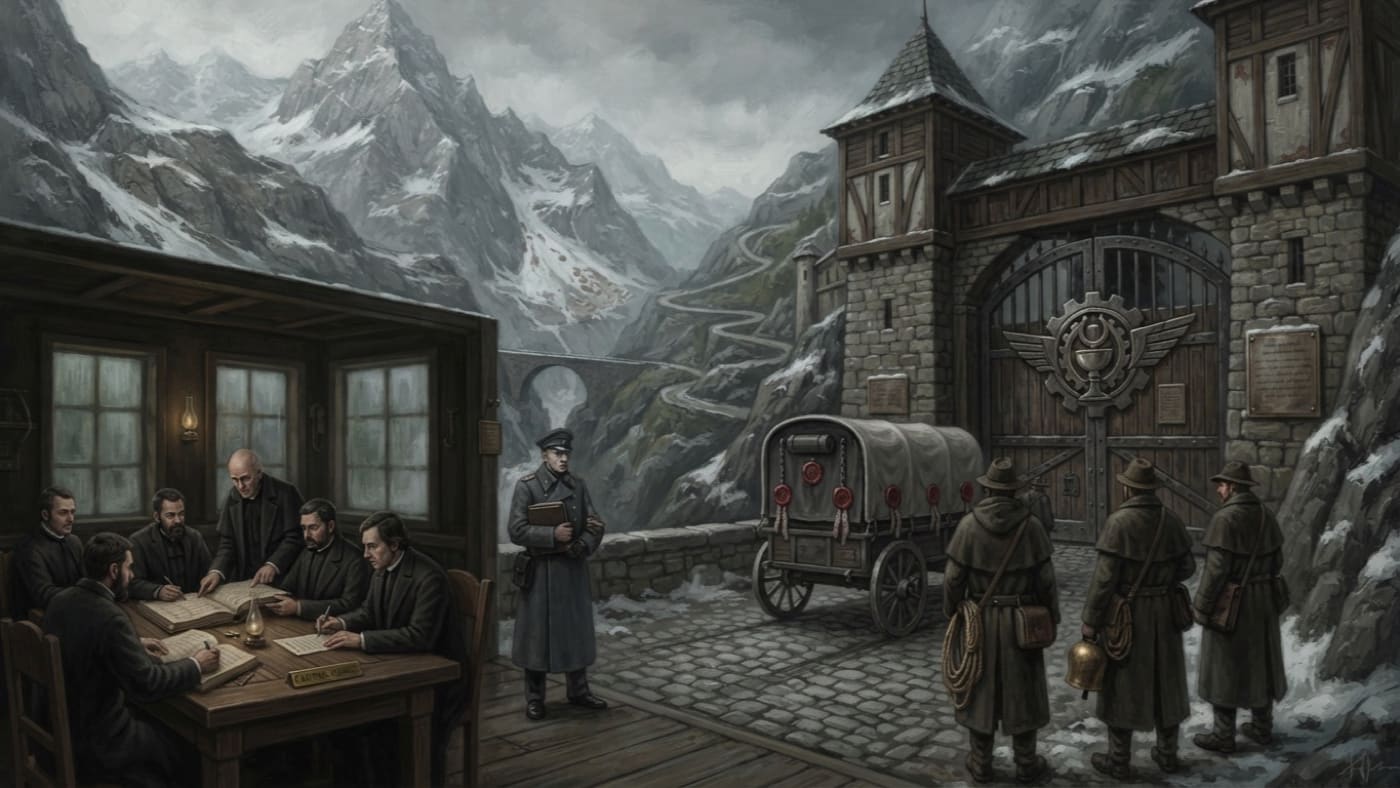
#On the Councils, Plural
"No unusual business." — closing line of cantonal minutes, as reported
This survey was compiled for the Bureau of Doctrine in A.S. 201, which the old calendar calls 1911 CE. That year dates this compilation and nothing else. Its subject is the cantonal councils of the Swiss cantons, and the plural is the first fact a clerk must master. There are councils. There is no single Swiss council. I have found no federal chamber, no chair, no charter of incorporation, no membership roll and no account of how any councillor came to his bench. Clerks who write "the Cantonal Council" in capitals will have the capitals removed with a knife.
What the councils share is a condition. They continue to sit, and Synodal authority sits beside them. A valley minute-book records a bridge plank and a timber allotment in a local hand. On the toll gate below the chamber window hangs a seal that came from Strasbourg. Both are genuine. This survey asks how the first makes the second workable, and what the councils take home for allowing it.
#On the Continuing Bodies
The councils govern the things mountains break: bridges, tolls, timber, cattle levies, snow maintenance, militia equipment, hospice provisioning, and the order in which valleys clear a road after a slide. Their minutes, as reported in my cantonal account, read like a quartermaster's litany: snow maintenance, timber allotment, cheese levy, bridge plank. No Bureau in Strasbourg wishes to administer the cheese levy. Every Bureau in Strasbourg eats the cheese.
Their competence lives in people the Synod could not replace with a writ. The recognized pass-warden knows which ledge will carry a loaded mule in the third week of thaw. The militia captain keeps the avalanche ropes and the men trained to haul on them. The council clerk knows whose barn floods, whose bridge rots, and which family has owed the toll house four winters of firewood. A Strasbourg inspector could requisition every scrap of this knowledge. He would then need the councils to explain it to him.
The valleys carry older habits as well. During the Rationalist ascent, Swiss barns hid the Cellar Saints' chalices under goat salt, while other Swiss houses sent professors into the fraternity of the Concordats of Ulm, whose original compact belongs to A.S. −55 / 1655 CE. Swiss institutional participation in that fraternity is reported by A.S. −40 / 1670 CE. Neither fact dates a single council now sitting, and I decline to rule a straight line from a hayloft Mass to a present minute-book. I possess no such line. What the mountains kept from that era is a manner: never become important in a way that can be easily counted.
#On Licensed Passage
The arrangement under which the councils now operate appears in some files as the Alpine Accommodation and in others as the Mountain Obedience Schedules. Those are names for the settlement. Neither names the councils, and no clerk will file a council under either. No complete instrument has been located. No year of signing, ratification or amendment has reached my desk.
The reported terms are few. Pass-wardens received recognition. Militias kept their pikes, horns and avalanche ropes. The councils went on sitting. In return the councils accepted Synodal seals on their toll gates, registry desks in their hospice houses and War priority over mule trains bound for the Italian and Danubian corridors. The cheese convoy waits on the switchback while the powder goes up.
The Swiss call the result old liberties confirmed. I record that as their claim. I have seen no instrument confirming any liberty, and none establishing that the councils hold anything Strasbourg could not take, given sufficient expense and a great many frozen soldiers. Strasbourg has declined the expense. That refusal is the nearest thing to a constitution the councils possess.
What the councils administer under seal is passage. A traveller who once gave his name to a hospice prior now gives it to a registry desk. A toll keeper, still local and still paid partly in local grumbling, raises a gate bearing a seal he did not cut. The pass notice reported in my cantonal account lists five requirements: relic freight declared before ascent; wounded personnel under Bureau seal sheltered first; Rationalist academic material surrendered at the toll house; avalanche bells matched to the canton register; and silence requests honoured when they bear Medicine wax. The notice is abbreviated. It says nothing of what a council may refuse, and I will not supply the missing half to make the page balance.
#On Bells, Convoys and the Form of Objection
The fourth line of that notice is where obedience acquires an accent.
Mountain echo comes back late, doubled or swallowed, so the cantons keep local ringing tables. The Bureau of Bells objects to the tables, and when winter shuts the passes it consults them. The Office's constitution in A.S. 52 and the ratification of the Bell Codex in A.S. 115 do not date these tables, and I have found nothing that does. Nor is there one table for every canton. Each valley rings as its rock permits.
The councils resist through clerks and weather. A council clerk says yes in a tone that records six reservations. A pass-master stamps a War writ, then holds the convoy for weather that arrives exactly when local dignity requires it. Provisioning follows the same liturgy. Hay is found, mules are found, winter grain is found, each a little later than Strasbourg asked and a good deal sooner than Strasbourg could have managed alone.
I have found no lawful council veto, no formal appeal from a Swiss bench to Strasbourg, no troop quota, and no settled answer to who owns the toll revenue. The Bureau of Tithes wants that answer badly. The councils seem content to leave the question unanswered.
#On Medicine Wax and Civic Silence
The fifth line of the notice costs the most.
The Bureau of Medicine, technically a subordinate directorate under Mercy and War, maintains a facility in the Swiss cantons as part of its wider sanitarium network. The facility is sealed. The councils hold no key to it, and nothing I have read gives them authority over its wards, its admissions or its treatment. Their part is the road.
That part is set out in a council extract I carry forward from my cantonal account. I reproduce it with its provenance attached, because a document that travels without its pedigree soon starts lying about its age.
Read it as a clerk would. The councils permit wagons. They retain jurisdiction over bells, and a bell is not a bed. They keep names off the civil rolls. The hospice registry desk may still log a traveller at the gate, and an omitted name proves only that someone chose which page to leave blank. When a mother comes down the valley asking after her son, the council sends her to a Bureau courier. In one hospice the prior admits Medicine custody to the upper ward and keeps the lower chapel for cantonal rites. That is the practice of one house. It confers no general right.
The Broadcast file shows what moves along this road. After the Vigil Ark Saint Barachiel incident of 3rd Argent, A.S. 199, four civilian witnesses were offered theological rest in the cantons: two fishermen and two harbour clerks. Separately, eight of the eleven members of the Ark's third crew accepted contemplative rest. These are two groups and two decisions, and neither amounts to a ward census. What was heard during the Broadcast remains sealed, and this survey leaves it sealed. Sergeant Kael declined, chose Kestrel-7 on the Blightmarsh perimeter, and called the cantons too quiet.
Early War summaries described the Swiss posting as a routine post-incident convalescence option accepted by most of Third Crew.
Corrected in the cantonal account and carried forward here. Routine convalescence does not require transcript shielding under Hierarch seal, Medicine review and a prohibition on visitors.
The councils are paid for the road. The cantonal account reports hard currency, salt rights, pass exemptions, winter grain priority and relief from certain levy quotas. It also reports training for young Swiss physicians, protection for local sisters from Tithes inspections, and favour for the councils. I have no rates, no recipients, no ledger of distribution, and no evidence that any of it was written into the original settlement. Certain quotas means certain quotas. Any clerk who reads it as exemption will be reassigned to counting salt.
The accusation that follows is mine. The councils see covered litters at dusk. They hear the valley bell ring twice where it used to ring three times. They watch the hospice laundry double, and they watch a Strasbourg clerk arrive pale and leave paler. Then they write timber allotment. I possess no secret resolution, no confessing councillor, and no proof that any bench knows what happens behind a single shutter. I do not need them. A body that permits the wagon, banks the salt and minutes the plank has chosen its ignorance with care. The Swiss learned that craft hiding chalices from men with inventories.
I defend Strasbourg's use of the road. Strasbourg needs it. That defence does not extend to people who accept winter grain as the price of not looking.
#On Present Application
This compilation closes where it opened, in A.S. 201 / 1911 CE, and its assessment dates nothing earlier.
The councils continue. They sit plural and unchartered, minute their planks, keep their ropes, and surrender their gates to seals they did not cut. They are accommodated under an instrument nobody can produce. They resist through bells, weather and the reservations of clerks. They are useful, which is why the resistance is tolerated and the silence bought. Traffic under wax has increased since the Broadcast. The minutes have not noticed.