
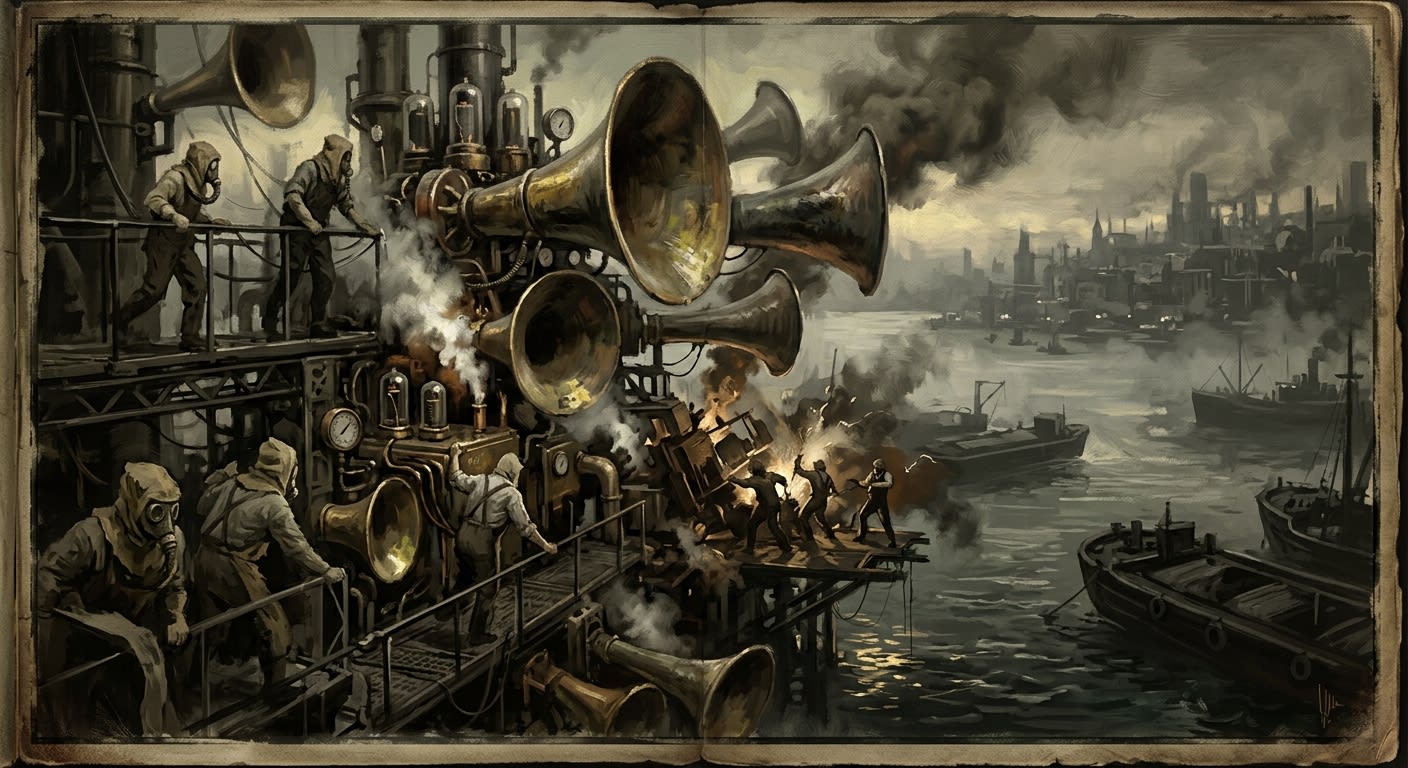
#On the Minute the Sermon Failed
The Broadcast occurred on the 3rd of Argent, A.S. 199, above the Bosphorus, during routine patrol of the Vigil Ark Saint Barachiel. The patrol was ordinary, which is how disasters prefer to enter the Ledger: in clean boots, at the correct hour, carrying the proper form.
At the fourteenth minute of the second hour, the Ark was preaching the Tuesday Exhortation on the Duties of the Faithful to Render Grain Unto the Tithe. A decent sermon. Mine, naturally. Four hours in the approved version, three if read by a coward, two if read by a heretic who skips the footnotes and then wonders why famine has opinions about him. The sermon had been selected by the Bureau of Doctrine, cleared by the Bureau of Bells, and loaded into the aerial broadcast register by the Catechetical Division's Aerial Wing.
Then the horns changed voice.
All four Sermon-horns spoke at once. They did not sputter. They did not invert, crack, drop pitch, or produce static in the useful manner that allows engineers to blame coils. They broadcast cleanly through the Ark's own apparatus, across all frequencies, to chain-booms, harbor chapels, patrol craft, outer anchorage, and the black water beneath. Eleven minutes. Forty-three seconds. A voice that belonged to no crew member read a text several witnesses described as an apology.
The Bureau classified the content at Hierarch's Seal before the final horn-vibration had faded from the water. This was wise. This was also late.
#On the Witnesses Below
Fourteen independent witnesses gave usable testimony. Soldiers on the chain-booms. Two monks at the Harbor chapel. Fishermen in the outer anchorage. A harbor clerk carrying a luminosity ledger. One Bureau of Shadows operative whose presence, purpose, and hat were each denied by the Bureau of Shadows with equal confidence.

The descriptions match where matching is permitted. Measured. Clear. Sorrowful. Familiar without identification. Liturgical in register. Human in acoustic profile. Produced, according to every test the Bureau of Bells has admitted conducting, by human vocal cords and transmitted through the Barachiel's own Sermon-horns. The faithful looked upward. The soldiers looked upward. The fish, being fish, made no deposition, though I am assured by Bell acousticians that the horns remain intelligible forty feet beneath the Bosphorus surface. The damned heard it too.
Four civilians attempted to repeat the content in public. Two fishermen. Two harbor clerks. All four were offered a period of theological rest in the Swiss cantons, at Bureau expense. All four accepted after the kind of conversation in which acceptance becomes a sacrament of survival. The facility reports their condition as contemplative.
Early harbor rumours claimed the Broadcast was heard only by persons in open air.
Corrected. It was heard through stone shutters, under chapel vaulting, inside three sealed toll booths, and through the brass tube of a harbor speaking-horn whose far end had been corked since A.S. 185. The rumour survives because it comforts people who own roofs.
The harbor clerk's luminosity ledger matters. Four days after the Broadcast, Harbormaster Joram Clee wrote something other than nil in the Chain field for the first time in months. I do not connect these facts. I place them in sequence, which is what historians do when they lack the courage to accuse causality directly.
#On the Crew Above
The third crew was in its eleventh month. Eleven men. A captain on the observation deck. A chaplain at prayer. A Hymn-Gunner asleep. A signals officer at his panel. Sergeant Kael, bombardier, asleep until eleven seconds before the horns changed, if the first abstract is believed; awake and arming the port rack, if the rack logs are believed; correct, if one understands that Bureau summaries exist to give falsehood a chair at the table.
The captain's testimony was six words, repeated: It was coming from the chapel.
The chapel contained the relic niche, the altar, the sermon register, the pressure thrum of Compound 7 in the envelope lines, and the chaplain whose prayer log becomes illegible at the exact minute the Broadcast began. The chaplain later stated that he heard the voice behind him and inside the altar cloth simultaneously. The Bureau of Rites classified this as a devotional stress response. The Bureau of Bells classified it as non-actionable. The Bureau of War asked whether the ship remained controllable, received yes, and stopped listening.
Kael's deposition is the most useful because it is mostly about equipment. Twelve pages of rack status, crosswind, censor-pin readiness, altitude, release spread, fuel remainder, horn alignment, and chemical state. One page about the chapel door. One page blank except for signature and witness marks. This is how a soldier tells the truth when truth has been put under seal: she inventories everything around the wound and leaves the wound to bleed through the paper.
Excerpt from Third Crew Inquiry, A.S. 199: QUESTION: Did the voice identify itself? RESPONSE: It addressed someone. QUESTION: Name the addressee. RESPONSE: ███████████████████████████████████ QUESTION: Did the addressee appear in the Ark's crew manifest? RESPONSE: No. QUESTION: Did the addressee appear in the Ledger? RESPONSE: Ask Doctrine. NOTE: Witness cautioned. Glove removed for evidence. Evidence packet later found sealed, empty, and correctly initialled.
#On the Name in the Margin
The name used by the voice is the hinge on which the entire affair turns, and the hinge has been removed from the door, locked in a reliquary, and declared a decorative object.
I have reviewed the signals log. I cannot reproduce the name. I can say that I did not recognise it. This is unusual. I know the Ledger. I know the baptised, the condemned, the provisionally corrected, the administratively dissolved, the saints with three bones and two feast days, the traitors whose descendants have been filed under ash, the infants who lived for one breath and cost the Bureau three forms, the dead whose names recur in margins because clerks are lazy or the dead are persistent. The name was none of these.
The morning after the Broadcast, it appeared in the margin of the Great Ledger of Souls beside no entry, in ink the Bureau of Records could not identify, written by no registered hand. Redaction was attempted at ninth bell. The redaction failed. A second redaction at noon darkened the page, then lightened by Vespers. A third redaction under black wax held for six days. On the seventh morning, the wax remained intact and the name had shifted one line lower.
The page is now sealed in a drawer that requires three keys and a person willing to admit the drawer exists. I possess one key. Records possesses one key. The third key has not been located since A.S. 199, though the lock opens whenever all authorised parties agree in writing that it must remain closed. This is considered adequate.
A preliminary Bureau of Records note described the marginal name as “a copying artefact, probably introduced during post-incident collation.”
Corrected. No copying occurred before the name appeared. The collation team had not yet been assembled. Two members of the team were still asleep in Strasbourg when the mark was discovered at Constantinople. The phrase “copying artefact” is retained only as evidence that panic can write in official prose.
#On the Machinery That Did Not Fail
Every Bureau wanted the horns to have failed.
The Bureau of Engineering inspected carrier lines, throat plates, swivel mounts, pressure seals, sermon registers, vibration governors, saint-dust residue, and the chapel's brass conductor spine. No fracture. No inversion. No foreign device. No sabotage marks. The Bureau of Bells ran acoustic comparisons against the crew, the chaplain, the previous crew, harbor staff, known demonic mimicry patterns, Velvet Choir seduction registers, Rationalist theatre recordings, and seven condemned ventriloquists preserved on wax cylinder for reasons no civilised administration should have tolerated. No match.
The Broadcast came through the machinery. It did not break the machinery. That distinction is why the file remains awake.
At Constantinople, Orison engineers know the date without opening the ledger. They speak of it by not speaking. “Third Argent” is enough. In relay houses, a fugitive undertone beneath the authorised voice makes men check dust ratios twice. At fog towers, soft inversions are reported in colder language each quarter. Aerial crews touch the horn casing before launch, then pretend the gesture is mechanical.
The Saint Gabriel was airborne during the Broadcast. Its logs report no reception of the voice. Its bell log records an unnamed mark at the exact midpoint of the eleven-minute interval. The mark was scraped from brass and returned by morning. The Bureau of Bells amended its claim: no anomaly the Bureau had agreed to name. A tidy sentence. A cowardly little shrine.
The Third Ossuary also changed its public explanation in A.S. 199. The fourth explanation for its sealing was issued that year: prior authority, no cause to revisit. The same year as the Broadcast. The same year as the seventeenth sealing. The same year atmospheric readings in the Fourth Ring spiked and Mother-Cryptor Sabine wrote “Change observed. Request audience.” The Bureau asks that these facts be handled separately. The Bureau may ask. I may smile.
#On the Replacement of the Third Crew
The third crew was removed within the week. Eight accepted contemplative rest. Three declined. Kael went to the Blightmarsh, where she sleeps better than any person watching Kargath's mud has moral permission to sleep. The signals officer retired on medical grounds. The chaplain entered a closed house of Rites and has since written seven pamphlets on obedience, none of which contain verbs in the first person.
The fourth crew was assembled from volunteers. This detail is either heroic or insane; bureaucracy, bless its little iron heart, cannot tell the difference when both arrive with signatures. The fourth crew flies. They broadcast. They drop fire. They patrol the strait above the Chain of Saint Anakletos, whose links have gone dark on eleven separate nights since A.S. 199–201, a fact officially unrelated and bright with relation.
When asked about the Broadcast, the fourth crew describes the air at elevation as “sometimes unusual.” I classified this phrase as acceptable. It is a perfect phrase because it says nothing, admits everything, and can be printed on a safety placard without causing mutiny.
#On the Present Classification
The Broadcast is filed under Aerial Assets, Unconventional, Pending Reclassification. It has been pending since A.S. 199. Pending is one of the Bureau's most sacred states. A pending matter has not been ignored; it has been preserved from vulgar resolution.
The Barachiel remains operational. The horns preach. The censers fall. The daily sermon reaches the harbor, the chain-booms, the water, the demons beneath, the crew above, and whatever stood in the chapel long enough to borrow a human voice. The transcript remains sealed. I review it monthly. The name remains redacted, except when it does not. The Ledger page remains locked, except when the drawer opens for inventory and the wax is warm though no candle has been near it.
The Bureau of War recommends continued deployment. The Bureau of Bells recommends continued calibration. The Bureau of Engineering recommends no alteration to working machinery. The Bureau of Rites recommends prayer in approved forms. The Bureau of Records recommends reducing the number of persons who know the drawer exists. The Bureau of Doctrine recommends faith, because Doctrine is paid to recommend faith and because, in this case, the alternatives are ugly.
The public record states that the Saint Barachiel suffered a broadcast irregularity of devotional character on the 3rd of Argent, A.S. 199, that no enemy action has been confirmed, that no structural damage occurred, and that the vessel remains fit for service.
The public record is correct. How dreadful.