
#On Seized Beauty
The Patron Window is the route by which beautiful contraband, once confiscated by the Circle of Stained Proof, is recorded as destroyed and delivered as devotion. It is a pipeline in the plumber's sense. Things enter one end under pressure and come out somewhere expensive, and the pipe is buried where no inspector cares to dig.
Two practices must be kept apart, because the Circle prefers them blurred. The aesthetic tithe is a habit of selection: from each major seizure the Brothers take one beautiful thing, officially for disposal, privately for patronage. The Window is what happens next. Selection is a matter of taste. Distribution is a matter of commerce, and commerce needs buyers, couriers, silence and a ledger willing to lie in a good hand.
Confiscation makes such stock valuable for a simple reason. An object seized by enforcement has been certified dangerous by the Church itself. No glasswright can offer that provenance. A pane the Circle has publicly called heresy becomes, in a private chapel, a pane the Circle has publicly called interesting.
#On Disposal and Delivery
The Window needs no timetable of its own. It travels inside the Circle's ordinary night.
At dusk the Brothers choose their disguises and target shops, and they prepare the seal-kit. At curfew they enter the relic markets and glasswright lanes as patrons, coin first, questions polite. Early night is for confirmation. A lens scope is held to a pane and an ear to a shard. Then comes the staged proof moment, in which a crowd is gathered so that it may gasp at the correct interval. At midnight comes the public seizure, with the short sermon that goes with it. In the same hour, privately, the tithe is taken. One piece goes into a cloth wrap instead of the proof jar. Nobody in the crowd counts the wraps.
Later in the night come the deliveries, which the charter calls deniable and I call punctual. Competitor suppression and rumour-seeding share the hour. Before dawn the fingerprints are wiped, the jars re-sealed and the night rewritten in clean ink.
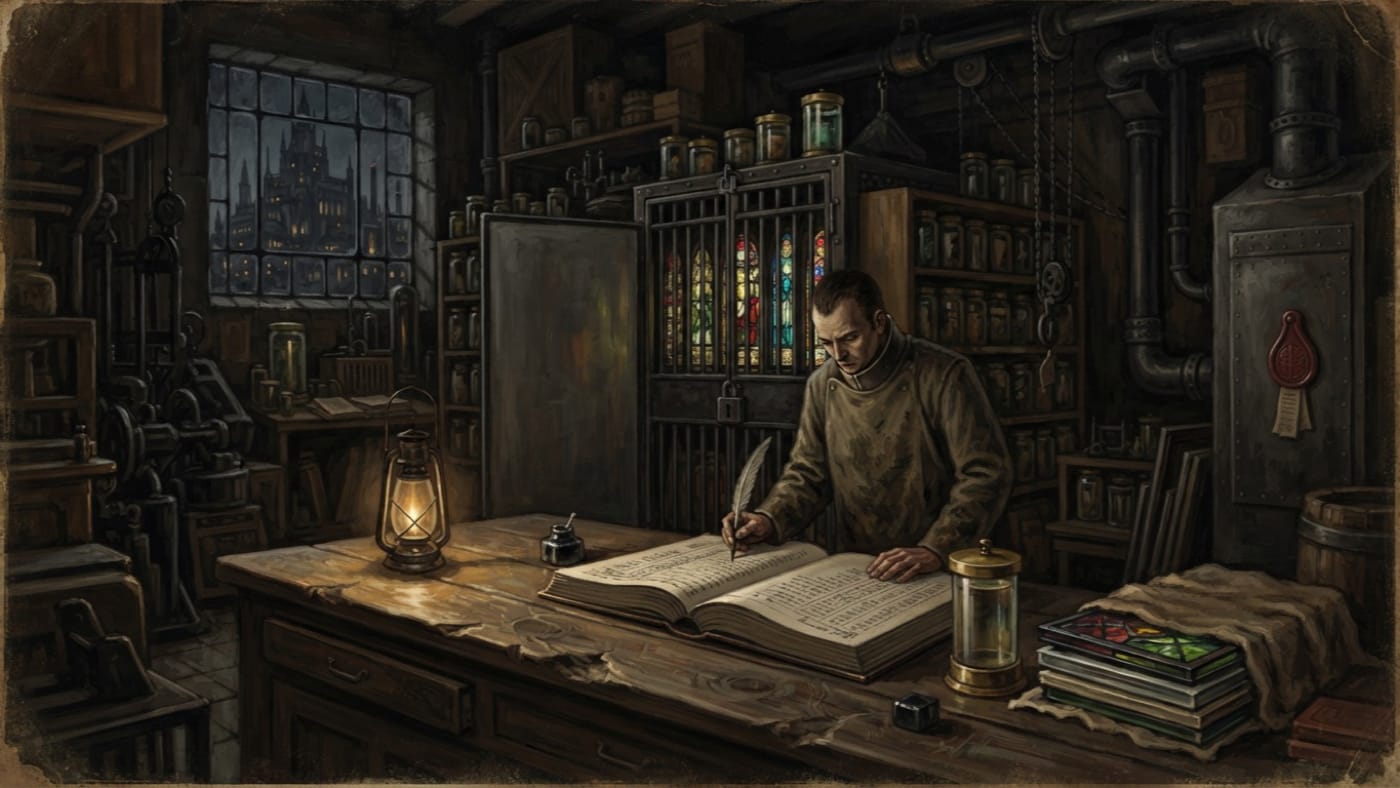
Between seizure and delivery lies Reliquary Annex Twelve, the Glaze Room, behind the cathedral workshops. Its furniture is the furniture of custody. There is a long polishing table, seal wax on every surface and a shelf of proof jars. At night a single hooded lantern burns, so that reflections do not multiply into testimony. Behind an inner screen stands a locked rack of disposed pieces. They are intact. By every register I have consulted, they are destroyed.
I do not claim that every tithe object rests on that rack, or that any single road runs from the Annex door to a patron's chapel. The couriers are unnamed. The prices are unwritten. If the payment is coin, it has left no trace in any book shown to me. If it is favour, it is entered elsewhere.
Some of the stock is demon glass, scavenged from Wrath's slag-plains and Lust's broken palaces and polished until it passes for chapel work. Doctrine orders such shards seized and shattered, so one surviving intact needs a sermon's worth of explanation. Much of the rest is humbler: lenses, ordinary devotional panes, painted clasps, any object whose only crime was being lovely in the wrong stall.
An earlier draft of this survey stated that tithe objects leave the Glaze Room only as cullet bound for the workshop furnace.
Corrected. The furnace keeps its own book. It does not record them.
#On the Patron's Interest
The buyers are known by class only: relic-men, guild patrons, Synod clerks, minor prelates, and officials of enough rank to own a chapel but too little to be audited in it. No record I am prepared to cite names an individual purchaser. I know a great many names. Knowing is a different office from citing.
What the patron wants is plain. A window in a private chapel is a sermon its owner hears alone. If the glass once whispered in a back stall, or warmed under a pilgrim's palm, so much the better. The owner has bought the miracle along with the right to condemn it in public, and ordinary piety cannot supply both.
In return the Circle receives protection. A patron with a seized pane on his wall has every reason to keep the body that seized it in good standing. He also has rivals. The charter itself imagines a patron who demands a raid against a competitor rather than against contraband. A teardrop seal on a lintel is a fine instrument for adjusting a market.
Circle-Captain "Saint" Havel Brune is the name most often attached to the tithe. In public he is a hero with spotless gloves. Reports hold that he sits after midnight before seized panes until the colours have finished with him. The sources do not show him making a sale, keeping any proceeds or founding the Window. They show a man who looks at confiscated glass longer than a custodian should.
#On File 6-P
The Window's best-attested case is a Glaze Room review. I reproduce the surviving extract as I received it.
GLAZE ROOM REVIEW — ANNEX TWELVE, FILE 6-P Inventory gap traced from seized shrine pane at Saint Odran's Lane to private chapel window belonging to ███████████████. Pane still warm after prayer. Three witnesses reported healing of minor ailments. Bureau ruling: "unverified aesthetic coincidence." Original seizure record amended to indicate total destruction by hammer.
Read it in parts, as one reads any confession its author never meant as one.
The pane was seized on Saint Odran's Lane. The seizure record admitted that much before it was amended. The pane was then traced to a chapel window whose owner the reviewer, or a later hand, has buried under ink. It is reported to be still warm after prayer. Three witnesses reported that minor ailments were healed. A Bureau ruled the matter an unverified aesthetic coincidence; the extract does not name that Bureau, and I decline to name it for them. The seizure record was then amended to say the pane had been destroyed by hammer.
That gives four kinds of claim: a trace, a material report, testimony and a ruling. Only the amendment is beyond dispute, because it sits in the ledger. The healing remains the account of three persons, and no office of the Church has certified it. Whether the warmth belongs to the Creator, the Great Deceiver or a south-facing wall lies beyond the scope of an inventory review.
The difficulty lies elsewhere. A pane recorded as hammered to dust cannot also be reported warm in a chapel. One of those documents is wrong, and the review shows which.
#On Conditional Toleration
The Circle survives by being useful to four Bureaus that want different things from it. The Bureau of Relics objects to its interference in licensed trade. The Bureau of Purity finds it insufficiently severe. The Bureau of Tithes asks whether seized goods were valued before destruction, and the Window makes that question awkward. The Bureau of Shadows asks who bought them, which is the only question that matters.
The Wardens keep their public distance from Brotherhood activity. The Brotherhood's auxiliary standing rests on the A.S. 94 clauses associated with Vicar-General Anselm Rihn and the Curfew Ordinance of Quiet Hours. They govern the night and say nothing about chapels.
Patronage softens each complaint and silences none. A clerk who owns a confiscated pane is reluctant to press the valuation question. A prelate whose chapel glows is slow to demand severity. Individuals inside those Bureaus profit from the Window. I have no evidence that any Bureau as a body runs it. The personal arrangement is cheaper and harder to prove.
The danger is identification. A seized object found in an official's private chapel would turn the enforcement apparatus into an exhibit of the Church's hypocrisy. Hypocrisy is an instrument of government, and the public must never be allowed to handle it. The expected responses are known in outline. The evidence would be suppressed and the records amended. The patron would discover a sudden indifference to glass, and a subordinate would be sacrificed. No public exposure has occurred. The responses have been rehearsed on paper, where the Circle rehearses everything.
#On the Present Record
As of A.S. 201 the Circle of Stained Proof remains conditionally tolerated under quarterly review. The Bureau of Records review covers proof jars, teardrop seals, workshop closures and aesthetic disposal logs. It also covers every private chapel installation that receives glass within thirty days of a seizure.
That last clause is the Window's only formal acknowledgement. It sets a period of thirty days, and whoever drafted it knew what a patient patron does with a period. Glass may rest on a locked rack for thirty-one days without injury.
The Glaze Room is bright by day. At night the hooded lantern is lit over the polishing table. A wrapped pane lies there awaiting its line in the disposal log, and the ink for that line is already mixed.