
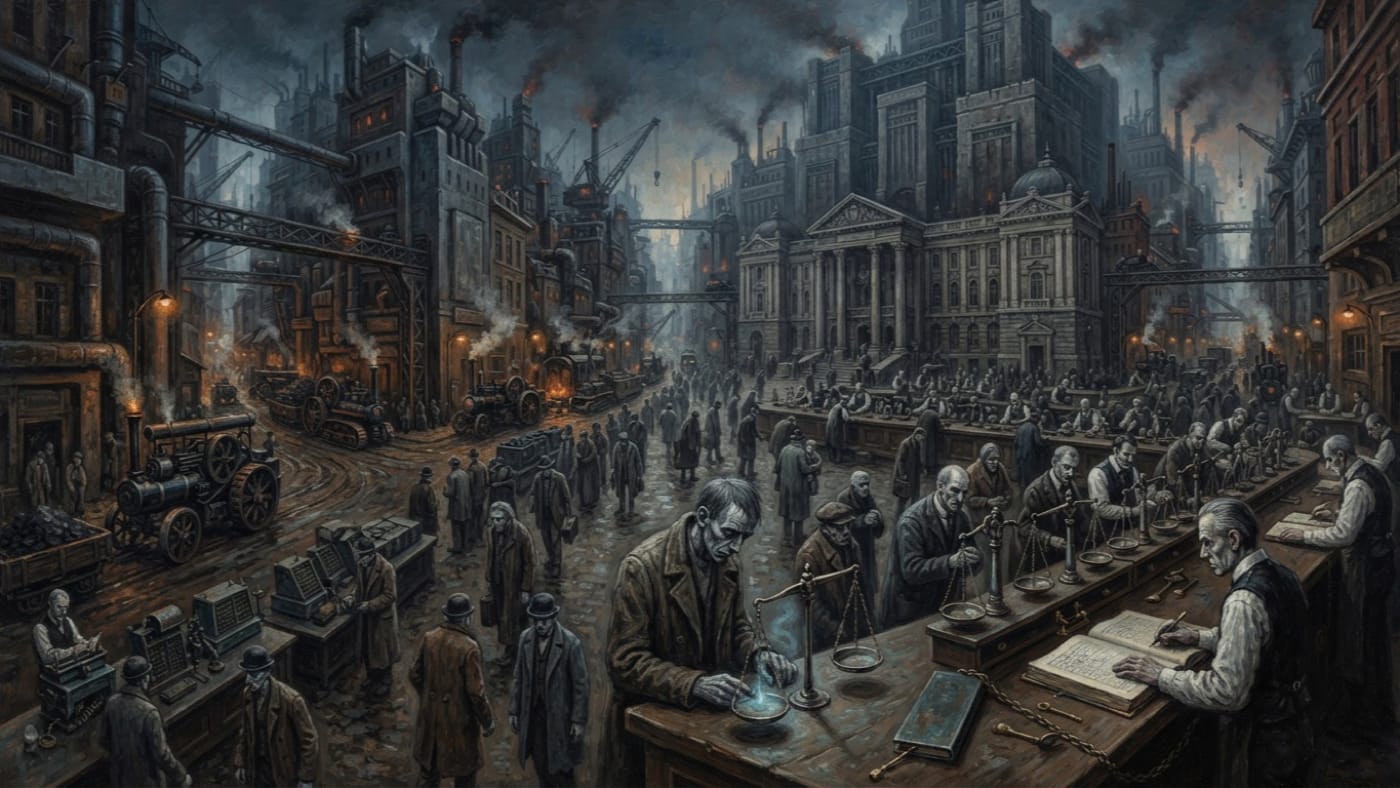
Current-condition survey — A.S. 201. This dates the dossier, not Plovdiv's foundation or conversion.
#On the Record
"Quod numeratur, venditur." — gloss in the hand of the present writer
Plovdiv comes into the Codex as one item on a list. The Velmora entry, sealed by the Bureau of Doctrine, names it among the Counting Kingdoms. These are the first of five zones into which the territories beyond the Gilded Chasm have been reorganised, and the entry gives the city company: Plovdiv, Varna, the fragments of Thessalonica. Old Balkan trade cities. Three names, one sentence, and a classification the Bureau of Records committed to print with visible reluctance.
This entry applies that classification to one city. It sets down what the account reports of Plovdiv's commerce, what that commerce consumes, and what Doctrine makes of the people who carry it on. It is a short entry. Plovdiv has been filed under its condition rather than its particulars, and a condition keeps no register of its own streets.
The account gives no date for Plovdiv's entry into the class. The Sundering of 1 November A.S. 45 marks the outer limit of the demonic order as a whole. It dates nothing about this city, and I will not use it to.
#On the City's Commerce
The markets still bustle. The guildhalls still operate. The caravans still run. The Bureau's fuller file on the Covetous Serpent adds banking houses to the inventory, and the addition matters, because a banking house is where a city keeps its promises in writing.
Everything a Synodal merchant would recognise is still in place. There are scales and counters. There are clerks who know the hand of every regular customer, and a guild that settles disputes over weights. Caravans arrive with goods and leave with goods. The account describes no siege and no sack, and it does not have the city emptied and resettled. The cities still stand. That is the phrase, and it is meant to unsettle the reader.
The fuller file puts the change in one clause: transaction has replaced all other interaction. A greeting has terms now, and so does hospitality. Grief is negotiated. The institutions survived because they were already built to price things. They had only to widen what they would accept.
Doctrine has never held that a market is a sin. If it were, the Bureau of Tithes would be the most damned office in the Synod, and that Bureau has resisted the classification with great vigour and some very well-bound memoranda. Wealth is not corruption. Neither is a fair price, or the honest clerk with his honest scale. The horror of Plovdiv is that the guild still keeps good order and the clerk still means what he says, while what passes across the counter is no longer goods.
#On What Is Traded
The account lists four commodities. I give them in its order.
Time. This is the first commodity sold, because everyone believes they have time to spare. An afternoon is easily given away. So is a season. A man who has sold a season still has a calendar, and the calendar does not show him which pages are no longer his.
Memory. I am an archivist, and of the four this is the one that turns my stomach. An archive exists to keep the record of what happened. In the Counting Kingdoms that record is stock to be sold. Somewhere in that city a person has sold a memory to someone who wanted it more. The account does not say who buys, or why.
The sensation of warmth. The account is exact here: it names the sensation, not the fuel. I will not improve on its wording. A customer who sells warmth may still own the stove.
Years of life pledged against future comfort. This is the only item on the list with a tense, and the tense is the future. It is credit. A person pledges what they have not yet lived to buy ease in what remains, and the ease is spent against the pledge. The fuller file adds sensation in general, and the capacity for love. I note those additions and let them stand without comment.
The account gives no rates. It records no instrument of extraction, no vessel and no receipt, and it does not set the price of a memory against the price of a year. The Velmora file states only that she collects her percentage of every exchange.
Doctrine's reading must be kept separate from the report. Its reading is that Greed takes things that cannot be measured and makes them measurable, so that they can be owed. Time, memory and warmth have no standard weight, and Contract Theurgy gives them one. The report describes the trade. Doctrine supplies the theology. A careful reader keeps the two in separate ledgers.
#On the Persons in the Account
The Velmora entry says the merchants of the Counting Kingdoms have traded away everything that made them people, and it describes them as animated contracts standing in their counting houses. It is a strong sentence. It has been quoted often, and sometimes by me.
The account does not say how a person reaches that state, but the general rule of Greed does. Each trade looks reasonable when it is made. A family that sells a winter's memory to eat through the winter has made a sensible exchange, and the winter is real. Need is real. So is relief. Velmora's offers are dangerous because they make sense, and the person who takes them is not stupid. That person is cold, or tired, or responsible for children.
The loss is gradual, and dependency builds on it. A person who has sold warmth buys comfort to make up for it. That comfort is bought with years, and the pledged years make the next trade seem necessary. When the account calls them animated contracts, it means people who now conduct their whole lives as business.
"…going through the motions of exchange because exchange is the only motion left to them."
The Velmora entry's sentence stands as a description of what the trade makes of a merchant and of what Velmora claims to own. As a statement of fact about every merchant in the Counting Kingdoms, it overreaches. Doctrine holds that no contract owns the will that signed it. The pact feels binding, and it does not bind. A merchant of Plovdiv can still refuse a term or leave a ledger unsigned. A merchant can also change, which costs dearly and is never convenient. The Bureau of Doctrine therefore amends "the only motion left to them" to read "the motion the account has observed." The amended phrase is less quotable. It is also correct.
The Ten Thousand Keys carry Velmora's congregation among the merchant classes, organised in the Hierarchy of Debt: Debtors, Creditors, Assessors, Ledger-Keepers, Inheritors. These are the wider congregation. No Plovdiv cell is recorded, and no officeholder, membership roll or local house. The cult's Assessors and Ledger-Keepers are human ranks. The demons who share those titles are another class of entity, and a reader who confuses the two will end up burning a notary for what a demon did.
#On the Wider Account
The Counting Kingdoms are one zone of five. The Debt Warrens lie beneath the old Danube cities. The Hollow Vaults, the Assessment Halls and the Binding Markets each have their own entries, and the Vault of Ten Thousand Keys lies at the Chasm's heart. The account does not place any of these inside Plovdiv. A Counting Kingdom is a trade city where the trade has changed. It is not a debtors' warren, a treasure chamber or a skin market, and the zones cannot be merged just because they serve the same mistress.
Varna and the fragments of Thessalonica are on the same list, while Synodal installations remain in service at Varna and at the Thessaloniki harbour. The list describes a commercial condition that reaches into such places. It does not record the surrender of whole cities, and Plovdiv's entry should be read the same way. The account draws no border around the city. Velmora's commerce extends into ground where other Sin-Generals also press, Syrion's Balkan theatre among them, and the reach of a market is not a surveyed frontier.
Velmora's principal opposing fortress is Bastion-Sibiu, far to the north on the Transylvanian wall. Her war there is fought with purchased quartermasters and corrupted convoys, and it is paid for out of an economy that collects a share of every exchange in the Counting Kingdoms. Plovdiv belongs to that economy. No route from Plovdiv to Sibiu is recorded, and neither is any levy or garrison duty. The connection is a matter of accounts, and accounts travel without wagons.
#On the Present Condition
The account reports that the markets of Plovdiv are open, the guildhalls sitting, the banking houses lending, and the caravans arriving on whatever schedule caravans keep. Somewhere among them a clerk is entering a sale of warmth at a fair price in a clean hand, and the Velmora file says her percentage has been taken. The Bureau of Records holds no later report on the city's condition.
The file is closed. The ledger it describes is not.