
#On the Peninsula That Broke First
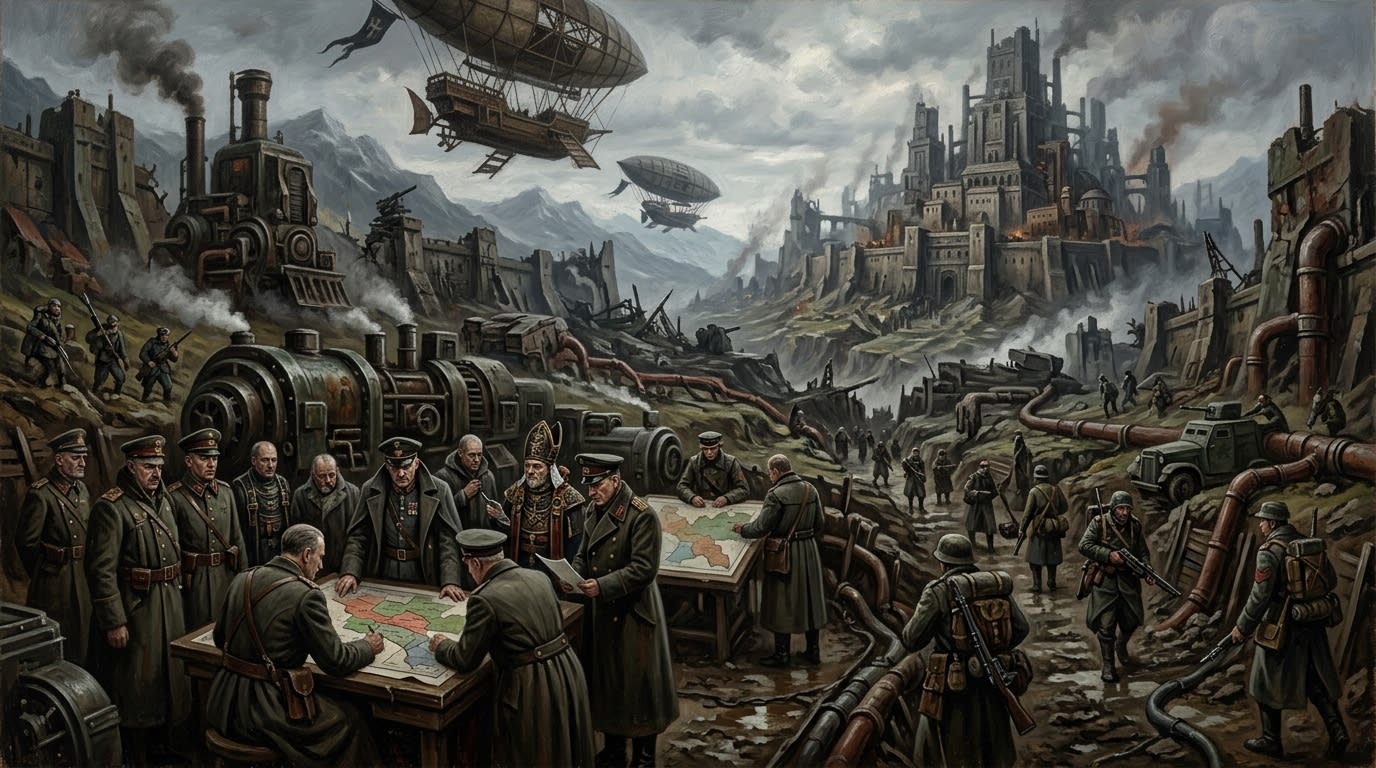
The Balkans were never quiet country. Before the Sundering, before the Rationalists attempted to reduce the continent to tables, before the Synod learned the holy convenience of numbered forms, the peninsula already possessed the temperament of a contested inheritance: mountains arguing with valleys, rivers refusing straight obedience, princes breeding border disputes in rooms too hot for prudence, monasteries guarding relics with the cheerful paranoia of men who had been raided often enough to make suspicion pastoral.
This made the old Balkans difficult to govern. It also made them difficult to kill. The first point delighted Vienna. The second offended Hell.
The official school maps now shade the region as eastern loss, southern pressure, hostile domain, Zone Six, Charnel Lands, Thracian furnace margin, Syrionic fog belt, Velmoran extraction theatre, Velkaran interior hazard, and other phrases by which the Bureau disguises the blunt fact that a cradle of cities, churches, markets, hill-forts, river crossings, saints, thieves, singers, tax-men, and stubborn grandmothers was fed into a wound in Creation and came out as doctrine. I have seen the maps. They are beautiful, clean, and morally insane.
The Balkans matter because they broke first. A.S. 38 gave us the Eastern Silence, when correspondence failed from Serbia, Thrace, the Wallachian marches (Unregistered), and the western passes. A.S. 45 gave us the Sundering, when the land cracked and the Seven Sin-Generals walked into history with the discourteous confidence of creditors entering a bankrupt house. A.S. 48 began the long proof that survival would require retreat, relics, mud, bridges, corpses, and the conversion of panic into institution. By A.S. 65 the Sagittal Line had hardened along the natural spine west of the worst ruin, and every clerk in Europe began pretending this had been planned.
The Balkans were the wound. The Line was the bandage. The Synod was the invoice.
#On the Old Roads and Older Quarrels
Before the world acquired its present scar, Balkan geography was already a sermon against administrative simplicity. The Carpathians bent down into the Transylvanian Alps. The Danube cut its gorge at the Iron Gates with the look of a river that had won a lawsuit against stone. The Balkan Mountains guarded the Shipka approaches. Thrace opened toward the Bosphorus. Macedonia (Unregistered) held escarpments, mines, monasteries, and those old inland roads where traders counted distance by tolls paid, saints invoked, and animals lost.
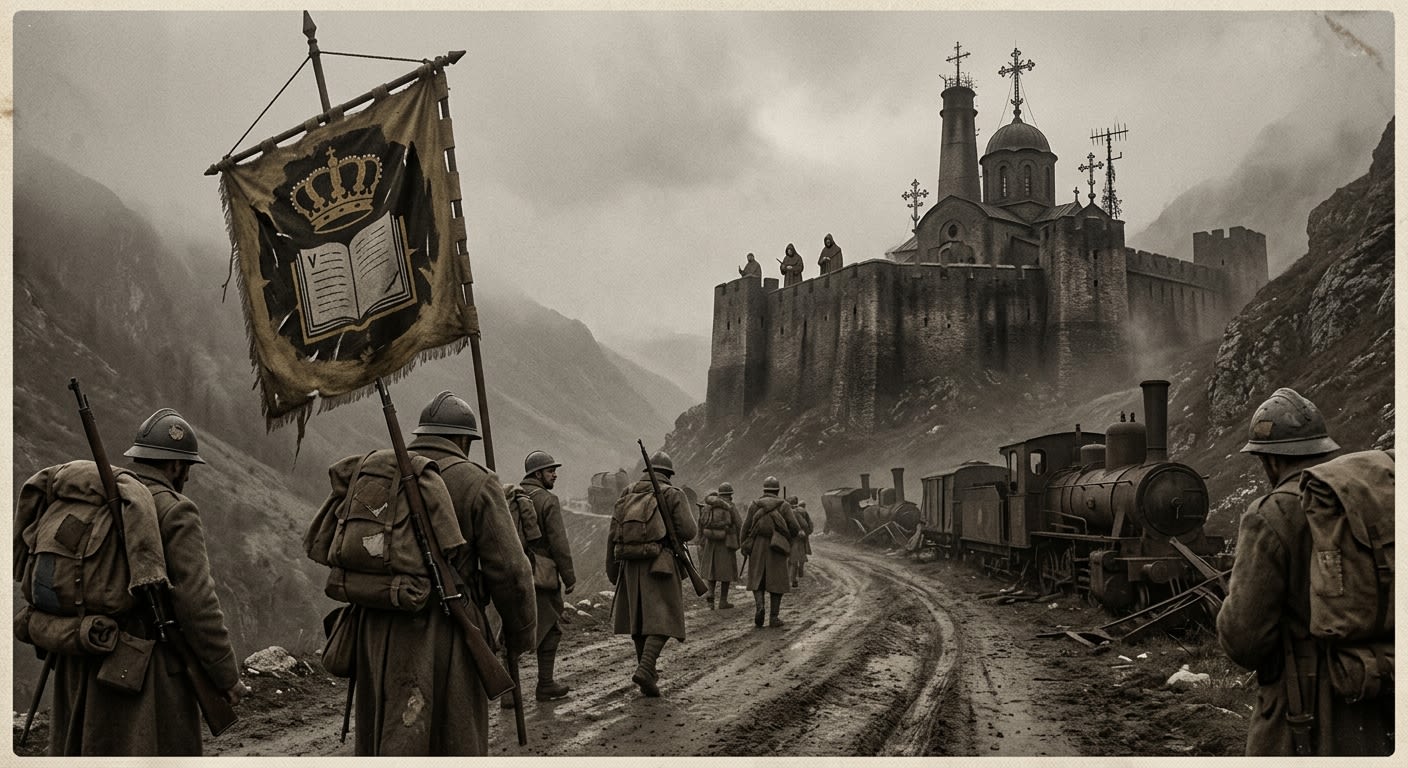
The old states and provinces owned their names the way minor nobles own swords: proudly, badly, and with too many ancestral claims attached. Serbia, Bulgaria, Wallachia, Moldavia, Thrace, Macedonia, the Dalmatian highlands (Unregistered), the old Greek approaches, the Hungarian eastern flatlands — each supplied the age with soldiers, grain, ore, liturgy, gossip, and disputes over jurisdiction that could make a parish clerk gnaw his own sleeve. There were fortified churches in Saxon Transylvania, river markets on the Danube, monastery ledgers in the highlands, princely ore quarrels in Macedon, sea-facing towers near Thessaloniki, and Balkan courts where music, appetite, and debt sat at the same table and called the arrangement culture.
The Rationalist Republic inherited these difficulties after the Treaty of Regensburg in A.S. 30 and mistook difficulty for backwardness. Vienna sent prefects, surveyors, secular magistrates, artillery instructors, tax auditors, philosophical police, and men with new seals who believed a map became obedient once sufficiently corrected. The old monasteries were inventoried. The old courts were reorganised. The old devotional routes were renamed civic corridors. The old saints were reduced to cultural residue, which is what a faith becomes when its enemies fear the word relic but still want the tourist traffic.
The Republic’s central error was not contempt. Contempt is common and occasionally useful. Its error was assuming that a country which resisted ordinary order would submit to extraordinary danger if danger arrived with the proper explanatory memorandum. When the East began to fail, Vienna reached for classifications. The Balkans answered by ceasing to answer at all.
#On the Eastern Silence
The Eastern Silence began in A.S. 38. That sentence is tidy enough for a catechism and too weak for the event. The Balkans stopped writing back.
Letters vanished. Couriers failed to return. Semaphore towers held signals no operator admitted sending. Packet boats came down the Danube with mail addressed to the dead, or with bags empty except for black silt and teeth too small for adults. Tax ledgers returned blank in the hands of men who swore they had written every arrear. A village near the Morava paid its tithe in coin bearing the faces of officials not yet born. A monastery in the western passes sent a single page to Vienna: we hear roots under the chapel. The page was filed under rural panic, then under fungal damage, then under sedition, then under restricted portent after the Sundering made comedy of the earlier categories.
Refugees arrived before reports did. They came with bark in their lungs, frost-burn on their palms, children who answered to wrong names, and stories of churches blackened from within. They spoke of fog that counted families incorrectly. They spoke of forests that crossed roads after travellers passed, roots dragging through soil like fingers drawing a curtain. They spoke of wells whose ropes were braided from human hair, of bells found kneeling in naves, of livestock returning with too many legs and soldiers returning in reverse order.
REFUGEE INTAKE FRAGMENT — VARDAR ROAD (Unregistered), A.S. 38 Witness: boy, age uncertain. Statement: “The valley folded after Father prayed. We saw our roof below us and above us. Mother said walk toward the bell, but the bell was inside my mouth.” Disposition: witness transferred to Rationalist medical custody; custody file later recovered blank; attending physician listed as deceased seven years before interview.
Vienna called it plague. Then communication failure. Then regional superstition aggravated by social stress. Then quarantine. Quarantine is a splendid state word: clean, decisive, cowardly in polished boots. Travel east was forbidden. Travel west was regulated. Supernatural accounts were punished under the Sedition Articles (Unregistered). Newspapers printed reassurance with the brisk confidence of men far from the smell.
Rationalist circulars described the Silencing of the East as a successful containment operation.
Withdrawn by all competent history. A cordon that preserves ignorance while the land beyond it becomes Hell’s antechamber has contained only the truth.
In cellars beneath Cologne, Lyon, Prague, and Mainz, the faithful understood better. The Year Without Dawn had already smothered the sky in A.S. 32. The Red Flood had boiled through the Danube in A.S. 34. Now the East held its breath. The faithful called it warning. The Republic called it disorder. The East saved its final correction for All Saints' Day (Unregistered).
#On the Sundering
On the first of November, A.S. 45, the Balkans opened.
No phrase improves that one. The old earth cracked through Serbia, Thrace, the Macedonian approaches, the Danube marches, and the roads that had already learned silence. Skopje and Novi Sad fell within hours. Belgrade became a memory before its couriers could agree on tense. The Great Deceiver did not arrive as a king with heralds. He announced himself through pressure, rupture, appetite, and seven manifested sins whose names became military geography.
Maldrake turned Thrace into furnace weather. Fire fell from clean sky. Brass guns softened. Ore seams rose through soil as if obeying a bell struck under the world. Kargath made hunger local law; at Debrecen and the broken granary circuits, provisions vanished into earth, air, mouths, and impossible absence. Syrion put valleys to sleep and taught time to pool. Velkara moved through survivors as appetite after stupor, proving that relief can be a gate if one oils the hinge with desire. Velmora found the gold-veins, market cities, treasuries, and debt habits of the peninsula and improved them into theology. Atheron rose in the highlands as a summit that made every crown look provincial. Morwen came last in many accounts, first in several nightmares, copying grief until the copy answered more quickly than the original.
The Rationalist garrisons met the irruption with clockwork artillery, parade discipline, and a faith in mechanism so touching that even I hesitate before mocking it. I overcome the hesitation. Mechanism failed. The Battle of the Iron Plains swallowed divisions in fire from a cloudless sky. Debrecen’s ration catastrophe broke one hundred thousand men by hunger before formal battle had the chance to make itself useful. Border principalities sent feudal levies into the broken country; one courier returned with a sealed bone-case containing teeth sorted alphabetically. Even Hell, the First Continental Levy file notes with admirable unease, had a filing system.
The old Balkan border forces did not collapse uniformly. Some fought. Some converted. Some vanished. Some became the first corrupted auxiliaries wearing local uniforms, speaking local dialects, and guiding later patrols toward roads that ended in pits. Mountain monasteries lit reliquary fires visible for days. River towns rang bells until the clappers snapped. Village priests led processions into fog and were heard singing after their throats were found nailed to chapel doors. Such details are excluded from patriotic murals because murals prefer silhouettes and clean heroism. Reality had mud under its nails.
The sequence is fixed in the files with enough stamps to hold down a coffin lid: A.S. 38, hostile absence; A.S. 45, open irruption; A.S. 45 through A.S. 48, Rationalist collapse and first westward flight; A.S. 48 through A.S. 65, relic-war and road institutions; A.S. 65, the first refusals of the Line. The chronology looks orderly because dead men cannot object to columns.
#On the Great Retreat Out of the East
The Great Retreat is often described as westward migration, armed withdrawal, strategic compression, or the Strategic Pilgrimage of the Faithful Westward, depending on which office has seized the lectern. The people walking called it walking. Many lacked the breath for adjectives.
From A.S. 48 to A.S. 65, the roads out of the Balkans became moving towns made of hunger, fever, cattle, relic carts, militia remnants, Philosophical officers who had misplaced their philosophies, widows carrying parish ledgers, monks carrying bones, and children carrying younger children. Hungary, Serbia, Bulgaria, Romania (Unregistered), the broken Balkan roads, and the Danube crossings turned into a long inventory of abandonment. Maldrake pressed rearguards with fire. Kargath followed by emptying fields before the columns reached them. Morwen’s spite-sickness entered camps as coughs, then as memory loss, then as a beloved dead face seen beside the cookfire. Syrion’s fog took hours from marches and returned years to the wounded. Velmora’s agents sold food on terms that outlived families.
At Kalnik Ridge in A.S. 48, Brother Tomislav raised the Reliquary of Saint Isidore, seventeen relics blazed, and Maldrake’s vanguard recoiled. The miracle did not save the Balkans. It saved the possibility of believing that anything could be saved. A rout became retreat once men could point behind them and say the Enemy had flinched.
Vienna held briefly and failed. Prague buried a Rationalist observatory in A.S. 61 by means of Litany-Engineers who sang until their throats bled. Refugee roads birthed half the future Synod: Mercy wards because sickness without visible care becomes riot; Gatewardens because every bridge becomes a border during panic; Erasure Notaries because duplicate rations breed phantom households; Festival discipline because despair must be given licensed occasions to clap or it will learn to scream.
The Balkans, in being lost, taught the West how to become the West. That is the cruellest sentence in this file and among the most accurate. Strasbourg did not invent its severity in tranquillity. It assembled it from road mud, corpse arithmetic, bell panic, ration fraud, and the sight of entire provinces changing masters faster than a clerk could sharpen a quill.
By A.S. 65 retreat ran out of west. The first Line was not drawn by genius. It was dug by exhaustion at defensible barriers: Masurian lakes, Bug River, Carpathians, Transylvanian Alps, Danube gorge, Balkan passes, Bosphorus. Shipka guarded the pass southward through the Balkan Mountains. Irongate gripped the Danube gorge. Constantinople sealed the Bosphorus. Lesser posts, road forts, ash-glyph hamlets, signal towers, quarantine huts, and trench towns multiplied along the wound-edge.
Triumphal histories state that the Sagittal Line was conceived before the retreat ended.
Corrected. The Line was ratified after frightened men had already begun holding it. Bureaucracy arrived after courage, inspected the ditch, and charged a recognition fee.
#On the Regions That Remain Named
The modern Balkans are no single theatre. Anyone who says otherwise is selling a school map, a sermon, or a budget request.
To the south and east, Thrace burns under Maldrake’s iron weather. The Iron Wastes are more than scorched ground: they are metallurgy given malice, where slag remembers battle and buried weapons sweat heat before learning language. Near the Balkan foothills, Maldrake’s furnace pressure meets Syrion’s fog in the Contact Zone, a strip of upward-burning rain, vitrified frost, sleeping ash, and stable mutual hatred that the Bureau of Inter-Infernal Analysis calls accommodation because the word cooperation would make Purity reach for tongs.
At Shipka, the Balkan Mountains remain both gate and trap. Syrion’s Vales of Stagnance press through marsh, sleep-plague, missing time, and the endless temptation to sit down and call surrender rest. The garrison rotates heavily through Bellwardens because bells are the only clocks Syrion has not fully insulted. Men posted there nail boots to parapets in some accounts. In others they ask politely to remain asleep. The first is easier to discipline.
Westward at Irongate, Morwen envies the gorge’s engineered beauty and ruins what she cannot possess. Her pressure comes through hollowing, mimicry, weeping reflections, and the peculiar horror of a familiar voice saying the wrong true thing. Farther north and east, Velmora’s influence thickens around the Transylvanian gold-veins and the old Balkan trade cities: Plovdiv (Unregistered), Varna, fragments of Thessalonica, counting houses that still bustle because commerce survives damnation when damnation learns invoicing. The Counting Kingdoms trade years, warmth, loyalty, memory, and children whose debts matured before birth.
Velkara holds no fixed Balkan front. The Shattered Courts may lie somewhere in the old pleasure cities, or may not lie in any mappable place at all. Her Pleasure Palaces (Unregistered) were once courts, academies, salons, and houses where sensation had already been given civic rank. She completed them. Appetite became administration. The grey afterward is worse than the appetite, which is why her victims continue the gestures after sensation has fled.
Sofia remains a reduced forward city, Synod-held or Synod-adjacent depending on which gun has spoken most recently, heavily fortified and fully aware of its expendability. The Macedon Escarpments function as southern supply corridor and optical hazard, carrying convoy traffic toward Constantinople under Velmoran and Velkaran pressure. Skopje persists as contested warrens, tallow trade, lamp-hymns, tunnel markets, and mutual heresy accusations. Belgrade lies at the edge of ruin and reclamation, repeatedly named in reports that smell of smoke. The Black Sea coast is a demonic attack lane, a grain hazard, a smuggling temptation, and a naval theology problem with waves.
These names persist because Records refuses to throw away old labels when they may still be used to accuse somebody. A province may be lost. Its tax archive remains.
#On Human Survival Under Hostile Appetite
The Balkans are not empty. Empty would be clean, and the East has never been clean.
Humans remain in corrupted cities, sleeping villages, debt warrens, forge pits, pleasure courts, black markets, false monasteries, famine circuits, and farmsteads where dinner is laid nightly for sons who returned with too many joints in their hands. Some are prisoners. Some are collaborators. Some are neither in any category a western tribunal can process before lunch. The public doctrine prefers the phrase corrupted populations. It is accurate enough to convict and too blunt to understand.
Most demonic forces in the region are made from people. A malformed infantryman in Maldrake’s host may have been a border conscript who survived the first fire by agreeing to carry the second. A Velmoran contract-servant may have signed for bread during a winter no Synod convoy reached. A Velkaran hunter may have been a courtier who reached for life after Syrion’s fog lifted and found appetite waiting with a glass. A Morwen-copy may be a stolen grief shaped into a face the living cannot stop following.
The Synod’s mercy toward such persons exists in theory, in pamphlet, and occasionally in the hands of a field priest too exhausted to obey policy quickly. Recovery procedures include bell exposure, salt immersion, relic contact, name recitation, maternal testimony, confession under guard, and the warmed-wax rituals of Records. Failure means pyre, blade, walling, or the little black mercy of a pistol behind the ear. Rearward readers flinch here. Front-line readers ask why I used so many words.
Refugees still come west when roads permit roads. They arrive from marsh, pass, tunnel, harbour, cellar, and false village with papers that may be authentic, stolen, prophetic, or written in a hand belonging to nobody born yet. Passage screens them. Purity questions them. Records tests the name. Mercy washes what can be washed. War counts useful bodies. Every refugee is a survivor and a possible breach. This is not cruelty. This is what remains after geography has become infectious.
#On Synod Use of Balkan Ruin
The Synod denounces the Balkan horrors daily and profits from them hourly. Only children and honest foreigners consider this contradiction.
The First Continental Levy drew strength from panic after Balkan garrisons vanished into teeth, fire, hunger, and sorted bone. Later renewals marched boys toward the Balkan front under seals whose ink smelled of necessity long after necessity had become habit. Rail corridors, gauge wars, convoy charters, Bellway harmonisations, Pass Office reforms, route indulgences, shrine artillery, Processional Arsenals, Black Sea reliquary fleets, and half the Bureau of War’s proudest tables exist because the Balkans remain half-lost and fully useful.
Pilgrimage uses the southern roads. Tithes uses the pilgrim roads. War uses the tithe roads. Doctrine uses the war dead. Festivals uses the doctrine. Records uses all of them, because Records has never encountered grief it could not improve by indexing. A Balkan ruin is a shrine if safe enough to visit, a restricted theatre if too dangerous, a cautionary exemplar if politically convenient, and a map blank if Cartography has been embarrassed there recently.
The old peninsula also supplies the Synod with its most effective terrors. Parents surrender sons because Brașov was taken. Merchants submit to audits because Velmora purchases treason. Officers accept Purity inspections because Velkara enters through appetite. Bellwardens endure Shipka rotations because Syrion’s fog makes sleep prosecutable. Engineers overbuild Irongate because Morwen envies beauty. Every sermon west of Strasbourg contains a Balkan ash-grain somewhere in its mortar.
The Bureau of Cartography suffers worst. Commission 73-C entered the Charnel territories to produce sacral geography and returned with contradictory folios, missing personnel, and the same face in too many margins. Later maps file certain areas as devotional fiction unless three witnesses die confirming them. This is not a joke. This is a professional standard born from repeated humiliation, which is the finest parent of standards.
#On the Present Condition
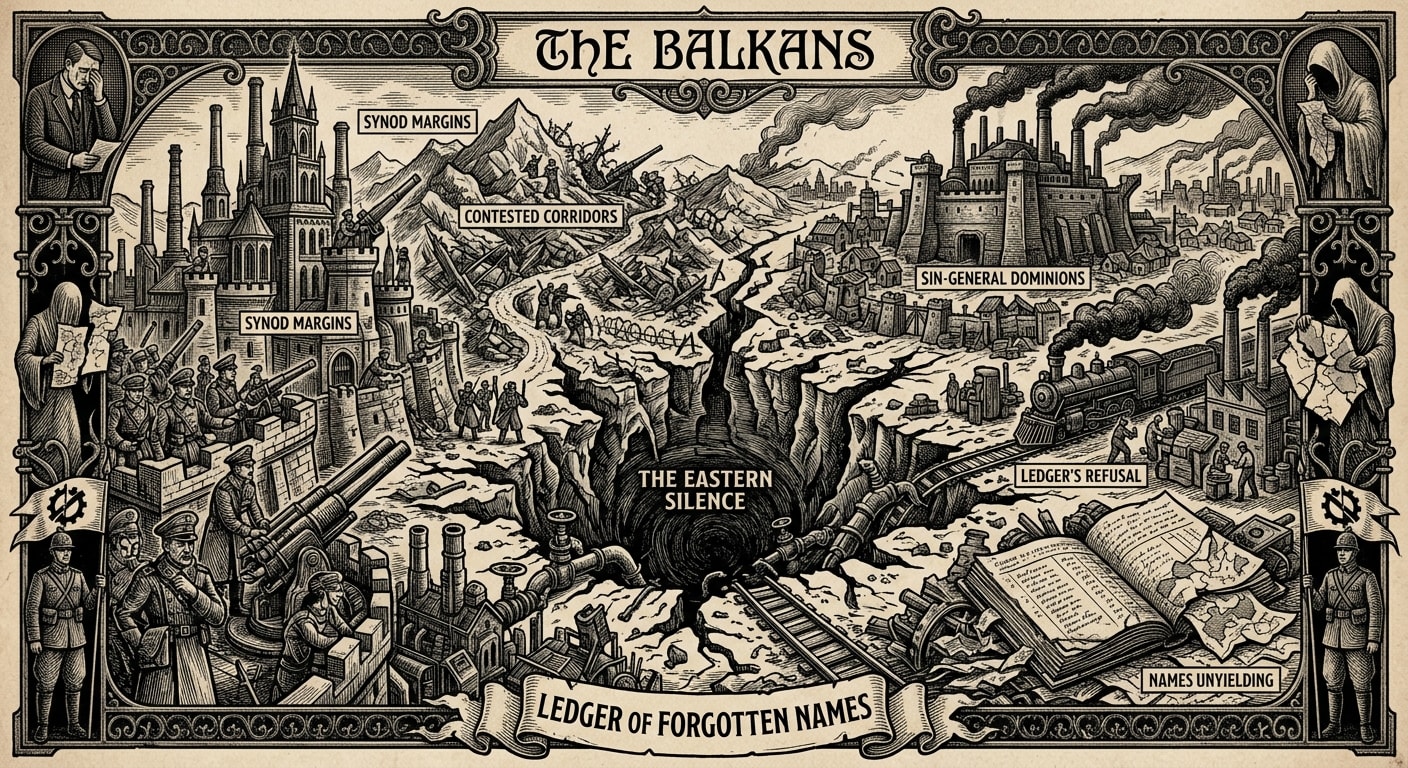
As of A.S. 201, the Balkans are divided between Synod-held margins, contested corridors, demonic dominions, vanished districts, corrupted survivals, and zones where the question of control presumes a stable reality the ground declines to provide. The Line holds at Shipka and Irongate. Constantinople locks the southern hinge under double pressure from Kargath and Maldrake. Sofia endures as a reduced forward city. The coastal routes through Thessaloniki and the Black Sea approaches remain guarded, bribed, haunted, inspected, and necessary. Necessity is the least sentimental tyrant.
The deep Balkans belong to no single Sin-General, despite what simplified catechisms imply. They are an argument conducted by appetite, fog, fire, envy, pride, contract, lust, and the Great Deceiver’s broader malice. Their borders are less lines than symptoms. A patrol may cross from Wrath into Sloth without moving, from Greed into Lust by signing, from Envy into Pride by accepting a compliment from the wrong reflection. War hates this. Doctrine classifies it. Soldiers learn to smell it.
There is another present condition, less suitable for patriotic instruction: the Balkan wound changes the West even when no demon crosses the wire. It changes contracts, because every southern merchant writes clauses against fog-delay, appetite-spoilage, false-reflection substitution, and routes that arrive before they depart. It changes marriages, because widows of men listed as dissolved cannot remarry without a Records hearing and a priest willing to say the word absent instead of dead. It changes architecture, because every new southern hostel builds inner shutters, salt gutters, mirror covers, bell hooks, and a sealed room for guests whose papers remain correct after their faces cease to be. It changes speech, because certain Balkan village names are no longer used aloud in barracks after dusk, while other names are repeated precisely to prove the mouth still belongs to the speaker.
Most of all, it changes children. A child in Strasbourg learns the Balkans as warning. A child in Sofia learns them as weather. A child at Shipka learns them as the place from which father may return tired, decorated, and unable to remember whether he had a daughter. The Bureau of Education prints the same catechism for all three. This is efficient. It is also stupid, but stupidity becomes policy when multiplied across classrooms with sufficient ink.
The question often asked by schoolchildren, minor nobles, and visiting dignitaries with soft hands is whether the Balkans will be reclaimed. Doctrine answers yes. War answers by requesting more shells. Records answers pending. Cartography answers with a locked cabinet. Refugees answer by keeping house keys to doors that no longer exist.
I answer this: the Balkans remain recorded. That is less than victory and more than surrender. Each old name preserved in the Ledger accuses the Enemy of theft and the Synod of debt. Serbia, Thrace, Wallachia, Moldavia, Macedonia, Bulgaria, Dalmatian passes, Danube towns, Black Sea ports, monastery roads, markets where mothers bought salt, courts where fools danced, chapels where bells knelt and should not have been able to kneel — all remain written.
At the edge of the Line, soldiers face east and hear guns, bells, fog, hunger, and sometimes music from villages the maps have struck through. At the rear, ministers speak of eventual restoration over dinners whose flour came by routes defended by boys from families already billed for the next levy. In the archives, I preserve the names because names are hooks in the throat of oblivion.