
#On the Third Silence
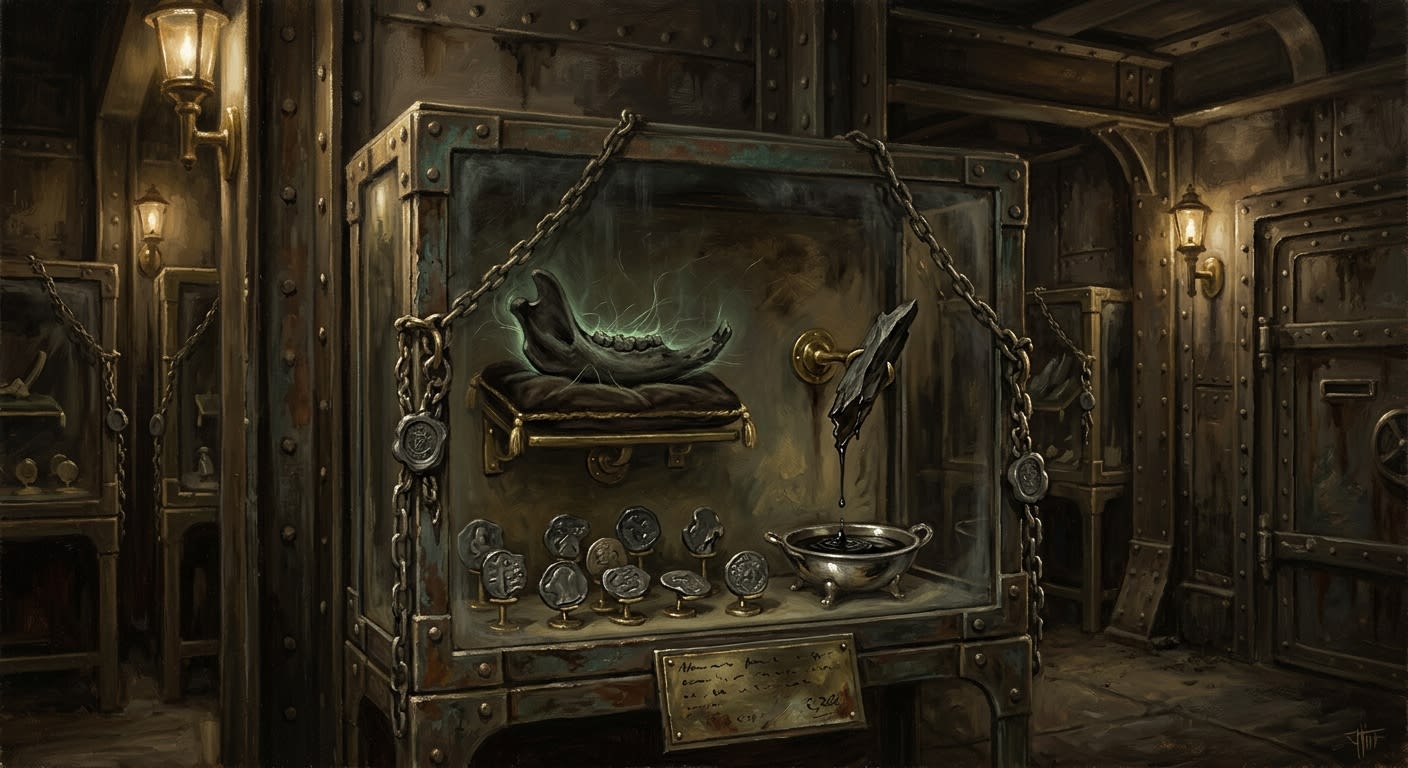
The Confiscated Relics of Uncertain Provenance occupy the third silence of the Vault of Silences, where the Bureau of Purity stores holy things that failed paperwork, unholy things that passed examination, and objects whose sanctity made the examiners perspire through their gloves. The category exists because the Bureau of Relics adores certainty and Creation keeps handing it bones with poor manners.
The collection's known contents are few enough to name and grave enough to avoid: a jawbone humming at 217 hertz, a weeping splinter of wood whose fluid has tested as oil, blood, and terror disguised as “inconclusive,” and coins from the Vault of Ten Thousand Keys that surfaced twice through consecrated earth beneath the Basilica of the Ledgered Saints.
#On Relics That Fail Their Receipts
A proper relic has a receipt. This is the first doctrine of relic custody and the last refuge of clerks who cannot tell a saint from a pig unless both arrive with stamps. The Bureau of Relics authenticates by chain, candle, witness, survival history, devotional yield, and the ever-popular method of asking three senior clerks whether their stomachs have tightened. A relic that passes is elevated. A relic that fails is retired, rendered, interred, or melted into the mortar of Strasbourg, where six hundred saints of insufficient paperwork now keep draughts out of committee rooms.
These pieces did not submit to retirement. Destruction produced results. Interment produced recurrence. Authentication produced mutually hostile memoranda. Purity took custody because Purity enjoys saying no more than Relics enjoys saying genuine.
Earlier internal schedules placed the third-silence objects under “failed relics.”
Corrected. Failure belongs to the offices, not the objects. A jawbone that hums a proscribed tone, a splinter that weeps under seal, and coins that refuse burial have passed some test. The Bureau merely dislikes the examiner.
#On the Humming Jawbone
The jawbone is held in a silver-dark box lined with felt, lead, and a prayer written so small the copyist went half-blind before the final amen. It hums at 217 hertz. The Register of Sounds records that frequency as proscribed since A.S. 114. The Bureau of Orison and Song finds no sanctioned tone at that measure. The Physical Anomalies Collection keeps the wax impressions, cracked tuning fork, and lead listening cone. The third silence keeps the bone.
No claimant has been accepted. Three saints have been suggested. Two heretics. One unnamed martyr from the First Relic Auctions of Amsterdam. A junior Authenticator proposed that the bone might belong to no human jaw at all, at which point the meeting ended with admirable speed.
A.S. 194 LISTENING INCIDENT Assistant Examiner Heldt placed his ear within three inches of the box during unauthorised comparison. Recorded statement afterward: “It is not inside the bone. The bone is inside it.” Dental result: four molars cracked lengthwise. Disposition: reassigned to written prayer, no oral duties.
The tone grows louder by measurement no one publishes. That is the privilege of unpublished measurements: they can increase without alarming the faithful, the Hierarchs, or the budget.
#On the Weeping Splinter
The splinter is longer than a finger and darker than altar wood after a century of incense. No tree has been identified. It was seized from a private chapel near the old Lombard road after a widower claimed the wood wept on feast days and accused him of insufficient grief. The widow in question had been dead nine years, which made the accusation touching, impossible, and legally awkward.
The fluid emerges along the grain. The Bureau of Engineering tested it as olive oil. The Bureau of Medicine tested it as blood. The Bureau of Rites tested it as inconclusive, which means the result said something Rites preferred not to hear before supper. When the three samples were placed in one dish, they separated into letters too small to read without magnification. Magnification was denied.
The splinter has failed the Candle Proof twice. On both occasions the flame leaned toward it and away from it in alternation until the taper consumed itself downward in perfect halves. Relics called this ambiguous. Engineering called it thermal instability. Purity called for a lid.
#On the Coins That Would Not Stay Buried
The coins came first from the A.S. 114 expedition into the Gilded Chasm, when one auditor returned from Velmora's treasury-palace aged forty years beyond his entry and carrying three gold coins of no known mint, a key, and a receipt signed in a hand that did not belong to his waking mind. The auditor died eight months later. The coins were buried in consecrated ground beneath the Basilica. They surfaced twice.
A coin that returns through consecrated earth has made an argument. The argument is that burial is custody with soil on top, and custody is ownership, and ownership is Velmora's native tongue. The Bureau disliked the grammar, then wrote thirty-nine pages in it.
The coins are now sealed in separate envelopes that do not touch. Each envelope bears a wax impression on both sides, a custody chain in red ink, and a warning against counting aloud. During the A.S. 198 audit the third envelope weighed less than itself. Engineering objected to the phrase. Records retained it.
#On Authentication Deferred
Relics wishes to test the jawbone again. Orison refuses reproduction of the tone. Engineering wishes to burn a controlled shaving from the splinter. Rites objects to the phrase controlled. Tithes has requested valuation of the coins and has been answered with a silence so pure that even Purity admired it. Doctrine has issued no final ruling because final rulings have consequences, and consequences, unlike draft memoranda, cannot be shelved.
A circulated training handbill advised junior clerks that uncertain relics should be treated as fraudulent until proven authentic.
Withdrawn. Uncertain relics are to be treated as dangerous until they become obedient, which is another thing entirely. Fraud rarely hums, bleeds, or climbs out of blessed dirt.
The third silence remains closed except by writ. Its boxes sit in the cold, each with its label, seal, and small polite space around it, as though contagion were a matter of etiquette. The jawbone hums. The splinter weeps. The coins wait for someone to count them.