

#On the Instrument and Its Office
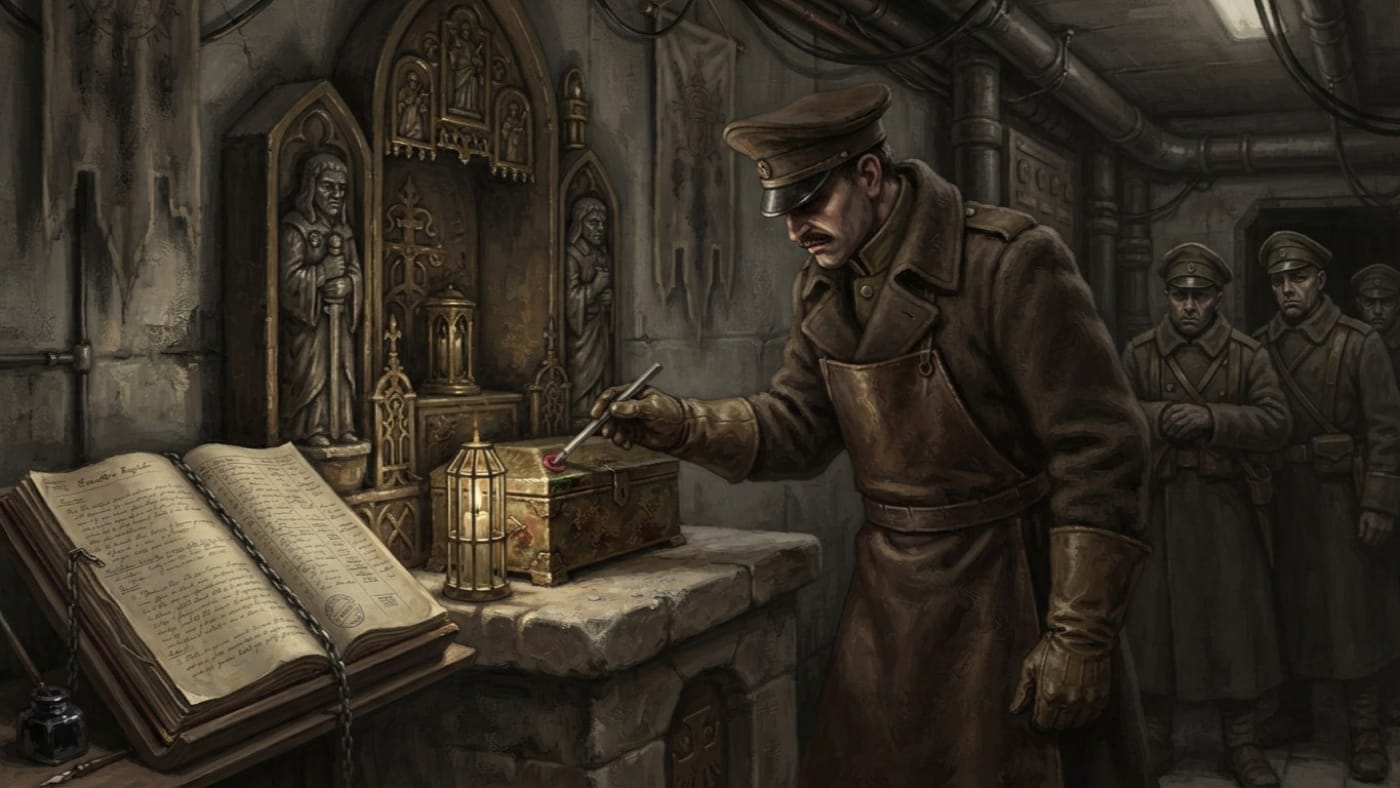
The prayer-resonance rod is the second instrument a Counter-Relic Examiner picks up, and the first one he is tempted to blame. It is a short length of plain metal with no ornament. It rides in the lead-lined satchel between the chained register and the oilskin packets of reagent. Its office is narrow: it detects sorcerous contamination in the relic stock of frontline chapels. It confers no blessing and pronounces no verdict. Those remain the business of men with seals.
Its first certain entry in the Ledger is Standing Order 88-R of A.S. 182 (1892 CE). That is the instrument by which the Bureau of Relics constituted the cadre, two years after Velmoric counterfeits reached frontline chaplaincies in A.S. 180 (1890 CE). The order sets the rod between taper and reagent set as though it had always lived there. The order does not say who drew the first one, in which workshop, or how many patterns came before the one now issued. I decline to invent a smith for readers who like their instruments to have fathers.
#On the Substance and Its Responses
Engineering calls the substance tuned alloy. Relics calls it obedient metal. Each name is a confession. The engineer's name admits that human hands set the thing to a pitch, and that it may drift from it. The reliquarist's name says the metal was taught its duty and performs it under discipline, like a novice or a hound. Why metal should care at all what lies inside a casket is a question I leave to the two departments, which have been leaving it to each other for years.
By the cadre's own description, the rod is calibrated for bone, ash, glass, wire, and certain categories of ivory. The description adds the ivory with a sneer, calling it too-obedient, which tells you more about the clerks who wrote it than about any elephant. The description does not list which categories. Neither shall I.
It quivers. It warms. It stiffens. It splits. These four behaviours are recorded, each one "according to contamination profile." The phrase sounds like a table and is not one. No issued document in my possession matches a given tremor to a given filth, ranks warming above stiffening, or names any motion as the mark of a clean box. The Examiner watches, writes down what the metal did, and carries that upward with the rest of his evidence. A split is at least unambiguous as an event, if not as a diagnosis. The rod is finished, a requisition form begins, and the casket stays exactly as innocent or guilty as it was a moment earlier.
The men who carry it call it the little liar, and say it earns the name because it never lies comfortably. Reliquary clerks repeat the joke as praise of the instrument's accuracy. It is better read as praise of its manners. A rod that moved in some agreeable, legible way would be trusted, and a trusted instrument is the first thing an enemy studies.
#On the Examination
The rod comes late in the rite. The Examiner names the relic. He reads its tag. He checks the transit seal against the register. He inspects the wax for reheating, the commonest vanity of counterfeiters, who warm an old seal to fix it onto a new lie. Next comes the taper, held at the prescribed distance in its brass cage, and the Candle Proof is watched and written down. Only after all that does the white-gloved hand take the rod from the satchel and touch it to the casket.
The rod touches the casket and nothing else. The remains stay sealed. The cadre's published procedure specifies contact with the reliquary and requires no unsealing. An Examiner who opens a suspect reliquary in a mud chapel to satisfy his curiosity has volunteered for other duties.
He then records the response in the chained register, in the words the behaviour earns: quivered, warmed, stiffened, split, or nothing visible to a tired man by taper-light. The Candle Proof keeps its own grammar. It was standardized in A.S. 98 (1808 CE), and in the Bureau's working reading a true relic draws the flame, a counterfeit makes it withdraw, and a doubtful one flickers. Those meanings belong to the flame. Moving them onto the metal is the error of an exhausted novice who wants one alphabet for two languages.
Then comes disposition. Clean stock is countersigned. If the stock is doubtful, the niche is sealed. Hostile stock is confiscated without a sermon. The Examiner makes this decision on the whole page: tag, seal, wax, flame, rod, reagent, and the story of how the box reached the chapel in the first place. The rod countersigns nothing. It has no hand.
A hall-bound Relic Authenticator has lamps, comparator slips and the luxury of a fortnight. The Examiner has a trench, a week, and a satchel. He writes small.
#On False Sanctity
The season of A.S. 180 taught the Bureau that a perfect seal proves only that someone owned a good press. The counterfeits that reached the chaplaincies arrived properly labelled, properly waxed, and properly loved. The Bureau of Rites recorded what followed in language I will not improve on.
Velmora's traffic moves by transaction: a shrine loan from an obliging merchant house, a faster convoy seal for a tired clerk, a donated fragment, cooperation bought cheap, a broker asking custody of a box for one night. Every step is a human choice, and every choice was free. The Serpent makes an offer and waits for the signature. She cannot sign for anyone.
Here the rod's limits become doctrine. It tests matter. It cannot read the quartermaster's motive, name his creditor, or measure how sincerely the widow weeps. The Examiner has to audit that commerce himself, through wax formulae, hand pressure in signatures, and debt-phrases buried in the provenance chain. A training note attributed to the Counter-Relic School at Strasbourg puts it in two lines: interrogate the favour, then light the taper. The rod comes after both.
Nowhere is this heavier than at Bastion-Sibiu. There, relic stock comes up the same roads as bribed convoys, and a devotional object can pass through more ledgers than it ever did through prayers. The rod is touched to the casket at the end of that road. What it measures is whatever the signatures let in.
#On Recorded Doubt
Everyone in the chapel wants a clean result, the Examiner included. That is the trouble. Misread hostile stock, and a company kneels before contaminated matter at the hour of assault. Misread a true relic, and a company is stripped of the object it fights for. War has measured what that costs in the days afterward, and Doctrine has declined to accept the measurement.
Between those two errors lies the sealed niche, the cadre's least loved act and its most honest one. The object stays where it is under wax, unconfiscated and unblessed, and the doubt is entered in the register in ink rather than resolved in the Examiner's head. Next week someone opens the register again.
Standing Order 88-R originally required monthly re-authentication of frontline relics.
Corrected within the season: weekly. The Bureau paid for the difference in terms it does not reproduce for instruction.
Readers sometimes press me about the southern-line report of A.S. 186: a finger-bone whose flame leaned inward, then withdrew, then did a third thing the report will not describe in full. The relic was confiscated. That was a taper incident. The surviving report records no rod result at all, and the people who ask what the little liar said that night get the answer I give now: the register is silent, and silence is not a reading.
An Examiner who countersigns wrongly will come to know the quarantine cabinets of the Vault of Sacred Custody from the inside of his next posting. An Examiner who seals too often is called a coward by the infantry and prudent by his superiors, and he hears both words in the same tone.
#On Present Service
As of A.S. 201 (1911 CE), the rod still goes out every week. It travels with the cadre through Sibiu's trench chapels and convoy shrines, through the crowded sanctuaries of Bastion-Constantinople, and through every relay chapel carrying suspect stock to the Line. The routine has not changed. Glove, tag, seal, wax, flame, and then the short metal touch on the casket while the company watches the Examiner's wrist.
The cadre has not grown fond of it. The rod quivers, warms, stiffens or splits, and the Examiner writes down which. What that means is still argued in Engineering, in Relics, and in the trench, where nobody consults the Bureau.