
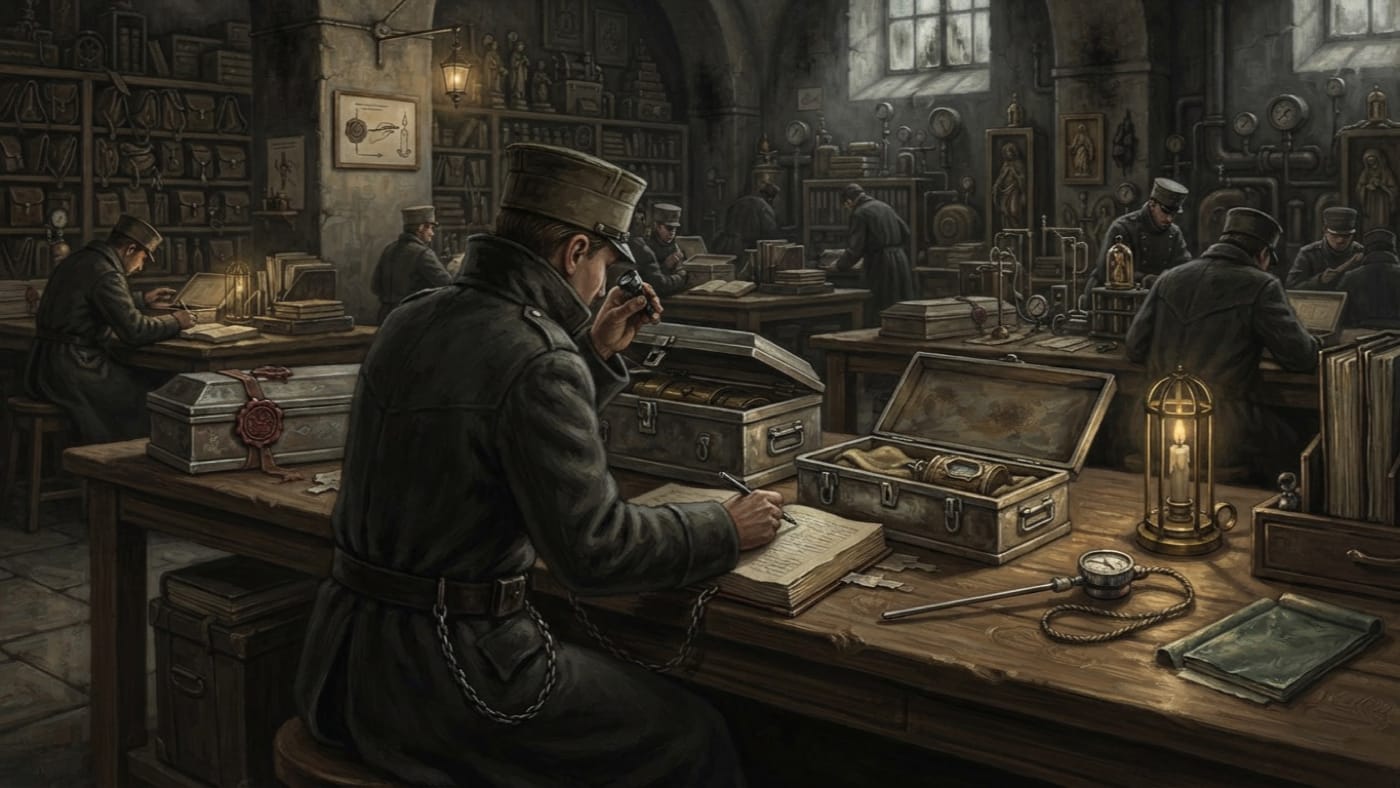
#On the Favour
The Counter-Relic Examiners learn their trade under a principle short enough to fit beneath a thumb. A training note headed COUNTER-RELIC SCHOOL, STRASBOURG, undated and unsigned and therefore beyond the reach of most of its critics, tells the pupil to interrogate the favour and only then light the taper. Every other lesson the school gives hangs from that order of operations.
The order matters because the enemy learned it first. In A.S. 180 the first confirmed Velmoric counterfeits got into frontline chaplaincies along the Line, and the Bureau of Relics found that its excellent tests had been examining the wrong end of the transaction. The bone sat in its casket and behaved. The favour that delivered it had already done the damage before anyone struck a flame: the loan, the hurried seal, the grateful donor. Standing Order 88-R constituted the cadre in A.S. 182, and instruction in Strasbourg serves that cadre. When the instruction began, who first chalked the principle on a board, whether there was a board at all: the Ledger keeps these questions open, and I decline to close them on credit.
#On Provenance
The pupil begins with wax, because wax lies slowly and leaves evidence of the effort. A reheated seal sags at the rim and carries a dull second skin where the first impression was softened and pressed again. Formulae differ by chapter house and by decade. A seal that claims a Sibiu sacristy but shows a Wallachian chandler's tallow has introduced itself.
Signatures come next. A forger copies the shape of a name and almost never its pressure. The pupil learns to tilt a provenance sheet against a window and read where the nib dug in and where it hesitated. He finds the hand that should have signed forty such sheets a week and instead signed this one with the care of a man making his first confession.
Then the hinges, where coin-sheen collects on a casket that no coin should have touched. Then the couriers' hands, since Velmoran contracts sometimes leave a faint vein-script in the skin near the wrist, and an Examiner who reads only paper has read half the delivery.
Then the transit seals, compared line by line against the register, and the custody gaps between them. A gap is a night. Someone held the casket for that night. The school teaches that the question of who outranks the question of what, until the first is answered or formally entered as unanswerable.
Debt language is the subtlest lesson and the one pupils resent most. Velmoric provenance chains do not announce themselves. They hide small commercial phrases inside pious ones: held in surety, released on consideration, returned with interest of prayer. A clean-looking chain may be clean. A weeping widow may be sincere. Sincerity has never once altered the composition of bone.
Patron pressure gets no separate lesson, because it never stops arriving. Every authenticator in the Church learns early that a patron can "remind" a clerk which answer keeps his household rationed. The Counter-Relic pupil learns that the same reminder is itself an item of provenance, whether it comes from a colonel, a merchant house or a beloved chaplain. It goes into the register beside the seal.
#On the Taper and the Rod
Only now the flame. The Candle Proof has been standard since A.S. 98, nearly a century before the cadre existed, and the school teaches it as observation before it teaches it as verdict. The taper sits in its brass cage at the prescribed distance. The pupil watches. The Bureau reads an inward lean as authenticity, withdrawal as a counterfeit's response and flicker as doubt. These are the Bureau's working readings, and the pupil drills them until he can call the lean without moving his face.
The harder discipline is to write down what the flame did before writing down what it meant. A trainee who records authentic has interpreted. A trainee who records leaned inward, steady, four breaths has observed, and the next Examiner can disagree with evidence in hand.
The prayer-resonance rod gets the same treatment. Touched to bone, ash, glass or wire, it may quiver, warm, stiffen or split. The school teaches the responses and refuses to teach them as a code. A rod that warms on one visit and quivers on the next has told the Examiner something, and what it told him goes into the register unflattered.
Reagent strips arrive sealed in oilskin and stay sealed until the moment of use. Their compounds are the Bureau's business, and they remain so on this page.
The taper and rod also teach a distinction the soldiers never accept. A correct lean says something about the object. It does not license the object to return to its niche, assign it a usable grade or place it under the Bureau's custody. Authenticity, grade, authorized custody and theological truth are four entries in four separate columns. A pupil who merges them has written a sermon onto a form.
#On Recording Doubt
Repetition is the school's least glamorous instrument and its most jealously defended. One test is an anecdote. The cadre's own field report from the southern Line in A.S. 186 records a finger-bone that drew the flame, then repelled it, then did something the report declines to describe. An Examiner who stopped after the first lean would have countersigned it.
Consider an illustrative exercise. I give its shape, not an entry in any timetable. A pupil sits before three caskets with three blameless chains. One leans, one withdraws, and one flickers on the second trial only. The verdicts matter less than the register. Was each trial entered? Was the inconsistency written down as inconsistency? Was the flickering casket sealed or argued with?
The register is chained to the Examiner's belt so that it cannot be lent, left behind or quietly improved by another hand. Clean stock is countersigned. Doubtful stock has its niche sealed. A seal is a recorded doubt with wax on it, and the school teaches pupils to take pride in their seals. The cadre's flatterers count confiscations. The Records clerks count seals, and they are right.
A prior training circular described Counter-Relic failure as "misclassification under hostile conditions."
Revised: failure is cooperation by negligence. The softer phrase was retired after the Chapel of Saint Berthold incident. No instructional record available to this office gives that incident's date or place, which has not stopped anyone from learning its name.
#On Confiscation
Hostile stock is taken. The word is short, and the school spends a disproportionate share of its effort teaching pupils to say it.
The difficulty is human. A company that has carried a bone through two winters at Sibiu will not hand it over because a stranger in white gloves watched a candle. The chaplain has blessed men by it. The quartermaster may owe a merchant house for the casket. The colonel wants reassurance before inspection. Each of them chose, at some hour, to accept the favour. A contract can lean on a man's will, yet it never owns it. The pupil is taught that a soldier who resists confiscation remains a soldier of the Church until he does something worse than shout. The Great Deceiver's lieutenant in Greed works through influence, and the school will not treat influence as possession. That distinction keeps Examiners from burning quartermasters, which War considers wasteful.
Pupils learn to confiscate without sermon. A sermon gives a hostile object time to prepare. It also gives the company time to form a line between the Examiner and the niche. The object goes into the lead-lined satchel and the entry goes into the register. The pupil notes any argument and does not answer it.
The cadre's attested penalties for misjudgement are loss of clearance, demotion to intake, vault penance and reassignment to the quarantine cabinets of the Vault of Sacred Custody. I have no record that pupils suffer them. I have every confidence that pupils hear of them.
#On Application Along the Line
The weekly re-authentication mandate allows instruction no holiday. It was corrected from monthly within the season of Standing Order 88-R, at a cost the Bureau declines to itemize. At Sibiu, where Ten Thousand Keys brokers ask only for custody of a casket for one night, the provenance lessons carry the load. At Constantinople, where every shrine draws a crowd, the confiscation lessons do. In the relay chapels between them, the register does.
At every station the sequence holds. Name the object. Read the tag. Compare the transit seals. Inspect the wax. Set the taper. Observe the flame. Touch the rod. Record. Then countersign, seal or take. Given the same evidence, an Examiner trained in Strasbourg should reach the same disposition, with the same entries, as one trained a year earlier or a year later. Uniformity is the whole product.