
#On the Doctrine of the Flawed Toll
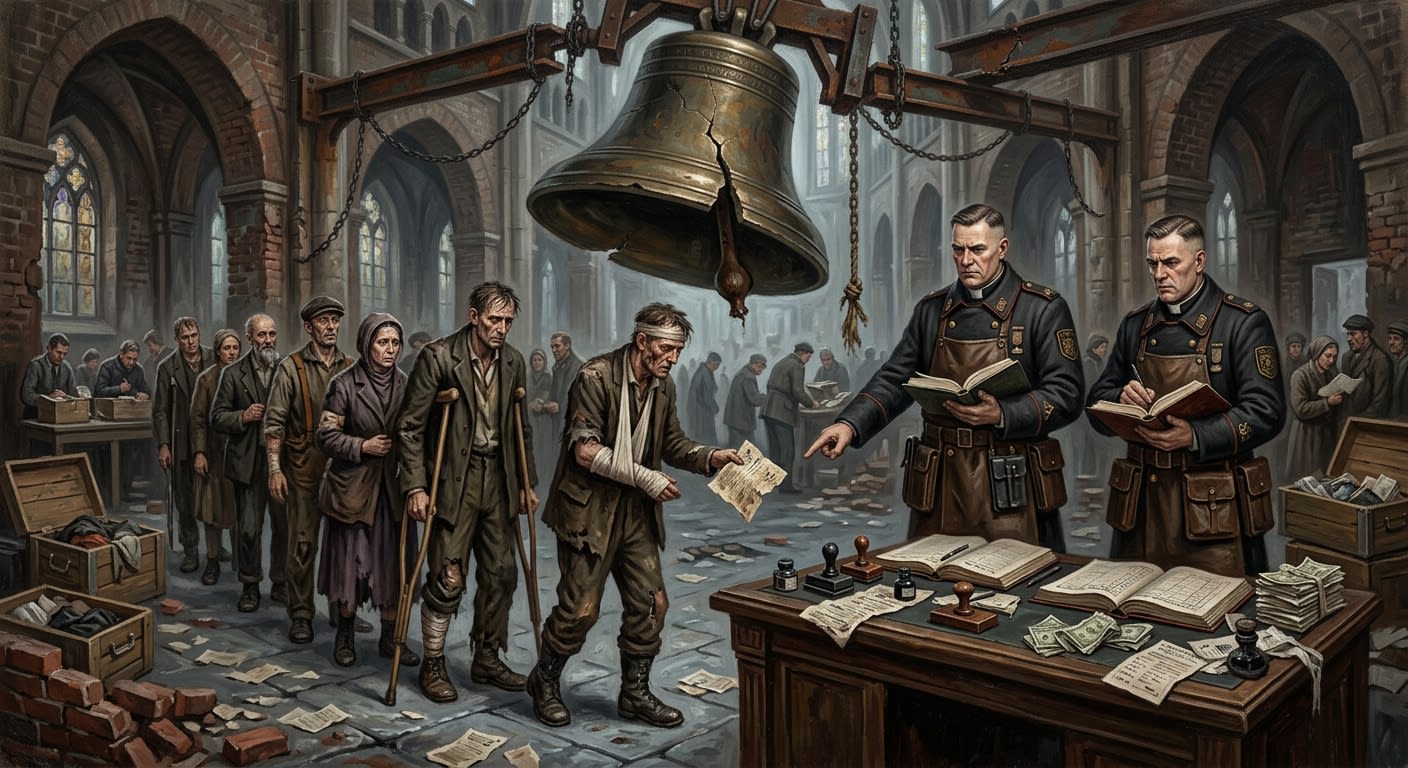
The Feast of the Cracked Bell is the Bureau of Festivals’ annual correction of a dangerous civic instinct: the belief that damage excuses disobedience. Once each year, broken bells are rung in parish yards, bastion squares, market courts, orphan refectories, debtor chapels, and all other places where the faithful might be tempted to confuse their misery with exemption. The official formula is pleasingly simple. Mankind is flawed. Mankind remains faithful. The cracked bell still tolls.
That is the slogan. The feast itself is less tidy, because slogans are what happen when a Bureau beats theology until it fits on a banner.
The observance centres upon damaged bells: cracked bronze, split handbells, warped alarm bells, chipped ship bells, tower bells lowered from condemned steeples, and the great mobile Bell of Saint Isidore when Relics can be bullied into releasing it and Bells can be outshouted on technical grounds. Each bell is rung once, twice, three times, or until its flaw declares itself. The stutter, rasp, doubled note, broken undertone, iron cough, or answering moan is entered in the local register. Then the congregation repeats the formula: Broken, bound, obedient.
The feast belongs formally to the Bureau of Festivals, with mandatory concurrence from the Bureau of Bells, relic custody review by Relics wherever Isidorean matter appears, moral surveillance by Purity, attendance reconciliation by Records, and levy-interest notation by Tithes when a district’s bell damage can be converted into a surcharge. The faithful encounter unity in public form. Five offices quarrel behind a curtain; one chant emerges.
The feast is popular. This alarms Purity and pleases Festivals, two reactions that have sustained more committees than hunger has sustained saints. The people love broken bells because the sound resembles them. The Bureau loves broken bells because the sound instructs them. I love broken bells because they are among the few instruments in Europe honest enough to admit injury before demanding silence.
#On Isidore, Kalnik, and the Debt of Sound
The feast cannot be understood without Saint Isidore, Brother Tomislav, and Kalnik Ridge, though Festivals would prefer the public to stop asking for details after the third verse. At Kalnik in A.S. 48, during the Great Retreat, Tomislav raised the reliquary when Maldrake’s vanguard descended. Seventeen relics ignited. Wrath recoiled. Faith, which had been treated by Rationalists as a charming provincial illness, resumed its old office as artillery.
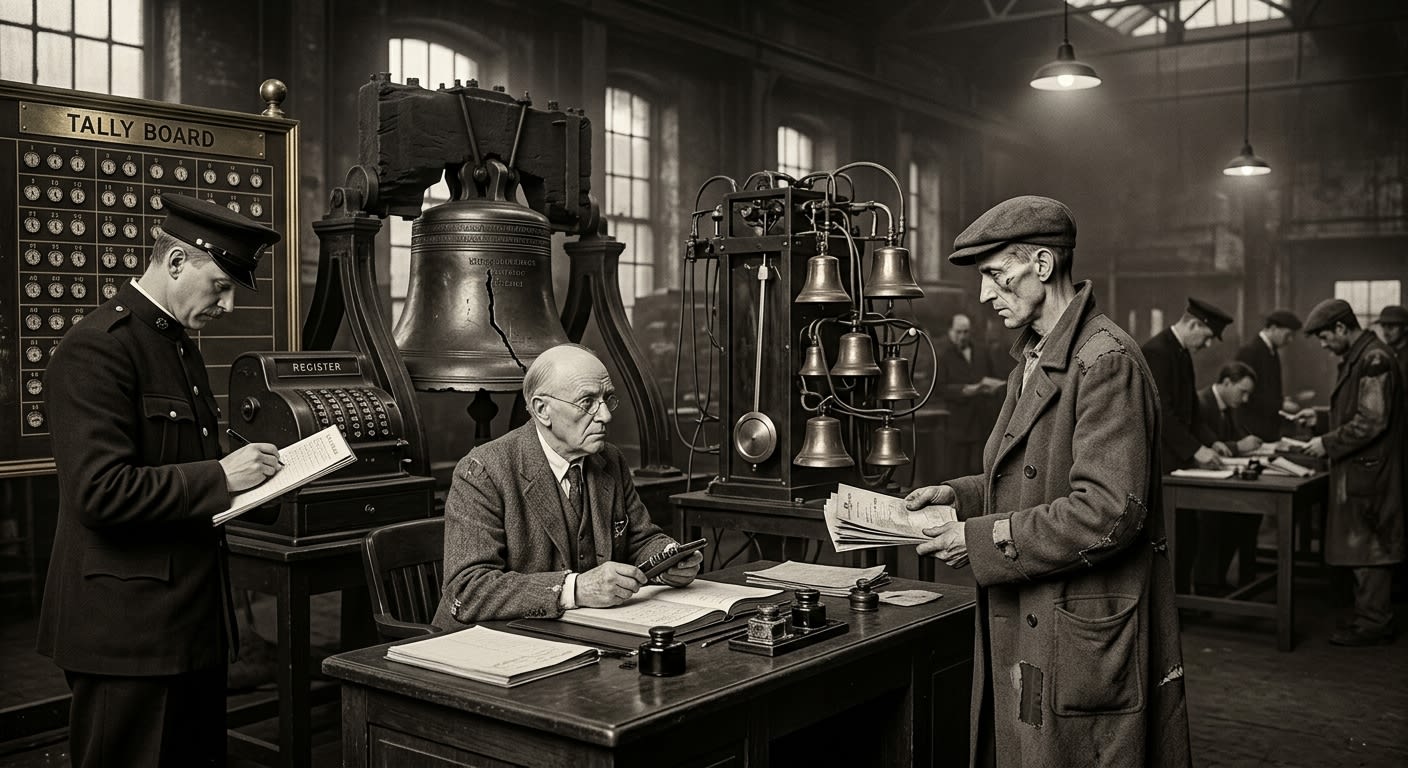
The Bell of Saint Isidore emerged from the aftermath: cracked bronze mounted on a black-silk gun-carriage, associated with ridge-glass, hinge filings, and a pinch of white ash that Relics refuses to identify while charging as if identification were complete. Its sound carries a high clean strike followed by a lower broken answer. Bells calls this acoustic instability. Soldiers call it useful. Debrecen calls it inheritance.
Debrecen paid twenty aggregate years of lifespan for one Isidorean peal. The Bureau calls the subtraction devotional expenditure. Debrecen buries its young with contract clauses in the marriage chest. In that city, birthdays are scheduled beside funeral contingencies, and old women count grandchildren by the years they suspect have already been shaved from them. The feast parades the Bell as miracle and warning. The crowd sees sanctity. The accountants see debt.
Older Festival schoolbooks stated that the Bell of Saint Isidore “rings without cost, teaching that faithful damage becomes pure strength.”
Corrected. Nothing holy rings without cost. The Isidorean peal charged Debrecen twenty aggregate years. Strength was purchased, receipted, disputed, inherited, and then decorated with ribbons by the Bureau of Festivals, which has never met a wound it did not wish to costume.
When the Bell appears in Strasbourg, its gun-carriage passes under sealed balconies and through lanes washed with vinegar. Civilians may kneel, sing, weep, and pay for certified proximity tokens. They may not touch the silk. They may not touch the axle. They may not touch the bronze. They may not pronounce Debrecen’s debit aloud during the third toll. That last prohibition was added after an A.S. 127 procession in which a Debrecen widow shouted the names of seven dead children and the Bell answered each name with a separate crack.
Relics classified the incident as unauthorized witness amplification. Festivals called it audience disturbance. Doctrine called it unacceptable accuracy.
#On the Calendar and the Rite
The Feast is fixed after the first winter fast and before spring levy notices, a placement so exact that one hears the Bureau’s little knife tapping the calendar. Too early, and the people are too hungry to be instructed. Too late, and they have already begun grumbling about taxes, seed, conscription, and the familiar municipal treason of wanting warmth. The cracked bell arrives between deprivation and demand. It teaches that being damaged does not release the hand from labour.
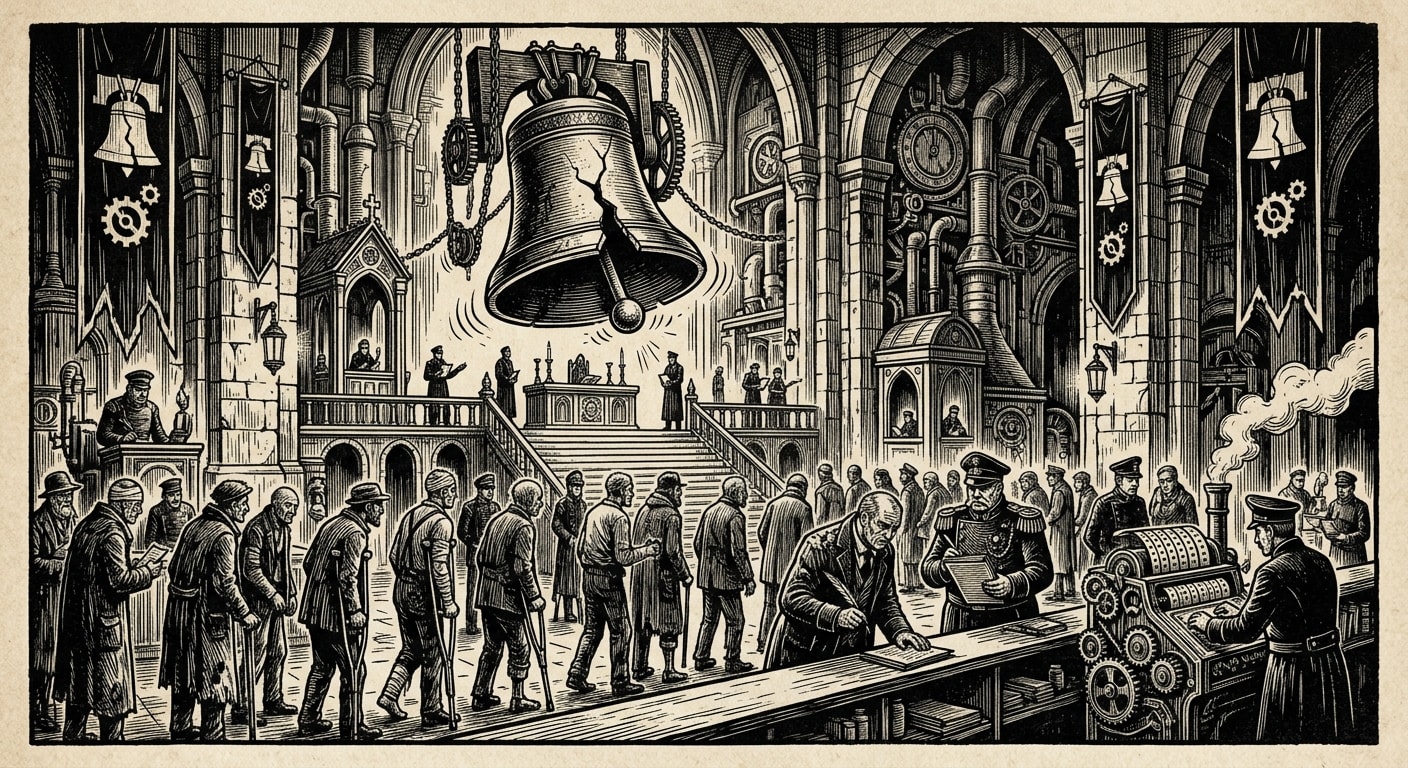
The standard rite proceeds in five motions.
First comes the Display of Faults. Bells are set upon frames, carts, hooks, scaffolds, tower doors, or funeral biers, each bearing a fault-card: cleft, cold-struck, fire-warped, war-cracked, foundry-split, lightning-opened, relic-stressed, unexplained. The last card draws the longest queues. The faithful pretend curiosity. The clerks mark faces.
Second comes the Reading of Imperfect Service. Local officials recite the bell’s history. A ship bell that sounded during a wreck. A parish bell that cracked in plague-year and continued curfew. A bastion alarm bell struck by shrapnel but kept the night-watch alive. A tavern bell confiscated after unauthorized joy and reassigned to penitential use. The moral is always service after injury. The facts are improved until they fit.
Third comes the Tolling. Each bell is struck in rank order by a licensed Bellwarden, Festival Chorus-Master, or penitent assigned under sentence. The congregation listens for the flaw. Children are tested afterward. “What did you hear?” asks the catechist. The correct answers are humility, endurance, obedience, gratitude, and the sinful nature of unlicensed repair. The honest answer, pain, is discouraged but common.
Fourth comes the Procession of Faults. The damaged bells are drawn through the streets while citizens carry small clay clappers on cords. The clay clappers do not ring. They knock, scrape, and clack against the body. Every participant must carry one. The silent clapper teaches that voice is granted by authority, while impulse produces only noise. A fine doctrine, and cheap to manufacture.
Fifth comes the Closing Peal, when the least damaged bell in the district rings the whole hour correctly. The people cheer. The clerks count the cheer. The Receipt-Procession Pageant Captain reconciles wrist-ribbons against parish rolls. The cracked bells are veiled. Ordinary sound returns.
The rite varies by region. In Strasbourg, the feast has marble stairs, disciplined choirs, and officials who smile as if suffering were a zoning matter. In Bastion-Constantinople, soldiers strike shell-scarred alarm bells with rammer heads and spit for luck despite Medicine’s protests. In Seville, after A.S. 153, the feast is quieter, watched by permanent Festival Auditors and men who know the price of laughing at the wrong measure. In Debrecen, nobody cheers during the Closing Peal. Festivals records this as local solemnity, because the alternative would require shame.
#On Pageantry, Counting, and the Ribbon
The feast teaches through sound and counts through joy. This is the Bureau of Festivals at its purest, which is to say at its most dishonest and effective. The crowd comes to honour damage. The Bureau records who came, who sang, who flinched, who mocked, who fainted, who refused the clay clapper, who wore mourning black without permit, and who touched the wrong relic-cart wheel.
After A.S. 138, the wrist-ribbon became mandatory for major processions. The Receipt Reform, born from famine riots and Bureau embarrassment, taught Festivals that citizens submit more readily to enumeration when the count wears garlands. During the Feast of the Cracked Bell the ribbon is grey with a bronze stripe and punched at the wrist with a pattern matching the district bell schedule. Counterfeit ribbons are common. Bad counterfeits are punished. Good counterfeits are studied, then punished with more interest.
The Pageant Captain moves through the route with ledger, punch, beads, drum-code slate, and the expression of a man who has confused civic love with accurate totals. His runners check wrists at corner shrines. His drum codes adjust crowd flow. His lost-child tents collect children, parents, drunkards, dissidents, and persons whose ribbon pattern does not match their declared parish. Sweetmeats are distributed in the tents. So are questions.
The cracked bells make counting easier because they slow the crowd. Nobody pushes during the Tolling unless drunk, foreign, or marked for future correction. Heads bow. Hands rise to clay clappers. Faces turn toward the frames. The Captain’s assistants pass behind and count. A bell that cannot ring straight produces the straightest census in the calendar.
The Seal-Forgers’ Winter left its own mark on the feast. After A.S. 145, all bell fault-cards required counterseal inspection, since three towns attempted to substitute ordinary damaged bells for certified relic-stressed bells in order to attract pilgrim coin. One card bore a forged Relics mark so beautiful that Masks and Seals requested it for training before permitting Purity to burn the forger. Since then, festival wax uses a harsher resin ratio, sour-smelling and green at the edge. Children call it goblin wax. Children are corrected. Children continue.
#On Mirth, Seville, and the Dangerous Laugh
The Feast carries a permanent Seville scar. The Laugh Riots of Seville began in A.S. 153 when taverns and guildhalls exceeded Bureau-mandated mirth quotas in coordinated civic insubordination. The immediate spark came during Cracked Bell observances, when laughter at a grief rite turned Festival paperwork into citywide song. Form 19-M became a drinking chorus. The quota clauses were chanted in markets. Auditors were applauded whenever their batons touched the ground. The Bureau of Festivals discovered that ridicule can travel faster than decree.
Purity answered with Lictors. Tongues were taken. The Fast of Silence followed. Two years later came the Subjugation of Seville. The feast survived, of course. Festivals never wastes a catastrophe when it can amend a manual.
After Seville, the Cracked Bell rite acquired the Mirth Boundary (Unregistered). Laughter is permitted only during the Fault Reading if the appointed reader delivers one of the three approved humility jokes. The jokes are terrible. That is their protective merit. Genuine laughter is restricted to the Gratitude Interval after the Closing Peal, measured by baton and terminated at second drop. Applause may continue longer in districts with strong levy returns. Sobbing has no upper limit unless rhythmic.
Provincial Festival Circular 153-L described the Seville disturbance as “unregulated cheerfulness during an otherwise successful observance.”
Corrected. Seville was coordinated civic defiance carried on laughter, song, mock-conducting, quota parody, and tavern discipline. Cheerfulness is what the Bureau calls rebellion before Purity arrives with knives.
The current manual instructs Chorus-Masters to watch for harmonic drift, mass silence after a cue, clay clappers striking in unscheduled rhythm, children repeating fault-card language as market rhyme, widows laughing during Debrecen debit references, and the dangerous expression known in Seville as the mouth before the laugh. That last item cannot be defined. Every auditor claims to recognise it. This is how prejudice becomes procedure.
SEVILLE MEMORIAL ADDENDUM — RESTRICTED TRAINING COPY During A.S. 193 review, one surviving witness with partial tongue removal demonstrated the original market rhythm by tapping cup against table. Three auditors present. One began laughing. One began crying. One requested transfer to grain inspection. Training copy shortened thereafter.
Purity would prefer the Feast stripped of all permitted laughter. Festivals refuses. A wholly silent Cracked Bell is bad theatre, and bad theatre breeds worse politics. The compromise is Bureau genius: joy allowed under escort, grief made audible, laughter measured by men with knives waiting two streets away.
#On Miracle, Damage, and Licensed Breakage
The feast also performs doctrine about miracles and sorcery, though the common catechist handles this portion with gloves. A cracked bell that tolls can mean holy endurance. A cracked bell that tolls wrongly can mean acoustic contamination. A cracked bell that tolls when untouched can mean relic response, demon mimicry, wind, fraud, settlement, or promotion for the first official who names it safely. The faithful hear mystery. The Bureau hears liability.
Doctrine states that a miracle is sanctioned fracture: Creation altered under licence, paid for by obedient bodies. The cracked bell is the perfect classroom because the sound itself is damaged yet useful. Every child can hear the lesson. Every soldier can. Every debtor can. The flawed instrument still serves; the injured body still owes; the exhausted city still kneels; the broken parish still pays.
The dangerous inference, naturally, is that damage creates authority. This inference breeds relic hustlers, self-wounding saints, false bell cults, and provincial idiots who hit church bronze with hammers hoping to manufacture grace. Bells hates this. Relics profits from it. Festivals schedules around it. Purity burns examples when examples become cheap.
The A.S. 119 Lorn Hill Case (Unregistered) remains the standard warning. A village bell cracked in winter cold and, when struck, caused every candle in the church to lean east. The parish declared a miracle, began selling wax scrapings, and petitioned for Cracked Bell elevation. Bells found a flaw in the clapper. Relics found no relic. Festivals found seven hundred pilgrims and argued for supervised observance. Purity found a girl hiding under the belfry with a magnetised iron rod and a grudge against the vicar. The girl was punished. The village still received a minor festival licence because the crowd had already bought tokens.
The feast teaches sanctioned suspicion. Believe the sound, but wait for the seal. Honour the crack, but inspect the edge. Kneel before the bell, but count the coin box afterward. The Creator may speak through broken bronze. So may a forger with excellent timing.
#On Local Customs and Licensed Abuses
Every district adds its own little deformity, and Festivals spends half its budget deciding which deformities to licence before they become uprisings. In Metz, children carry clay clappers shaped like debt tablets. In Lyon, the clappers are gagged with red thread during the Mirth Boundary, a cheerful reminder that tongues are rented from authority. In Prague, Procession of Tongues veterans strike cracked handbells once with bound wrists. In Thessaloniki, harbour workers lower a split chain-bell into saltwater until it bubbles, then pull it up and read the foam. Bells objected. The harbour continued. The objection was reclassified as correspondence.
In Debrecen, families bring empty chairs to the Closing Peal for relatives whose Isidorean debit came due before old age. The chairs are placed facing the bell, never the altar. Relics attempted to forbid the practice as unratified ancestor seating. Festivals overruled, having discovered that empty chairs increase attendance by twelve percent and donations by eighteen.
In Seville, clay clappers are carried but rarely struck. The citizens press them against the throat instead. The manual calls this a local penitential variant. Purity calls it watched. I call it memory with excellent posture.
Abuse follows licence as gulls follow offal. Local officials sell better positions near relic-stressed bells. Pageant Captains offer ribbon correction for a fee. Bellwardens accept coin to strike a family’s damaged house bell harder, hoping to make the flaw sound more pious. Forgers produce false fault-cards. Pilgrims buy fragments of ordinary bronze advertised as Isidorean flecks. Widows rent mourning veils near procession routes. Children steal clay clappers and sell them back to latecomers. The Bureau condemns all this with one hand and taxes it with the other, which is the oldest form of applause.
The worst abuse is substitution. A district embarrassed by too few worthy damaged bells may borrow, counterfeit, overstate, or create damage. The A.S. 176 Reims Enthusiasm Fraud (Unregistered) involved three bells cracked deliberately before inspection, a bribed Bellwarden, and a Pageant Captain who recorded attendance at one hundred and seventeen percent. Festivals praised turnout before discovering mathematics. The bells were recast. The Bellwarden was reassigned to silence. The Pageant Captain was promoted briefly, then corrected when Records stopped laughing.
#On the Bellwrights, Bellwardens, and Other Necessary Liars
No feast of damaged bells can proceed without men and women paid to know exactly how damaged a bell may become before it stops being symbol and starts being lawsuit. The Bellwrights (Unregistered) arrive first, with calipers, chalk, listening rods, oilcloth pads, tuning hammers, ear-cotton, and that professional expression by which craftsmen announce contempt for everyone who has ever written a regulation about their hands. They measure crack length. They tap crown, waist, lip, and shoulder. They listen for the undertone. Then they argue with the Bellwardens, who argue with Festivals, who argue with Bells, who send a memorandum reminding all parties that bronze is not improved by enthusiasm.
The Bellwarden's task is sacerdotal fraud of the approved kind. He must make the bell sound wounded enough for doctrine, safe enough for the crowd, loud enough for attendance, and controllable enough for the after-report. A light strike suggests timidity. A heavy strike may split the bell and kill three children in the first row, which looks poor in the annual summaries unless those children can be reclassified as devotional expenditure. The trained Bellwarden lands between embarrassment and catastrophe. This is a narrow art.
The fault-card is sworn before the first toll. A bell marked war-cracked must show either shrapnel evidence, heat stress from bombardment, or a witness statement old enough to have become inconveniently sacred. A bell marked relic-stressed requires Relics concurrence, which means the bell must have touched, contained, carried, accompanied, offended, or been struck by some certified holy matter. A bell marked unexplained draws Doctrine review and twice the crowd. No bell may be marked miraculous before sounding. No bell may be marked ordinary after attracting pilgrims, because ordinary things with revenue attached become pastoral questions.
Bells maintains the Register of Unsuitable Cracks (Unregistered). Spiral cracks are forbidden after the Lotharingian tower event (Unregistered). Mouth-splits wider than three fingers require rope barriers. Crown fractures that open eastward need Purity presence if the district has prior sorcery cases. Green blooms in bronze count as corrosion unless accompanied by singing, in which case Bells retreats and Doctrine finds its boots. The people imagine a festival. The officials see a table of allowable failure.
There are illegal Bellwrights, of course. There are illegal everything. They travel with padded carts and offer families a better-sounding flaw before inspection day: a deeper rasp for a dead son, a cleaner double-note for a sainted grandmother, a little edge filing to make an ordinary cracked kitchen bell pass as plague-year service. Festivals condemns them. Families hire them. Bells catches them when the work is bad. The excellent ones become consultants under sealed contracts, proving again that crime is merely procurement before it learns Latin.
#On the Children’s Lesson and the Old Men’s Complaint
The Feast has a school form, because no Bureau trusts doctrine to survive unless children are made to repeat it while uncomfortable. On the morning before the public tolling, pupils are marched to parish yards carrying miniature clay bells with deliberate cracks pressed into the side. The teacher strikes a real handbell. The children strike their clay. The handbell rings. The clay answers with a dull click. Then the catechist asks which instrument is more faithful. The correct answer is both. The handbell sounds because it was made whole. The clay obeys though it cannot sing.
Children hate this lesson, which recommends it. Hatred fixes memory with a better nail than affection. By afternoon they have learned the five approved Faults, the formula, the prohibition against mocking Debrecen, the Mirth Boundary, and the emergency instruction if a cracked bell rings before struck. They are told to report the sound to a Bellwarden, not to a parent. This is how the Synod improves the family: by making every child a small lateral office.
Old men complain for the opposite reason. They remember when the feast was rougher, shorter, louder, and less infested with ribbons. They say cracked bells were once rung from towers until pigeons fell stunned from rafters and inn signs trembled loose. They say men wept without being classified. They say Debrecen widows named their dead openly. They say clay clappers were children’s toys rather than attendance devices. Some of this is true. Most of it is nostalgia, that impudent counterfeit of evidence.
Still, the old men preserve fragments the manuals omit. They remember the A.S. 91 northern winter when broken trench bells were rung over uncounted dead and the snow jumped from the parapets. They remember the A.S. 112 Lintel Pogrom (Unregistered) streets, where cracked lintel bells called households out for re-knotting. They remember the A.S. 145 winter when nobody trusted wax and cracked bells were sealed with cords instead, each knot witnessed by three neighbours because paper had embarrassed itself. They remember Seville before the knives. Memory, like bronze, becomes more dangerous after cracking.
The Bureau tolerates the old men as long as their complaint remains seated. Once complaint stands, it becomes address. Once address gathers listeners, it becomes festival matter. A Chorus-Master then approaches with a smile, a ribbon, and a place in next year’s instructional play, where the old man will be portrayed by a twelve-year-old with a false beard who learns that obedience is better than recollection. The audience applauds. The original sits in the third row and considers treason with his gums.
#On Present Observance
As of A.S. 201, the Feast of the Cracked Bell remains one of the Synod’s most widely kept prescribed observances, beloved by citizens, exploited by clerks, watched by Purity, resented by Bells, treasured by Festivals, and misunderstood by foreigners who think a people gathered around broken bronze must be expressing sorrow. Foreigners are adorable until they speak.
The current Festival Register lists 2,711 certified damaged bells eligible for local tolling, 442 relic-stressed bells requiring Relics note, 91 war-cracked bastion alarms, 17 travelling cracked bells under armed writ, and one Isidorean mobile relic-bell whose route is decided each year by a committee that has never once ended before midnight. Debrecen petitions annually to restrict Isidorean display. Strasbourg denies annually with language polished enough to reflect guilt.
The A.S. 201 concerns are familiar. Seville’s throat-clapper rhythm has spread into two Iberian towns. Thessaloniki’s saltwater chain-bell rite has begun producing foam shaped like ledger numerals. A cracked parish bell in Ghent rang once during a forbidden theatre rehearsal, causing three masks to split down the mouth. A children’s rhyme in Lyon now pairs broken, bound, obedient with a second line the Bureau has failed to suppress because the rhyme is catchy and the children run faster than auditors.
I attended this year’s Strasbourg rite from the west reviewing stair. The bells stood veiled in grey. The Pageant Captains moved like bright insects through the crowd. The clay clappers knocked against wrists and ribs. At the third toll of the largest cracked bronze, an old soldier beside me began to weep without altering his posture. A clerk marked him enthusiastic. A Purity man marked him stable. I marked him correct.
The final peal rang clean. The crowd cheered within permitted measure. The damaged bells were covered. The wrist-ribbons were counted. Somewhere, Debrecen buried another young woman with a mortality clause sewn into her wedding linen. Somewhere, Seville held laughter behind its teeth. Somewhere, a village boy struck a cracked pot and heard Heaven, Hell, or his own hunger answering back.
The Bureau filed the observance as successful.