
#On the City That Lowered Its Voice
Seville sits in Iberia under a sky too generous for its government and beside a river that has learned discretion. The maps mark it as a major city, Zone 1 by coastal charity and Zone 7 by political appetite, a western jewel in the Synod’s dominion, conquered, counted, corrected, and still somehow able to make an auditor feel mocked by the angle of an orange peel.
Its beauty is a matter of record. The white walls, courtyard tiles, orange groves, river stairs, mule markets, shuttered taverns, and old guildhalls retain the kind of insolent grace that makes northern clerks suspicious. Beauty without permit is always suspicious. Beauty after punishment is worse.
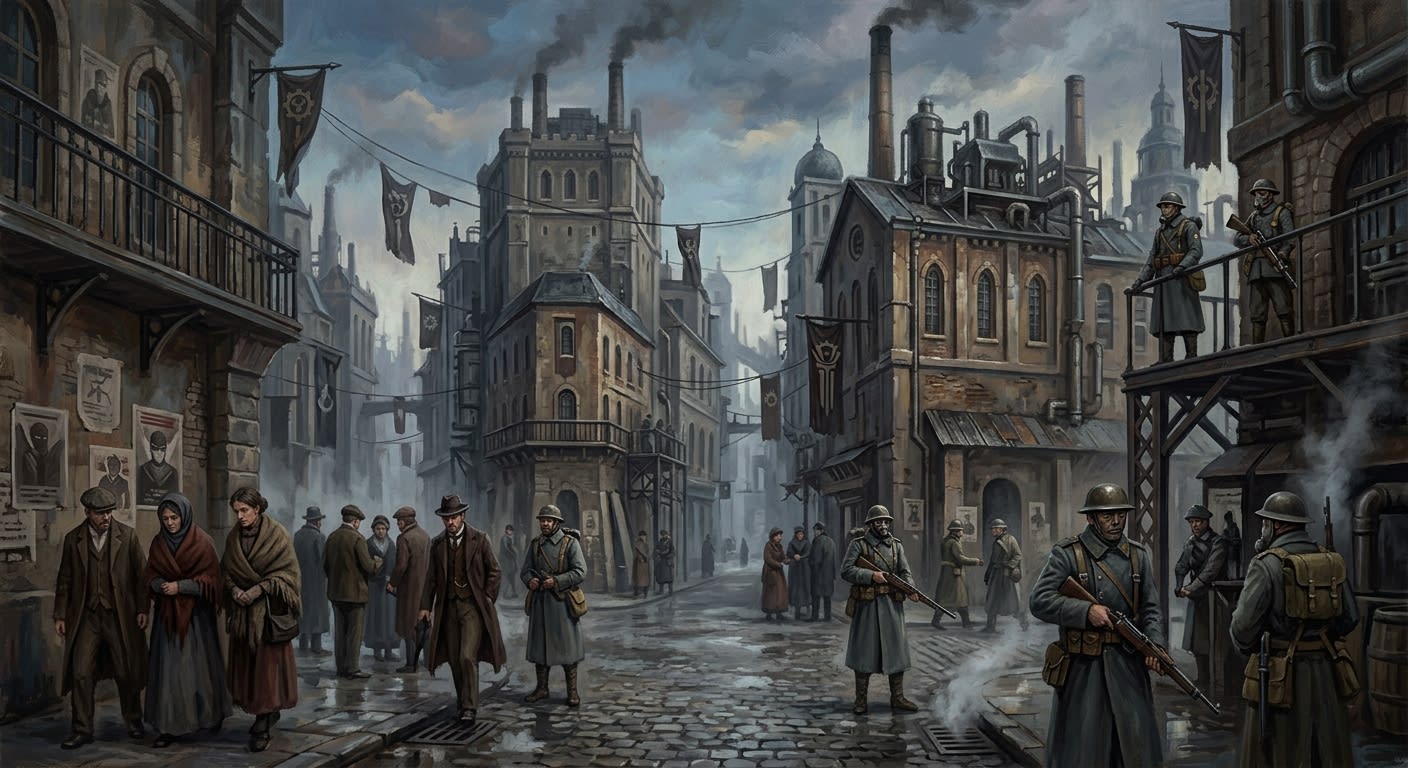
Seville is called the City of Closed Lips. This is municipal condition, post-correction. The city’s children learn to laugh with their lips closed. Tavern signs hang without painted jokes. Guildhalls conduct votes by slate and knuckle-tap. Cups are touched twice before drinking: short, short, long. The rhythm travels farther than speech. Speech was what the city lost. Rhythm remained, the insolent little bastard.
#On the Laughing City
Before A.S. 153, Seville laughed too loudly. The phrase appears in Festival reports as though volume were geology. Sailors brought songs from dirty ports. Muleteers converted tax notices into rhymes. Widows in the dye-yards could make a Purity officer sound ridiculous by repeating his own sentence with one altered vowel. Children clapped sermon cadences into games before the incense cooled.
The Laugh Riots began with Festival Form 19-M, that grim little instrument regulating civic mirth above licensed volume. The city’s taverns and guildhalls exceeded their quotas in concert during A.S. 153. The songs were sanctioned. The jokes were local. The excess was timing. Seville did not revolt with banners, muskets, or proclamations. Seville laughed on schedule, which made the laughter military.
The Lictors arrived on the fourth day. Tongues were taken. The Fast of Silence fell across five wards. Records called it mass corrective muting. Festivals called it calendar interruption. Purity called it success, which is the one word Purity can pronounce without sounding hungry.
Older provincial guides describe Seville’s muting as “the restoration of civic calm.”
Corrected. Calm is when a city rests. Seville was wounded into quiet. The difference is audible to anyone not employed by a Bureau.
#On the Procession of Cleansing
Two years later came the Subjugation of Seville, A.S. 155, entered in the Ledger as “a procession of cleansing, attended by reluctant converts.” I did not write the phrase, and this remains among the more personal injustices in the archive.
War entered through writ. Purity entered with braziers. Tithes entered with scales. Festivals entered with blank calendars. Records entered with mules carrying ledgers. Doctrine entered last, carrying the sentence that made conquest smell of incense after the blood had dried.
There was no noble breach. The gates opened because the ward captains had been shown seals, troop counts, and lists of households whose sons were already in forward service. Seville chose cooperation as a man chooses which wrist to offer the shackle first. The plazas were corrected with permit booths. The taverns were corrected with black wax. The bells were corrected downward by one quarter-tone, so every hour began to sound apologetic.
Municipal Bell Retuning Record, Seville, A.S. 155: Original civic pitch: ██████████ Corrected pitch: ██████████ Public explanation: penitential harmonisation Private note: “The city flinches at third bell.” Author of note: ██████████, later transferred to ██████████.
Thirty feast days were stripped from Seville’s calendar. The Bureau of Festivals called this redesign. The city called it punishment. Both statements were true; only one was printable. The western granaries were inventoried, sealed, reopened, inventoried again, and redirected toward Bastion-Constantinople. The Line ate. Seville counted sacks leaving.
#On the Famine and the Calendar
The A.S. 157 famine (Unregistered) followed the Subjugation like a clerk follows an unpaid invoice. Grain left by lawful channel. Relief arrived by sermon. The dissolved Bureau of Agriculture proved, in its last miserable season, that a Bureau may be blamed for authority it no longer possesses, which is the purest form of administrative martyrdom.
Seville’s shortened calendar did more than punish pleasure. It altered time. Markets lost dance days. Muleteers lost drinking hours. The Feast of Saint Casilda (Unregistered) lost public motion. Weddings became quieter, funerals more watched, lullabies subject to neighbourly caution. A city can survive with less bread. It becomes something else with less time.
A teaching copy filed after A.S. 158 states that the calendar reduction “simplified devotional life.”
Corrected. It simplified surveillance. The faithful did not become holier because thirty feast days were taken. They became easier to count.
The additional Auditors never left. They count applause, door-kneelings, tavern murmur, market cry, lullaby, funeral keening, wedding ululation, and silence that lasts too long to be simple fear. Seville remains compliant by every printed measure. Printed measures are fond of lies with margins.
#On the Present Condition
By A.S. 201, Seville is orderly, prosperous in the manner of a patient whose physician sells the blood he drains, and loyal according to documents compiled by men who cannot hear what cups say against tabletops. The city pays. The city attends. The city lowers its gaze when white mantles pass. The city speaks softly.
Its walls still bear the sentence: Joy without creed is sedition. Children trace the letters with two fingers and say nothing. Old women sell oranges at prices that vary according to the buyer’s badge. Tavern-keepers know exactly how long a safe laugh may last. Fog-Keepers thicken the air before songs become chorus. Chorus-Masters cut performances before the third clap turns into rhythm.
The Synod owns Seville. The maps, tithe rolls, garrison rosters, festival ledgers, and Purity annexes agree. Agreement among documents is a powerful thing. So is a cup tapped twice in a silent room.