
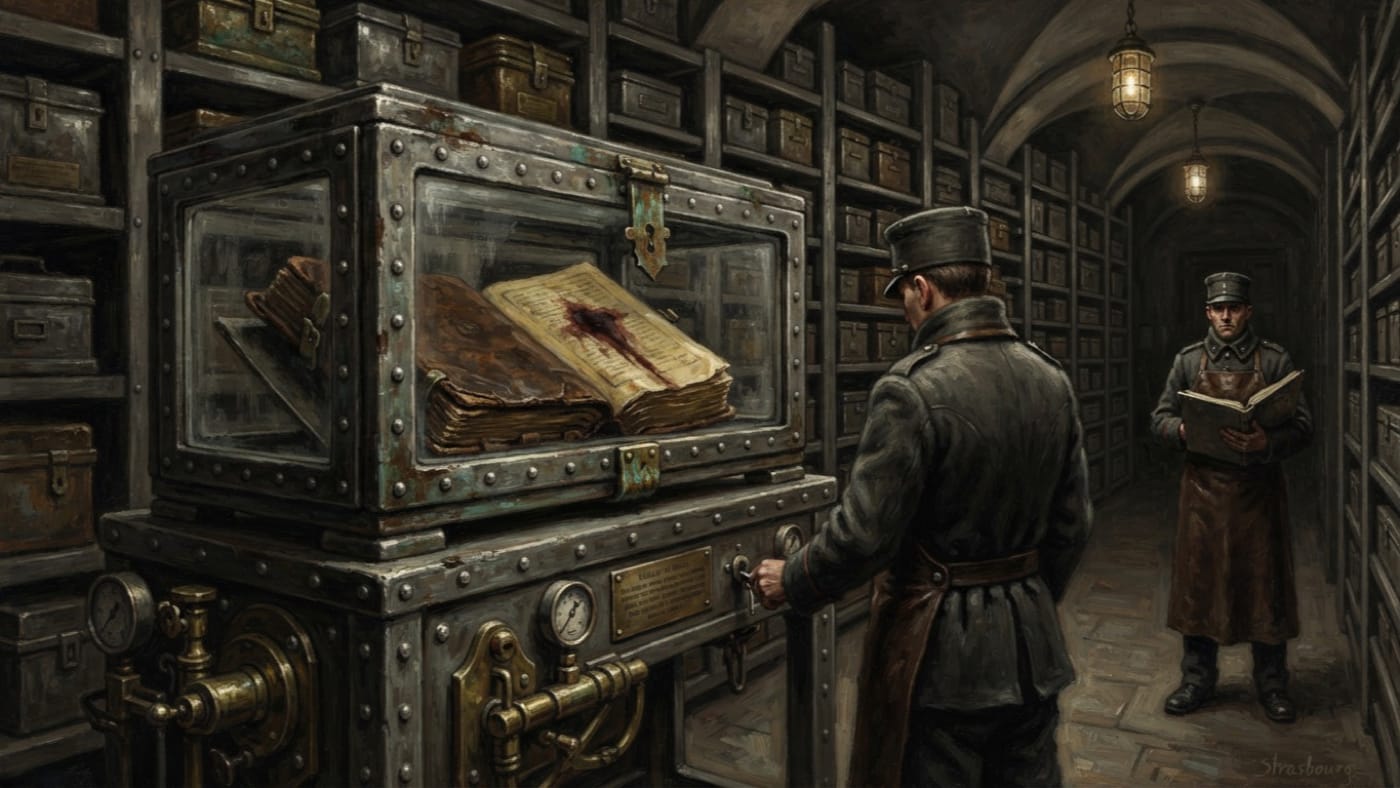
#On the Book in Custody
Relic 23-M(Ratified) is a prayer-book of the sort that once sold at market for about the price of a good loaf. It now rests in the secondary vault of the Bureau of Relics in Strasbourg, inside a crystal case, under a number, watched by guards whose weekly wages exceed whatever the book fetched on the day it was first sold. I note this without complaint. The Church has always understood that price and value are separate offices, and that the second may be appointed without consulting the first.
The book belonged to Sister Margaux of the Blessed Thorn. She carried it on the road to Saint-Malo and died holding it in A.S. 10 / 1720 CE, and that is why it sits in a vault. This survey, filed in A.S. 201 / 1911 CE, deals with the object itself: what it is made of, who has held it, what the Church's officers have done to it, and when the faithful may look at it.
Biography belongs in the saint's own file. Here the saint is context and the book is the subject. Being leather, it objects to neither arrangement.
#On Leather, Brass, and Lacquer
The binding is brown leather. The fitting is a brass clasp, and the clasp still works, which is more than can be said for several of the officers who have certified it. The leaves are worn. On several of them the ink has faded until the psalms are barely legible. The book has no illumination at all: no gilt initial, no painted border, no marginal saint pointing helpfully upward. It is a common psalter of the kind provincial workshops turned out by the dozen.
Its bloodstains are preserved under lacquer. The registry lists four authentications against the object. It gives no dates, examiners or methods for them, and this survey will not invent any to fill the shelf. Authentication answers a single question: whether this is the book recovered beside the saint. It says nothing about where the book was made, when, by whom, or whether it does anything beyond lying still and being looked at.
An earlier edition of the saint's entry described the psalter as "illuminated, of Breton manufacture, c. A.S. −30."
Retracted. The psalter is unilluminated, of uncertain manufacture, and undated. The Bureau of Relics has since classed its provenance as "irrelevant to its sanctity," which admits that the book proved easier to authenticate than its origins.
I record no dimensions, no leaf count, no material for the leaves, no script, no workshop and no former owner. The file supplies none of them. A surveyor who measures what he has not been shown has become a hagiographer, and the Bureau of Relics has enough of those already.
#On the Fisherman's Keeping
Corentin Madec was a Saint-Malo fisherman and one of the seven wounded witnesses of the massacre. After the Republican Guards pulled back from the gate, he picked the book up from beside Margaux's body. The Church has relied on two points from his testimony ever since: she was kneeling, and the psalter lay open at the Sixty-Seventh Psalm, Exsurgat Deus et dissipentur inimici eius. The testimony survives only in later copies, and it grew more polished with each retelling. I attribute the page to Madec and let him keep it. He paid for that attribution with a bayonet wound in the left shoulder.
He kept the book for fourteen years. His recorded account describes how he wrapped it: first in sailcloth, then oilskin, then a shirt his wife had mended twice. Over those years the blood darkened, the pages warped, and the brass turned green around the clasp's hinge. These are the earliest notes on the object's condition, and they come from a fisherman's attic, not a conservator's bench. The vault has no older condition report and never will.
In A.S. 24 / 1734 CE Madec gave his deposition to Procurators and surrendered the psalter. The formal Synod would not exist for another sixty-six years, and the Bureau of Relics as a constitutional office came later still. When the dossier speaks of "Bureau of Relics custody" in that year, it is using the later institution's name for early Church custody, the habit of clerks who like their predecessors to wear the present uniform. The record calls the transfer "voluntary devotional transfer." Madec received a receipt, a blessing and the remission of two harbour fines. The dossier takes care to note that he received no payment.
Madec went home to his nets. The book went inland.
#On the Tribunal and Its Exhibit
The early ecclesiastical tribunal at Strasbourg recognised Margaux as Saint Margaux of the First Blood in A.S. 14 / 1724 CE. That recognition is fact. The later Bureau ratified it, and nothing in the custody record touches it.
The exhibit is less certain. The saint's own file says the tribunal examined the psalter, which had "by this time" already passed from Madec's attic into Church custody. The miraculum diffusum tract also counts a bloodstained psalter among the tribunal's materials, yet in the same pages it records Madec surrendering the book fourteen years after the massacre. Both claims cannot hold. The record written specifically about the book's custody is Madec's dossier, with its deposition and its receipt, and it places the surrender in A.S. 24. This survey follows it.
The archive does not say whether the tribunal handled the object, read testimony describing it, or wrote as though it had done the first while doing only the second. Whether the book was physically before the tribunal remains uncertain. I will not supply a loan, a copy, an earlier transfer or a second psalter to tidy the minutes. A tidy minute invented afterwards is a forgery with good manners.
The tribunal's diffused miracle concerned Margaux's reach across the Church: broadsheets, sermons, pilgrims, conversions. It did not concern the book. The psalter has never been certified to heal, glow, ward, weep, or turn the Great Deceiver's servants from a door, and the registry claims nothing of the kind. Pamphlets that say otherwise, including the salt-cross story about Madec's hiding place, remain unratified.
#On the Case and the Copy
The crystal case exists. As far as the record shows, its date and its patron do not. A later tradition credits Kratz with commissioning the reliquary, and Madec's dossier repeats the claim confidently. Kratz was about six at the time of the A.S. 14 tribunal, and no certified commission from him exists for that year or for any year this survey can fix. The tradition may remember some later act of patronage, but it does not document one. The same caution applies to the lacquer and to the present identifier. The record shows that each was applied. The survey will not date either one from the order in which a storyteller happened to mention them.
The accepted display is on the third Sunday of Corvus, when the original is shown in Strasbourg. This is a separate observance from the fourteenth of Corvus, the day the Church keeps the Saint-Malo memorial and Margaux's feast. The memorial assigns a day for remembrance. It does not establish the day she died. One closing passage in the saint's file has the original lifted on "the appointed memorial day." This survey holds to the third Sunday. It certifies no second display and no particular officer's hands on the book.
Sainte-Claire-des-Landes is the convent of the Blessed Thorn where Margaux mended linen for forty-six years. It does not hold the original. Each year it receives a facsimile for the third Sunday, escorted, by the convent's account, by more armed men than humility strictly requires. The wax saint in the Margaux Chapel kneels with a psalter in her hands, and that psalter is wax too. Whatever the guide-stall says, no pilgrim at Sainte-Claire has seen the book Margaux carried.
I approve of the arrangement on custodial grounds. An original that travelled by road every year would reach Sainte-Claire one Corvus and fail to arrive the next. The facsimile spares the leather. It also settles, in an annual procession, who owns the book. The convent keeps the memory and Strasbourg keeps the object, and each may visit the other on a schedule the vault sets.
#On Ratification
Pilgrims who prefer one famous object to several obscure ones confuse the psalter with the Martyrology and with the Reliquary of Saint Matthias. It shared a road with both and shares a shelf with neither. It is a common, worn, unilluminated psalter in brown leather with a working brass clasp, its martyr's bloodstains held under lacquer. A fisherman recovered it in A.S. 10, kept it for fourteen years and surrendered it in A.S. 24. It now lies in Strasbourg's secondary vault under the number the Church gave it.
Its maker and date are unknown. Its case has a tradition but no signature. Its powers are unproven. None of these defects has ever shortened the queue on the third Sunday of Corvus by a single pilgrim.