
#On the Name and the Grid
"Basin-7: dormant." — Survey classification, entered before A.S. 178 and never formally amended
Quiet Basin is the name the trade uses for the wound-site the registers call Basin-7. They are the same hole in the same ground. I say this at the start because the Bureau of Records keeps two cabinets for it: one under the designation and one under the name, with a cross-reference card in each that points to the other. Neither card says where the basin is.
What the file allows me to say is this. Basin-7 lies in the southern extraction corridor, inside a licensed extraction grid, and was worked under charter in the ordinary way by Wound-Site Prospectors holding ordinary papers. The fuel of that corridor moves along the Budapest–Irongate road to bastion furnaces, and every drum on that road pays its tithe at the same tables. That is the economy the basin belonged to. It does not fix the basin's position on the road. No coordinates have been released. No owner is named in public text. Neither the year the ground was wounded nor the year it was found and staked appears in any document I have been allowed to see, and I have been allowed to see a great many documents.
The disappearance of A.S. 178 is set down in the companion entry, the Quiet Basin Incident. That entry deals with what happened. This one deals with where it happened, and readers who confuse the two will be corrected by whichever office they consult first.
#On the Ground at the Lip
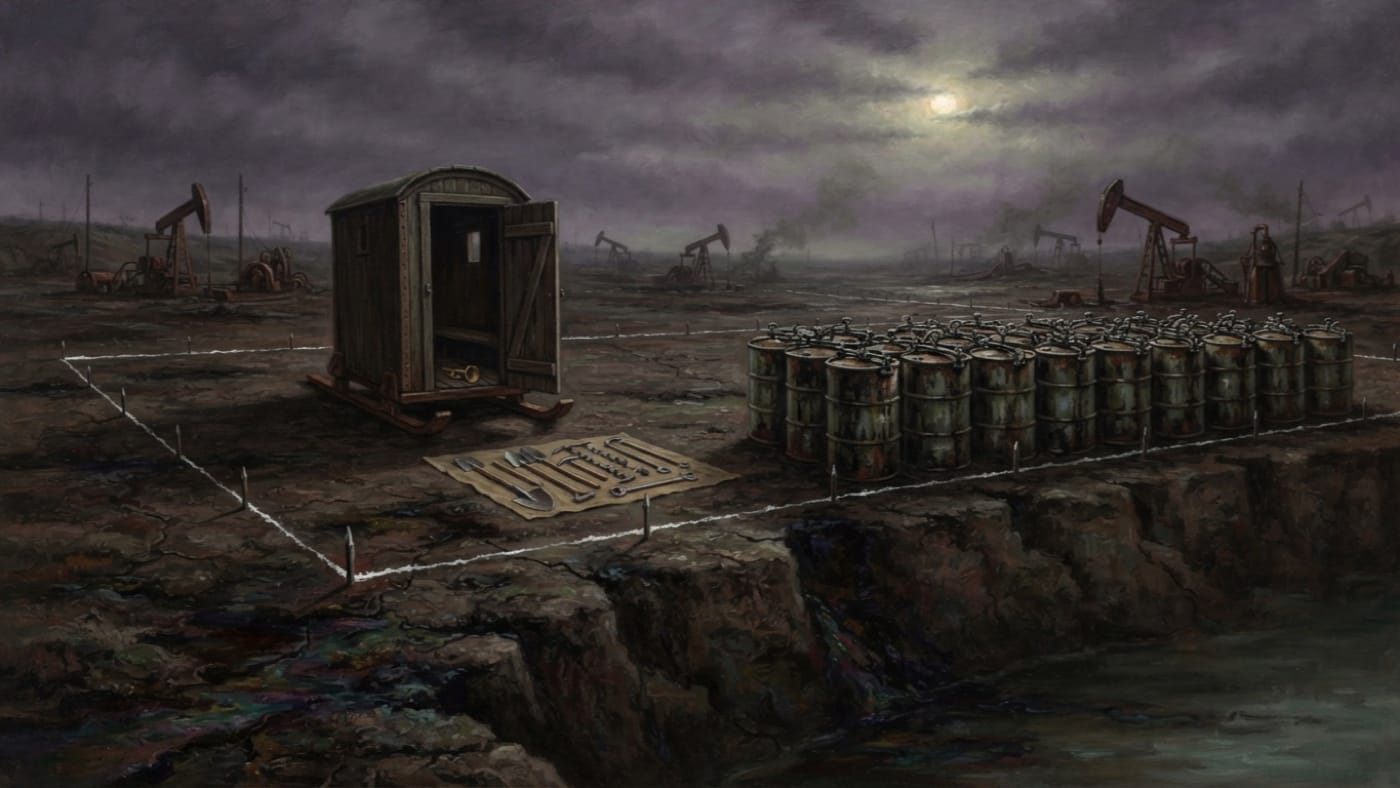
A wound-site is worked from its lip, the edge where sound ground ends and wounded ground begins, and that is where a crew does its work. Ward spikes are driven along the perimeter. Salt lines are poured between them. Two exit stakes are planted, because one exit is a tomb. The tap-mouth is marked, and the auger or tap-spear goes in there. A chapel sled is dragged into position so that the hymn singer has consecrated footing, since a gasket seal sung from bare wounded dirt does not hold. The cadence of clamp, wax and closing verse was settled under the Gasket Hymn Reform of A.S. 152 and is maintained in the sealing tradition of the Gasket Choir. Each piece of equipment has one job. A recovery party reads a site by asking which of those jobs were done.
Before A.S. 178, Basin-7 was listed as dormant. The incident dossier reports that it reached that listing after two surveys and one shallow, profitable tap. In extraction language "dormant" means a low pressure pitch and no harmonic deviation. Old crews will tell you it also means the wound is pretending. I record the designation because it is in the file. What the ground actually was, before or after the designation, I do not know, and I will not pretend to know. The surveyors who wrote the classification cannot be questioned about it.
#On What Was Left in Order
Seventeen people entered Basin-7 in A.S. 178: fourteen crewmen, a hymn singer, a ward setter and a survey scribe. None came back. No bodies were found. The rest of the record concerns what was found.
At the lip stood the drums, stacked neatly. They were still warm when the recovery party reached them. Each was sealed with gasket work that the inspectors, who are paid to find fault, described as exemplary: correct cadence marks, full wax pressure, clean clamp bite. Their combined contents were the highest single-site extraction yield on record. The number itself is not released. The ranking is.
Behind the drums lay a tarpaulin with the crew's tools set out on it in order of use, cleaned, oiled and parallel, as if for an inspection nobody had ordered. A prospector who has spent a day in a seam does not leave his auger like that. He drops it.
Further in stood the chapel sled, upright. Its ward spikes were driven into fresh ground. Its salt lines were unbroken. The singer's pitch pipe lay on the chapel floor, still vibrating at a frequency the Bureau of Bells declined to identify.
RECOVERY INVENTORY — BASIN-7 (PUBLIC EXTRACT) Drums: recovered. Sealed. Warm. Yield: ████████. Tools: recovered. Cleaned. Ordered. Chapel sled: upright. Ward spikes: set. Salt lines: intact. Pitch pipe: recovered. Frequency: ███████████. Classification: declined. Personnel, seventeen: ███████████████████████████. Survey folio: absent. Agency responsible for cleaning, stacking and arrangement: ████████████████████.
The inventory lists everything at the site except an explanation. Every duty a crew performs was completed, and none of the people who perform those duties were there. Ninety years of extraction manuals agree that an orderly lip means a safe crew. At Basin-7 the lip was orderly and the crew was gone, which makes those manuals wrong about the one point they were written to settle.
#On Custody, Credit, and the Quiet Provisions
The Bureau of Shadows sealed the matter in A.S. 179 under Classification Order 7-QBI. The parent entry records that Shadows sent three investigators to the site and that they came back without the capacity to report. I keep that wording exactly as it was given. I do not know what was taken from them or how, and I will not guess.
Custody of the basin was never given to a single office, so it ended up with several. Records holds the file and still wants the missing folio. The Bureau of Doctrine, my own office, decides which interpretations of the basin may be spoken aloud, and has so far approved none. Bells declined to classify the pitch and has kept declining ever since. The Bureau of Tithes administers the charter rights to the grid and wanted the record yield credited to the charter house. The Bureau of Engines & Furnaces sets the industrial requirements for fuel handling and wanted the drums tested before anything was credited at all.
What made the basin a problem for the offices was the yield. Seventeen workers were missing, and the fuel they would have drawn was sitting at the lip, sealed, inspected and ready to sell. A charter system built to price losses had no category for a site that took seventeen people and returned its best output on record. Tithes has a schedule for dead crewmen and Engines has a procedure for ruptured drums, but no office had a form for fuel that arrived complete with nobody left to sign for it.
District notice, Basin-7: "a routine extraction loss with exemplary equipment recovery."
Withdrawn. The incident dossier records that the notice was recalled after the classification review. The phrase "exemplary equipment recovery" is accurate and has been retired from use in connection with this site.
The Fuel Monopoly Acts of A.S. 112, already amended by the charter settlement of A.S. 167, received their quiet provisions in A.S. 189. The amendment does not name Basin-7 in its public text. Its clauses require that anomalous yields be reported under sealed annex. They forbid routing any record yield associated with personnel loss to a furnace until it has been reviewed. They restrict the handling of instruments recovered from such sites and of tools found cleaned beyond what any crew would do. Engines reports that the Basin-7 drums were later routed under seal. Being routed under seal means the drums passed through the review procedure. It does not mean anyone approved them, found them safe, or understood what was in them.
#On the Present Condition
The incident dossier records that, as of A.S. 201, Basin-7 does not appear on pilgrim maps and is not on any commercial extraction schedule. No charter house lists it and no convoy is routed to it. The file does not say whether anyone guards the ground, whether the tap-mouth has been plugged, or whether anything there has changed since A.S. 178, and I will not make up a guardhouse to cover the gap.
The prospectors keep their own map. On private route cautions, passed from one crew to the next and never filed with any office, the basin is marked with a small empty circle with no tap-mark inside it. The convention is professional, not Synodal, and it says plainly that nobody draws from that site. No Bureau publishes a document so short or so widely obeyed.
The trade jokes about almost everything: breathing drums, wrong flame, charter barons who have never smelled seep, auditors who would like a seam to show a little more enthusiasm. They do not joke about Quiet Basin. A rookie who asks about it is told that nothing happened there, in a tone that ends the conversation. The veterans have said "nothing" so often that it now sounds rehearsed.
Basin-7 remains in the registry under its designation, its trade name and its dormant classification. The survey folio is still missing, the pitch is still unclassified, and the seventeen are still listed as unrecovered. The file stays sealed and the blank on the prospectors' map stays as it is.