

#On the Present Compilation
This survey is compiled in A.S. 201 / 1911 CE. That year belongs to the compilation and to nothing it describes. I don't have a founding date for the Register of Unsuitable Cracks, an edition, or the day any one of its clauses was adopted. I don't have its full entries either, and they will not be printed here. They are held by the Bureau of Bells, which has never yet mistaken my curiosity for a warrant.
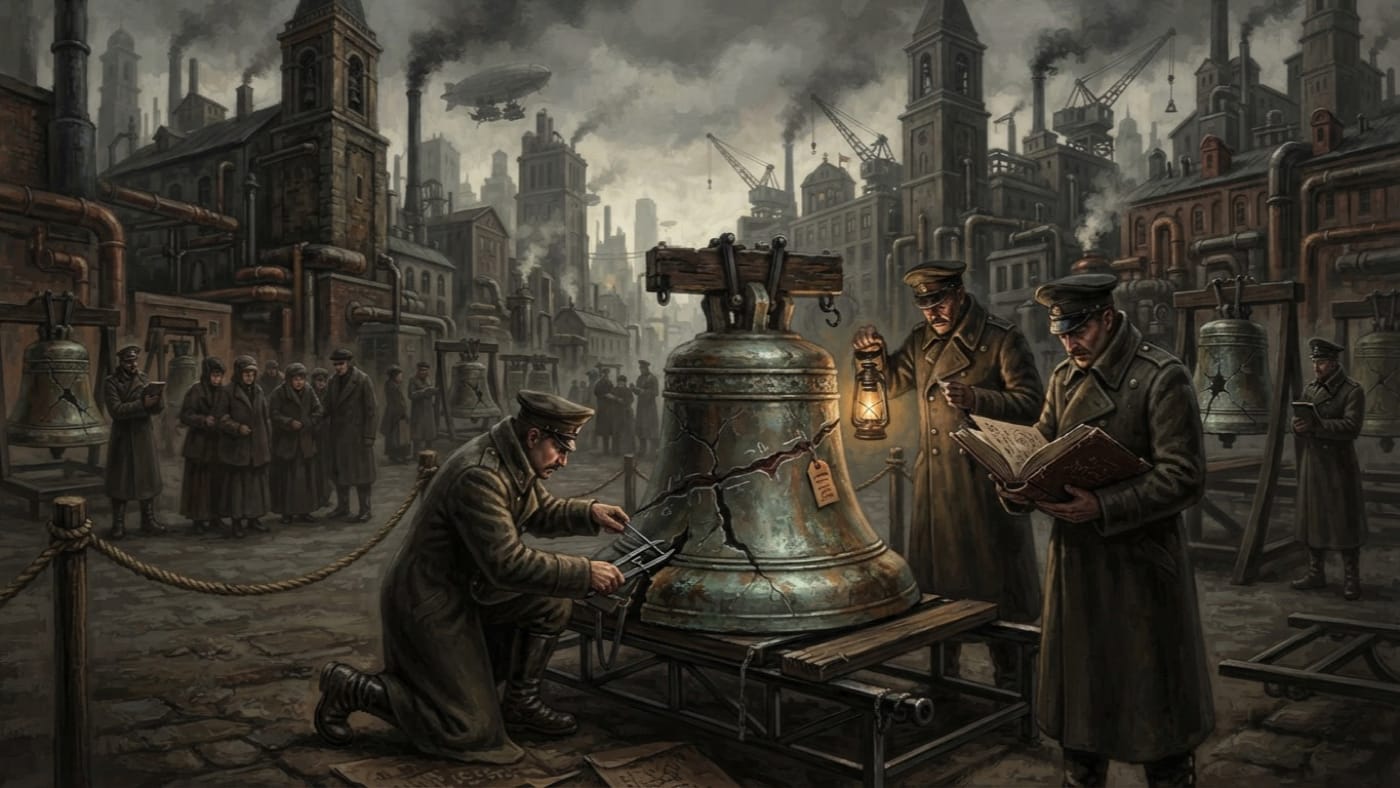
What I can survey is the Register as it shows up in public. That happens once a year, on the morning of the Feast of the Cracked Bell. Damaged bronze stands on frames and biers, and someone has to decide whether a given wound is fit to be shown to a crowd. The Feast asks whether a crack may preach. The Register answers by saying where it may not, or not unless somebody is watching.
The chronology around the Register is easy to get wrong, so here it is. The Office of Bells was constituted in A.S. 52. The formal Synod dates from A.S. 90. The current Bell Codex standard was ratified in A.S. 115. None of these dates the Register. Bell practice and local records may be older than the Office, and a list of forbidden cracks could have begun in any belfry where someone once looked at a split lip and decided not to stand under it. Any reader who wants a founding year can have one when Bells produces one.
Certain timeline inventory places the founding of the Bureau of Bells at A.S. 115.
Corrected. The Office of Bells was constituted in A.S. 52 / 1762 CE. A.S. 115 is the ratification of the current Bell Codex standard. It is a later act of the same office and not its birth. Anyone who wishes to date the Register of Unsuitable Cracks from either year may submit the supporting folio to Bells. I wish them a pleasant winter in the queue.
#On the Hour Before the First Toll
The Bellwrights arrive first. They bring calipers, chalk, listening rods, oilcloth pads, tuning hammers and ear-cotton. They measure the length of the crack. They tap the crown, the waist, the lip and the shoulder. They put the rod to the bronze and listen for the undertone, the lower answer under the strike that tells a trained ear what the crowd will never hear.
This is the hour the Register works in. It applies in the yard, before the first stroke, with chalk on the bronze and nobody kneeling yet. The Bellwarden who will strike the bell is close by and impatient. The Bureau of Festivals, which owns the observance, wants its wound audible by noon. Bells holds technical authority over what that wound may be. Relics has a say wherever relic matter is involved. Doctrine and Purity wait for the particular situations that call them in, and I will name those situations exactly.
Each bell carries a fault-card, sworn before the first toll. The record doesn't say whose oath it is, and I am not going to provide a name for the sake of tidy paperwork. The displayed labels are cleft, cold-struck, fire-warped, war-cracked, foundry-split, lightning-opened, relic-stressed and unexplained.
Readers keep confusing these with the Register, and I object. The fault-card labels belong to the Feast. They tell the congregation what story a bell is about to tell. A war-cracked bell has to show shrapnel evidence, heat stress from bombardment, or a witness statement. A relic-stressed bell needs Relics' concurrence. An unexplained bell brings Doctrine review and a longer queue. All of this concerns meaning. The Register concerns permission. One card may say how a bell was injured. A separate question is whether the injury may be put in front of children, and the Register answers that one. No one has shown me the Register's complete classification of cracks, and I won't make one up from the labels on a festival cart.
The figure of 2,711 certified damaged bells, entered in the Festival Register for A.S. 201, counts bells found eligible for local tolling. It does not count unsuitable cracks or Register entries. I have heard it quoted at dinner as the number of bells the Register has condemned. Those numbers come from different books, and the guest who quoted it is no longer invited.
#On the Four Conditions in Public View
Four conditions from the Register reach the public account. They are a partial record. There are four of them because four is what the Feast record reports. They are not universal standards for every bell in the Church, and anyone who carries them up a parish tower as an engineering code has misread a festival table.
Spiral cracks are forbidden. The record says this follows the Lotharingian tower event. I don't know which tower, when, who was present, what set it off, or what followed. I will not place it on a map. Its name tells me a region of speech and nothing else. Of the four conditions, this is the only outright prohibition. There is no rope that makes a spiral crack acceptable and no observer whose presence admits it. The Register refuses it, and the refusal is attached to an event the Register does not describe in public.
Mouth-splits wider than three fingers require rope barriers. A split mouth is not forbidden. It is fenced. The bell may toll and the congregation may hear it, but a line is drawn between the crowd and the bronze. The threshold is three fingers, measured at the mouth, and I give it exactly as the record does. Whose fingers is a matter on which the Register keeps its usual silence.
Crown fractures opening eastward require Purity presence, but only where the district has prior sorcery cases. The condition has three parts. The fracture must be at the crown. It must open eastward. The district must have prior sorcery cases on file. Where all three hold, Purity attends. Where the district's file is clean, the same fracture in the same bronze needs no such escort. The bell's direction is read together with the parish's history. I make no claim about why east matters. The Register states the rule and no reason, and I am content to leave it there.
Green blooms in bronze count as corrosion unless accompanied by singing. In ordinary cases this is reclassification. Green is weathering, a matter for oilcloth and patience. The exception is singing. When a green bloom sings, Bells withdraws and Doctrine becomes involved. The record doesn't say what the singing is. It doesn't say the bloom is anything other than verdigris. I'll say no more than that, because I am not paid to explain the noises of other offices.
The four clauses work in four different ways. The first forbids. The second keeps people back. The third calls in an observer, and only under conditions. The fourth reclassifies the bloom, and if the bronze sings it hands the matter to a different office. The Register is not a single wall. It is a set of separate gates, each tied to its own condition, and most of them stand open for most bells.
#On Families, Fraud, and the Improved Flaw
The Feast's formula is Broken, bound, obedient, and it turns damaged bronze into a lesson about continued service. The Register decides which damage may take part in that lesson. In the parishes, this restriction meets grief.
A family's house bell cracked the winter their son died. They want it to toll at the Feast. They want its rasp heard in the yard, read out at the Reading of Imperfect Service, and carried in the Procession of Faults. The Register can tell them no, or tell them yes behind rope, or yes with Purity in the second row.
There are illegal Bellwrights who go door to door before inspection day offering a better flaw: a deeper rasp, a cleaner double note, some edge filing so that a kitchen bell can pass as something holier. Festivals condemns them and the families pay them. Bells catches the bad work. The record doesn't say that any named worker did any named fraud, and I won't enlarge one case into a guild of criminals.
The Reims Enthusiasm Fraud of A.S. 176 / 1886 CE shows the pressure at its full size. Three bells were deliberately cracked before inspection, a Bellwarden was bribed, and a Pageant Captain returned attendance at one hundred and seventeen percent. The bells were recast. Reims also had a choir fraud in the same year, filed under the same scandal name. The two share a city and a decade's worth of embarrassment. No common parish, conspiracy or sequence connecting them has been established, and I keep them apart even though Reims would prefer a single file.
#On What Remains Unpublished
This survey closes, still within the A.S. 201 / 1911 CE compilation, where the public account runs out. The Register of Unsuitable Cracks is kept by Bells. Four of its conditions are visible through the Feast. Its full entries, its origin, any other prohibitions, and the facts of the Lotharingian tower event stay with its keepers. I have not invented a taxonomy to fill the gap. I have not supplied a tower, a date or a trigger, and I have not explained the singing.
The Feast teaches that a cracked bell still serves. The Register says that some cracks may not, and that others need a rope or a witness.