

#On the Reims Finding
The Reims Enthusiasm Fraud sits in the Festival files under A.S. 176, which is 1886 to the clerks who still keep the old count. I write of it from A.S. 201. Distance helps. It does not change the fact that I have to work from the same files as everyone else. Reims is a cathedral city and wine market on the Champagne roads, north-east of Paris and west of the Line, and its own registry places it in Zone 2. It keeps a Festival district office. It hosts the Feast of Doctrinal Submission and the processions of the Cracked Bell. Its citizens have performed for inspectors so long that the performance has picked up a local accent.
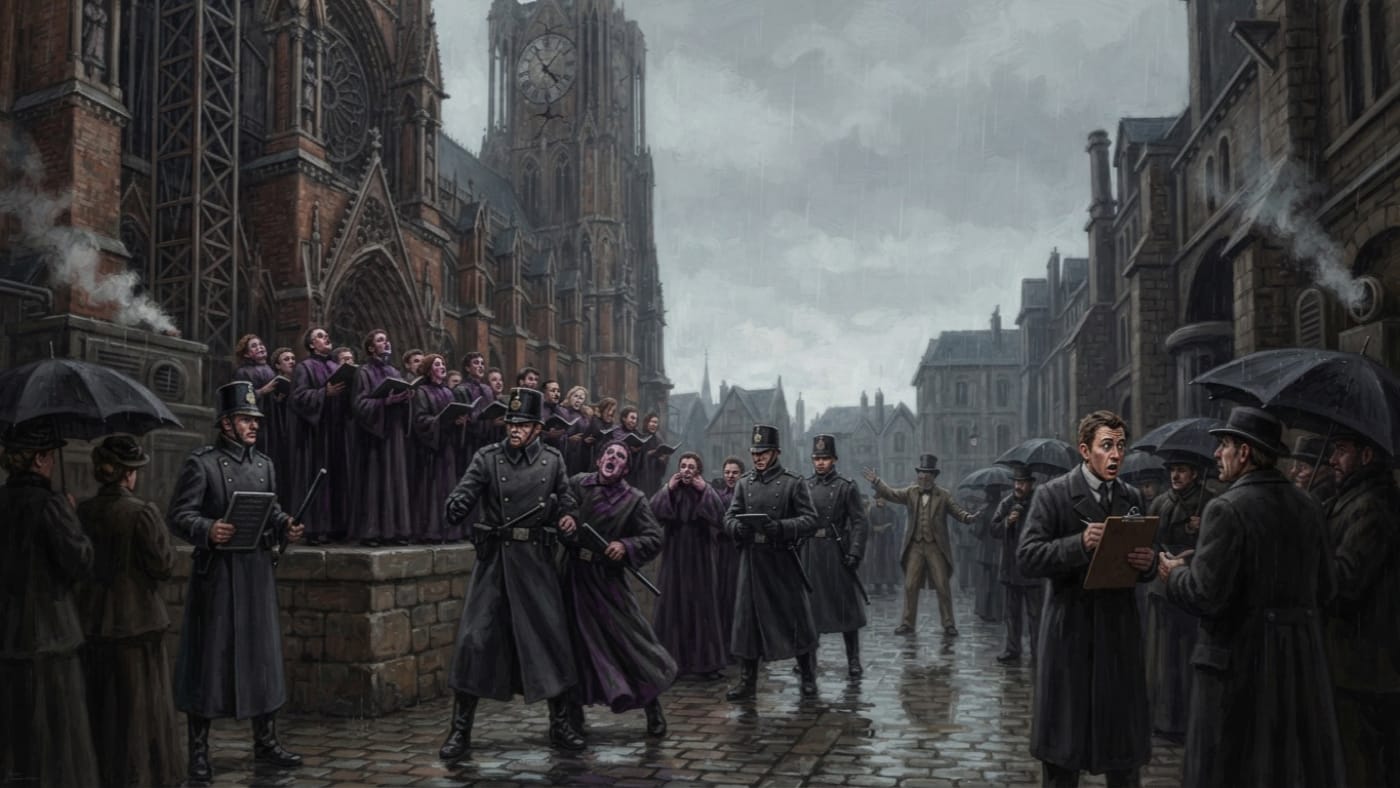
The facts fit on one docket. A parish choir in Reims painted mild gratitude onto their faces with diluted berry dye. Their affective compliance was measured as perfect for three years running. Rain exposed the paint. Purity prosecuted the choir, the painter, the berry seller, and two weather observers accused of negligence. The Bureau of Festivals argued privately that the parish had met the measurable standard. Doctrine suppressed the argument.
The rest is commentary, and commentary is my trade.
Before that commentary starts I have to fix one distinction, because half the provincial sermons on this case have smudged it worse than the rain did. An approved expression is a finding about a face. An officer looked, and an officer wrote. A feeling is a fact about a soul, and souls are audited above Strasbourg by an Office that does not answer memoranda. The Reims choir held the first for three years. Whether they had the second, in any quantity, the files do not say. The files were never built to say it.
#On the Face as a Register
The Feast of Doctrinal Submission is mandatory. Absence goes into the Great Ledger, and attendance is only the first thing counted. Enthusiasm is measured in three registers. Vocal compliance asks whether the mouth produced the required words. Physical compliance asks whether the knee went down, the head bowed, and the ration card appeared at the correct bell. Affective compliance asks whether the face showed gratitude at a level neither seditiously low nor theatrically high.

The first two registers are honest labour. A word is spoken or it is not. A knee strikes the stone or hovers above it in what the Bureau calls an interrogative attitude. The third register is where the Bureau climbed toward Heaven and came back down with a slate. Sorrow looks like dissent. Terror looks like piety. On some faces hunger looks like philosophy. The officer has to read all of it from a distance, in open weather, and write a judgement that will travel up to men who never saw the face.
The Chorus-Master answers for it first. He posts the calendar, reads out the attendance requirement, announces the approved emotional range, and conducts the square through its kneelings and refrains. If his crowd goes flat, he is blamed. If it gets too warm, he is blamed. A parish choir is both his showpiece and his hostage. It is the front rank of faces every observer sees first and judges the rest by.
Watchers stand around him. Purity keeps observers at the major feasts. Records keeps counters. Festivals keeps its own Auditors, and the Bureau's present standard assigns numbers to smiling, weeping, kneeling and singing, with a gap between too little and too much narrow enough for a careless parish to fall into. The files do not record which scale governed the Reims returns of A.S. 176. They record the result: perfect.
Consider what mild gratitude means to an officer with a slate. It sits in the middle of the permitted band. Nobody can call it cold, because the mouth turns up and the brow is eased. Nobody can call it excessive, because nothing in it grins, weeps, trembles, or seems to be enjoying itself without a licence. Mild gratitude is the face the Bureau would have designed if it were allowed to design faces. In one Reims parish, for three years, somebody did.
#On Three Years of Gratitude
Three consecutive years of perfect affective compliance. Read the phrase slowly, as Festivals once did with delight and Purity later did with something else.

The record does not name the three years separately, and I will not invent a sequence to comfort tidy minds. It gives their quality. Each year the choir stood where it was told to stand. Each year the faces were assessed. Each year the assessment came back without fault. The Reims account says the Auditors approved the scores and the Choir-Master praised the discipline.
At this point the vulgar reader wants to hear that the Auditors were bribed, that the Choir-Master mixed the dye himself, that the whole parish office stood in a cellar stirring berries by candlelight. The files support none of it. Neither surviving account shows that any assessing officer knew the faces were painted. What the files do show is worse for the Bureau and better for literature. The officers looked at the faces exactly as their office required and found them correct.
Approval is a signature. A signature swears that the thing seen matched the thing required, and for three years those signatures were true. The faces did match. The gratitude on them was mild, steady and centred in the band, and cold and grief never touched it. The Auditor saw what he was paid to see and wrote down what he saw. Whatever lie there was began before his slate.
The Choir-Master's praise deserves the same care. He praised discipline, and he had it. A choir that holds one expression through a whole Feast, through the kneelings, the refrains, the bread and the cold stone, shows a steadiness of face that most Chorus-Masters demand for whole careers and never get. That the steadiness came from pigment and not piety does not make it less steady. He praised the right thing for the wrong reason, which puts him in the company of most of the Synod's hagiographers.
Nothing is said of their pitch. Of their kneeling, nothing. The perfection belonged to one register only, and that register alone carried the fraud.
What did three perfect returns prove? They proved that on inspection the faces showed acceptable gratitude. They proved nothing about devotion and never claimed to. The Feast's measurement read the face because the face was what an officer could see. The soul it was meant to indicate stayed where souls stay, out of reach of slates. The choir did not break that arrangement. They took it at its word.
#On the Rain
Then it rained.
The files give no day, no hour, no record of the season, and no name for the first man who noticed. They give the rain and what it did. The smiles streaked. The Reims account says they ran into purple tears. I see no reason to improve on that, since it is already better than anything Festivals has commissioned in a century.
Picture it from where the observer stood. A face that has scored perfect for three years starts changing in public without permission. The mouth keeps its curve while the colour leaves it and slides down the cheek, and the gratitude drops toward the jaw. Whatever was under the dye comes up in streaks: pallor, cold, boredom, fervour, private grief, or a man's ordinary blankness while he thinks about supper. Nobody can say which, because the underlying face was never assessed. It had never been presented.
This is the point the whole affair turns on. Before the rain the faces were findings. After it they were evidence. The choir, the faces and the parish were all the same. The water had changed, and so had the classification. By the Reims account, Purity made the discovery. Purple runs onto collars, collars can be seized, and Purity has never waited for a second invitation.
#On the Prosecutions and the Measurable Standard
Purity prosecuted four classes of defendant: the choir, the painter, the berry seller, and two weather observers.
The list repays study. The choir wore the faces. The painter applied them. The seller sold the berries. Each stands one step further from the offence, and at the end of the line are two men whose only recorded connection to the matter is the sky. They were accused of negligence. The files do not say what the negligence was: failing to announce the rain, failing to foresee it, or some duty of theirs the surviving accounts never describe. I will not supply the charge. Purity supplied enough.
The choir's size is not recorded. The painter and the seller are not named. No account I may treat as settled gives the outcome for any of them. Provincial retellings hand out sentences generously, burning some defendants and pardoning others to suit the preacher's Sunday. The record holds the prosecutions, and I hold the record.
Then there is Festivals. By the surviving accounts, the Bureau of Festivals argued privately that the parish had satisfied the measurable standard and deserved commendation for its technique. By the same accounts, Doctrine suppressed the argument.
I despise Festivals on principle. It is a costume department with a seal, and it believes every wound can be improved with ribbon. Still, I have read the standard, and the argument holds up on the standard's own terms. The standard required gratitude shown at a level neither deficient nor excessive, and the choir showed it. Nothing in the standard required the gratitude to grow from the face God issued. It measured the visible face because the visible face was all it could measure. Prosecuting the choir for meeting it amounted to admitting that the standard had never been the standard.
That admission is exactly what Doctrine could not allow into the file. If Festivals were heard, every measure in the Synod would become the whole of the law it measures. A man who meets the knee-count could claim he owes no more kneeling. A parish that satisfies Tithes could claim its debt to Heaven is paid. The citizen would learn that obligation ends where the slate ends. Doctrine holds that the measure is evidence of an obligation larger than itself, and that it shrinks from the citizen as he approaches. Festivals' argument was never answered. It was filed, and nothing has been seen of it since.
This was not a ruling that the choir was innocent, sincere, or entitled to paint itself. No such ruling exists. Festivals made an objection about arithmetic. Doctrine answered on authority, and authority does not lose disputes about arithmetic. It removes them from the record.
I would have signed the suppression, and admired the brushwork while I signed it.
#On the Other Reims Return
The scandal's name has a second tenant. The Cracked Bell account files a separate matter under the Reims Enthusiasm Fraud of A.S. 176: three bells deliberately cracked before inspection, a bribed Bellwarden, and a Pageant Captain who recorded attendance at one hundred and seventeen percent. Festivals praised the turnout before it discovered mathematics. The bells were recast. The Bellwarden was reassigned to silence. The Captain was briefly promoted, then corrected when Records stopped laughing. The Reims account puts this in the same year as the choir.
The two frauds inspected different things. The bell fraud manufactured damage that the Bells register would honour and a headcount that exceeded the population. The choir manufactured a face. One fraud overshot and the other hit dead centre. No account I hold puts them in the same parish, the same dock or the same conspiracy, or says which came first. They share a city, a year and a name. The one hundred and seventeen belongs to the bells. The choir's figure was perfect, a different number and a more insulting one.
#On the Damp Cloth
The prosecutions also corrected a sentence from an earlier generation of Festival guidance.
A.S. 148 Festival guidance described measured enthusiasm as "non-punitive communal encouragement."
Corrected after the Reims prosecutions. A parish was encouraged to perfection for three years and prosecuted when the perfection got wet. Measured enthusiasm punishes deficiency, suspects excess, and, as Reims showed, can punish exactness when the exactness was applied with a brush.
Reims did not sulk. According to its own city account, it professionalised. Berry sellers acquired licences. Painters began keeping devotional alibis. Chorus-Masters now press damp linen to the cheeks of the singers before the third refrain. The account gives no year for any of this, no form number, no statute, and no figure for how many painted faces the cloth has since found. These are Reims practices, reported from Reims. As far as any file of mine shows, they have not become law beyond the city.
The cloth is officials' favourite kind of instrument because it adds one more moment in the Feast at which obedience can be watched. Citizens hate it. By the same account, children laugh at it, the old put up with it, and the middle-aged work out which relative has the driest skin and seat that one nearest the aisle. Reims has always been good at reading the inspector before the inspector reads Reims.
Consider what the linen actually tests. It touches a cheek and comes away clean or stained. A stained cloth proves dye. A clean cloth proves the absence of dye and nothing more. It has no setting for gratitude and no measure of devotion, and it would come away just as white from a man silently cursing the Synod. The Bureau has improved its instrument by one square of wet linen and its knowledge of the soul by nothing at all. I say this approvingly. An instrument that claimed to measure sincerity would be heresy, and an expensive one.
The three registers stand, and so does the affective slate. Auditors still assess mild gratitude, Chorus-Masters still answer for it, and Purity still waits behind the crowd. A wet hand now passes along the front rank before the third refrain, and at that hand's height Reims is the most honest city in Zone 2.
The choir's slate still reads perfect, and nobody has corrected it.