

I've read the continuity, voice and source files. Writing the prose now.
#On the Work Before the Toll
This survey of the Bellwrights is compiled in A.S. 201 / 1911 CE from what the Codex already holds on them. That is less than their usefulness deserves and more than their regulators would like. The year belongs to this compilation and to nothing else. The craft is older than the page, and it has not told me how much older. No founding has been produced for it, and I will not forge one to give an infobox something to do.
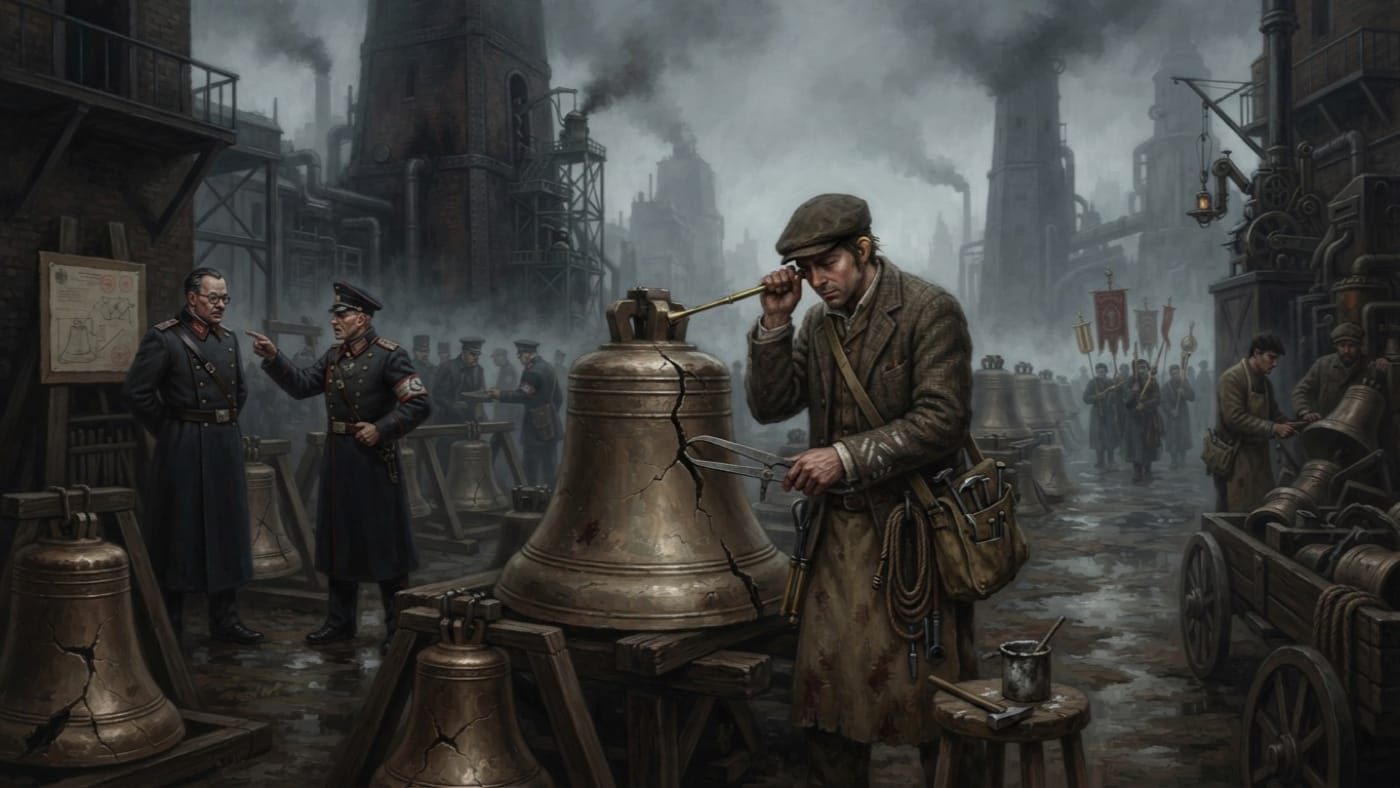
What the record offers is a single hour: the morning of the Feast of the Cracked Bell, before the first toll, when damaged bronze stands on frames, carts, hooks and funeral biers and somebody must decide how damaged it is allowed to be. That somebody is a Bellwright, man or woman, and paid. The Bureau of Festivals wants a wound the congregation can hear. The parish wants its bell back afterward in roughly the same number of pieces. The first row wants to go home. Between these appetites stands a person with chalk on one sleeve and a settled contempt for everyone who has ever written a regulation about their hands.
Records has filed them under factions. The filing describes a shelf. It does not describe a guild, and I have looked.
#On Calipers, Chalk, and the Undertone
They arrive first. That is the whole of their precedence, and they guard it like bishops.
The kit is plain. The Feast record lists calipers, chalk, listening rods, oilcloth pads, tuning hammers and ear-cotton, and the list is shorter than the inventory of a minor chaplain's sacristy. It carries no relic or blessing, and no instrument in it has a saint's name attached. The calipers measure crack length. The chalk marks what was measured, so that a crack which grows overnight can be caught in the act. Then the tapping begins: crown, waist, lip and shoulder. Like most anatomy, the parts of a bell were named by men who wanted the body to sound respectable.
The listening rod goes to the bronze, and the ear goes to the rod. The Bellwright is listening for the undertone. The strike is what the crowd hears. The undertone is the bell's confession, the lower answer beneath the note that says whether the metal is tired, split through, or merely theatrical. A cracked bell can strike handsomely and confess badly. The Feast prefers the strike, and the Bellwright is paid to hear the confession.
The ear-cotton I take to be self-defence. A craftsperson who listens to broken bronze for a living has every reason to ration what reaches the skull, and I respect anyone who keeps their own hearing in better order than the Bureau keeps its accounts.
Nothing in the record says the Bellwright mends anything on Feast morning. They assess, and their calipers report without promising. A bell judged sound enough to toll is not thereby healed. It has been given permission to keep its injury in public.
#On the Bellwright and the Bellwarden
The Bellwright says what the bell is. The Bellwarden must then make it say so in front of witnesses. The Feast assigns him a narrow and ugly art: strike hard enough that the flaw declares itself and doctrine gets its wound, gently enough that the crowd keeps its children, and evenly enough that the after-report can be signed without perjury becoming visible. The Bellwright measures the danger. The Bellwarden performs inside it.
Their trades overlap. Bellwardens calibrate and maintain in their own towers, and no honest account hands every technical matter to the Bellwright. The line drawn here is the Feast's line, between examination and the controlled stroke.
The Feast record gives the order of the argument exactly. Bellwrights argue with Bellwardens, Bellwardens argue with Festivals, and Festivals argues with the Bureau of Bells, which issues a memorandum reminding all parties that bronze is not improved by enthusiasm. Festivals owns the observance. Bells supplies the technical concurrence. The Bellwright supplies the measurements over which everyone else quarrels, and the record says nothing about whom, if anyone, they answer to between feasts.
Bells has its own age, which is often confused with theirs. The Office of Bells was constituted in A.S. 52. The formal Synod's settlement came in A.S. 90. The current Bell Codex standard was ratified in A.S. 115. None of these dates the Bellwrights. Craftsmen were tapping bronze before any office wrote down that they should.
The Lore Book's account of the Bureau of Bells states that entire provinces live by "Strasbourg's Bell Codex of 231."
Corrected. The current Bell Codex standard was ratified in A.S. 115 / 1825 CE. The year 231 has not yet arrived, and the Bureau's confidence about it is premature even by Bureau standards. Earlier bell folios and local practice stand apart from the ratified standard, and so does the apocryphal Lyon folio, which may be filed wherever Records pleases so long as nobody tolls from it.
#On Fault-Cards and Unsuitable Cracks
Each bell's fault-card is sworn before the first toll. The record is reticent about whose oath it is, and I see no reason to improve on that reticence by guessing. The displayed categories are fixed: cleft, cold-struck, fire-warped, war-cracked, foundry-split, lightning-opened, relic-stressed, unexplained.
The bell supplies the sound, and the card supplies the meaning. A rasp is a rasp. A rasp sworn as war-cracked must show shrapnel evidence, heat stress from bombardment, or a witness statement, and with that it becomes a sermon about endurance under fire. A bell marked relic-stressed needs the concurrence of Relics. A bell marked unexplained draws review from Doctrine and twice the queue. The Bellwright can tell you where the crack runs. Whether the crack came from Providence is another office's question, and approval of the card proves only that the card was approved.
The Feast account sets out the Register's conditions, and conditions are what they are. Spiral cracks are forbidden after the Lotharingian tower event. The record keeps that event's year, its participants and what actually happened to itself, and so shall I. Mouth-splits wider than three fingers require rope barriers. Crown fractures that open eastward require Purity present, but only where the district has prior sorcery cases. Green bloom in bronze counts as corrosion unless it is accompanied by singing. The record does not explain the singing, and I like it better unexplained.
Each of these clauses carries an if. Anyone who carries them out of the Feast as universal law has mistaken a festival table for an engineering manual, and will deserve whatever bell the error finds.
#On Improved Flaws and Other Work
There are illegal Bellwrights, of course, as there are illegal everything. They travel with padded carts and call on families before inspection day with an offer of a better flaw: a deeper rasp for a dead son, a cleaner double-note for a sainted grandmother, a little edge filing so that an ordinary cracked kitchen bell can pass as plague-year service. The family does not want a repaired bell. It wants its grief to be audible. Festivals condemns the trade and the families pay for it. Bells catches the bad work. The excellent practitioners, the record says, end up as consultants under sealed contracts. This should surprise no one who has ever held a sealed contract.
The A.S. 176 Reims Enthusiasm Fraud shows the demand at full size: three bells cracked deliberately before inspection, a bribed Bellwarden, and attendance recorded at one hundred and seventeen percent. The bells were recast. Who cracked them, the Codex does not say, and the absence of a named Bellwright in that file is a fact I will not tidy away for the sake of a moral.
Their work does not end with cracked bells. In the matter of Sermon-horns, Bellwrights argue over throat angle, because too wide a throat turns a sermon to mud and too narrow a one makes every sibilant sound like an accusation. The test prayer and the clean carrier belong to the Orison Signal Engineer. The Bellwright's part, so far as the record runs, is the geometry and the grievance.
Montreval tolerates Bellwrights among its other useful visitors, along with veterans, mule handlers and candle women. Its upper chapel keeps three bells: a cracked original, a post-Concordat recast, and a bell made from Rationalist gun brass. A town that keeps a cracked bell ringing first at dusk will put up with people who know exactly how cracked it is. That is the whole extent of what Montreval tells us about them.
#On the Present Compilation
This compilation, made in A.S. 201 / 1911 CE, holds what the record supports: an inspection made before a toll, a kit of six items, a quarrel conducted in a fixed order, a table of conditional prohibitions, a black market in sorrow, and an argument about brass throats. It holds no charter or rank, and no master or chapter. If the Bellwrights have any of these, they have kept them out of my archive, which is either discretion or the beginning of a Purity file.
Purity, for its part, has already done some listing. When Inquisitor Breel was questioned after the Incident of A.S. 187, her interrogators looked for friendships with singers, cantors, bellwrights, laundresses, nursery women and anyone else whose labour might put rhythm into a skull. They found no such friendship. That list implicates no Bellwright in the matter. It shows only what Purity fears whenever bronze and a human ear are left alone together.
I have watched the regulations multiply around their hands for most of my career. The Register grows a clause, the card grows a category, and Festivals finds another way to make the wound more profitable. The Bellwright still arrives first, still sets the rod against the shoulder, and still listens past the strike for what the bronze is willing to admit. Of all the offices that gather around a broken bell on Feast morning, theirs is the only one whose work requires the bell to tell the truth.
The others require only that it ring.