

#On the River Landing
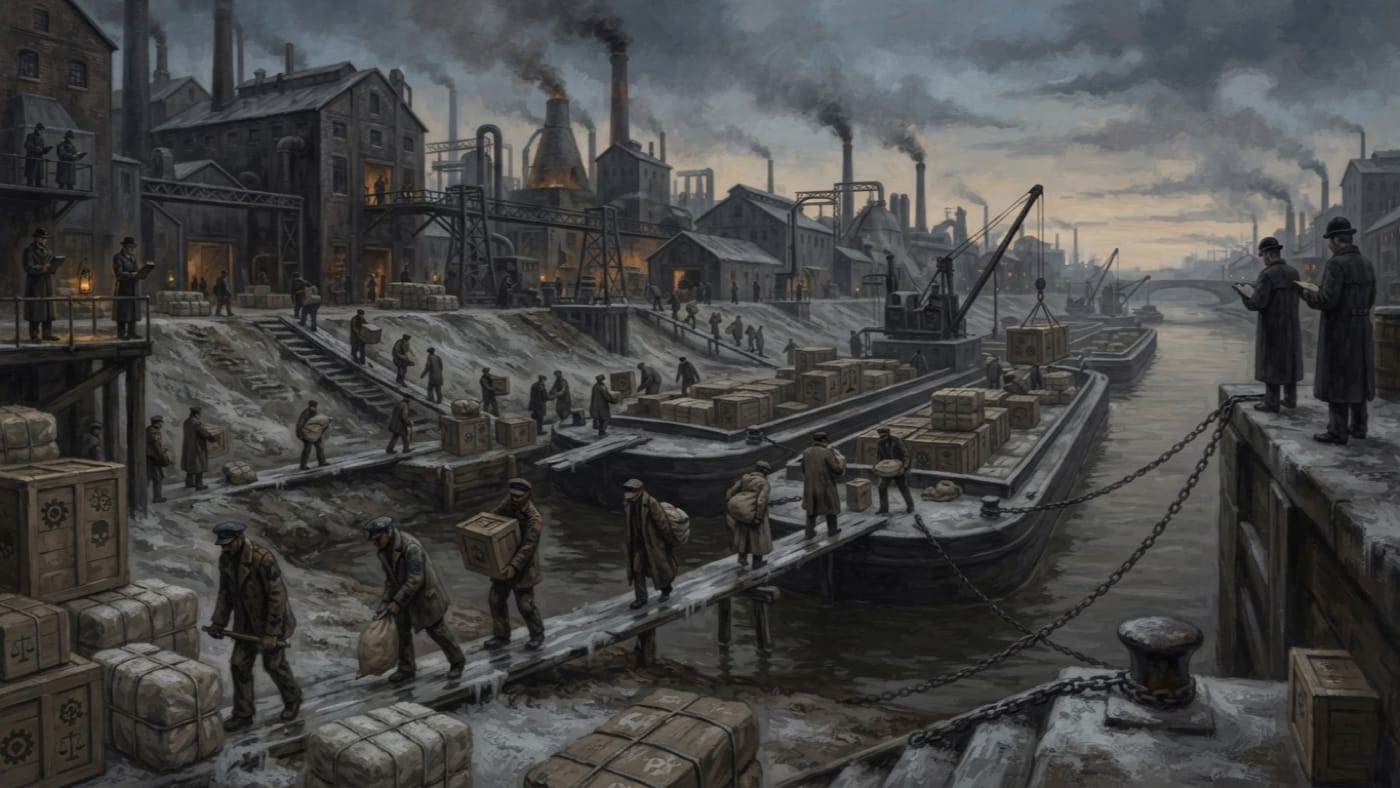
Every account of Marrowgate starts at the Wagon Quays, because that is where the city prefers to be seen at work. The wounded come in by cart, the intake bell counts them, and the Sanitation Chapter stands at the gate looking indispensable. The River Spur Ash Docks get no such attention. They lie lower, on the wet lip of the river terraces where the spur touches the city, and they do plainly what the Wagon Quays only borrow the vocabulary for. Barges tie up. Barges are loaded. Barges leave.
The dossier gives the place five words of sensation and one of hazard: wet ash, river stink, drowning. I have read longer entries on minor saints that told me less. Kiln ash drifts down from the yards and settles on anything left near the water, and the river works it into a grey paste. The loading edge is grey and slick by every account, and the timbers never dry. Chains run from the hulls to iron in the bank, and they make the place's one sound, a dragging complaint that climbs the terraces whenever a hull shifts. Barge skiffs pass between the larger boats. Labourers carry sealed crates down planks laid across the slurry.
People drown here. The record does not say how often. A labourer on a wet plank over moving water, carrying a crate he did not pack, can come to three ends, and only one of them is entered as freight.
#On Ash and Freight
Marrowgate became a medical port around A.S. 72. River trade along the forward corridors had collapsed under military requisition, and a logistics officer, whose office the Bureau of War would later claim as its own, turned the old river-market town's port logic over to wagons. The river paid no attention to the decision. Its trade shrank, the town's attention turned to the roads, and the waterfront went on loading boats. The Ash Docks are what remains of that older town's landing, kept in service by the city that replaced it.
Marrowgate is an inland port with no sea — only roads.
Marrowgate is an inland port with no sea. Wagon roads carry the bulk of its intake, and its river spur carries barges loaded with lime, linen and sealed crates. The same dossier records both. The word "only" has been withdrawn as ornamental.
The city's exports are on file: bone-lime and ash, disinfectant salts, bandages and stitched canvas, prosthetics, and a great many stamped clearances. Its imports run the other way, including grain, lamp oil, surgical steel and purification reagents. The dossier assigns three of these cargoes to the barges by name, namely lime, linen and sealed crates. The rest I will not load onto a hull the record never put there. A Hieromnemon who invents manifests is a clerk with ideas above his ink.
The lime is the obvious freight. The Lime Yards burn day and night, turning the processed dead into mortar, road surface and the whitewash that paints Marrowgate's clean lines, and what the city cannot use it sells. The Bone-Lime Consortium lists river barges among its territory alongside the Yards, and it holds the kilns, the wagons and the labour gangs. Whether it owns the landing, leases it, or keeps enough men on it that ownership never comes up, no document says. In Marrowgate those three arrangements have always been the same arrangement.
Linen is the second cargo. It is boiled in the washhouses of the Suture Slums by debt-labourers working off prescriptions with no fixed end, then folded, baled and carried down to the water. Bandages leave the city the way soldiers arrive, in quantity and badly handled.
The sealed crates are the third. Their seals attest only that someone sealed them.
#On Clearance and Cargo
Nothing moves in Marrowgate without passing someone who checks papers. The dossier names three kinds: Sanitation Chapter inspectors, ward sentries and tribunal clerks. The outer cordon is a ring of quarantine fences, lime trenches and inspection gates. Inside it, whitewash lines divide the streets into clean corridors and everything else, and crossing one without a stamp is a crime. Freight bound for the river has to cross that geography before it reaches the water.
The papers in force are many: health clearances, death dockets, quarantine release writs, intake manifests, confession receipts, work prescriptions. No customs house for the Ash Docks appears among them, and neither does a landing tariff, an inspection calendar, or a permit issued by the docks themselves. The landing answers to the citywide regime or to nothing. Anyone who has stood at a Marrowgate gate knows which answer gets used, and when.
What the city forbids to move at all is written down with a precision I admire: unnotarized body parts, blank medical certificates, unsealed surgical tools, corpses without confession receipts, and "cold boxes" that rattle, which the dossier glosses as suspected illicit organ transport. Moving a corpse without a death docket gets the mover shot.
Three kinds of freight leave this landing. Lawful cargo is lime, linen and anything else whose papers and contents agree. Declared cargo is whatever the papers say, which is a separate matter. Smuggled cargo is the remainder. A crate does not announce which of the three it belongs to, and the record does not let me sort every crate after the fact. The bribes that work elsewhere in the city are listed as linen bolts, lamp oil, a "donation" to the Mercy Chapel, and forged fever certificates. Two of those four already travel by barge.
#On the Stitchmarket Route
The Stitchmarket calls itself a labour-placement concern. It works out of the Suture Slums and the drainage tunnels beneath them, which are older than the cordons and belong to the river-market town that came before. It trades in forged clearances, bed tokens, stolen anaesthetic and illegal surgery. It also trades in organ crates, and the organ crates go by water. The record of Marrowgate routes them through the River Spur Ash Docks. The record of Needle-King Pavo says they leave by the same landing and adds the only sentence that matters: the ledgers do not say whose organs they hold.
That sentence is all the evidence there is, and I will not improve on it. The files name no supplier, no buyer and no destination downriver. They do not say which crates on a given day held organs, which held lime, and which held something a clerk would sooner not name. A Bureau that knew those things would have acted on them, or filed them where nobody could, and neither has happened in any record I have.
The cartel's methods are listed as bribery, kidnapping, counterfeit papers and night surgery. Each of them has a use on a river landing. A bribe moves a sentry's eyes off a plank. Counterfeit papers turn a cold box into a crate of linen for as long as nobody lifts the lid. Night surgery fills the box. The dossier also records kidnapping for debt-labour among the city's crimes, and that sits closer to the cartel's stock than its public face would like.
The Stitchmarket is no charity. It is also no aberration in a well-run city. It exists because the lawful system produces more need than it will treat: more men waiting for beds than there are beds, more pain than the Chapel will dose without a confession, and more bodies needing repair than the Sealhands will touch without the cut-stamp. Desperate people buy what the cartel sells. Some of what it sells was taken from people who never agreed to sell anything. Both facts belong in the same file, and the Stitchmarket is careful to keep them apart.
#On the Present Condition
The river terraces flood every season, and the landing is the lowest working ground in the city, so it floods first. Floodwater turns the mud roads into slurry channels, carries the yards' runoff toward the spur, and leaves standing water that the dossier lists among the city's disease carriers. When a flood reaches the lime pits, the Consortium loses supply, and lost supply reaches the barges inside a week. Drowning gets easier in high water. The record does not explain this, and a man who has seen a river in spate does not need it explained.
The clean paper plague of A.S. 199 left every document in Marrowgate weaker. Men died while their health clearances, properly stamped and filed, declared them fit. The plague did not begin at the docks, and no record I hold says it did. It still taught every inspector on every gate that a sealed paper proves only that a seal was pressed on it, and an inspector who has learned that about clearances will apply it to crates. The Stitchmarket intends a "paper liberation", a flood of forged clearances big enough to make the whole permit system worthless. It is a plan. The river already demonstrates the result in small every working day.
One custom belongs to the landing. On Ash Lantern Night the people of Marrowgate float candles on the river spur for their dead. The water fills with small lights drifting downstream toward places the city never names, and everyone on the bank watches the candles, so nobody watches the boats. The dossier says plainly that smugglers move contraband under cover of the ceremony. It gives no date for the festival and no seizure, so I record neither. It is the one night when Marrowgate's mourning and its freight go down the same river together.
The docks go on loading. The Sagittal Line goes on supplying the city that sends lime back to it, and whatever is loaded at the Ash Docks reaches its buyers without stopping to be counted.
Nihil obstat. Entered as freight.