

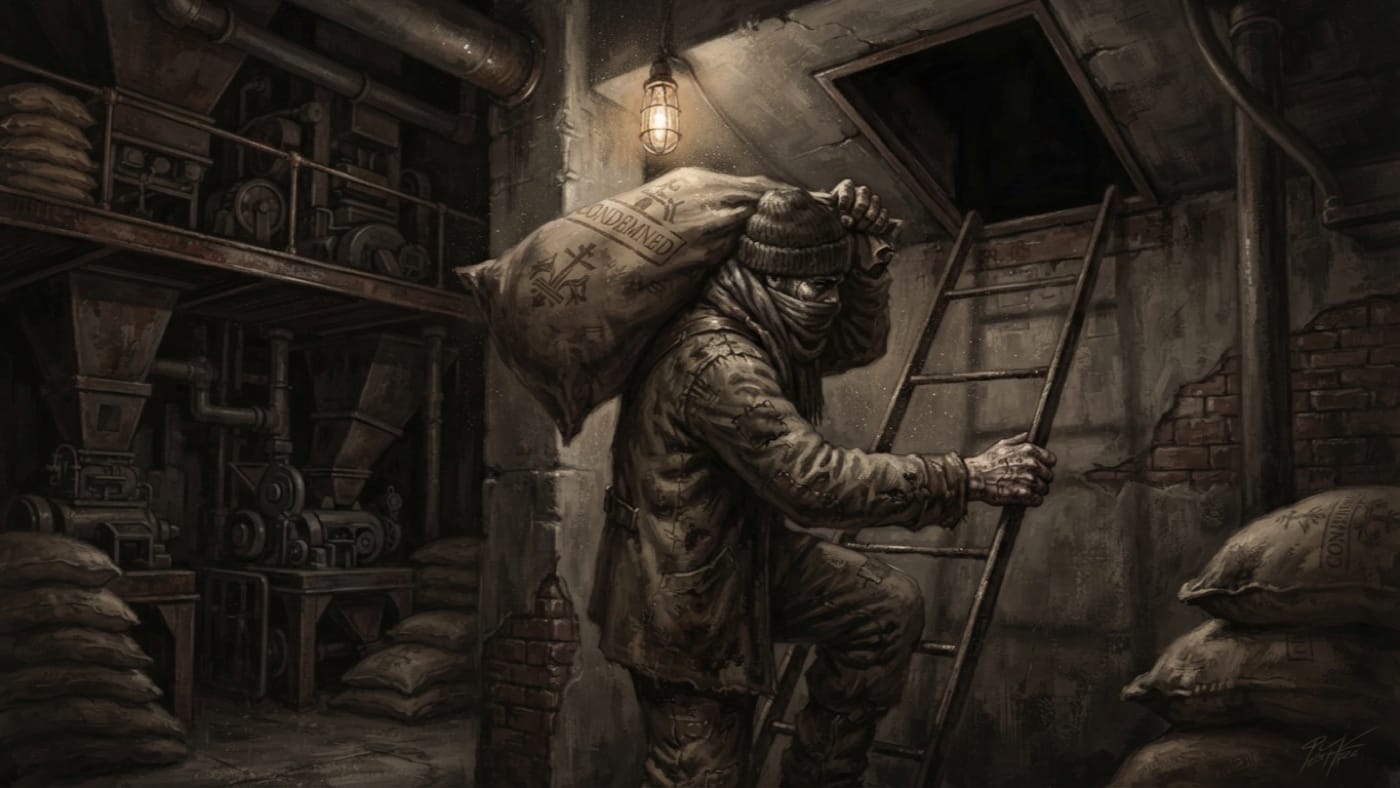
#On the Carrier's Station
A Sack-Hand is the lowest rank in the Grain Keeper trade, and the only one defined by the spine. The internal ladder, as Purity has pieced it together from confessions and the Keepers have failed to hide it, describes the rank in four words: carrier; learns the smells. I have read longer epitaphs on dogs.
Above the Sack-Hand the ladder forks. The Scale Clerk keeps the numbers. The Cache Runner keeps the routes. These are parallel offices, and a carrier who rises goes to one or the other depending on whether their gift runs to arithmetic or to alleys. Above both stands the Cellar Warden, who controls a district's hidden stores. Above the Warden stands the Keeper-of-Keys, one to a ward, who decides in a crisis who eats.
The Sack-Hand decides nothing. A Sack-Hand lifts what a Clerk has written out of the count, takes it by the road a Runner has chosen, and puts it down in a cellar governed by someone else. Rank in this trade is counted in keys. The carrier's is counted in sacks.
#On Learning the Stores
No examination exists. The carrier learns by carrying, which is the oldest curriculum in the Church and the cheapest.
Sound grain smells of dust and not much else. Damp grain smells of wet straw. Mouse musk means the sack has had visitors, and they have left their droppings as receipts. Flour clings to the creases of the fingers and stays there through washing, prayer and interrogation. Sweet rot is the smell every Sack-Hand learns first and fears longest, because it sits in the bottom third of a sack while the top third looks fit for a bishop's table.
That is the whole education, and it matters because the label and the sack disagree. A sack sealed condemned may hold clean barley under one spoiled layer. A sack stamped sound may be soft and warm at the base where the damp has settled. The ledger knows what a sack is called. The carrier knows what it weighs, how it shifts, and what it gives off when the twine is cut. The Keepers' trick called the Weevil Blessing, in which a bin is seeded with insects so that it can be lawfully condemned and quietly recovered, depends entirely on someone being able to tell a bin that has been blessed from a bin that has truly turned. Get that wrong and the infestation is real.
The trade takes payment in the body. Grain dust settles in the chest and becomes a cough that never quite clears. Mould gets into the lungs. Rats bite the knuckles that reach into dark bins, and the scars are a recognised mark of the profession. Stacked sacks fall. Crawlspaces collapse. A Sack-Hand who has worked three winters can be picked out of a ration queue by the hands alone.
#On the Sack Removed from the Count
Take one representative night. I describe no particular night, since particular nights belong to Purity's case files.
In the licensed granary, a Scale Clerk has run a sack through the routine perfected under the name of Old Klem the Ledgerman: condemned once, condemned again under a new lot number, then moved into a disposal ledger that no ration auditor reads. On paper the sack is now waste. In the corner of the store it is still forty-odd pounds of grain in burlap, sealed with twine, smelling of the granary.
The shuffle's whole elegance lives in the ledger. Its whole vulnerability lives in the corner. A sack written out of the count still has to leave the building, and ink cannot carry it.
The carrier waits in the wagon shed until curfew empties the street. The Runner has marked the road in chalk where a patrol would take it for a child's scrawl. The sack goes out by the back door and along a wall. Then it goes down, because Keeper caches go down: under a false floor, into a hollow behind a stair, into a dry crawlspace, sometimes into a cavity in an ossuary wall where the dead raise no objection. A waxed cloth sack keeps out the damp. The original burlap, if it is sensible, goes to the disposal cart with the rotten portion, which proves the condemnation was honest.
Earlier Bureau training notes, reproduced in the Ledgerman's dossier, describe the spoilage shuffle as "primitive cache theft masked by clerical confusion."
Corrected in that dossier as to primitive and confusion. Corrected here as to cache theft. The phrase put the cleverness in the ledger and the crime in the cellar, and so gave the Bureau nobody to look for in between. Every shuffle ends in a pair of hands walking a sack through a curfew. Inspectors trained to read columns were never trained to watch back doors.
#On Whose Bread Is Carried
The same sack, carried the same way, serves three masters depending on who holds the keys at the bottom of the stair.
Among the Mercy Keepers it becomes bread for children first, given without questions. Among the Quota Men it is a modest skim from a system they intend to keep running, since a ward that riots brings auditors and a ward that eats a little better than its chits allow does not. Among the Hunger Brokers it becomes a debt, a recruitment loaf, or a hold over a household that will remember who fed it and who could stop.
The carrier chooses none of these outcomes. Allocation belongs to the Keeper-of-Keys and the cellar to its Warden. Purity has found no oath binding every Sack-Hand to any one of the three, and in practice the hands go where there is work, a bowl at the end of the night, and the least chance of a lictor at the door. One hand may carry for a Mercy cellar in autumn and a Broker's cellar in Lent without knowing the difference, since flour on the fingers is the same in both.
#On the Hand Offered Up
The audit, when it comes, comes with fresh scales and a fume-inspector from the Bureau of Purity. Keepers read this arrival as proof that someone has talked. Contraband becomes real for Purity only when it is sampled, sworn to, seized and written down. A hidden sack is rumour. A found sack, with a carrier standing beside it, is a case.
At that point the network does the arithmetic it was built for. The Keeper's own maxim names what can be given up under pressure: a Sack-Hand, a "rogue" Cache Runner, or a whole cellar offered as proof of cooperation. The Sack-Hand heads the list for plain reasons. The carrier holds no keys, keeps no book and controls no store. A carrier's confession closes a file without opening a ward. The inspector goes away with a name, the Clerk keeps their columns, the Warden keeps the district, and distribution resumes within the week, one pair of hands short.
The penalties are the profession's general ones, applied from the bottom up: public shame, forced confession in front of the ration line, reassignment to trench depots, erasure, and immurement for hoarding. There is no special tariff for carriers. None is needed. The ordinary scale falls hardest on whoever has the least to bargain with.
The Keepers have their own story on this point, and it should be quoted exactly as far as it goes. Keeper testimony, preserved in the Ledgerman's dossier, says Klem trained five Scale Clerks and vanished when a Sack-Hand betrayed a cellar under questioning. The account gives no carrier's name, no cellar, no date, and no record of capture. The Bureau's own version of Klem's end is different and equally unproven. A separate Purity deposition is attributed to a captured Cache Runner, a different witness of a different rank, and it names no Sack-Hand at all. The story is testimony and nothing more. Notice who in it does the betraying. Even in their own legends, the Keepers put the lowest hand in the traitor's place.
#On Present Employment
The rank persists because the problem persists. Since the First Ration Reforms made every chit portable and every shortfall predictable, the ledgers have grown cleverer and the sacks have stayed the same weight. The Bureau of Tithes condemns ward-level diversion in public and counts the revenue stability it brings in private. Purity takes its quota of carriers. Hands are hired again by spring.
Sack-Hands, according to the Ledgerman's dossier, keep one phrase of their own: Klem sees the weight. It means the missing measures have been counted by someone, and that someone will come to collect. It is a warning between carriers, and it has nothing to do with saints. The Keepers who coined it understood their trade's accounts well enough. Whoever collects starts with the hand nearest the sack.