
#On the Softest Heresy
The Mercy Keepers are the most beloved and least durable faction inside the Grain Keeper trade: cellar saints, ration cheats, flour-handed fools who feed children first, ask no questions, take no payment, and then stand astonished when the Bureau of Purity treats charity as evidence. They are the profession's conscience. This is why the profession hides them from auditors and from itself.
A Mercy Keeper begins with the arithmetic every decent criminal learns too late. One sack will feed twelve children or purchase three patrolmen. One hidden oven will warm a ward or expose a network. One widow at the cellar door will bring gratitude, witnesses, coughs, prayers, loose talk, and a boy who later repeats a phrase before the wrong white sleeve. Mercy makes noise. Noise carries.
Their unofficial patron is Saint Silo-Agnes, immured for three sacks of millet and publicly repainted as a charity martyr by the Bureau of Festivals. Mercy Keepers keep the restricted version. Three chalk dots inside the left sleeve: hungry, hidden, denied. A crust placed on the highest shelf. A muttered request that Agnes count faster than Tithes.
#On Their Method of Feeding
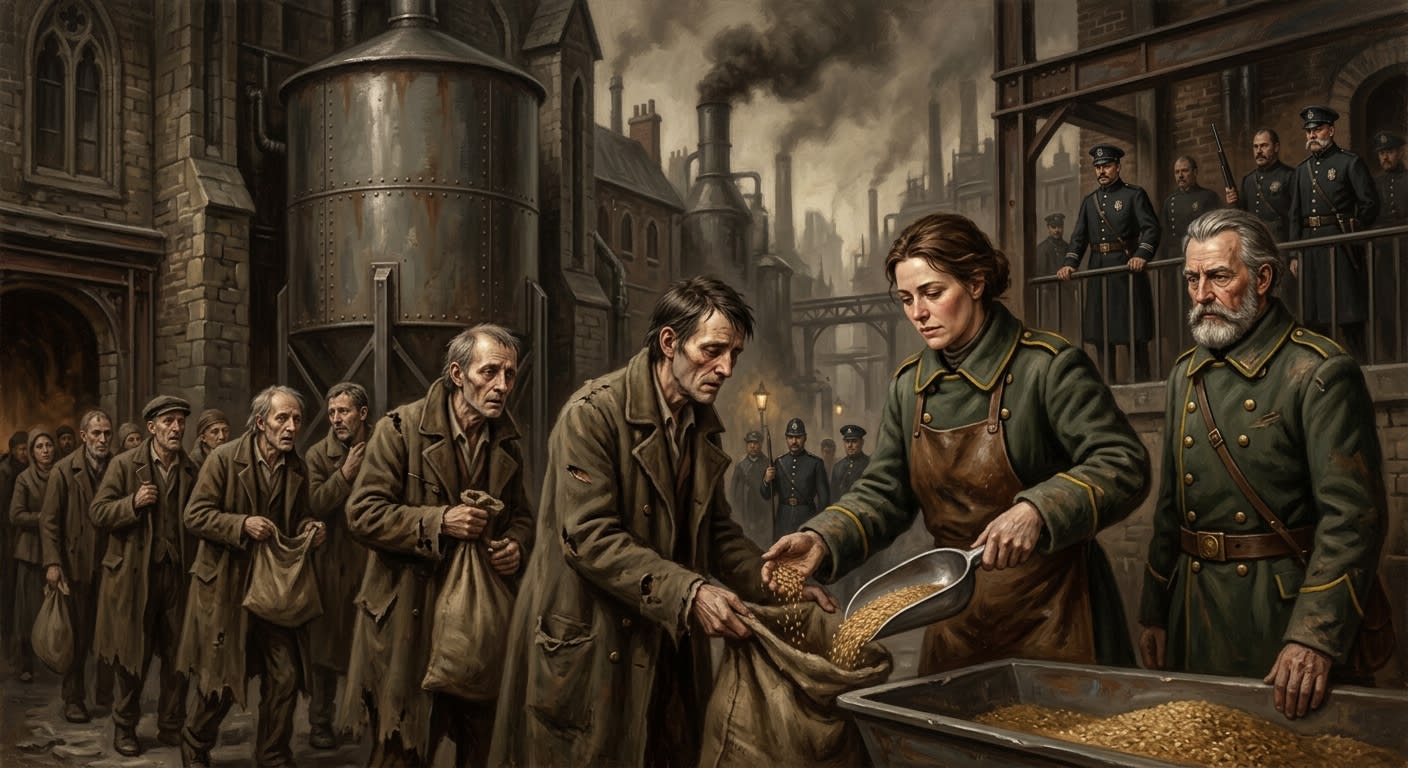
Mercy Keeper practice is embarrassingly plain. A Sack-Hand carries what can be carried. A Scale Clerk misreads what must be misread. A Cellar Warden opens the cache before dawn, when shame has not yet put on boots. The old receive small loaves. The sick receive barley water thick enough to offend doctrine. Nursing mothers receive the good flour and are told to lie about it convincingly. Children receive first issue unless a fever ward is collapsing. This rule has caused fistfights among Mercy Keepers, which proves they remain human despite their paperwork.
They use the ordinary Grain Keeper apparatus — false-bottom bins, waxed sacks, counterfeit chits, spoiled-lot diversions inherited from Old Klem the Ledgerman — but strip it of profit. That stripping is their danger. A Quota Man can show why diversion stabilises the official granary. A Hunger Broker can show why a fed ward obeys him. A Mercy Keeper has only a child with bread in her mouth. The Bureau hates arguments it cannot invoice.
Their distributions happen through parish alms rooms, shuttered bakeries, grave-field kitchens, laundry courtyards, and soup stalls whose permits are always three weeks out of date. A bowl is never handed directly twice in the same place. Routes shift by bell, weather, patrol mood, and the number of mothers who have begun waiting too early. Waiting is fatal. Waiting makes a queue. A queue invites a Queue-Marshal, and a Queue-Marshal invites counting, and counting is the first cousin of arrest.
#On the Liability of Goodness
Every Grain Keeper cell that shelters Mercy Keepers knows the price. They burn through reserves. They create debt without collecting it. They feed people who cannot protect them. They rescue refugees whose names have not cleared Records. They pass bread to a fever house that Purity has marked for silence. They will empty an emergency cache because a boy's lips have turned blue. Then the ward loves them, and love is a lantern held above contraband.
Earlier interdiction manuals described Mercy Keepers as “minor sentimental auxiliaries within the larger grain-diversion economy.”
Corrected. Mercy Keepers are operationally destabilising precisely because sentiment moves faster than command. Their disbursements can preserve a district through famine, compromise a whole cell through gratitude, or turn a ration riot into a hymn before officers arrive.
The Bureau of Tithes despises their inefficiency. The Bureau of Purity despises their popularity. The Bureau of Shadows studies them with the cold respect one gives to an untrained animal that keeps finding exits from a locked yard. A Mercy Keeper network leaves marks no ledger wants: fewer dead infants, fewer enlistment surges, fewer bread-gang recruits, more civilians willing to lie under questioning with impressive unity.
Extract from Purity Ward Report, western Rhine circuit, A.S. ███: Subject elderly female, suspected Mercy Keeper, asked to identify cache recipients. Response: “All of them.” Follow-up: “All who?” Response: “All who knocked.” Disposition: ███████████████████████ Ward outcome: three nights of window candles; no informants recovered.
#On Factional Quarrels
Quota Men call Mercy Keepers children with keys. Hunger Brokers call them bad landlords. Both accusations contain professional envy. The Mercy Keeper owns the one power neither faction can counterfeit: unpurchased loyalty. A ward fed by Quota Men remains grateful to a system. A ward fed by Hunger Brokers belongs to a tyrant. A ward fed by Mercy Keepers becomes dangerous because it remembers kindness without a receipt.
The quarrels are practical before they are moral. Mercy Keepers dislike reserve thresholds, ration-denial lists, and the phrase “strategic withholding,” which Quota Men pronounce with the solemnity of priests handling relics. Quota Men dislike empty shelves. Hunger Brokers dislike any bread that does not return with interest. The resulting meetings are short, bitter, and usually held near exits.
Mercy Keepers also attract saints, or people eager to be mistaken for saints, which is worse. A competent Mercy Keeper hides. An adored Mercy Keeper becomes a shrine with legs. Children name dolls after her. Widows press ribbons into her palm. Someone paints three dots beside a cellar stair. By the next audit, Purity knows where to knock.
#On the Present Toleration
As of A.S. 201, Mercy Keepers remain condemned, watched, used, and quietly spared whenever their disappearance would produce a riot more expensive than their arrest would satisfy. This is called enforcement discretion. In plainer speech, the Synod shoots the dog after the rats are gone.
Their cells are strongest in Zone 2 ration districts, Rhine ward granaries, forward family depots behind the Sagittal Line, and cities where official queues have acquired that hollow discipline which means the people have stopped expecting food and begun expecting explanations. Strasbourg claims no dependence upon them. Strasbourg claims many things while chewing.