
#On the Runner's Station
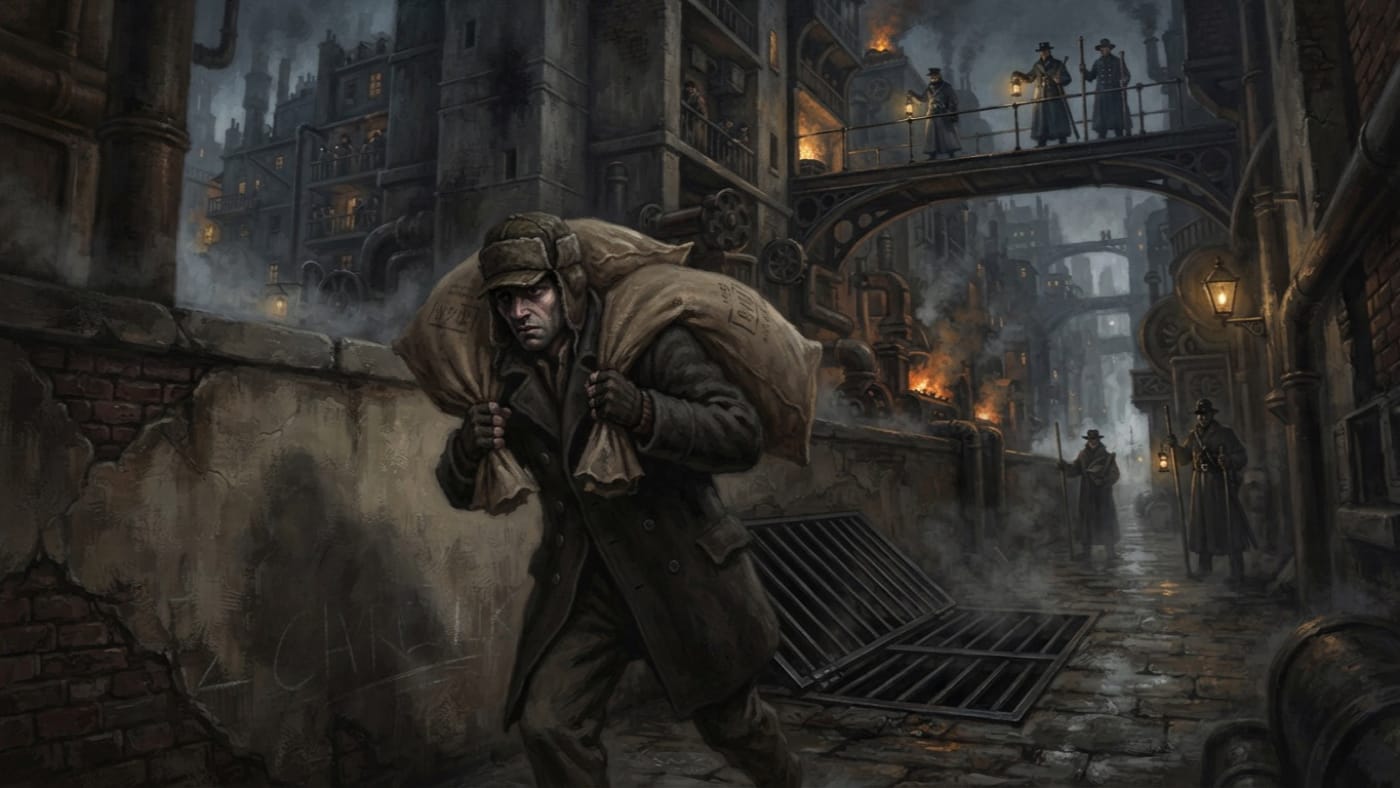
The Cache Runner is the Grain Keeper who knows the way. That is the whole office. It is also most of the danger.
The trade keeps a ladder, and like most criminal ladders it copies the Bureaus it robs. Sack-Hands stand on the lowest rung. They carry, cough, and learn what damp barley smells like before anyone shows it to them. Above them stand two middle ranks of equal height. The Scale Clerk keeps the numbers. The Cache Runner keeps the routes. Above both stands the Cellar Warden, who controls a district's hidden stores. At the top is the Keeper-of-Keys, one to a ward, who decides who eats when there is no longer enough to pretend.
The runner decides none of that. A runner does not own the cellar, does not keep the ward ledger, and does not choose which household's chit is honoured tonight. A Sack-Hand carries a sack from one place to another. A runner knows which stair is unlatched after Vespers and which patrolman takes bread instead of names. The runner also knows which wall has a hollow behind it and which mill loft holds weight, and which holds weight only until the second winter. Others own the grain. The runner knows where it can travel without being seen.
#On the Passage of Grain
The ledger fraud of the trade is well studied, and Old Klem is its patron. His spoilage shuffle moves a sack out of ration custody, through condemnation, and into the disposal books, where no ration auditor will look for it. On paper the sack no longer exists. In the wagon shed it still weighs what it did at the official weigh-in. Somebody has to carry that missing sack through a curfewed city to a cellar that appears on no map.
The Keepers have left no written code dividing this labour, which is sensible of them. What follows is my reading of the hierarchy from its sources. My readings are usually adopted. The Scale Clerk creates the gap between what the books say and what is in the shed. The runner moves grain through that gap before anyone notices it.
The work follows Keeper practice. Grain is never hoarded in one place, so a single seizure cannot starve a district. Where the Warden can afford it, the caches go in threes, so that one can be found and two survive. One sacrificial bin is kept for inspectors, who are thereby allowed to feel useful. Every one of those practices needs a route. The runner moves stock between licensed granaries that serve as cover, the lofts above mills, parish alms rooms, wagon sheds, the space under stairwells, hollows in ossuary walls, false floors, and the bone-dry crawlspaces that every old city keeps beneath its civic pride. Waxed cloth sacks keep the damp out and the smell in. Seal twine, lifted and retied, makes a broken custody look intact. Chalk marks low on the plaster tell later walkers which passage was safe last week, and anyone who trusts last week's chalk deserves the patrol they find.
Transfers happen at night, under curfew, when movement is itself an offence and a sack is a confession. Patrols are paid in bread and fuel, never in coin, since coin can be traced. Some routes end at an oven instead of a cellar. Grain becomes bread, bread becomes church alms, and the alms have no provenance at all. "Let the priest bless the sack," the Keepers say. The runner delivers the sack to the priest.
#On the Price of Service
The route is the same whoever pays for it, and three kinds of Keeper employ it.
The Mercy Keepers feed children first and ask nothing. A runner in their service carries grain to the fever house and the widow's back stair. In return the runner gets risk, a share of thin soup, and the warm feeling of having broken the law for the deserving. Mercy Keepers invoke Saint Silo-Agnes sincerely, which costs nothing and pays nothing either.
The Quota Men skim modestly to keep the system running, and their runners walk the dullest routes in the trade: small transfers, predictable hours, a reserve built against the next bad month. Quota Men prize a runner who is never remembered. In their service the best runner is the one an auditor cannot describe.
The Hunger Brokers use grain for recruitment and blackmail, and they treat a runner as something owned. Their own reported terms state the arrangement plainly. Good flour for a nursing mother costs her brother's service as a Cache Runner. The Broker gains a body who knows the stairs, and the household eats for exactly as long as the brother walks. If he stops walking, the household stops eating, and so his obedience is enforced by his sister's cupboard. Broker books also record child-runner pledges, which shows how far the Brokers will go. It does not make the trade a child's trade. Any rank becomes a child's when a Broker holds the debt.
None of this makes a runner a member of any faction. The same feet may carry Mercy sacks in autumn and Broker sacks after the frost, and the route records neither. The Keepers learned long ago that route knowledge sells to whoever offers bread.
#On Klem's Witness
The shuffle needed legs. Klem's genius was clerical: he knew how custody passed between the ration books and the disposal books. A clerk who makes grain vanish from a ledger still needs someone to make it vanish from the building. I make no claim that Klem invented the Cache Runner. The trade does not say so, and I do not grant founders more than their own disciples ask.
One document does connect the rank to the man. Klem's dossier preserves a Purity deposition fragment attributed to a captured Cache Runner. It quotes an order of distribution: the first sack to the children, the second to the old, the third to whoever keeps the patrol away. Its value as evidence is poor. The year has been blacked out. The witness has no name. The witness recanted after exposure to white fume, and the Bureau keeps the original transcript for training. Whether the runner knew Klem, served under someone who claimed to, or repeated a cellar proverb under duress cannot be established. A recanted fume deposition proves only that Purity owns fume.
The fragment is still useful for one purpose. Purity took a runner, not a Clerk or a Warden, and expected the runner to explain the system. The Bureau already understood which rank had been to every cellar.
Earlier Bureau training notes describe the spoilage shuffle as "primitive cache theft masked by clerical confusion."
This was first corrected in the dossier on Old Klem the Ledgerman, which defended the "clerical" half and left "cache theft" standing, as though carrying grain required no skill. Further corrected: the method's custody transitions are useless without managed physical routes between condemnation and concealment. The theft was never primitive, and the cache was never simple. The only confusion in the system remains the Bureaus'.
#On the Rogue Runner
The Keepers can survive many things. They cannot survive an inspector who finds hidden sacks that match the entries missing from the ledger. When those two facts meet, a ward's arrangements end, along with several people.
A runner is the one person who can connect them. A runner who is followed, stopped, or arrested with a waxed sack shows the inspector exactly where the ledger's missing grain went. One interception does three kinds of damage. It exposes a cellar. It cuts off every household on that route, which may go without bread for a week or for good. It also points directly at whoever held the keys.
Keeper practice has a remedy. When pressure rises, the trade gives up a Sack-Hand, a "rogue" Cache Runner, or a whole cellar as proof. The rogue runner is a fine piece of administration. The runner acted alone, the sacks were stolen, the Clerk's books were deceived and are now corrected, and the Warden is shocked. The Keeper-of-Keys attends the sentencing and is seen to be shocked too. The runner, who never decided who ate, becomes the only person punished for deciding it.
The Bureaus accept this because each of them gets something. The Bureau of Purity gets a culprit, a confession, and a bin overturned in public. The Bureau of Tithes gets peace in the queue, since the rest of the network keeps distributing and stable distribution is the only form of virtue Tithes has ever audited. The Bureau of Shadows keeps watching the Hunger Brokers, and a frightened runner talks more freely than a frightened Warden. None of this is lawful authorisation. It is tolerance, and tolerance can be withdrawn at any time.
The rank is often confused with others. The Black Ledger has a Runner of its own, an entry rank in a separate hierarchy of thieves and killers, and its dealings with the Hunger Brokers do not make every grain carrier a knife. Night papers couriers supply the trade with paperwork cover and carry deniable authority. A Cache Runner carries rye. Curfew-fog tavern runners trade food for calm on the same streets and sometimes in the same hour. Sharing a curfew does not make two people colleagues.
#On the Present Employment
By A.S. 201 the rank is busiest in the Zone 2 ration districts and the Rhine ward stores. In Strasbourg, official queues stand quietly because the real allocation has already moved through the stairwells the night before. In Rheinscarp, ration mills and controlled terrace crossings leave the space under the stairs as the obvious alternative. The same work goes on in parish cellars, bastion granaries, and forward family depots behind the Sagittal Line, wherever ration accounting and actual hunger have drifted apart.
The trade has no headquarters, no guild, and no saint of its own. It needs only somebody who knows the stairs, a household that needs feeding, and a clerk with an obedient pen. The Bureau of Records has not yet found a column for the runner's work, and the runners would prefer it stayed that way.